A faceless baptismal font in a small town in Hertfordshire

HITCHIN IS A SMALL, attractive town in Hertfordshire. When we first visited it in 2020, despite an easing of the covid19 lockdown rules, we were unable to enter the town’s 14th to 15th century church of St Mary’s. On the 26th of August 2023, we spent a couple of hours in Hitchin and were able to enter the church. It contains many items of interest including a large painting created in the studio of Ruben’s.
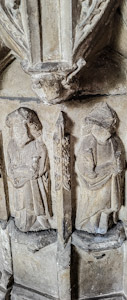
It was the 15th century carved stone font that particularly interested me. The column supporting the bowl, which contains water with which children are baptised, has twelve carved figures. These depict the 12 apostles. Looking at these closely, you will see that they are all mutilated. Their faces have been chipped away, leaving the figures faceless.

The very helpful and informative gentleman who was looking after the church was not sure whether the faces were obliterated by Thomas Cromwell during the Reformation of Henry VIII or during the time of that other iconoclast Oliver Cromwell.

Luckily the carved angels that adorn the ceiling of the Chapel of St Andrew and a finely carved 15th century wooden screen escaped the attention of the iconoclasts. In one or two Suffolk churches we have visited, angels such as these were destroyed as part of the attempts to ‘purify’ the English Church.

Apart from what I have described, there are plenty of other things that make a visit to Hitchin’s church worthwhile. And if you enjoy ‘Olde Worlde’ British buildings, the town centre is rich in them.
A battle and a window in Essex

IN THE YEAR 991 AD, the Anglo-Saxons fought a battle with Viking invaders in Maldon (Essex). The Vikings, who often raided for looting and plundering rather than conquest, won. Rather than continue to struggle with the Vikings, the Anglo-Saxon king Æthelred the Unready was advised by the Archbishop of Canterbury to pay them off. He paid the Vikings an enormous sum of money, which satisfied them.

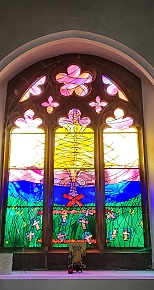
Recently, we visited the church of St Mary the Virgin in Maldon. It stands on a small hill that overlooks the mudflats and rivulets of the Chelmer River where the battle was fought. In its north wall there is a striking, colourful modern stained-glass window. Designed by Mark Angus, it was installed in 1991to commemorate the 1000th anniversary of the Battle of Maldon. It is a great addition to an otherwise unremarkable church.

No, not the former Prime Minister

AT THE WESTERN END of Chiswick’s Turnham Green, there is a striking church, which was designed in the Arts and Crafts style by the architect Richard Norman Shaw (1831-1912) and consecrated in 1880. It served the community that was beginning to settle in the recently established Bedford Park, which I described as follows in my book “Beyond Marylebone and Mayfair: Exploring West London”:

“Bedford Park near Turnham Green is probably the first example of what has become known as a ‘Garden Suburb’ development, although originally it was not known as such. Pevsner noted:

‘Its reputation as the earliest garden suburb needs some qualification. Trees and green spaces … are found in many earlier suburbs; the novelty of Bedford Park is their combination with ‘artistically designed’ houses … inspired not by classical or Gothic pattern books but by the red brick and tiled idiom derived chiefly from the home counties vernacular of the c17 and c18…’

He added that the idea was to recreate the:

‘… relaxed informal mood of a market town or village…’, in ‘… a completely speculatively built suburb.’

And, in the case of Bedford Park this ideal has been almost but not quite fully achieved, because the suburb, attractive though it is, has a somewhat staid, bourgeois feel about it. Created by Jonathan Thomas Carr (1845-1915), its development began in 1875 …”

If you want to know more, you can find it in my book.

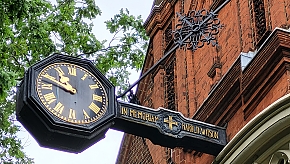
Returning to the church, which we re-visited today (20th of June 2023), I showed my wife the interesting clock on one of its exterior walls. It is held away from the building by a sturdy beam on which there are some words. On one side, you can read: “Spion Kop Africa 1900”, and on the other, you will see: “In memoriam Harold Wilson”.

In case you are wondering, the clock has nothing to do with the former Prime Minister Harold Wilson (1916-1995). Instead, it commemorates 2nd Lieutenant Harold AC Wilson, who fell at the battle of  Spion Kop in January 1900 during the 2nd Anglo-Boer War (1899-1902).

[My book is available from Amazon: https://www.amazon.co.uk/BEYOND-MARYLEBONE-MAYFAIR-EXPLORING-LONDON/dp/B0B7CR679W/ ]

A surprise in Stamford

WHEN I WAS A YOUNG child, I remember going with my parents to south London to visit a Spanish sculptor, who had escaped to Britain as a refugee during the Spanish Civil War. Although we only visited him once, I recall that his name was something like ‘Alberti’. That is all I can remember, and I do not believe that my parents ever spoke about him much since that visit made maybe more than 60 years ago.

Today, the 20th of May 2023, we spent a couple of hours in the Lincolnshire Town of Stamford. This attractive place has several lovely old churches, one of which is St Martins. This edifice contains a chapel filled with glorious funerary monuments of members of the Cecil family, which was of great importance during the reign of Queen Elizabeth I and other Tudors.

When we were about to leave the church, I spotted a modern wood carving of the head of a man with a beard and moustache. Although it was not nearly as attractive as the Cecil monuments, I decided to examine it. I do not know why I did, but I am glad that I did.

I was surprised to discover that the carved head was created by Jose Manuel de Alberdi Elorza (1922-2008). Beneath the head there is a notice with the following words written by Alberdi:
“A kind of anti-war protest… The face at the moment just when Christ died on the cross … The deed is done. We have killed.”

The sculptor was two years younger than my mother, also a sculptor. All that I can discover about Alberdi on the Internet is that he was Basque and a refugee from the Spanish Civil War. Also, he taught sculpture at the St Martins School of Art in London from 1948 to 1958 , which is where my mother made sculptures during that time.

Although I cannot be certain, I am pretty sure that this head in Stamford was made by the Spanish sculptor we visited in South London so many years ago.

English Church in Madeira

THE FIRST RECORDED Anglican service in Madeira was held on a British ship passing by in 1774. Randomly occurring services were officiated by chaplains of passing ships until about 1807 when some British soldiers were stationed on Madeira as part of the war against Napoleon. Thereafter, the British garrison’s chaplain held services for British residents in the island’s British consulate.

In 1813, a plot of land was purchased close to the already established English Cemetery. The land is where the English Church stands today. Designed by Henry Veitch, the church was completed by 1822.

From the outside, the domed neoclassical building does not much resemble a church. Square in plan, inside it contains two concentric circles of supporting pillars. The top of the dome is above the central point of the church’s floor. The interior of the church is simple but elegant. Veitch, who was a freemason, might have been influenced by freemasonry in his choice of design, or possibly by the round style of temples favoured by the former Knights Templar.

When the church was built, it was attended by members of Madeira’s British residents, who numbered about 700 in 1822. Currently, there are only about 70 British residents. It was not until William Reid opened his hotel in the 1890s that the flood of tourists from Britain and elsewhere began in earnest.

Currently, the English Church, set in its lovely gardens, hosts many musical events – classical and otherwise.

Queen of Hearts maybe?

HOLY TRINITY CHURCH in the Suffolk Town of Long Melford is a grand perpendicular gothic affair built in the 15th century when the town was prospering because of the then thriving wool trade. Fortunately for us today, several of the original stained glass windows have survived in reasonably good condition.

On one of these mediaeval windows, which survived the iconoclastic behaviour instigated by Henry VIII, depicts Elizabeth Talbot, the Duchess of Norfolk, who was born in about 1442. Her daughter was married as a child to Richard, one of the two princes murdered in the Tower of London in about 1483.

It has been suggested that John Tenniel, the Victorian illustrator of Lewis Carroll’s “Alice’s Adventures in Wonderland”, might possibly have visited Long Melford, seen the portrait of Elizabeth Talbot, and then modelled his illustration of the Queen of Hearts on that image on the window. Whether this was actually the case or just pure coincidence is up to the viewer to decide. I remain undecided.

Adeline and James in Calcutta

THE CHURCH OF ST JOHN in central Kolkata was built by the British East India Company in the 18th century. Its foundation Stone was laid by Warren Hastings in 1784. We had visited it today, the 13th of January 2023, mainly to see the magnificent painting of the Last Supper by Johann Zoffany (1733-1810). We also spent time looking at the memorials that line the walls of the church. Suddenly, my wife pointed at one of them, which is of great interest to me at the moment. It commemorates James Pattle, who died in 1845 aged 68, an his wife Adeline, who died the same year aged 52. Whereas James is buried in London, Adeline was lost at sea.

My interest in this couple is related to a book I am writing about one of their daughters, who became one of the most famous British photographers during the 19th century. You will learn more about her after I publish my book.

James was born in Calcutta, as the city was named in his time. He was educated in England, and returned to Calcutta, where he became a High Court Judge. Adeline was born in French Pondicherry. Her maiden name was De l’Etang. Her father was a French nobleman who has fled from France to French India after the Revolution. He had been in charge of the French Royal stables and became important in the welfare of the East India Company ‘s horses in Calcutta . Her mother Therese had some Indian ancestry. James and Adeline married in 1811 at Bhagulpur in India. They had 10 surviving children.

⁸After James died in his home on Chowringee, he was placed in a barrel of preservative spirits so that, according to his wishes, he coukd be buried in London beside his mother in Marylebone Parish Church. Adeline travelled from Calcutta to London on the same ship as her husband’s corpse. Adeline died at sea according to the memorial in St John’s, but this might be incorrect. In any case, Adeline died a few months after James.

James’s remains did reach England, but they are interred at St Giles Church in London’s Camberwell. It is in this church, not the one in Marylebone, where his mother was buried.

The memorial in St John’s Church must have been placed because his fellow British citizens held him in high regard. The memorial was also a token of love given by their sorrowful childrenAs for his famous daughter, I will leave you in suspense!

Armenian script in a church in Chennai

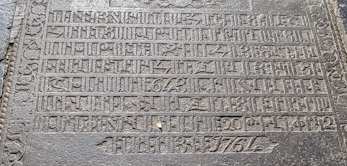
I HAVE VISITED ST THOMAS Mount in Chennai twice so far. The two visits were separated by at least a quarter of a century. Amongst the many interesting things to see and experience on this sacred hill are some examples of Armenian script. This characteristic lettering can be found both on several tombstones and on some framed paintings of saints. Also, there is some Armenian writing inscribed on an ornate pulpit.

The church on the Mount is dedicated to Our Lady of Expectation. There are several sculptures of the pregnant Mary in or near the church, which was constructed close to the spot where St Thomas (the doubter) is supposed to have died. The church was constructed by Portuguese Franciscan missionaries in the 1520s. None of this information provides any clues to the presence of the Armenian lettering.

Armenians began setting in Madras in significant numbers in the mid-17th century. There is an Armenian Street in Chennai, where one can find an Armenian church. This was built in 1712. The two funerary monuments I saw on the Mount are dated after 1712: 1739 and 1764. The paintings with Armenian script are far newer. I am no expert on Armenia, so can say little if anything about their religious practices. Many Armenians are Christians, and a few of them are of the Catholic variety. I can only assume that the graves on the Mount are those of Catholic Armenians, and that some Catholic Armenian donor provided the paintings.

If anyone can give me more information about the presence of Armenian script in this church on the Mount, please share it with me.

Charnock, Kolkata, Chennai, and granite

THE CHURCH OF ST MARY in Fort St George in Chennai (Madras) was constructed by 1680, when it was consecrated. It is the oldest Anglican church east of Suez.

The church contains a memorial to the founder of the famous American Yale College – Eliahu Yale. He had been Governor of Chennai’s Fort St George, where the church is located, between 1687 and 1692. He had also been the vestryman and treasurer of St Mary’s church.

The font within the church is made of a form of black granite known as Charnockite. This stone is named after Job Charnock (c 1630-1693). A member of the British East India Company, he is credited with founding a British settlement at a pre-existing village on the bank of the Hooghly River. Although the place had already been settled long before his arrival, Charnock’s establishment grew into what is now Kolkata (Calcutta).

In about 1678, Job entered a romantic relationship with a Hindu woman, whom he called Maria. They produced a son and three daughters. The daughters were baptised in the font in St Mary’s in Chennai in August 1689. A few years later, Job died. His funerary monument is in Kolkata, where he passed away. Like the font in Chennai, Job’s tomb, which is housed in a mausoleum in Kolkata, is made of Charnockite. This form of granite can be found in the south of India. It was local to Chennai but far from Kolkata. This type of rock was first described in Tamil Nadu and was named in honour of Job Charnock.

Apart from the font and the memorial to Yale, the church of St Mary’s has many fascinating sculpted monuments to Britishers who died in India or on their way to or from it.

Holy Communion and covid19

ST MARKS CATHEDRAL in Bangalore was constructed between 1808 and 1812. It is an elegant late Baroque church standing in its own spacious grounds. We visited it on Christmas Day 2022. There was a service in progress. The congregation was too large to be fully accommodated within the building. Many people were sitting outside the church, some of them under a canopy. The service was conveyed to those outside the building using loudspeakers and a giant television screen.

While the cleric began reciting the words associated with taking communion, he spoke of receiving the body of Christ. As he said that, I noticed a woman in the congregation opening a small container and taking a small flat white object from it, and then slipping it into her mouth.

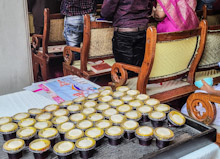
A man nearby asked if we wished to take communion, and then pointed to a table covered with small round plastic containers with lids. Each of these contains a communion wafer fragment and some “communion nectar”, which I imagine represents the blood of Christ.

At St Mark’s, it appears that Holy Communion is self-administered, rather than being handed out by a cleric, as is the case in most churches where I have witnessed Holy Communion. I wondered whether these little pots of Holy Communion ‘ingredients’ are an attempt to reduce the risk of transmitting disease in these times when the covid19 virus is so prevalent.