FROM THE STREET, the Victorian gothic façade of Hampstead’s Heath Street Baptist Church is unremarkable. Over the past more than 60 years, I have walked or driven past this place of worship, but it was not until today (20th July 2021) that I entered it for the first time.
The church was designed by the architect and surveyor Charles Gray Searle (1816-81) and completed 1860-61. Searle was himself a Baptist. He had been apprenticed to the renowned master builder Thomas Cubitt (1788-1855), who bought stone from his father, John Searle, who owned a quarry near Wapping. Charles set up his own practice in about 1846.
“An early print of the proposed chapel shows buttresses but in its method of construction it was more modern, cast iron being used not only for the pillars and probably for the whole interior framework, but also for the gallery fronts and the mouldings of the pew-ends. The strength of the building is based upon this framework formed by the cast-iron pillars in church and hall below and their linking beams. The brick walls cling to the framework and have tiebars linking the hammer beam roof.”
Cast-iron columns
Cast iron, which has high compressive strength, began being used to create buildings at the end of the 18th century. Pillars made of this material can be made slenderer than masonry columns required to support the same load. The slender nature of the columns in the Heath Street Chapel is immediately evident when you enter the building. What is less obvious is that the decorative fronts of the gallery that surrounds the nave are also made from cast-iron. The material has hardly been used for structural elements of buildings since modern steel and concrete became available at the start of the 20th century.
If you do visit this church, do not miss the fine art-nouveau stained glass window at its western end.
Although the Heath Street Chapel was certainly not the first church to be built using cast-iron structural elements, it must have been one of the first buildings of its kind to have been built in Hampstead, which is why I have given this short piece the title “A High-tech Church in Hampstead”.
When we stepped inside the church, two men were setting up things for a lunchtime concert. They told us that these are usually held on Tuesdays at 1 pm. Details about these can be found on the church’s website, http://www.heathstreet.org/activities/lunchtime-concerts/.
AN UNUSUAL CRUCIFIX hands within the church of St Mary in Bruton, Somerset. It is a sculpture typical of early 20th century German Expressionism, yet it was created in 1969, long after the heyday of this artistic trend. The creator of this religious sculpture was Ernst Blensdorf (1896-1976). He was born Ernst Müller in North Germany, but after his marriage to his first wife, Ilse Blensdorf, in 1923, he changed his surname to ‘Müller-Blensdorf’, then later to ‘Blensdorf’.
At first, Blensdorf became a seaman. After having been interned as an enemy alien by the British during WW1, Ernst travelled to Johannesburg in South Africa with a fellow internee. It was here that he made a table-top wood carving of an African village. On his return to Germany, this fine carving persuaded Ernst’s father that his son had a future as an artist and was willing to support him towards this aim. While in Africa, Ernst had seen African art first-hand and exposure to this certainly helped influenced his future creations.
After a brief spell at an art school in Barmen, he left to become apprenticed to a master joiner. By 1922, he had become a journeyman for a furniture company, which specialised in manufacturing luxury items. During this period, he was influenced by the Bauhaus artist Paul Klee and the sculptor Alexander Archipenko. The skill that Ernest acquired and developed whilst manufacturing wooden objects for the furniture company became useful as he moved from applied craftsmanship to artistic endeavours. In addition to other activities, he taught at the art school in Barmen during the 1920s. By the 1930s, he had become an established sculptor and had exhibited his works at various exhibitions in Germany, where he received both private and public commissions.
When the Nazis took power in Germany, Blensdorf became one of the first artists whose works were categorised as ‘degenerate’ by Hitler and his regime. This led to him losing his teaching post at Barmen and his studio being wrecked by the Nazi’s loutish followers. Ernst, his wife, and children, moved to Norway, where he was planning a giant peace monument to honour the Norwegian statesman and Nobel Peace prize winner Fridjtof Nansen. In Norway, he worked on this project and made a living creating and selling artistic ceramic works, alongside the Norwegian ceramicist Eilif Whist.
When the Germans invaded Norway in spring 1940, Blensdorf and his children fled to Scotland. His wife, Ilse, remained behind, saying that she was a follower of Adolf Hitler. Following his arrival in the UK, Blensdorf was once again interned as an ‘enemy alien’. Along with many others, including a good number of men with artistic talent and German nationality, he was interned on the Isle of Man (from 1940 to 1941). His children were placed in a couple of orphanages. While interned, he, along with fellow artists, were allowed to satisfy their creative urges and even to sell their creations. Using whatever materials he could find during this period of scarcity, Blensdorf’s creative output was impressively large. For the first time in his life, he had plenty of time to undertake artistic work in the absence of anxieties such as he had experienced before arriving on the Isle of Man.
Blensdorf was released from internment in 1941. He went to live with an Austrian couple, the Schreiners, whom he had met in the internment camp. They lived in Charlton Musgrove in Somerset. With him, the Schreiners planned to set up an art school, but this failed for financial reasons. Ernst remained in Somerset. His first job was teaching pottery at a school in Bratton Seymour. It was here that he met his second wife, Jane Lawson. They married in 1942 and moved into a house near Wincanton, where they were joined by his children. Blensdorf taught in various schools in Somerset including the King’s School in Bruton.
In 1943, Blensdorf and his family bought a run-down 17th century house close to Bruton. Gradually, the house was restored and improved. It remained his home for the rest of his life. Although he exhibited often and in prestigious venues, Blensdorf never realised the great reputations that other artists, such as Henry Moore, Elizabeth Frink, Anthony Caro, and Barbara Hepworth, gained in the UK and beyond. For this reason, seeing his work for the first time during my first visit to the lovely Bruton Museum in July 2021, was a wonderful surprise and an exciting eye-opener. In one corner of this small museum, there is a large glass cabinet that contains examples of Blensdorf’s sketches, ceramics, and sculptures. When I told the lady, who was looking after the museum, how much I liked what I had seen of his works, she told me about the crucifix in the local church, which fortunately I was able to see. She also sold me a copy of a well-illustrated catalogue of an exhibition of his works that was held some time ago in the Bruton Museum. It is from this publication that I have extracted much of the information above. Bruton is a gem of a town. Visiting its museum is a ‘must’ because not only does it allow you to ‘discover’ the works of Blensdorf but also to see a display of artefacts relating to the author John Steinbeck, who lived close to Bruton between March and September 1959 … but that is another story.
THE CHURCH OF St Mary’s in Cornwall’s western town of Penzance overlooks the harbour and much of the town. Its site has been a place of worship since at least 1321, when there was a chapel on the spot. Between the 2nd and 4th of August 1595, Penzance, along with Newlyn, Mousehole, and Paul, was sacked by Spanish forces under the command of Carlos de Amésquita. After causing much damage, Carlos celebrated mass in the chapel of St Mary at Penzance, an edifice he had spared from destruction.
The chapel was enlarged in 1662-1672 and then again in 1782. Until 1871, when a new parish was created, the enlarged chapel had been a ‘chapel of ease’ for the parish of nearby Madron. Reverend Thomas Vyvyan began replacing the old chapel with a new church in 1832. Its architect was Charles Hutchens (c1781-1834), of Torpoint near Plymouth. In August 1832, the old chapel was demolished, and worshippers used a temporary wooden building whilst the new church was being constructed (https://historicengland.org.uk/listing/the-list/list-entry/1220507). The new church, gothic revival in style, was ready for use in November 1835.
The church’s interior was damaged by fire caused by an arsonist in 1985 but was restored the following year. Being built of granite, the church looks older than it is at first sight. However, the design of its windows is typical of gothic revival. Inside the church, there are features that exemplify the very best of the gothic revival style, which reminded me of that masterpiece of the style, Strawberry Hill at Twickenham (near London). Having been restored after the fire, they are looking in superb condition.
I am glad that I climbed the several staircases that ascend the steep slope from the seashore near Penzance’s art-deco Jubilee Bathing Pool to the church. For those who prefer not to climb, the church can also be accessed by walking down Chapel Street from the central shopping area of Penzance. However, after seeing the church you will have to climb back up to where you started, but on the way, you might pause to look at the Chapel Street Methodist Church, with its odd but harmonious mixture of architectural styles, built in the mid-19th century. Or, if you have had enough of ecclesiastical architecture, you could drop into The Turks Head Inn for some refreshment spiritual or otherwise. The pub’s name reflects the fact that Cornwall used to be raided by Moorish pirates, who captured some of the locals and made them enter slavery, but do not let that put you off entering the place. Oh, and whilst you are on Chapel Street, do not miss seeing the unusual Egyptian House near the top of the thoroughfare.
MANY SMALL PLACES in East Anglia have disproportionately large churches. Cley-Next-The-Sea (‘Cley’) is no exception. Its parish church of St Margaret of Antioch is one of the largest in northern Norfolk. It stands atop a hillock, which used to be an island only reachable by boat. The boats that reached Cley were not only those of locals but also foreign vessels bringing valuable cargos to Cley. According to Marjorie Missen, who has written a detailed guide to the church, it was at Cley:
“… that strong links were made with Hanseatic traders and it was in some measure due to their wealth that today we are able to wonder at the size and magnificence of St Margaret’s.”
Without doubt, this church is both impressive in size and contains much of remarkable beauty. Most of the church was built during the 14th and 15th centuries. Its external walls are of flint with stone dressing. Amongst the things that caught my eye during our first and, as yet, only visit to the church were the beautiful, vaulted ceiling of its south porch; the stone carvings on the 15th century font: they depict aspects of the Sacrament; the wood carvings on some of the choir stalls (miserichords); and stone carvings of musicians on the tops of columns lining the nave. However, what first attracted my attention to this church was part of its exterior.
A roofless gothic structure projects from the south side of the church at the place where one would expect a transept. This structure is affixed to the main body of the church but is blocked off from it. Once upon a time, this might have been accessible from within the church when or if it it formed the south transept. I have so far been unable to find any definitive explanation for the abandonment of the south transept and its decay. Ms Missen wrote:
“The large scale work on the transepts and nave are unlikely to have begun before about 1315, or even later. Although the transepts have been in ruins for some centuries the delicacy and tracery of the south window can still be appreciated.”
Interesting as this is, it does not provide any reason why the south transept and the north have been blocked off from the church and allowed to become dilapidated. It has been suggested by Simon Knott (http://www.norfolkchurches.co.uk/cley/cley.htm) that the transepts, whose construction began in the early 14th century, were never completed because of The Black Death, which reached Norfolk in 1349:
“The most beautiful is that in the south transept, elegant lights that build to a cluster of vast quatrefoils. This was competed on the eve of the Black Death, and is probably at the very apex of English artistic endeavour. But I think that it was never filled with glass. I can see no evidence that the transepts were completed in time for their use before the pestilence, or that there was ever a need to use them after the recovery from it. And, then, of course, the Reformation intervened.”
This seems a quite reasonable theory. Yet, it is only a hypothesis, and so the mystery lives on. Is the south transept a ruin or an uncompleted building? That is the question.
MANY CHURCHES IN NORFOLK have circular towers. Actually, there are 124 of them in the county. Here is one example, St Mary’s in tiny Titchwell, near the north Norfolk coast. The small spire that tops the round tower dates to the 14th century. The foundation of this church was much earlier.
By the way, the name ‘Titchwell’ is derived from an Old English word meaning ‘ kid (young goat)’ and an Anglian word meaning ‘spring or well’.
SHE SITS THERE MOTIONLESS, day after day and year after year, watching the traffic on Westway either rushing past or crawling along in a traffic jam. In her heyday, before being captured in stone, instead of the noise of motor vehicles, she would have enjoyed the sound of the applause given by audiences in dimly lit theatres. She was the actress Mrs Sarah Siddons (1755-1831), and her carved stone statue stands facing the elevated Westway in Paddington Green, just west of the Edgware Road.
Mrs Siddons
Paddington Green used to be part of an expanse of ancient wasteland located in an area now bounded by the Regents Canal, the Paddington Arm of the Grand Union Canal, and Edgware Road, but now much of this wasteland has been built upon. Writing in 1867, John Timbs noted:
“Paddington Green, now inclosed and iron-bound, was the green of the villagers, shown in all its rural beauty in prints of 1750 and 1783. Upon a portion of it were built the Almshouses, in 1714; their neat little flower-gardens have disappeared. South of the green is the new Vestry -hall. At Dudley Grove was modelled and cast, by Matthew Cotes Wyatt, the colossal bronze statue of the Duke of Wellington … it is thirty feet high, and was conveyed from the foundry, upon a car, drawn by 29 horses, Sept. 29, 1846, to Hyde Park Corner.”
Dudley Grove was in Paddington. What is now left of the wasteland consists of St Mary’s churchyard and next to it a small grassy area, still known as ‘Paddington Green’, and marked as such on a map drawn in 1815. It contains the statue of Mrs Siddons. The first written record of the Green is dated 1549. The Green contained a mediaeval chapel, now long-since gone. It has been replaced by St Mary’s Church, which was built in the Georgian style, in 1788. It was designed by John Plaw (1745-1820), who emigrated from London to the North American Colony of Prince Edward Island in 1807. His church in Paddington was later modified in the 19th century but restored to its original shape (a Greek Cross in plan) in 1970 under the guidance of the architect Raymond Erith (1904-1973), amongst whose other creations was the current form of the Jack Straws Castle pub in Hampstead.
The present church is the third in the area, which was halfway between the ancient villages of Paddington and Lilestone. The old Manor of Lilestone (or ‘Lilystone’) included the present Lisson Grove and extended as far as Hampstead. The earliest church was taken down in about 1678. The second church, which replaced it, can be seen in old drawings. It was a simple edifice with a single aisle and a small bell tower at one end. Edward Walford, writing in the 1880s, described it as:
“… not unlike the type of country churches in Sussex…”
The poet and preacher John Donne (1572-1631) preached his first sermon in the first church in 1615 and the painter William Hogarth (1697-1764) was married to Jane Thornhill (c1709-1789) in the second in 1729 without her parents’ knowledge.
Next to the western end of the church there is a single-storied rectangular, brick building decorated with trompe-l’oeil grisailles, one of which depicts Mrs Siddons. Today, this houses the Phileas Fox Nursery School. Built on the site of the old, now demolished, vestry hall (parish council meeting place), this building, the church hall, in a late Georgian style was designed by John Quinlan Terry (born 1937), an architect of the ‘New Classical’ style favoured by Prince Charles, and built in 1978-81.
Apart from the statue of Mrs Siddons on Paddington Green, most of it is surrounded by buildings or roads built either at the end of the 19th century or long after. At the eastern side of the Green there is what looks like a pair of either early 19th or possibly 18th century houses. The reason Mrs Siddons is commemorated on the Green is that she is buried in the adjoining St Mary’s Churchyard. Her gravestone is contained within a cast-iron enclosure that looks like a small cage. For some time, the actress lived in Paddington in a house which used to stand in the area around Westbourne Green, which is near the current Westbourne Park Underground station.
Mrs Siddons was highly acclaimed as an actress by many. The critic James Henry Leigh Hunt (1784-1859) had reservations as he remarked in his autobiography:
“Want of genius could not be imputed to his sister, Mrs Siddons. I did not see her, I believe, in her best days; but she must always have been a somewhat masculine beauty; and she had no love in her, apart from other passions. She was a mistress, however, of lofty, of queenly, and of appalling tragic effect. Nevertheless, I could not but think that something of too much art was apparent even in Mrs Siddons; and she failed in the highest points of refinement.”
Although the poet and playwright Joanna Baillie (1762-1851), shared Hunt’s opinion about her, others held her in higher regard.
The statue of Mrs Siddon in Paddington Green was sculpted by the French sculptor Léon-Joseph Chavalliaud (1858-1919). In the 1880s, he moved to London from France and lived south of the Thames in Brixton. His Mrs Siddons, based on a portrait by Sir Joshua Reynolds, was unveiled by the actor Sir Henry Irving (1838-1905) in 1897. It was the first statue of a woman, who was not royal, to be put up in London.
Paddington Green, like its close neighbour Paddington Station, figures in the history of London’s transportation. For, it was from here that the coachbuilder George Shillibeer (1797-1866) ran London’s first omnibus service to The Bank of England in 1829. He had got the idea from Paris, where he had been asked to design carriages that could carry up to 24 passengers at any one time.
The Paddington Green police station building stands a few yards east of Paddington Green. Constructed in 1971, this used to provide local policing services as well as an interrogation centre for terrorist suspects. Suspects accused of terrorist activities were brought here for questioning from all over the UK. Although it was refurbished in 2009, the station was closed in 2018. The building’s future is in the hands of property developers, who plan to build new housing on its site.
Until the beginning of the 19th century, Paddington Green was a bucolic environment on the edge of what was then London. Now, surrounded by buildings and highways, it is a green but noisy oasis in a highly urbanised area.
WEST HAMPSTEAD, FORMERLY known as ‘West End’ in the time, before the 20th century, that Hampstead was a small town separated from London. Now, yet another of London’s numerous suburbs, West Hampstead has several churches as well as a synagogue. One of these places of worship, St James Church, is worth entering because it is not what it seems from its external appearance.
The large Parish Church of St James, built mainly with red bricks, was erected in about 1887 (www.lwmfhs.org.uk/parishes/6-middlesex/28-hampstead). It was designed by Sir Arthur William Blomfield (1829-1899), the fourth son of CJ Blomfield, Anglican Bishop of London between 1828 and 1856, who encouraged much new church building during the 19th century. This large church could seat 1000 people (www.british-history.ac.uk/vch/middx/vol9/pp145-152#h3-0007) and has some fine 19th century stained-glass windows.
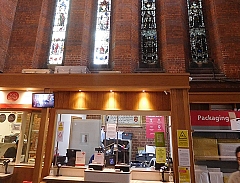
On entering the church through its electrically operated glass sliding doors, you will be surprised by what you find beneath its fine hammer beam timber ceiling. The west end of the nave is occupied by a post office, the first main-branch of a UK post office ever to be housed within a church. The north aisle of the church contains a children’s ‘soft play’ area, appropriately named ‘Hullabaloo’. The floor of the nave is filled with tables and chairs occupied by people of all ages, some enjoying refreshments from the church’s Sanctuary Café. All these things that you would not normally expect to find inside a church are part of The Sherriff Centre, a community organisation that began operating in 2014 (https://thesherriffcentre.co.uk/). The Centre’s activities also include a stationery store, a free food bank, live music as well as other events, free wi-fi, debt advice, and more.
Jesus is said to have thrown the moneychangers and others involved in commercial activity from the Temple in Jerusalem (“The Holy Bible”, John, Ch 2, v 13-16). However, he might have approved of the commercial activities within St James because profits from the sales outlets in the Centre are used to help finance charitable work. In addition to everything that I have already described about what goes on within St James, there is one more thing to mention. Despite the activities that you might not expect to find inside a church, regular religious Church of England services are held there. It is wonderful that St James, instead of becoming yet one more barely used Victorian church in London, has become a vibrant and beneficial part of a local community, catering to more than only just its by now small congregation.
A FRIEND INVITED us to dine one evening at the exclusive Mosimann’s Club in West Halkin Street in London’s elegant Belgravia district. As it was dark when we arrived and I was too busy chatting with our host, I failed to notice the exterior of the establishment. Years later, I noticed that the narrow façade of this fancy eatery, named ‘The Belfry’, is that of a Victorian gothic church with a slender spire.
The church was being used by the Presbyterians in 1866, so wrote Edward Walford in the 1880s. The website of The London Metropolitan Archives catalogue reveals more:
“…a chapel was built on Lower George Street, called the Ranelagh Chapel. In 1845, on the death of the Methodist minister, the church joined the English Presbyterian Church and was renamed Ranelagh Presbyterian Church. The lease on the Lower George Street chapel expired in 1866 and the church merged with a Presbyterian Mission in West Halkin Street, Belgrave Square. The name Belgrave Presbyterian Church was adopted. The church was rebuilt in 1881. In 1923 the church moved to premises in Emperor’s Gate, Kensington.”
The former church is an unusual structure in that the end facing the entrance is considerably wider than the façade. As to when it was originally built, I am uncertain. Nikolaus Pevsner, the architectural historian, does not give it a mention in his extremely detailed guide to the buildings of the City of Westminster in which it is located. However, he does mention the chapel’s neighbour, to the left of it as you face the façade. Far more attractive than the chapel is the façade of its neighbour which is decorated in a neoclassical style. It has two porticos supported by pillars with Doric capitals. This building was built in about 1830.
Today, the Doric pillars flank entrances to a branch of Waitrose food stores. This shop also has an entrance on the street parallel to West Halkin Street, Motcombe Street. Thus, two temples of food stand side by side. If you cannot afford to dine in the former church, then you can console yourself and appease your appetite by acquiring something edible in Waitrose by stepping between the Doric pillars. In case you are wondering what we ate at Mosimann’s, I am afraid I cannot recall as it was so long ago, but I do remember enjoying it.
IF YOUR TRAIN FROM CAMBRIDGE to London stops at Shepreth and Meldreth, you can be sure that you are in for a longish journey because only the slower trains halt at these stations. Over the course of many years, we have been travelling to and from Cambridge by train and as I enjoy looking out of the window, I have always noticed this pair of oddly named stations. Only recently, we visited both places by car and took a look around these lovely villages between Cambridge and Royston and close to the A10 road, which runs from London Bridge to Kings Lynn via Cambridge.
The ‘reth’ suffix in the two villages names means ‘stream’. Shepreth means ‘sheep stream’ and Meldreth means ‘mill stream’. There is archaeological evidence of settlements in both places long before the Romans invaded England. The Romans may have occupied part of the parish of Shepreth and their successors, the Saxons, developed the village of Meldreth. Both villages are listed in the Domesday Book (1086). Little appears to have been recorded in the history books about events in tiny Shepreth. The larger village of Meldreth also played no great role in the history of England but, in the 16th century, Christ College of Cambridge moved to its estate near the village to escape from the plague. Members of the Meldreth Local History Group might disagree with my assessment of Meldreth’s place in British history. Their superb website (meldrethhistory.org.uk/) details many aspects of the place’s past, but most of them are about the village rather than the wider world.
I imagine that the building and opening of railway stations in the two villages in 1851 were major events in their history and development. Currently, the stations are served by Thameslink trains. The villages are popular places for commuters to both London and Cambridge.
Both villages are rich in historic buildings of great beauty. Many features of vernacular architecture can be found including many fine thatched roofs. A particularly charming old, thatched edifice In Shepreth is Corner Cottage, which is close to a more aristocratic looking building, Docwra House. This former manor house was built in the 17th century and then provided with later additions (www.docwrasmanorgarden.co.uk/history.htm). The village sign at Shepreth is suitably adorned with sheep, bales of fleece, a stream, a bridge, a water mill, and a leaping fish. The bridge, which we did not see, was built in the 17th century. It crossed the River Rhee, a tributary of the River Cam, in which sheep were washed, and was used by farmers taking sheep to the market in Cambridge.
At Meldreth, through which flows the tiny River Mel, a tributary of the Cam, we entered the parish church of Holy Trinity, whose construction began in the mid-12th century on the site of an 8th century church. Its square tower, nave, and chancel were all constructed in the 12th century. The church contains some fine brass chandeliers; an elaborately carved pulpit and choir stalls with wooden carvings; fragments of pre-Reformation frescoes; a lovely timber beam ceiling; some heavily whitewashed carvings supporting some of the ceiling timbers; and a mediaeval parish chest. The latter is one of about 150 surviving examples. It was made in Baltic pine with iron bands between about 1400 and 1420 and was used for securely storing valuable liturgical items (e.g., silverware, books, and vestments). In addition to visiting the church, we drove through long village to its station, which up until our visit by car, we had only ever seen whilst speeding through it by train. However, we did not see any mills as suggested by the meaning of the name Meldreth.
We did not spend nearly enough time in the two villages as we fitted them into an already busy day of sightseeing. However, having sampled them, we feel that they merit a longer visit in the future. Once again, these places provide good examples of the wealth of historical features to be discovered in England’s rural areas.
THE PARISH CHURCH in Thaxted, Essex, which was built in the English Perpendicular Style between about 1380 and 1510, is at first sight simply an impressive, attractive, typical example of this era of church construction. Recently, we were able to enter it and the lady who showed us around revealed that this was no ordinary, ‘common or garden’ church. During the early 20th century, it had been home to activity that you might not expect in a building such as this.
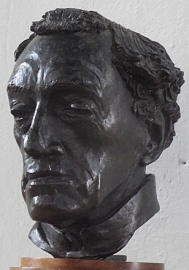
Conrad Noel
Within the church, there is a bronze sculpture by Gertrude Hermes (1901-1983). Mounted on a small wooden shelf, it depicts the head of Conrad Noel (1869-1942), who was the vicar at Thaxted from 1910 until his death.
Conrad was the grandson of the Earl of Gainsborough and son of Roden Noel (1834-1894), a Groom in the Privy Chamber, who left his exalted position after discovering radicalism. It was Roden who translated the words of “The Red Flag” into English. As a student at Cambridge, he had been a Cambridge Apostle. Conrad’s mother Alice (née de Broe) was daughter of a banker. Conrad was sent to school first at Wellington College and then at Cheltenham College. Then he entered Corpus Christi College Cambridge but failed to complete his course. After leaving Cambridge, he studied at Chichester Theological College, a high church Anglican establishment (https://en.wikipedia.org/wiki/Chichester_Theological_College). It was here that Conrad began to conceive his unique ideas about socialist Anglo-Catholicism. By 1893, he defined his theology as ‘Liberal Catholic’, which Edward Poole explained in “Troublesome Priests: Christianity and Marxism in the Church of England, 1906-1969”, his master’s thesis in 2014, was:
“…a theology that looks to the orthodox teaching of the Christian Church, that of Jesus and the Early Fathers, combined with a democratic approach to churchmanship and the active participation of the congregation in worship.”
At first, Conrad found it difficult to become ordained because of his radical, socialist ideas. In 1894, the Bishop of Chester ordained him, and he became a curate in Salford, where Poole related:
“Noel began giving lectures on Catholic Socialism which were boycotted by the ordinary congregation but … were successful in drawing in large numbers of working people who had never attended Church. The indignant Church Wardens referred the matter to Bishop Jayne, resulting in an acrimonious interview between Curate and Bishop. Jayne accused Noel of having no respect for the long-standing congregation, and of irreverence by encouraging attendees to ask questions about Christianity in Church. Noel reminded Jayne of Jesus’ invitation to ‘all and sundry’, but Jayne dismissed the argument.”
Conrad married Miriam Greenwood in 1894.
Jumping ahead, in 1910 the socialist cleric, Conrad, was appointed Vicar of the Parish Church in Thaxted. His appointment to this position was offered to him by a local aristocrat, a former mistress of King Edward VII, Frances Evelyn (‘Daisy Greville’), Countess of Warwick (1861-1938), who had become to quote Christopher Hibbert in his biography of Edward VII: “… a dedicated socialist…” by 1906. Thaxted’s new vicar began revolutionising his parish almost as soon as he accepted the post. Mark Chapman, author of “Liturgy, Socialism, and Life” wrote that Conrad’s: “…first great battle was over the bible boxes, which were used by the richer parishioners to reserve their places in church, and which deprived many of the poorer members of the congregation of the best seats.”
Actions such as these caused some of the wealthier members to leave the congregation, but this did not worry Conrad. He made many changes in the church and its liturgical practices in order to democratise his parish church. He wanted the church to be for all, for the common people, a recreation of the spirit of the earliest Christians. To do this, he introduced music and dancing and folkloric activities. John Millbank wrote in relation to this:
“The joy of Thaxted was a wise joy. The liturgy and the music and the dancing were as essential to Christian socialism as work amongst the poor” (quoted from Chapman).
Conrad had a strong disregard for the church hierarchy, who, on the whole, disapproved of his methods of helping people to believe they were an integral part of Christianity rather than only its recipients.
Socialism flowed through Conrad’s veins. In 1918, he set up the ‘Catholic Crusade’, which was a socialist movement that would:
“… work through the Church for a new economic society basing itself on the laws and principles of the gospels and the prophets. “(Chapman).
In addition, Conrad was strongly against imperialism, especially the British Empire, and also firmly in favour of reviving the Arts and Craft aspects of the socialism of William Morris and John Ruskin. The latter could be seen in many of the activities organised under his guidance at Thaxted.
Poole explains that Conrad’s socialism was based on Marxism and he was in favour of public ownership of the means of production, distribution, and exchange. His formation of the Catholic Crusade in 1918 followed the Bolshevik Revolution of 1917, which Poole notes:
“Noel saw the Revolutions… which brought the Bolsheviks to power, as evidence of a spiritual revival in Russia.”
Conrad hoped that a similar revolution would soon happen in the UK. Poole relates that later Conrad met Ivy Litvinov, wife of the Soviet Ambassador in London. She:
“…expressed to Noel surprise that a clergyman would celebrate the Bolsheviks despite their professed atheism. Noel responded that “dialectical materialism gave no true inspiration for the revolution, and that it was in spite of Marxist philosophy, rather than because of it, that those changes had taken place.”
Later when writing his autobiography, Conrad explained:
“I believe that the mystical element in the Russian people was much more the inspiration of the Russian Revolution than the appeal to the Marxian dialectic.”
By then, although still a socialist at heart, he was appalled by the Stalin-Trotsky split in about 1936 and he joined other clerics in the formation of the Anti-Stalinist Order of the Church Militant.
There is much more that could be discussed regarding Conrad’s idiosyncratic take on Socaialism and the Church, but I will concentrate on an incident that brought his church in Thaxted into the news in 1921. He had placed three flags in his chancel: the flag of St George, the tricolour of the Irish Sinn Fein, and the Red Flag of Communism. Students from Cambridge and also the ecclesiastical courts tried to remove them, but in vain. He preferred the flag of St George to the Union Jack, because the latter, he felt, ignored England and favoured plutocracy and British imperialism. As for the Irish flag, Chapman explained that it emphasised Conrad’s anti-colonialist ideals and the rights of national self-determination, for which WW1 had been fought. The Red Flag was chosen by Conrad because he felt that it:
“… was there to serve as a pointer to something more universal than a nation … it emphasised the notion of God as fellowship, and of the commonwealth and democracy of nations, none of which could be allowed to exist as an isolated entity…” (Chapman).
Poole noted:
“During the First World War, Noel displayed the flags of the Allies in Thaxted Church. After the Russian Revolutions, he added a plain red flag to represent the workers of the world, and by 1921, it hung with the cross of St. George and the Sinn Fein tricolour on the chancel arch, and on May Day that year it was paraded in the church. By the following morning it, and the tricolour, had been stolen by Cambridge University students, leading Noel to place a notice outside reading “Stolen! Two flags from Thaxted church and two universities (Oxford and Cambridge) from the people by the rich.””
The flags chosen by Conrad caused great strife (known as the ‘Battle of the Flags’) in Thaxted, as Poole describes:
“On 24 May, Empire Day, some residents hung the churchyard with Union flags, which Noel then replaced with ‘mutilated’ versions in which St Patrick’s cross had been removed. At a meeting at the Thaxted Guildhall, protestors demanded that Noel cease preaching political and seditious themes. A crowd gathered outside the Church, and fights broke out between them and former policemen defending the church. Noel’s friends called on him to leave Thaxted for his own safety, but he refused. After a night of unrest, Noel wrote to his wife to describe the excitement of the evening, and to reassure her that “the flags of our religion are still flying.” Further scuffles followed when protestors tried to remove a new flag on 20 June, and on 26 June when demonstrators successfully burnt the red flag and hung more Union flags in the church. In July the red flag was burnt again, but local moderates finally took control of the opposition to prevent further violence. In January 1922, a petition calling for the removal of the flags was sent to Chelmsford consistory court and Noel defended his right to fly the flags, but by July he was instructed to remove them, and complied.”
Many years later, when WW2 was declared, Conrad:
“…mused on the irony that the flag that had been so reviled by his parishioners was cheerfully displayed alongside the Union flag as Britain and the Soviet Union fought Nazi Germany. In his view, “the very people who opposed it are now grateful that the USSR is pulling our chestnuts out of the fire”” (Poole).
The only flag of note that we noticed during our visit to Thaxted’s church is a banner sewn in 1917 by Conrad’s wife Miriam. It bears some words of JS Bach that were chosen by the composer Gustav Holst who had a house in Thaxted (I will discuss Holt’s involvement with Thaxted in a future essay).
When visiting Thaxted and its lovely church, it is hard to imagine that the place was once the location of so much violence and controversy. I am glad to see that Thaxted’s highly original parish priest is remembered respectfully within his church. A plaque next to his sculpted head reads:
“Conrad Noel. Vicar of Thaxted 1910-1942. He loved justice and hated oppression.”
These are fitting words by which to remember an unusual man who espoused both Communism and Christianity, who saw no incompatibility between these two belief systems that many others believe to mutually opposed. To summarise, quoting Mark Chapman:
“… it seems to me that Noel was a genuine visionary, although his practical solutions may have neglected some or even most of the complexities or realpolitik, he nevertheless sought to make the church an expression of the kingdom of righteousness, justice, and equality and thus a beacon in a desperate world.”