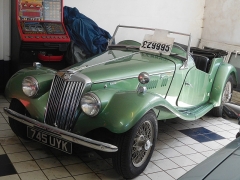
William Morris lived here in Oxfordshire but did not make wallpaper

THE NATIONAL TRUST looks after a house in Oxfordshire, which was once owned by William Morris. When I came across this property, Nuffield Place, I was surprised, because I believed that the artist and socialist William Morris (1834-1896) had lived in properties in Hammersmith, Walthamstow, Bexleyheath, and Gloucestershire, but not in Oxfordshire.

Nuffield Place was the home of another William Morris, who became Baron Nuffield in 1934, and later in 1938, Viscount Nuffield. He lived from 1877 until 1963. At the age of 15, he set up his own bicycle repair business. By 1901, he had a bicycle repair and sales shop on the High Street in Oxford. Two years later, he was manufacturing motorcycles. In 1903, he married Elizabeth Anstey (1884-1959), a seamstress whom he met when both were members of a cycling club. They never produced children.

By 1909, he had set up the Morris Garage in Oxford, and was selling and repairing cars. In 1913, he and his small team of workers had built the first car he had designed. By the time the First World War had begun he had acquired larger premises in Cowley on the edge of Oxford. He was already producing cars that were affordable to the popular market, but during the war, his factory switched to producing products needed for the war effort. While doing this, which was not very profitable, he developed much experience in the techniques of mass-production. One of the many models turned out by the Morris factory was the Morris Oxford. This car has made its mark in India because it was the prototype for the Hindustan Ambassador, which was made in India between 1957 and 2014.

After WW1, Morris began making huge numbers of affordable Morris cars, which sold well. William Morris became incredibly rich. However, he was a modest man and extremely generous. He spent most of his money on philanthropy, particularly in the medical field. Many of the institutions he paid for, which bear the Nuffield name, including Oxford’s Nuffield College, still exist. The number of ways in which he helped are far too numerous to be listed. As a child, he wanted to study medicine, but economic circumstances did not allow that to happen. However, because of all he did to promote healthcare and medical research, he was made a Fellow of the Royal College of Surgeons in 1948.

Nuffield Place, the house which William Morris purchased in 1933 and lived in for the rest of his life, was built for the shipping magnate Sir John Bowring Wimble, also chairman of an insurance company, in 1914. It was designed by Oswald Partridge Milne (1881-1968), who worked in the office of Edwin Lutyens between 1902 and 1904. When Sir John died in 1927, his widow sold the house, which was then called ‘Merrow Mount’, to Morris in 1933.

The house is spacious and must have been comfortable to live in, but it is remarkably modest to have been the sole residence of a man as wealthy as the automobile manufacturer William Morris. We were shown around it by a knowledgeable lady, who helped us to appreciate how modest were the lives led by William and Elizabeth Morris. Among the many things that interested me was William Morris’s bedroom. In one corner of it, there is what looks like a wardrobe. However, when the doors are open, it can be seen to be filled with tools and a workbench. Morris had his own workshop in his bedroom. His wife continued her seamstress skills, and many chairs were covered with textiles she had worked on. The house contains many books on a variety of subjects including history and politics. One bookshelf is filled with medical treatises. Morris, although he never became a doctor, was interested in reading about medicine.

Nuffield Place contains an iron lung machine, such as was used to help sufferers of poliomyelitis to breathe. On learning that there was a shortage of these machines in Britain, Morris used his factories to produce many of them to distribute to hospitals that needed them. The model he helped design, and his factories manufactured, has some curious details. The handles that were used to adjust the apparatus look just like car door handles. And some other components on the iron lung look very much like the hinges of car doors. These iron lungs were a valuable contribution to the treatment of diseases such as polio.

I could describe much more of what we saw at Nuffield Place, but it would be better if you visit the it. Lovers of gardens will also enjoy visiting this house owned by a William Morris, who did not design flowery wallpapers.
An interesting outdoor bazaar in Bangalore

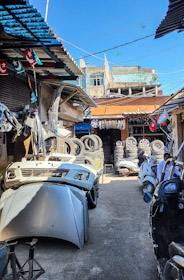
AT FIRST SIGHT, you might well think that you are looking at a crowded carpark which has been blown to pieces by a powerful bomb. There are parts of cars – bodywork, tyres, engine parts, etc., – all over the place.

After a moment or two, you begin to realise that there is a semblance of order in this ocean of car parts, many of which have been salvaged from cars at the end of their useful lives. For this area in the Shivajinagar district of Bangalore is a car parts bazaar. There are many different dealers, each specialising in particular parts of a vehicle. For example, there are merchants selling radiator grilles, others purveying axles (both front and rear), there are sellers of tyres, there are shops selling car doors and body panels … and so on.

Near both Russell Market and St Mary’s basilica, the car parts bazaar is almost hidden from sight by the buildings surrounding it. It is approached by short gullies – narrow lanes. I first stumbled across it in late December 2007. Then, on subsequent trips to Bangalore, I tried to find it again, but in vain. Today, the 26th of December 2023, I managed to locate it, and spent a few minutes wandering around it, stopping to take photographs.

It seemed that most of the dealers were Muslims. Some of them stopped me, greeted me, and asked where I came from and my name. When I replied ‘Adam’, they asked me whether I am Muslim. This reminded me of my first visit to Kosovo in 1975. As soon as I stepped of the bus that had carried me from Skopje (Macedonia) to Prizren (Kosovo), a group of youngsters surrounded me. They wanted to know my name, and when I told them, they were very happy because they thought that, like them, I was a Muslim.

Most of the dealers in the car part bazaar were happy with my taking photographs, but a few in one section of the market asked me not to use my camera.

As far as I could see, no repair work was being undertaken in the bazaar. Nearby, next to Russell Market, there were plenty of cars being repaired. Often those involved in repairing a vehicle were engaged in noisy discussions.

It is seeing places like the seemingly shambolic car parts bazaar that help to endear India and its people to me.

By car from Kuwait to London

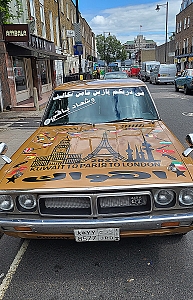
ON THE FIRST OF August (2023), we went to one of our favourite kebab shops – Raavi in London’s short Drummond Street (near Euston station). There was a large Datsun saloon car parked outside Raavi, and another across the road. Neither of them was in pristine condition.  Both were covered with stickers, and each had Kuwaiti registration plates. On the front bonnet of each of them were the words:

“Kuwait to Paris to London 2023”

Beneath these were words in Arabic. Above the word ‘Kuwait’, there was an image of London’s Big Ben. Above ‘Paris’, there was an image of the Eiffel Tower, and above ‘London’, there was a picture depicting some Kuwaiti landmarks. In Arabic, one reads from right to left. Therefore, reading the Arabic way, the images depict: Kuwait to Paris to London’.

On each of the car’s bonnets, there were flags of different countries and either a boat or an arrow between neighbouring flags. Reading the bonnets from right to left, the route taken by the intrepid drivers of these cars was as follows:

By sea from Kuwait to Turkey; by road from Turkey to Bulgaria to Romania to Hungary to Slovakia to Poland to Holland to Czech Republic to Austria to Belgium to Germany to Italy to France to England to Spain. Then, by ship to Morocco.

The order of the countries seems a little odd. Maybe, a few have been omitted. Because there is an arrow rather than a ship between France and England, and between England and Spain, I guess that the cars travelled through the Channel Tunnel.

I do not know why these cars were parked in Drummond Street, but whoever drove them had made a journey that I am sure I would have enjoyed.

A Ford Zodiac in Notting Hill and hot weather

TODAY THE TEMPERATURE in Athens (Greece) will exceed 35 degrees Celsius, and in Rome it is predicted to reach 42 degrees in two days’ time. Two years ago, a temperature of 48 degrees was recorded in Sicily. So, it seems that so-called Global Warming is happening with vigour. Meanwhile, this Sunday (16th of July 2023) in London, we enjoyed a breezy morning with temperatures not greater than a pleasant 21.

While walking along Portobello Road this Sunday, we spotted a beautifully cared for open-topped Ford Zodiac. These vehicles were manufactured between 1950 and 1972. I remember seeing them in my childhood and teenage years. In those days, I was not much interested in cars, but now when I see one that used to be common in my earlier years, I find them worthy of examination. I took several photographs of the Zodiac and then headed for the bus stop from which we were returning home.

Despite the external temperature being 21 degrees or less, it was far warmer inside the bus although its windows being open. The higher temperatures that we have been experiencing here in London and are now affecting places near the Mediterranean are commonly believed to be at least partly due to emissions produced by fossil fuels, such as petrol. As we moved homewards, a thought struck me. The beautiful Ford Zodiac, which we had just seen, is aesthetically pleasing and a souvenir of one of the great eras of automobile engineering, but it is also an ‘ancestor’ of Global Warming. Beautiful as it is, it too burns fossil fuel and makes its own contribution to what is believed to be causing dangerously high air temperatures in many parts of the world.

A Fiat car in Goa

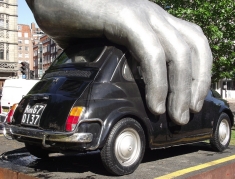
MY MOTHER WOULD ONLY drive Fiat cars. Because they were made in Italy, a country with many hills and mountains, she believed that they must have been built with powerful engines. So, we owned first a Fiat 600, then an 1100, and lastly a 1200. These memories were stimulated by seeing a Fiat 600 on the heart of Panjim in Goa.

Fiat began licencing car making factories outside Italy long ago. In 1964, the Premier Company began manufacturing an Indian version of the Fiat 1100, which was marketed as the ‘Fiat 1100 Delight’, which was renamed the ‘Premier Padmini’ from 1974. These cars looked almost identical to our old family Fiat 1100. Padmini means ‘she who sits on the lotus’.

The Padmini remained a popular purchase until the mid-1980s when the more modern Suzuki Maruthi came on to the market. Decline in Padmini sales was accelerated by liberalisation of the Indian economy in the 1990s, which allowed other foreign car manufacturers to enter the Indian Market. By the late 1990s, the Padmini was manufactured no more.

The owner of the Fiat 600, which we spotted in central Panjim, told us that his vehicle had been imported from abroad by a relative some years ago. Although it looked in immaculate condition, we noticed that after it had been driven a few yards, it had stopped and its owner was tinkering about in the car’s rear engine compartment.

Original Fiat 600s are rarely seen in the UK. After more than 50 trips to India, this 600 in Goa is the first I have seen in the subcontinent.

A filling station in rural Cornwall

THE LAST TIME that a person other than me put petrol into a car that I was driving was in August 2003 in South Africa, where self-service petrol pumps were then a rarity. In India, where I do not drive, vehicles are often filled by the garage attendants. Today (24th June 2021), we were driving along the A394 road in Cornwall when we spotted a petrol station, the modest-looking Double S Garage at Ashton, selling lower than average priced petrol. It was charging £1.26 per litre (currently the price of a litre in Cornwall ranges from £1.24 to £1.36).

I stopped by a pump and got out of the car, ready to operate the pump when an elderly man came out of the garage and on to the forecourt. Instead of having to fill the car myself, he filled it. While he was putting petrol into our car’s tank, I looked around and noticed that his small garage was filled with about five used cars, all with prices attached.

The most prominent car on sale was an aged Bentley, which the garage owner told me he had been driving for the past 15 years. The other cars in the small showroom-cum-garage included a vintage MG convertible; an old Jaguar sports car with a soft top; an Austin Seven complete with engine crank; and a very old looking Morris Minor. The owner, who had filled our car, allowed me to take photographs of his collection of old vehicles and appeared pleased when I told him that his garage was like a small motor car museum.

The Double-S is across the road from a small Victorian gothic chapel built with granite walls and a tiled roof. This is The Annunciation. It is the parish church of Breage with Godolphin and Ashton and is contained within the C of E diocese of Truro. The edifice was designed by the prolific church architect James Piers St Aubyn (1815-1895) and dedicated in 1884. The church is small but seen from outside, it is lacks architectural distinction.

We could have filled up at a superstore, where petrol prices are often not unreasonable, but I am glad that we patronised The Double S Garage, which must be amongst a diminishing number of fuelling places in England where the customer does not need to serve himself or herself. Also, it was fun finding the fascinating collection of vintage or almost vintage cars being stored close to the pumps. It is idiosyncratic experiences such as visiting this garage that help to make Cornwall a delightful place to visit.

In the footsteps of a great Indian politician

DURING THE FIRST ‘LOCKDOWN’, we spent a lot of time walking within two miles of our home. Despite having lived in Kensington for about 30 years, we wandered along many streets, which we had never visited until after March 2020. One of these many streets, which we ‘discovered’, is Aldridge Road Villas, a few yards south of Westbourne Park Underground station. On our first walk along this road, we met a man, who was repairing or restoring an old model of a Volkswagen parked near his home. Amongst his collection of old restored cars was an old Chevrolet truck, which we admired. We chatted with him and hoping to meet him again, we revisited Aldridge Road Villas several more times, sometimes meeting whilst he was working on one of his vehicles. Because we tended to walk along this road hoping to meet him, we managed to miss something else of great interest to us. It was only recently, that I spotted what we had been walking past without noticing it.

Statue of Sardar Vallabhbhai Patel in Gujarat, India

Aldridge Road Villas is probably named after the Aldridge family, who had owned land beside the Harrow Road at Westbourne Park since 1743 or before. The barrister, member of Lincoln’s Inn, John Clater Aldridge (c1737-1795), who became MP for Queensborough between 1780 and 1790 and then for Shoreham between 1790 and 1795, married Henrietta Tomlinson, widow of William Busby and a wealthy landowner, in 1765 (www.historyofparliamentonline.org/volume/1790-1820/member/aldridge-john-clater-1737-95). Through this marriage, John came into possession of more land around Westbourne as well as some near Bayswater. It is on this land that Aldridge Villas Road was built (www.theundergroundmap.com/article.html?id=10787). The oldest houses on the street date from the middle of Queen Victoria’s reign. A map surveyed in 1865 shows that the road was already lined with houses by that date.

One former resident of Aldridge Villas Road, at number 1, was the surgeon George Borlase Childs (1816-1888), who was born in Liskeard, Cornwall. A biography (https://livesonline.rcseng.ac.uk/) reveals that he was:

“…connected with the Metropolitan Free Hospital for many years, but is perhaps best remembered as Surgeon-in-Chief to the City of London Police, and to the Great Northern Railway. He took, indeed, a large share in organizing the medical departments of these institutions, displaying on a wider field the characteristic forethought and ingenuity of his work as an operator. The sanitary and physical well-being of the City policeman was one of his prime interests. He devoted much thought and care to the process of selection of members of the force, to their housing and their dress. The last-mentioned is, in fact, his creation, for he introduced the helmet as we now know it, the gaiters, and so forth. He also established the City Police Hospital…”

Celebrated as he should be, it is not Childs who was the best-known resident of the short road near Westbourne Park station. Although he did not live for a long time in the street, the most famous inhabitant of Aldridge Road Villas must be Sardar Vallabhbhai Patel (1875-1950). It was the plaque affixed to a five-storey terrace house, number 23, which had avoided our attention the first few times that we walked along the road.  

Like many other Indians living under British rule in India, who became involved in political activity, including Mahatma Gandhi, Shyamji Krishnavarma, Bhimrao Ambedkar, Vinayak Damodar Savarkar, Jawaharlal Nehru, and Mohammed Ali Jinnah, Patel decided to sail to England to study. Vallabhbhai set sail from Bombay in July 1910. On arrival in London, he stayed briefly at the then luxurious Hotel Cecil in the Strand. After that, he stayed in a series of ‘digs’ in different parts of London while he completed his legal training. One of these was for several months at 23 Aldridge Road Villas, the address that appears in his records following his admission to The Middle Temple to become a barrister on the 14th of October 1910 (https://middletemplelibrary.wordpress.com/2020/04/08/famous-middle-templars-3/), the same year as that in which Jawaharlal Nehru joined Inner Temple. Patel was called to the Bar on the 27th of January 1913 (www.telegraphindia.com/india/alma-mater-honours-iron-man/cid/220801). Incidentally, many years later my wife was also called to the Bar at Middle Temple, as had also been the case, many years earlier, for my wife’s great grandfather and his father-in-law.

Patel was hard up as a student in London:

“After his arrival in England, he joined Middle Temple and allegedly studied at least 11 hours a day. Because he was not able to afford books, he used the services of the Middle Temple Library where he spent most of his days.” (https://middletemplelibrary.wordpress.com/2020/04/08/famous-middle-templars-3/).

This shortage of money might well have been the reason that he walked between his digs and the library every day. His biographer, Rajmohan Gandhi, a grandson of Mahatma Gandhi, wrote in “Patel. A life”:

“His twice daily walk between Aldridge Villas Road, Bayswater and the Middle Temple – 4 ¾ miles each way – took him past parks and edifices of great charm or magnificence, including Kensington Gardens, Buckingham Palace, St James Park, Cleopatra’s Needle and Waterloo Bridge. When he moved digs his walks were as long or longer but not less scenic.”

Gandhi lists Patel’s other London digs as 62 Oxford Terrace, 2 South Hill Park Gardens, 57 Adelaide Road, and 5 Eton Road. With the exception of Oxford Terrace, the other did were near Belsize Park and Swiss Cottage.

Back in India, Patel became involved in the struggle for Indian Independence, joining Mahatma Gandhi and the Indian National Congress Party. Like many other freedom fighters Patel served several terms in prison. After WW2, he was significantly associated with negotiations with the British regarding transfer of power to the Indians. In 1947, when India became independent, the country consisted of areas that were directly under British rule and well over 800 Princely States that were allowed some independence providing that their rulers did not do anything to challenge the overriding authority of the British Empire. Sardar Patel oversaw and encouraged the rulers of these Princely States to give up their supposed sovereignty and to become part of a new unified India. This was no easy task because some of the larger states, notably Junagarh, Kashmir, and Hyderabad, wished to become part of the recently created Pakistan instead of India. Some considerable persuasion was required to get these places to merge with India. Patel’s achievement at unifying India must surely rival that of Otto Von Bismarck, who unified the myriad German states to become one country by 1871.

The plaque in Aldridge Road Villas is a modest and almost discreet memorial to the great Patel. If you wish to see a more spectacular monument to this remarkable man, you will need to travel to Gujarat in western India, where an enormous statue of him, almost 600 feet high, was completed in 2018. Called ‘The Statue of Unity’, its bronze plates and cladding were cast in the Peoples Republic of China.

Usually, we walk south along Aldridge Road Villas. Until we spotted the plaque commemorating Patel’s residence in the road, we had not realised that we were likely to have been following in the footsteps of one of India’s greatest politicians, which he made when he set out for Middle Temple every morning. And, the idea that one is often walking where famous figures of the past have trod is yet another thing that makes London so wonderful for both residents and visitors alike.

Your vehicle is no longer taxed

A CROWD OF CROOKS is out to steal your money, but they vary considerably in skill. Today, I received the following email bearing the triangular logo of the DVLA (Driver and Vehicle Licensing Agency). It was addressed to my email address not to me, the licence holder, by name. It reads as follows:

_________

𝗬our 𝘃ehicle is no 𝗹onger 𝘁axed.

Dear myemailaddress@hotmail.com,

𝐃VLA have been notified electronically about you latest 𝐩ayment for your 𝐯ehicle tax failed because there is not enough 𝐦oney on you debit card.

We sent you a 𝐃VLA bill, and we still haven’t received 𝐩ayment.

Acknowledge that it’s illegal to drive your 𝐯ehicle until you’ve taxed it.

𝗧ax 𝘆our 𝘃ehicle – 𝗦TART 𝗡OW >

Notice: Un-taxed vehicles risk a fine of up to £240. 𝗬our 𝘃ehicle is no 𝗹onger 𝘁axed.

 Yours sincerely

@GOV.UK

Vehicles Service Manager        

_________

Many of the letters in the email were in bold type. The words ‘START NOW’ is a hyperlink, which I did not click. Initially, I was concerned, but only for a few seconds. This obvious scam contains something in common with many other scam emails that try to worry the reader into believing that something momentous might happen if the instructions in the email are ignored. That common factor, which is well-illustrated above is bad use of the English language. For example, in this case:

“𝐃VLA have been notified electronically about you latest 𝐩ayment …”,

and

“Acknowledge that it’s illegal to drive your 𝐯ehicle until you’ve taxed it.”

Neither of these mistakes would have been made by the DVLA, nor would that organisation have signed itself as “@GOV.UK, Vehicles Service Manager”

Also, the DVLA would know my name and would address me by that, rather than by my email address. Just in case you missed the erroneous wording of the email, you might become suspicious of the sender’s email address: pashegm@hotmail.com, which does not look like the kind of email address that the official DVLA would use.

So, there is a great need to brush up on your use of the English language if you wish to succeed, you contemptible bunch of damnable scammers.

In brief, this scam email was hardly convincing, and the dishonest sender deserves to reap a poor reward, if any, for his or her pathetic attempt to rob me of cash or, worse, sensitive banking or similar details. So, please read all emails carefully before making an error that you might easily regret.

PS: my vehicle is taxed until June 2021. You can check the validity of your vehicle’s tax on https://www.gov.uk/check-vehicle-tax

Autobahn

SOME YEARS AGO, I began listening to music performed by the German group Kraftwerk, formed in 1970 in the West German city of Düsseldorf. They specialise in electronically generated music, a field in which they were pioneers in their country. In the 1980s, I used to drive across Europe from my home in North Kent to places as far afield as Italy, Hungary, and Yugoslavia. The cars I drove at the time were equipped with music cassette players. I recorded my own cassettes from LPs and CDs in my own large collection. Amongst the music I found satisfying during the long journeys I made were some of the creations of the Kraftwerk band. Amongst my favourite of their albums were “Autobahn” (first released 1974) and “Radio-Aktivität” (released 1975). The music was a great accompaniment to speeding along the highways of Europe including Germany’s Autobahns.

I used to break my journeys along the highways at regular intervals, stopping in villages or towns to take a short rest and refreshment. On one journey, I drove off the Autobahn into a picturesque small town in Bavaria, whose name I have forgotten. I entered a busy Gasthaus (pub with a restaurant) and found a vacant seat next to an elderly gentleman who was enjoying a stein of lager.

I remember seeing people sitting nearby drinking beer with slices of lemon. However, what I remember most is the brief conversation I had with my elderly neighbour. My German was, and still is, rudimentary but sufficient to have a simple conversation. He asked me where I was from and what I was doing. I explained that I was driving to Yugoslavia. Then, I said something about the high quality of motorways (Autobahns) in what was then West Germany. The old man smiled, and said (in German):

“Naturally. They were made by our leader Adolf Hitler.”

I was at a loss for words because few if any Germans I had met until then had ever mentioned Hitler and certainly not in such a favourable light. Without waiting for me to respond, he explained that he had been taken as a prisoner of war by the Russians during WW2 and had spent many years in prison camps there. I would have loved to have discussed this with him in detail, but my German was not up to it and also, I had to get on with the journey I had planned for that day.

Most people, including yours truly, credit Hitler with stimulating the building of Autobahns and similar highways. This is a mistake depending how one defines a motorway. In this context, a motorway is a road often with limited access and limited to motorised vehicles.

While Germany was being ruled by the government of the Weimar Republic, work began on an ambitious scheme to build a car only highway/motorway linking Hamburg to Frankfurt/Main and Basel (Switzerland). Parts of this were constructed before Hitler came to power. That road lacked a central reservation as found on modern motorways, but excluded traffic such as cyclists, pedestrians, and vehicles pulled by animals. The Autobahns constructed after Hitler came to power were similar to those currently constructed.

In the 1920s before Hitler ruled Germany but after Mussolini became Italy’s dictator, Italy was the first country in the world to build motorways reserved for motorised vehicles travelling at speed. The first Italian autostrade (motorways; singular: autostrada) were completed between 1924 and 1926 and by the end of the 1930s, the country had over 250 miles of both single- and dual-carriageway autostrade. It is sad to relate that the UK had to wait until 1958 for its first motorway, the Preston by-pass, now part of the M6. In 1959, the first section of the M1 was opened, linking Watford and Rugby. This stretch of highway had no central reservation, no lighting, no crash barriers, and no speed limit. Things have changed since then.

When I used to cross Germany, the motorways (Autobahnen) had long stretches where there were no speed restrictions. Once, I decided to check out the ability of my box-like Volvo 240 estate car on a German Autobahn. To my surprise, the vehicle whose shape looked anything but aerodynamic, effortlessly achieved a speed of 105 miles per hour going up a steep incline. When driving at high speeds in Germany, you can be sure that there will be plenty of vehicles that shoot past you at even higher speeds.

After the Berlin Wall crumbled in 1989, many former East Germans flooded the Autobahns with their poorly powered Trabant vehicles. Often when driving along the motorways in Germany I saw these slow-moving cars valiantly sitting in the overtaking lanes trying to pass vehicles with far more powerful engines. The drivers of speedy cars like Porsche, Audi, and Mercedes Benz, needed fast reflexes and good brakes to avoid crashing into the Trabants being driven by those who were enjoying the freedom of travel after many years of repression in the former DDR.

My days of driving across Europe from the UK have ended. The short journey from Kensington to the Channel crossings is tedious on account of the heavy traffic in London and South East England. Also, it is tiring to drive for at least a day and a half before reaching lovely countryside, be it the south of France or the mountains of Switzerland or Austria. I still enjoy driving but not the great distances I used to cover, and my enjoyment of the music of Kraftwerk remains as great as ever.

Death of an automobile

It is odd how an old photograph can trigger a whole lot of memories, which you thought were long forgotten. This photograph brings back memories of the last hours of one of our motor cars.

I had just had our old Saab car serviced and I asked the dealer how much it would beworth as part exchange for a newer model. I was told £400 would be generous. I was horrified, and said:
“Really? You’re kidding”
“No, Sir, yesterday I was shown a ten year old Jaguar in good nick. I only offered the owner £400.”

I paid for the service, having been told that several quite costly repairs might be needed soon if wanted to keep our Saab on the road. The first of these, and this was a legal requirement, was to replace the four tyres.

We bought four new tyres a couple of days later and set iff to attend a wedding anniversary in Kent. On the way, we stopped at a bonsai tree nursery to see an old acquaintance.

When we returned to the nursery’s car park, our car would not start. All that happened when I turned the ignition key was a whining noise followed by smoke seeping out of the engine.

We called the AA, the emergency breakdown service, and an agent arrived soon. He looked at the problem and came to a rapid diagnosis. I asked him how much it would cost to repair the major problem that had occurred. He said about £400. With that information and the knowledge that other major repairs might be needed in the near future, it was not a difficult decision to scrap our Saab.

That was back in late 2010. Prior to that date, we had used our car to make annual visits to France, where we enjoyed staying at ‘Gites rurales’, rented holiday homes often in picturesque rural spots. I took many photographs on these lovely holidays. The picture illustrating this piece was taken somewhere in France, but as I never bothered to label all of my photos at the time, I cannot tell you where I saw this fine set of doors.