
Tied up by the bank
Reflect-ed on the water
She waits for trippers

Tied up by the bank
Reflect-ed on the water
She waits for trippers
THE ITALIAN WORD ‘scuola’ (plural: scuole) does not always mean ‘school’ (i.e., an educational establishment). In Venice, there are several scuole, which were never schools, but confraternities (or guilds). Well-known examples of these include the Scuola Grande di San Rocco, which contains many fine paintings by Tintoretto (1518-1594), and the Scuola Dalmata dei Santi Giorgio e Trifone, which contains a superb set of paintings by Carpaccio (1465-1525). The latter, also known as the Scuola di San Giorgio degli Schiavoni, was founded by Slavs (‘schiavoni’ in Italian) from Dalmatia (now mainly Croatia).
Another group of migrants from the Balkans, Christian (mostly Catholic) Albanians, began arriving in Venice in the early 15th century, both as traders and refugees from the Ottomans. In 1442, the Albanian community in Venice established its own confraternity, the Scuola di Santa Maria degli Albanesi. The building that housed it from the end of the 15th century still stands on a narrow passageway, the Calle dello Spezier, connecting Campo San Stefano and Campo San Maurizio. During our annual family holidays in Venice in the late 1950s and throughout the 1960s, we often passed along the passageway whilst walking from the Academia Bridge to Saint Mark’s Square. After my interest in Albania was first kindled in about 1967, I learnt about the Albanian scuola and always felt excited when we walked past its façade decorated with bas-relief stone carvings.

Three of the sculptures, which are affixed above the ground floor windows, depict two saints (Gallo and Mauritius) with the Mother and Child between them. Above them and located between the two second floor windows there is a larger bas-relief. It portrays a scene with two men in turbans standing on a rock facing a high hill on top of which there is a building with two heraldic crests. One of the men is brandishing a curved sword. This scene is a representation of the great Siege of Shkodër (1478-79). The city was then a Venetian possession. One of the men with a turban is a depiction of Mehmed II. The shields on the building and on the top corners of the sculpture were those of the Loredan and Da Lezze families, who were heroes of the siege.
The Albanian community in Venice was quite important during the period of the Venetian Republic, which ended in 1797. Several years ago, I met the Kosovan scholar and diplomat Bejtullah Destani, who told me that the city’s archives contain many documents charting the activities of the Albanians in Venice, and they have yet to be examined in detail.
Like the Scuola Dalmata, the Scuola degli Albanesi was decorated with a series of paintings by Carpaccio. In 1780, the Albanian scuola was closed. Its building became home to a bakers’ confraternity. 28 years later, when Venice was under Napoleonic rule, the other scuole were all suppressed. The Carpaccio paintings have long since been removed from the Albanian scuola, and can be found in museums in Venice, Milan, and Bergamo.
To get some idea of how splendid the Scuola degli Albanesi must have been in its heyday, a visit to the wonderful Scuola Dalmata should do the trick. Even if you have minimal interest in either Albania or Dalmatia, the paintings by Carpaccio make a good reason to visit Venice.
EARLY IN SEPTEMBER (2022), I was eating spaghetti alle vongole (spaghetti with clams) in a restaurant in Venice (Italy). The place where I was eating this delicious dish has many memories for me.

During the late 1950s and throughout the 1960s, my parents took my sister and me for annual holidays in Venice. My parents were discerning eaters. Unfortunately, back in those now far-off times, there were very few restaurants in Venice which served food that met my parents’ approval. Eventually, they homed in on one place that they liked enough to return there for every evening meal (our accommodation provided lunch as part of our demi-pension deal). That restaurant is called the Antica Locanda Montin (‘the Montin’). According to its website, it has hosted celebrities including Modigliani, Ezra Pound, Robert de Niro, Luigi Nono, and David Bowie. Well, I did not know that when I used to dine there with my family.
During our recent trip to Venice, we found out that the Montin is still in business, and we booked a table for lunch. To my delight and amazement, the restaurant looks exactly as it did when I last visited it over 50 years ago. It does not seem to have changed one little bit. The front of the Montin faces a small canal. The dining room is long and rectangular. At the far end opposite the front door, a rear door gives access to a pleasant garden, where people can eat in good weather. The walls of the dining room are covered with framed paintings, many of them of great artistic quality. Apparently, they have been donated over the years by artists, who have dined in the restaurant.
I cannot remember what I used to eat at the Montin over 50 years ago. However, my spaghetti alle vongole was tasty and enjoyable. My wife and our daughter were also happy with what they ate. Our lunch was one of the better meals we ate during our four days in Venice. What I enjoyed even more than the food was discovering that the Montin looks as it did when I was much younger. I am glad that the place has survived the trying times we have been through recently and Italy’s various economic crises.
I HAVE WALKED past London’s Victoria Coach Station many times without looking at it particularly carefully. Yesterday, the 28th of September 2022, I was early for a meeting at the Embassy of Albania, which is not far from Victoria Station. So, I walked slowly, stopping to look at the Coach Station. I had never noticed before that it is a fine example of Art Deco architecture.

The Coach Station, which opened for use in March 1932, was designed by Wallis, Gilbert, and Partners.
I suppose that my interest in Art Deco buildings was initiated by visits to Bombay (Mumbai), where there are many splendid examples of this style of architecture. Gradually, I am discovering that London also has a rich collection of Art Deco buildings. The Coach Station is a fine and well-maintained example.
KNOLE HOUSE IN KENT is filled with marvellous things for the visitor to enjoy. The orangery contains an item that at first sight did not seem to be of great interest. It is a tall, bulky black iron heating stove. Undoubtedly impressive in both size and appearance, it was its inventor that interested me.

The stove, which used to heat Knole’s Great Hall, was patented by its inventor in 1765. The example at Knole was manufactured in 1774. The man who invented this kind of stove was Abraham Buzaglo (1710-1782), born in Mogador (Morocco), son of a rabbi who served in that town. In 1762 after many years travelling, Abraham settled in England.
Buzaglo’s stoves were multi-tiered devices, suitable for heating large spaces. He may have got the idea for his design having seen similar stoves whilst travelling on mainland Europe, particularly in Germany where multi-tier heating stoves were in widespread use. Coal was burnt in the bottom tier of the stove and a vent with a pipe conducted smoke and any fumes and smoke away from the oven without allowing them to enter the room where it was being used. How Buzaglo’s invention differed from earlier multi-tier stoves, I have not yet discovered. However, his stoves were in great demand. One of his trade cards, kept in the British Museum, reads as follows:
“Buzaglo Patent Warming Machine Maker To Their Majesties, Strand, London. N.B. Lately finished, a very Large and Elegant Warming Machine, with one fire only will agreeably Warm the Largest Church Hall, &c. and render any new Edifice immediately habitable, with a variety of others.”
(www.britishmuseum.org/collection/term/BIOG174942)
Following the invention of his heating system, Buzaglo invented a therapeutic method that made use of the heat emitted. Patients waited near a stove until they were sweating profusely, and then undertook muscular exercise. This therapy, it was suggested, was especially good for alleviating the symptoms of gout. Buzaglo also invented a heater to warm carriages.
The Buzaglo stove at Knole was in use until the 19th century, when it was moved to be stored in the orangery. Apart from being an attractive bit of ironmongery, this rare example of a surviving Buzaglo heater introduced me to an 18th century inventor, whom I had never heard of before.
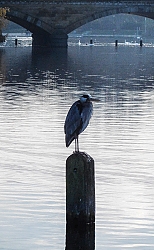
Waiting silently
By the Serpentine lake
Stands a serene heron
THE DISCOVERY OF Canada by Europeans is not usually at the forefront of my mind, especially just after an airflight landing in Venice. Yet when we disembarked from the waterbus that carried us from Marco Polo Airport to the city, I noticed a building that surprised me at the south end of the Via Garibaldi (in the Castello ‘sestier’ of Venice). It has one plaque commemorating Giovanni Caboto (c1450-c1500) and his son Sebastiano Caboto (c1450-c1557). Giovanni is better known (to me) as John Cabot. I had no idea that Cabot, the ‘discoverer’ of Newfoundland was from the Italian peninsular. Sebastiano was also a maritime explorer. His most famous work was done in South America.

Giovanni Caboto’s birthplace is unknown, but is likely to have been in the Province of Genoa. By 1476, he had become a Citizen of Venice. He was a trader there. Getting into financial difficulties, he left Venice for Spain in the late 1480s. After seeking financial support for a trans-Atlantic expedition, which never happened, he set off for England in 1495. Cabot, as he became known in England, went to Bristol. From that seaport, he led at least three expeditions to explore the east coast of North America. During these voyages, he set foot on what is now called Newfoundland and probably also on parts of what is now Nova Scotia. One of his later expeditions is believed to have been one of the earliest attempts to discover a Northwest Passage.
Cabot received a reward for his services from England’s King Henry VII. Where John Cabot died is uncertain. It might have been during his last expedition to North America during the period 1498-1501, but no one knows for sure whether he died at sea, or in North America, or after his expedition had returned to England.
A monument on the house in Via Garibaldi, which was placed in 1982 by the Canadian Province of Newfoundland, records that John’s discoveries in 1497 were made with his son Sebastiano. The house that bears this monument (written both in English and French) and another one in Italian, is said to be the house where John Cabot lived in Venice. From many of its windows, the great explorer would have had a good view of the lagoon and the quays, where trading vessels might well have been loaded and unloaded.
Our rented apartment was on a narrow street leading off the Via Garibaldi. I was pleased to see that this is close to a narrow alleyway called Ramo Primo Caboto.
THERE IS A ROOM in Knole House (near Sevenoaks in Kent), which contains several portraits painted by Joshua Reynolds (1723-1792). One of them is a self-portrait. Near to this, there is a portrait of a man with a red cap, seated cross-legged. His youthful face has Chinese features. The sitter is Wang-y-tong (‘Huang Ya Dong’: born c 1753). Reynolds painted him in about 1776.

Wang was one of the earliest known Chinese people to have visited England. He came over following in the footsteps of an earlier Chinese visitor, the artist Tan-Che-Qua (c1728-1796), who arrived in London in 1769. Tan met King George III, and his work was shown at the Royal Academy in 1770. In about 1770, Wang was brought from Canton to England by John Bradby Blake (1745-1773), an employee of the East India Company. Blake was a naturalist and was interested in Wang’s knowledge of cultivating Chinese plants, and their uses. Wikipedia noted:
“Wang visited the Royal Society on 12 January 1775. In a letter of 1775, he is said to be about 22 years old. He was visited at Blake’s house, where he discussed the manufacture of Chinese ceramics with Josiah Wedgwood, and acupuncture with physician Andrew Duncan.”
It also describes how Wang became a page to Giovanna Bacelli (1753-1801), who was a mistress of John Sackville, 3rd Duke of Dorset, who owned Knole House. Wang lived at Knole, and was educated at the nearby Sevenoaks School. He returned to China by 1784, at which date he was working as a trader in Canton.
Wang’s portrait hangs amongst those of many famous men painted by Reynolds, including Samuel Johnson and David Garrick, as well as the 3rd Duke. The latter is said to have paid Joshua Reynolds 70 guineas (almost £76) to paint Wang’s excellent portrait. Wang was well-received in England. It would be interesting to learn what he thought about life as he found it at Knole and other places he visited in England.
I PRACTISED DENTISTRY in North Kensington’s Golborne Road between late 1994 and about 2000. When I first began working there and for a year or so afterwards, the practice faced a double-fronted, old-fashioned fruit and vegetable shop. It was run by the friendly Hicks family.
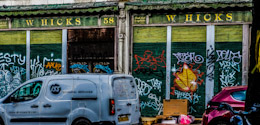
Later, Hicks closed. Their premises were acquired by their neighbour the Portuguese Lisboa Delicatessen, which continues to flourish today. Lisbon use the former Hicks shop as a warehouse. Whenever I have been able to peer inside the former fruit and veg shop, I have noticed that it’s current users have displayed e little if anything to change its interior appearance.
Hicks is just one of several shops on Golborne Road that have retained aspects of their original facades despite changes of ownership and usage.
UNTIL THIS SEPTEMBER (2022), I had only visited Knole House (near Sevenoaks in Kent) once, and that was in about 1972.
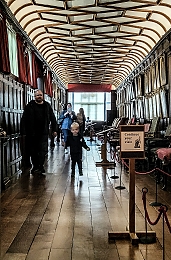
I remember three things about that visit. First, it was a grey, drizzly day. Second, in those far-off days, visitors were taken on a guided tour of the house. Third, was the miserable guide. He was an elderly man who did his best to seem unenthusiastic about Knole House. He took us from room to room, stopping at various exhibits, saying things like:
“This is a Jacobean cupboard. Quite interesting if you like that kind of thing”
And:
“Here is a Queen Anne clock. Quite interesting if you like that kind of thing.”
And:
“This is a carved wooden staircase, if you like that kind of thing.”
He made similar comments, always lacking in enthusiasm, each time he pointed out an exhibit or feature. What with the dull weather and the depressing commentary provided by the guide, I believe that subconsciously I avoided revisiting the place.
It was only recently, when we were on our way to visit some friends who live in Kent, that my wife said that she had never visited Knole, and that we should see the place. I agreed, thinking that it would be a good idea to see Knole again: to give it another chance. We went on a sunny afternoon. We walked at our own pace from room to room in the building that was the country home of an archbishop of Canterbury in the 15th century, and later (for over 400 years) the home of the Sackville family, which still resides there. In each room, there were knowledgeable National Trust volunteers who answered our questions and, unlike the guide I met on my first visit, inspired us with enthusiasm for the fascinating place.
Whereas after my first visit to Knole and the poor impression it made on me, I used to be reluctant to recommend people to visit it, but having seen it again, I would put into my top 10 places to visit in Kent.
 yamey
yamey 