A collection of colourful saree textiles in Bangalore

ONE OF THE THINGS that struck me when I first visited India in January 1994 was how everyone was wearing clothing far more colourful than anywhere else I had been before. Wherever I have been in the country, there is a feast of colourful clothing to be seen. Whether the colourful garments are worn purely for aesthetic reasons and/or for ceremonial or group identity reasons, everywhere there is much to please the eye.
I am not alone in noticing the Indian penchant for wearing bright colours. In 1956, the famous style ‘diva’ Diana Vreeland noted in British Vogue magazine: “… pink is the navy blue of India …”. Following from this, an article in India’s “Economic Times” of January 2022, pointed out that “Red is the Indian beige and yellow is the Indian grey…”. In other words, that the exuberant colours worn by Indians contrast dramatically with the much more drab colours currently worn in the West. Actually, as my wife pointed out, long ago in Europe (eg the 18th century and before) clothes – especially those worn by the wealthy and the aristocracy – were far more colourful than now.

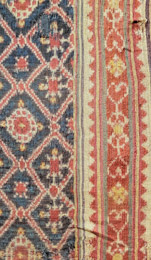
On the 23rd of December 2023, we were fortunate to get admission to an exhibition of sarees on its last day. Intriguingly entitled “Red Lilies, Water Birds”, the show was hosted by The Registry of Sarees in a house on Hayes Road in Bangalore. The Registry (established in 2016) is a trust set up by the Mysore Saree Udyog (founded in 1932). Its purpose is to promote the study, design, and conservation of handspun and handwoven textiles.

The nine rooms of the exhibition contained about 84 examples from the Registry’s much larger collection. Each room concentrated on either a particular region of India, or a specific method of creating the textiles. Every room was filled with sarees, which filled the viewer’s eyes with richly coloured, intricately patterned delights.

Many of the visitors to the exhibition, and the staff looking after, and explaining, the show were wearing clothing that demonstrated what I mentioned at the outset – namely, the preference of many Indians to dress colourfully.
Driving on roads on India

WHEN I FIRST visited India – that was in January 1994 – I carried my British and International driving licences with me. Boldly, I drove in the heavy traffic and densely crowded streets of the busy City Market area of Bangalore and also all the way to Ootacamund (‘Ooty’) – over 270 Km, and that was before the highway was constructed. You can share in these experiences by reading my book about travels in India, “The Hitler Lock & Other Tales of India”. This book/kindle is available from Amazon (https://www.amazon.co.uk/HITLER-LOCK-OTHER-TALES-INDIA/dp/B0CFM5JNX5/ ), and IF you live in India, from: https://store.pothi.com/book/adam-yamey-hitler-lock-and-other-tales-india/ .

Where a famous botanist from Germany used to lecture in Bangalore

DURING AN EXCELLENTLY guided walk through Bangalore’s Lalbagh botanical garden, I saw many parts of the place I had never seen before on several previous visits. One of these new ‘discoveries’ was a small neoclassical building with a triangular pediment on which the ganderberunda (double-headed eagle) of Mysore can be seen in bas-relief.

Painted with deep red paint, this small edifice is a recent reconstruction of Krumbiegel Hall, which was first built over 100 years ago (some say in 1860). For many years the original building was neglected, and it fell to pieces. In about 2020, it was rebuilt according to the original plans. So, today it looks brand new.

Gustav Hermann Krumbiegel (1865-1956) was born in Germany near Dresden. He was a botanist and garden designer who came to India in 1893, after having worked in London’s Kew Gardens. He helped to develop the Lalbagh Garden into the wonderful place it has become. Apart from designing the gardens, he introduced many interesting and exotic plants into Lalbagh. His importance in the development of the botanical garden cannot be overestimated.

The original building was used to hold lectures. Krumbiegel was one of those who spoke there. He used to enjoy practicing his speeches and talks in the hall. The construction of the replica of the original hall was stimulated in no little way by the campaigning of Krumbiegel’s great granddaughter, Alyia, who resides in south London.

When I saw the hall yesterday (22nd of December 2023), it was locked up and in front of it were a couple of lamps stands awaiting election. One day, I hope that I will be able to attend a lecture in this hall that has been replicated on the footprint of that which Krumbiegel would have used.

The loss of an earring made by a jeweller in Bosnia

ONE MORNING IN Kutch (part of Gujarat), we set off to see a historical monument not far from the town of Mandvi. On the way, we stopped at a cash machine (ATM) to withdraw some cash.

We inserted the debit card and the appropriate PIN code. After keying in the amount we wanted, the machine made the normal noises, and then asked us to remove the cash and our card. To our great dismay it delivered no cash. Yet, we received an SMS stating we had just withdrawn the amount of cash we had keyed in. This worried us greatly.

Fortunately, there was a branch of our bank near the ATM. We spoke with the manager, and explained what had happened. After taking a few details, he resolved the situation and instructed the cashier to give us the cash we had wanted. From his desk, he also managed to ascertain that the ATM had suffered a technical problem.

We drove on towards our intended destination. Despite information on the Internet and on noticeboards, all of which suggested that the place would be open, it was closed. The watchman at the gate explained that the attraction was closed for repair. However, he let us go in for a couple of minutes, after telling us that if anyone saw us enter, he would be in big trouble.

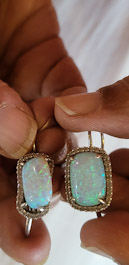
After this second mishap of the day, our driver took us to see a lovely Hindu temple a few miles away. As we began walking around the place, my wife noticed that one of her earrings had become detached. It was one of a pair that a jeweller in Sarajevo (Bosnia) had made. The pair had been made by the uncle of one my Bosnian dental patients, who, having been pleased with my dentistry, had given them to me to present to my wife. These earrings were of great sentimental value, and Lopa was most unhappy to have lost one.

After retracing our steps in the temple compound and failing to find the piece of jewellery, we decided to return to the bank and the ATM, where during the panic of the debit card problem, it might have fallen. On the way, we returned to the closed visitor attraction. We asked the watchman of he had spotted the earring. He had not.

So, we decided to search the part of the driveway, where we had stopped earlier. Lopa and I looked around in vain. Then, our driver joined the search. Within a couple of minutes, he found the earring in the gravel of the roadway. Sadly, either something had driven over it or stepped on it. The earring was intact but the silver stone setting had been distorted. We will have it repaired by Kalim, our skilful jewellery repairer in Bangalore.

They say things happen in threes. That was the case that morning in Kutch. Fortunately, two of the three problems were resolved in a good way.

Towers of light at a water tank in Mumbai

HAPPY CHRISTMAS

A DEEPSTHAMBH IS a Hindu architectural feature found near temples or temple compounds. It is a tower with many small niches into which small oil lamps (diyas) are placed and lit to celebrate special Hindu occasions. A good place to see a number of these is at Bombay’s Banganga Tank in the Walkeshwar area.

Two deepsthambhs next to Banganga Tank

The tank is a rectangular pool surrounded by steps that lead into the water contained within it. At one corner of the tank water flows from a spring vigorously into the pool. The tank is full of large fish, which the locals feed. Being in a strictly vegetarian neighbourhood, these fish are safe from being caught and eaten. The tank is surrounded by houses and many smallish temples. The Tank is a few yards from the rock strewn seashore.

The tank was first built in 1127 AD by Lakshman Prabhu, a minister in the Sihara Court of Thane. This makes the Tank one of the oldest surviving features of what is now Mumbai. It was rebuilt in 1715. According to legend, the spring that now feeds the Tank appeared suddenly when Rama stopped at this spot during his search for Sita.

Banganga Tank is a pleasant spot at which to linger. So near to the hustle and bustle of Mumbai, here is a place that us both beautiful and relatively peaceful. It gives me a good feeling.

The title greatly enhances the photograph.

THERE IS A PHOTOGRAPH in the “Times of India” (Mumbai edition: 19th of December 2023). It is a good image showing a group of women wearing saris, and seated on a wall next to the sea close to the Gateway of India. The picture on its own is a pleasure to see, but what enhanced my enjoyment of it was its wonderfully witty title:
“SAREE SOIREE AT THE GATEWAY”

Pop Art on show in a gallery in Bombay

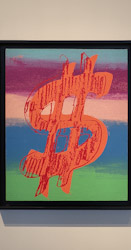
DURING THE FEW DAYS we have been in Bombay, we have visited 10 art galleries. With one exception, the exhibitions have been both beautifully displayed and contained exciting works of art. The exception is an exhibition of Pop Art being held at the recently constructed Nita Mukesh Ambani Cultural Centre in the Bandra Kurla district of Bombay.

The spacious gallery occupies parts of four floors of a glitzy cultural centre-cum-shopping mall. To view the exhibition, one needs to book a time-slot, and part with 800 Rupees (about £8) per person. When we visited on a Sunday afternoon, the few visitors to the gallery were vastly outnumbered by security personnel and charming, but seemingly poorly informed, young ladies who are employed to provide information about the exhibits.

The flyer for the exhibition promises the visitor the opportunity to see works by 12 exponents of Pop Art. However, the majority of the items were creations of Andy Warhol. Almost my favourite piece was a large creation by Robert Rauschenberg.

Each of the very spacious, well-lit galleries had surprisingly few artworks. Of the four galleries, I thought that the one on the third floor was best. It contained, amongst a few other things, the Rauschenberg, and a work by Claes Oldenburg, and yet more Warhol images.

Would I recommend making a visit to this exhibition? Probably, I would not. If you are familiar with Pop Art it offers little to add to what you already know and/or like. If you are not familiar with this kind of art, I am not sure that the exhibition would provide you with much if any insight. And at 800 Rupees per person, you might be better off buying a decent book about this exciting era of art.

Bargaining for a book in Bombay

NEAR BOMBAY’S FLORA Fountain there are several booksellers on the pavement. They stock both new (original and pirated copies) and old books. In general, the vendors are amenable to bargaining with their customers.

Today (in December 2023), I found a second-hand, oldish book about the history of Bombay. It looked as if it would satisfy my requirements. I asked the price. It was 800 Rupees. Because I have become accustomed to hagling over the price I offered 600. I was hoping that we would eventually agree on a price of about 700. The bookseller was adamant. He would sell it for 800 and no less. He kept saying it had been 1000 when it was new … long ago. I walked away, and viewed other bookstalls nearby.

Keen to have the book, I returned and offered 750. The stubborn vendor said to me:
“What is 50 Rupees to you? You are rich man.”
I walked away, and joined my wife who had just engaged a taxi to take us elsewhere. Seeing me board the taxi, the bookseller ran up to our vehicle, and proposed that we pay 780. My wife, who was not yet in the vehicle, offered him 750, which he accepted.

The man was right. What was 50 Rupees to me? Only about 50 pence. However, that was not the point. Getting the book was one thing but the pleasure of fighting to reduce the price, and succeeding, is another. And the sense of achievement after serious bargaining leaves me with a curiously fine sense of contentment.

Bats in a baobab tree in Bombay

I HAVE SEEN PHOTOGRAPHS of baobab trees, but until we visited the café of the formerly named Prince of Wales Museum in Bombay, I had never seen one ‘in the flesh’. A member of the mallow family of plants, baobabs are native to Madagascar.

Baobab tree in Bombay

These trees with curious looking conical trunks were imported to India by Arab traders. Although this is the case, this baobab in Bombay is the first such tree I have seen during my 30 years of frequent visits to India.

As we sat with our cold drinks, I looked up at the high branches of the baobab, and saw something flapping about. At first, I thought it was a black plastic bag caught in the branches. Then I noticed that it was a large bat stretching its wings. I saw it was not alone, but one of a large number of bats hanging on the high branches. These large creatures had black wings and dark brown bodies.

Despite the fact we had just seen a wonderful exhibition of ancient sculptures (from India, Ancient Rome and Greece, and Assyria), finding the baobab and seeing the bats in it, made my day.