Two historic hotels by the sea

MOST OF SOUTHEND in Essex was built after the Victorian era. The town on the estuary of the River Thames was and still is the nearest seaside resort to London. According to “Encyclopaedia Britannica”, Southend:

“…became fashionable as a seaside resort when visited by Princess Charlotte of Wales in 1801 and by her mother, Princess Caroline (wife of George IV), in 1803.”

Originally, Prittlewell, once a village north of Southend but now one of its suburbs, was the only settlement in the area now occupied by the modern town of Southend. South east of it on the coast was a tiny village called Leigh, which is now the much larger Leigh-on-Sea. The resort now known as Southend-on-Sea was developed at the end of the 18th century in Prittlewell’s  southern district of South End. Today, more than seven miles of buildings extend from Leigh-on-Sea through Southend to Shoeburyness.

The High Street, part of a road heading south from Prittlewell, runs from near Southend Victoria Station towards the sea, ending at the edge of a steep slope that falls to the seashore below. Various roads and a lift can be used to descend this incline. At the top of the slope, the High Street meets the eastern end of Royal Terrace. At the corner where these two streets meet, stands the Royal Hotel. Next to the hotel and lining Royal terrace, numbers 1 to 15 were built in the 1790s at the same time as the hotel. These were backed by the Royal Mews, a road still in existence. These constructions were part of a then new phase of development of the town, which was known as ‘New Town’.

The hotel, a fine Georgian edifice, opened with a grand ball in 1793.  Princess Caroline House that adjoins the hotel. number 1 the High Street, is a listed building, which looks as if it is contemporary with the hotel. The gardens on the slope in front of the hotel and the Terrace are known as The Shrubbery and were originally for the exclusive use of residents in the Terrace, but now they are open to the public. According to www.southend.gov.uk/historic-southend/history-southend/2:

“The Terrace was named “Royal” following visits by Princess Caroline, wife of the Prince Regent, in 1803 and for a short time attracted fashionable society. But difficult access from London by road and river discouraged further development until the construction of the railway in 1856. Royal Terrace is the only surviving Georgian terrace in Southend.”

Just east of the High Street and dominating the shoreline is the massive Park Inn Palace hotel, formerly the The Metropole. Built in 1901, this hotel that looks like an oversized liner had 200 rooms, a billiard room, and a splendid ballroom. During WW1, it was temporarily used as a Royal Naval Hospital. An online article (http://beyondthepoint.co.uk/first-world-war-southend-the-palace-hotel/) related:

“The Palace Hotel was built in 1901 and served great use in the war effort. Messrs Tolhurst; the owners of the hotel, were generous enough to offer the building up for free as a naval hospital for the rest of the war. Its glorious five star interior would’ve been quite bizarre with hospital beds placed amongst its lounges and ballrooms. It held possibly the world’s first purpose-made x-ray department. It recently underwent refurbishment by Park Inn to bring it back to its former glory.”

Both hotels overlook both the sea and Southend Pier. The older, Royal Hotel, is less of a blot on the landscape than the Palace hotel.

A great art gallery near the sea

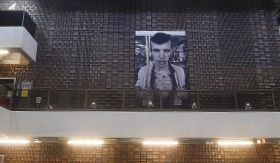
UNTIL WE WENT to Southend (in Essex) in February 2022, it was not the first place to spring to mind when thinking about art galleries. To my mind, Southend was mainly associated with its spectacular pier, which is over one mile in length. Now, to the pier I will add the Beecroft Art Gallery to the good reasons for visiting Southend.

The gallery has been housed in a distinctive 20th century building on Victoria Avenue since 2014. Its current home was formerly Southend’s Central Library. The edifice was designed by Borough Architect R Horwell and opened in 1974. Prior to moving there, the gallery was housed in a large Edwardian house on Station Road in nearby Westcliffe-on-Sea.

The permanent collection of art in the gallery was donated to the town in 1952 by a local collector, a solicitor called Walter Beecroft, who worked in Leigh-on-Sea. His paintings ranged from the 17th century to the late 19th, and a few from the 20th. A selection of these was on display in the first-floor gallery of the Beecroft when we visited. Newer additions, mainly on long-term loan, to the gallery’s collection were hung alongside examples donated by Beecroft.

We went to the Beecroft to see a temporary exhibition of 20th century artists from London’s East End. It was excellently curated. I will write about this in the future. There were also temporary exhibitions of Pakistani wedding outfits and feminism during the covid19 lockdown. The basement of the Beecroft is currently dedicated to the history of jazz.

All in all, the Beecroft Gallery is well worth visiting. The quality of the exhibitions we saw there puts to shame a few of the better-known art galleries in London.

A bridge, canals, and a church in west London

THE GRAND UNION canal meets the River Thames at Brentford. From there, it runs towards the Midlands where it meets other waterways in England’s extensive network of canals, which was built for commerce, but is now used mainly for pleasure.

Six miles along the canal from Brentford, there is an important junction. Here at Bulls Bridge, the Paddington Arm branches off the main Grand Union canal. From beneath the bridge, the Arm runs 13 ½ miles to Paddington. Near its destination in central London, the arm flows through a large body of water, known as Little Venice. From there, two canals, the continuation of the Arm and the Regents Canal, link Little Venice to Paddington Basin and Limehouse Basin respectively.

The Paddington Arm was opened for use in 1801. The Bulls Bridge is a single-arch brick bridge spanning the Paddington Arm a few feet east of its junction with the Grand Union Canal. It stands amidst a dull landscape filled with industrial units and large supermarkets.

Following the towpath along the Grand Union Canal away from Bulls Bridge in a north-westerly direction for 177 yards, we reach a bridge that carries the canal over a narrow stream, the River Crane. a tributary of the River Thames. According to a website, touristlink.com, the course of the Crane is as follows:

“The River Crane is 8.5 miles (13.6 km) in length. Its source is taken to be a point south of North Hyde Road in Hayes, Hillingdon, from where its course is generally in a southerly, if near semi-circular, direction, before it joins the River Thames at Isleworth. Its name is a back-formation from Cranford, London. Formerly it was called the Cranford River. The River Crane creates the boundary between the London boroughs of Hillingdon and Hounslow.”

What could be seen from the bridge carrying the canal over the Crane was a deep weed-filled fissure in the depths of which there was a narrow stream. This lies in the shadow of an elevated road, the busy Parkway (A 312) that links both the A40 and the M4 with Heathrow Airport.

Continuing north-west along the Grand Union, the canal passes beneath a series of railway bridges that carry trains to and from Paddington Station. Nearby is Hayes and Harlington station, which stands in a part of Hayes, which was once the village of Botwell. This is now a shopping area with supplied with lavishly stocked fruit and vegetable shops and a branch of Lidl’s supermarket chain. Lidl’s faces a Roman Catholic Church, Immaculate Heart of Mary, built in 1961, which according to Pevsner, contains a painting by Pietro Annigoni (1910-1988). Near the station is a less attractive church, St Anselm, built between 1926 and 1928.

Even at the beginning of the 20th century, Hayes in Middlesex was a village north of Botwell and separated from it and other neighbouring settlements by open countryside. By 1940, Hayes had begun to be engulfed by London’s western spread. The village was, according to James Thorne, writing in 1876:

“… quiet and respectable, and chiefly dependent on the wealthy residents … consists of a few ordinary houses and shops.

Today, it is still quiet, the commercial district being in Hayes Town, the former Botwell, near the railway station.

There is one good reason to visit what was old Hayes. That is to see the parish church of St Mary the Virgin. It stands on the eastern side of Barra Hall Park, which are the grounds of the former manor house, now much modified. The church is mediaeval. Its lychgate is probably early 16th century.  Its chancel is late 13th century, the tower and the north aisle are 15th century, and the main aisle is 16th century. The church has beautiful timber ceilings and a 12th century font. On the north wall there is a large wall painting of St Christopher carrying the Christ child. Pevsner did not consider this image was painted before about 1500.

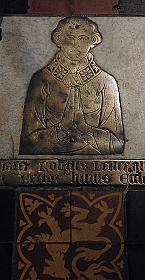
The church is full of fine funerary monuments. These include elaborate memorials for Sir Walter Grene (1456); the judge of the King’s Bench Edward Fenner (died 1612); Roger Jenyns (died 1693) and members of his family; Richard Lugg (1697); and Thomas (died 1576) and Elizabeth Higate. There are plenty more monuments to be seen as well as several fine brasses. Fenner’s monument consists of an effigy of Fenner lying recumbent supporting his head on his right hand. This is framed by marbled pillars supporting an elaborate carved stone semi-circular canopy, which is flanked by a pair of sculpted figures.

Although Hayes is not high on most tourist’s lists of what to see in London, the old church parish church of Hayes is certainly worth a detour. As for Bulls Bridge, visiting it is only for dedicated enthusiasts of  desolate landscapes and inland waterway history.

Out to sea without stepping off land

THE FIRST TIME I visited Southend in Essex was in about 1960. I was invited to go there on a day trip with my best friend, his younger brother, and their father, who was a senior official in London Transport. We went by car, stopping on the way at several London Transport bus garages, where we saw a few vintage busses. I remember two things about Southend on that first visit. First, we ate fish and chips. It was the first time I had sampled this cuisine because my parents were too snobbish about food to have been seen dead in a fish and chip shop. I have enjoyed fish and chips ever since that time in Southend. The other thing that sticks in my mind was travelling along Southend Pier in a special train that carried passengers almost to its furthest point from the seafront. It was not until the 11th of February 2022 that I made my second visit to Southend.

Southend Pier

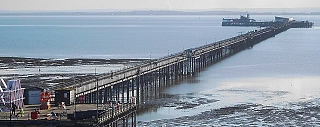
Southend Pier is the longest pleasure pier in the world. It is 1.34 miles (2.16 kilometres) in length. The present pier, which replaced an earlier wooden one built in the early 1830s, was completed in the late 1880s. it was opened to the public in 1889. At about this time, the single-track railway running along it was also ready for use. It was extended by 1898. The trains were then electrically operated. In 1978, the electric railway was closed. By 1986, it had been re-opened using trains that were driven by diesel engines. It was on one of these that we took a return trip this February.

I enjoy piers. They provide a way of going out to sea without leaving land and without risking seasickness. In addition, like the one at Southend, most of the piers in England are visually satisfying when viewed from the shore. At the sea end of Southend Pier, there are various structures ranging from painted wooden shacks to the beautiful contemporary-style Royal Pavilion, opened in 2012. Despite being a complete contrast to the other constructions on the end of the pier, it enhances to visual attractiveness of the area.

Although the pier was not the primary reason for our excursion to Southend, it certainly enhanced our enhancement of the place as did our lunch at a local fish and chips shop.

Put it in your pipe and …

ONE OF MY COUSINS, who was on a trip around Europe during his high school years in the late 1960s, met me while he was in London. A keen collector of pipes, he wanted to visit the Dunhill shop in central London’s Piccadilly. We did this together, but I cannot recall whether he purchased a pipe. Since that day several decades ago, I have barely thought about Dunhill or even smokers’ pipes.

Today (8th of February 2022), I was strolling along Uxbridge Street near Notting Hill Gate when I looked at a building that looks as if it might have once been a factory or warehouse. I have often noticed it and wondered about its former purpose. However, it was only today that I noticed a commemorative plaque affixed to it. I am sure that I have never noticed it before; maybe, it was placed recently. The words on it read:

“This building was the Dunhill pipe & cigarette factory 1916-1946.”

Well, that got me interested.

Tim Rich published an article about Alfred Dunhill and his firm in an issue of “The Pipe” (number 2, 1995). Alfred Dunhill (1872-1959) opened his first tobacco shop on Duke Street in 1907. Three years earlier, he had invented a ‘windshield pipe’, which allowed motorists to smoke in draughty vehicles. In 1910, dissatisfied with the pipes he was selling in his shop, he decided to start his own pipe factory. At first, they were made in Mason’s Yard, where today a branch of the White Cube art gallery is located. As business grew, he moved his factory to Notting Hill Gate and later opened another in Plaistow in the East End. The Notting Hill factory “…turned out several thousand Dunhill pipes per week” (https://rebornpipes.com/tag/history-of-dunhill/).

According to Carolyn Hubbard-Ford, writing in a 2014 issue of “The Notting Hill & Holland Park Magazine”, Alfred Dunhill was a major employer in the area. The factory used to be linked by a bridge, now gone, to another building across the road. The bridge was made of metal and low enough for local children to throw balls over it. Alfred’s daughter Mary began working in the factory in the 1920s immediately after she left school. Dunhill’s also had a shop, no longer in existence, close to the factory at 137-143 Notting Hill Gate.

After Dunhill’s moved out of the factory in 1946, the building on which the plaque is attached was converted into offices. In about 2001, the building was again converted, this time to provide residential units.

The writing on the … lampposts

It is interesting what one can spot when walking leisurely along a street

CALLCOTT STREET IN Notting Hill Gate is only 76 yards long. It contains two lampposts that provide evidence of Kensington’s administrative history. Once, this street was in the Borough of Kensington, which was incorporated into the larger Royal Borough of Kensington and Chelsea (‘RBKC’) in 1965.

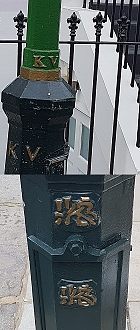
Most streetlamps in RBKC, are marked with the letters R, B, K, and C, intertwined. However, one of the lampposts in Callcott Street is marked with ‘RBK’, without the ‘C’. The other lamppost in this short thoroughfare is marked with the letters ‘KV’. This stands for Kensington Vestry. In the 19th century and probably earlier, local affairs were governed by the local vestry. This was a meeting or council of parish ratepayers, which often met in the local parish church or its vestry. In the case of Kensington, there is a fine Victorian building, now a branch of the Iranian Bank Melli, which used to serve as the Kensington Vestry Hall. Before this was built (in 1852), the local vestry used to meet in a room attached to the nearby St Mary Abbots church.

In 1901, the Metropolitan Borough of Kensington was granted the status of ‘Royal Borough’ and was known as the Royal Borough of Kensington. So, the streetlamp marked with ‘RBK’ must date from between 1901 and 1965, and the one with ‘KV’ is even older.

A bridge in London waiting for repairs

In the middle years of the 1720s, Daniel Defoe described Hammersmith as a village that was growing into a small town:

“… and some talk also of building a fine stone bridge over the Thames …”

It was almost 100 years after Defoe speculated that a bridge across the Thames would be built at Hammersmith. A suspension bridge was constructed between 1824 and 1827. It was the first of this type of bridge to be constructed anywhere near London and the first to span the Thames. James Thorne, writing in 1876, that in outline and simplicity of style, it:

“… remains the best-looking-bridge of its kind on the Thames …”

The bridge was designed by William Tierney Clark (1783-1852), who had been guided in his development of bridge construction techniques by Thomas Telford and John Rennie, who designed the old London Bridge that now stands in Lake Havasu City in Arizona. Clark also designed the suspension bridge (1832) across the Thames at Marlow and the impressive Széchenyi (Chain) Bridge which crosses the River Danube to link Buda and Pest. The latter resembles Clark’s Hammersmith Bridge as depicted in old engravings.

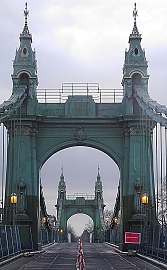
In 1883-37, Clark’s Hammersmith Bridge was replaced by a newer one designed by Joseph Bazalgette (1819-1891). According to Cherry and Pevsner in The Buildings of England. London 2: South, Bazalgette:

“… re-used the piers and abutments. Iron-framed towers clad in cast iron partly gilt, with Frenchy pavilion tops, and elephantine ornament at the approaches … The deck stiffening girders were replaced in a major overhaul in 1973-6.”

This bridge, which was built for use by horses and carts, pedestrians, and the occasional cyclist, long before the advent of heavy motor vehicles such as busses and lorries. It has been closed for repairs several times, causing much nuisance for those who live on both sides of it. In April 2019, Hammersmith and Fulham Council closed the bridge to all motorised traffic. This was done following the discovery of serious cracks in the pedestals that support the bridge. It remained open for pedestrians and cyclists until August 2020, when a heatwave caused further deterioration. Then, the bridge was closed to all users.  

A variety of schemes have been proposed for repairing the bridge and there was some disagreement as to who would pay for the work. In June 2021, Hammersmith and Fulham Council came to a cost-sharing deal to complete the rehabilitation of the Victorian bridge. In July 2021, the bridge was reopened for use by cyclists and pedestrians until 2027. In February 2022, I stepped on the bridge for the first time since it closed. The view from it is marvellous, especially upstream where one gets a good view of the historic buildings lining the waterfront between Hammersmith and Chiswick.