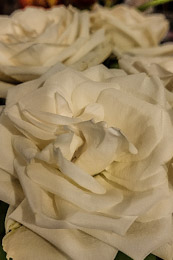
Layers of petals
Overlapping each other
Quite a pleasing sight

Layers of petals
Overlapping each other
Quite a pleasing sight
THE GARDEN CINEMA is in Parker Street, which is near both Holborn Underground station and Covent Garden. This gem of a place opened in 2022. Housed in the building which formerly contained the offices of businessman Michael Chambers, who founded Chambers and Partners in 1989, a research company for law firms around the world, it was the realization of Mr Chambers’s dream to create a cinema for film enthusiasts such as he is.

The ticket office is on the ground floor. Stairs and lifts lead to the basement, where the bar, various small seating areas – some quite discrete, and the two auditoriums are located. The premises are designed and decorated with many Art Deco features and a good selection of sculptures and prints. The darkly coloured wallpaper (with nods to the William Morris style) and subdued lighting give the place a cosy, intimate night club atmosphere. The bar is reasonably priced. The staff are friendly and helpful. This is a cinema complex quite unlike any other I have visited in London – it is both stylish and intimate.
We watched a Romanian film made in 2023: “Do Not Expect Too Much from the End of the World”. Before I discuss this excellent movie, let me tell you one more unusual thing about The Garden Cinema. There were no advertisements (commercials) prior to showing the main film – only several trailers of forthcoming shows in the cinema. This is quite different from other ‘independent’ cinemas, in which the feature film is always preceded by ads including one for the car company (currently Kia), which supports independent cinemas.
The Romanian film, which runs for almost three hours, is a ‘whacky’ and gritty black comedy with serious comments about life in post-Communist Romania. The brilliantly acted film blends skilfully ‘doctored’ flashbacks to life in Ceausescu’s Romania with scenes in Romania since the war in Ukraine commenced. One of the many things that this highly entertaining film emphasises is how the difficult, regimented, but relatively simple life under the dictatorship contrasts with the hectic, corrupt, and very hard life in capitalist Romania. Nothing was easy during Ceausescu’s ‘reign’, but after it ended, nothing has made life any easier. The film made me think that the tyranny of the dictator has been replaced by the tyranny of corruption and exploitation of cheap labour by countries outside Romania. Another thing that I felt was that the film showed how when the shackles of a highly oppressive regime were released following the death of the dictator, Romanian society seems to have gone crazy. Whether this is an exaggeration by the film makers or truly reflects contemporary life in Romania, I do not know. All I can say is that the 163 minutes of the film sped past remarkably quickly because I found it so highly enjoyable and engaging.
Even if I had not enjoyed the film so much, I would have thought highly of the Garden Cinema – a place I hope to visit many more times in the future.
WE ARE KEEN on many of the plays put on at the Young Vic Theatre on The Cut near Waterloo Station. Last night (the 11th of March 2024), after seeing a superb performance of a weird but enjoyable play (about a painting by an infamous dictator) called “Nachland”, we walked along The Cut and then further west along a street called Lower Marsh. Sometimes. we return from the theatre via Lower Marsh, and I have often wondered about its name.

About 344 yards in length, Lower Marsh runs southwest from near the Old Vic theatre on Waterloo Road to Westminster Bridge Road. Until the 19th century, much of the northern tip of the old Parish of Lambeth, where Waterloo Station and the South Bank are now located, was marshland. A settlement called Lambeth Marsh (after which Lower Marsh was named) was first recorded on a document in 1377. This settlement ran along a raised road that some believe dated back to Roman Times. The marshland was drained in the 18th century, and by the 19th century isolated individual houses were being built in Lambeth Marsh. In 1848, after the opening of Waterloo railway station, the area known as Lambeth Marsh became known as it is now – as Waterloo. Lower Marsh and its neighbour The Cut formed the commercial area of the district.
There has been a market in Lower Marsh since the early 19th century. As I have only ever walked along Lower Marsh in the late evening, I have never seen the market in action. The street, which was already marked on a map drawn in 1690, linked two bridges (Waterloo and Blackfriars) constructed in the mid-18th century, and ran past:
“Leisure activities, including pleasure gardens, circuses, theatres which characterised the south bank in the late eighteenth and early nineteenth centuries [and] were present in and around Lower Marsh.” (www.lowermarshmarket.co.uk/).
During the 19th century
:“The building of Waterloo Station in 1848 and its subsequent expansion cut the street off from the riverside, creating a number of yards and cul de sacs from former streets. In the twentieth century war damage, and subsequent housing redevelopment significantly changed the historic street patterns, confining the street market to Lower Marsh.”
Until quite recently (in the 21st century) Lower Marsh and its surroundings would have been described as somewhat ‘run down’. But of late, the area has undergone ‘gentrification’ and become quite a ‘trendy locale. As the Lower Marsh Market website related:
“The current buildings on Lower Marsh Street represent many different phases of development and several styles. Amongst the diverse buildings are some interesting examples of early nineteenth century vernacular architecture, continuing the Georgian vernacular patterns and layouts of the eighteenth century. Good examples of shop-fronts from different eras are present on the street and courts and alleyways and some original paving can still be seen on streets off to the sides. This variety gives the area great character, enhanced by the market.”
In 2015 and 2016, the market took first place in the shopping category of The Time Out Love London Awards. Next time we go to a matinée at either The Young Vic or The Old Vic, we will leave early enough to take a look at the market.
WHAT IS YOUR EARLIEST memory of a news item? In my case, I remember my parents discussing something about Cuba. This was The Cuban Missile Crisis of October 1962. I had little or no idea about it, but later I learned that US President John F Kennedy was involved in its resolution. A year later, when we were staying in the USA, we were there when he was assassinated. I well recall that and my feelings about it at the time. That remains in the forefront of my memory, but far back in the fleshy recesses of my grey matter, the name Grunwick resides. While visiting an exhibition at the Tate Britain recently, I saw several photographs that brought this vague memory back into my consciousness.
Grunwick Film Processing Laboratories (‘Grunwick’), located at Willesden in northwest London, processed photographic films and produced finished prints from them. Photographers (mostly amateurs) put their undeveloped exposed films into an envelope along with payment, and sent them to Grunwick, who later returned the developed film and the prints made from it. In 1973, some workers at Grunwick joined a trade union and were subsequently laid-off by the company. The company employed many workers of Asian heritage – including a substantial number of ladies. As the then Labour politician Shirley Williams pointed out, the Asian ladies were being paid very much less than the average wage, and conditions were bad – hours were long, overtime was compulsory (and often required without the employer giving prior notice).

On the 20th of August 1976, Grunwick sacked Devshi Bhudia for working too slowly. That day, three other workers walked out in support of Devshi. Just before 7 pm that day, Jayaben Desai (1933-2010) began walking out of the factory. As she was doing so, she was called into the office and dismissed for leaving early. When she was in the office, Jayaben said (see guardian.com, 20th of January 2010):
“What you are running here is not a factory, it is a zoo. In a zoo, there are many types of animals. Some are monkeys who dance on your fingertips, others are lions who can bite your head off. We are those lions, Mr Manager.”
Thus began a two-year long strike, which was supported not only by the company’s workers but also by many politicians and trade unions, including, for a short time, the Union of Post Office Workers, who refused to cross the Grunswick picket lines.
Jayaben was born in Dharmaj, now in the Anand district of the Indian state of Gujarat. Soon after marrying, she and her husband migrated to what is now Tanzania. Just before the Commonwealth Immigrants Act (1968) made it difficult for Commonwealth citizens to settle in the UK, the couple moved to England. There, she was obliged to take up poorly paid work, first as a sewing machinist, and then as a worker at Grunwick.
Not only did Jayaben initiate the strike, but she helped keep it going until the dispute was resolved. In November 1976, when the Post Office workers stopped supporting the strike, she told an assembly of Grunwick’s workers:
“We must not give up. Would Gandhi give up? Never!”
Later, like Gandhi, she employed his tactic – the hunger strike – outside the Trade Union Congress in November 1977. During the court of enquiry led by Lord Justice Scarman, she gave powerful evidence against her erstwhile employer. When the strike was over, she went back to sewing, and then later became a teacher of sewing at Harrow College. After passing her driving test at the age of 60, she encouraged other women to do so to increase their freedom. After her death, some of her ashes were deposited in the Thames, and the rest in the Ganges.
The reason that Grunwick came to mind at Tate Britain was that its current exhibition “Women in Revolt! Art and Activism in the UK 1970-1990” (ends 7th of April 2024) includes several photographs taken at Grunwick during the strike. Three of them include portraits of Jayaben in action.
As I wrote earlier, I had heard of Grunwick, but I could not recall why until I saw the exhibition. As for the remarkable Jayaben Desai, I am happy that I have become aware of her and her amazing achievements.
A COUPLE OF DAYS ago (in March 2024), I received an email from the widow of an American (USA) anthropologist with whom my father collaborated many years ago (in connection with the economic aspects of peasant society). She wrote that she had read one of my blog articles about my mother’s career as a sculptor, and wanted to let me know that she and her husband had bought one of them while my mother was alive (she died in 1980).
I asked the lady whether she could send me pictures of the piece they had purchased. She did. The piece is abstract, and made of pieces of steel welded together. At first sight, you might mistake it for a work by Anthony Caro (1924-2013). This similarity might well have arisen because my mother and Caro worked together in the sculpture studios of London’s St Martin’s School of Art.

I was pleased to receive the two photographs of the work because I remember that steel and metal working were my mother’s favourite materials for creating sculptures. After she left St Martin’s, she had a studio in a garage in Golders Green, but did not have access to welding equipment and other tools needed for making steel sculptures. Instead, she created large abstract works from heavy chunks of timber, but this did not satisfy her nearly as much as working with metal. Gradually, she lost enthusiasm for sculpting, which I felt was a great shame.
I am very grateful having received the photographs, and seeing them prompted me to write this short piece.
PHOTOGRAPHY HAS LONG been an artistic medium for expressing protest. This is well exemplified by photographic images on display at the excellent “Women in Revolt” exhibition, which is on at London’s Tate Britain until the 7th of April 2024, and is well worth seeing. Running concurrently with this. is an exhibition at the South London Gallery (in Peckham) – “Acts of resistance: photography, feminisms and the art of protest”, which is on until the 9th of June 2024.

As its title suggests, the show at Peckham consists mainly of exhibits that make use of photography. There are also several digital items. The subject matter deals with matters that concern feminists (and ought to concern everyone) including rape, abortion, genital mutilation, other forms of violence against women, and so on. Unlike the exhibition at Tate Britain, which deals mainly with feminist activities in Britain during the 1960s to 1980s, this show was to coin a phrase ‘art sans frontières”, and bang up to date. The exhibition has as its inspiration the words that the artist Barbara Kruger used in 1989:
“Your body is a battleground”.
Incidentally, there is an exciting exhibition of Kruger’s work at the Serpentine South Gallery (in Kensington Gardens) until the 17th of March.
The exhibition at Peckham (to quote the gallery’s website):
“… explores feminism and activism from an international and contemporary perspective. Looking at different approaches to feminism from the past 10 years, the show highlights shared concerns including intersectionality, transnational solidarity, and the use of social media and digital technology as a tool for change.”
It includes works by at least 20 artists, some of them working as collaborators. Their creations are displayed well both in the gallery and its annexe nearby in a disused fire station. Put simply, the works on display at Peckham have a far more visceral impact than those being shown at Tate Britain, which in many cases appeal more to the brain than to the heart. Even if you ignore the messaging conveyed by the artists in the works at Peckham – and this is not easy to do – their visual impact is magnificent. They are works of art as well as being tools of protest. This is an exhibition well worth making the trek out to Peckham!
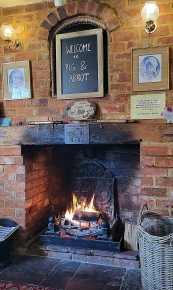
A warm welcome
Awaits the hungry visitor
At this rustic pub
Pig and Abbot pub, High St, Abington Pigotts, Royston SG8 0SD
THE BRITISH MUSEUM is chock-full of exciting exhibits. To view them all would take many months, if not years. During a recent visit in March 2014, we were heading through the museum on our way to view a special exhibition of drawings and prints by four post-WW2 German and Austrian artists when we passed a painting that caught my eye. The exhibition was fascinating but not as much as the painting we passed as we were heading towards it.

The colourful painting (oil on cloth) was created in Ethiopia sometime between 1940 and 1949. So, by the British Museum’s standards it is relatively modern. The picture depicts two large armies facing each other. On the left side of the image, we can see the Ethiopian forces, and they are facing the Italians on the right side. Between the two armies, there are several dead or injured combatants. And amongst this carnage, there are two armed men on horses – they are riding towards the Italians. The faces of the Ethiopians are not all the same in appearance, whereas there is almost no variation of the faces of their Italian opponents.
Although it was painted in the 1940s, the picture illustrates the Battle of Adwa, which raged on the 1st of March 1896. The Ethiopians defeated the Italians. By the end of the 19th century, most of Africa had been invaded and occupied by various European nations. The exceptions were Liberia and Ethiopia. In 1889, Italy, having occupied to coastal territory of Eritrea, signed a treaty with King Menelik of Shewa. It was signed in Italian and translated into Amharic. The Italian version made Ethiopia a protectorate of Italy – virtually, an Italian colony. However, the Amharic version read differently – it agreed that the Ethiopians could use the ‘good offices’ of the Italians in their relations with foreign powers, if they wished.
The Italians decided to go to war with the Ethiopians to enforce the Italian version of the treaty. The Battle of Adwa put an end to the treaty with the Italians, who then recognised Ethiopia as an independent state. This situation lasted until the 1930s when Mussolini decided to invade the country.
In the painting at the British Museum, Emperor Menelik II of Ethiopia is depicted in the top left corner in his royal crown. In the bottom left of the painting, seated on a horse, and surrounded by Ethiopian soldiers, sits Empress Taitu of Ethiopia. Look carefully, and you can see that this veiled lady is holding a large revolver.
The painting is in a short corridor, which also has exhibits relating to the Copts of Egypt. As the painting fascinated me so much, I took little notice of the exhibits near to it. So, as if one needs one, yet another reason to revisit the British Museum.
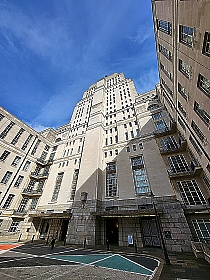
Senate House in London’s Bloomsbury was designed in the Art Deco style by Charles Holden (1875-1960), who also designed many buildings for the London Underground including quite a few stations on the Piccadilly Line. It was once, London’s tallest building.
Senate House was built between 1932 and 1937, and is the administrative centre of the University of London. Currently, there is a small exhibition about the planning of the building on the first floor.
GOLDERS HILL PARK lies halfway between Golders Green and Hampstead – both in north London. It occupies what used to be the extensive grounds of a former country house that was built in the 18th century and destroyed during WW2 (in 1940). Its fine landscaping was influenced by the great garden designer Humphry Repton (1752-1818). I have been visiting the park since my early childhood in the 1950s, when, if I remember correctly, my parents used to play tennis on the still existing tennis courts. The park has many attractions including a pond with an attractive stone bridge; a walled garden; many fine old trees; plenty of shrubs and flowers; a bandstand, which was certainly in use during my childhood; a good café-cum-restaurant; a wooded area; a stumpery; a deer enclosure; and a small zoo. The deer enclosure and the zoo were in existence when I was a young child. Today’s visitors can watch the deer and view animals such as wallabies; ring tailed lemurs; at least one kookaburra; donkeys; and a variety of exotic birds. The pond mentioned above is often visited by ducks.

Today (the 3rd of March 2024), we visited the park on a crisp, cold, sunny morning. The dew-covered lawns were full of blooming crocuses, and some of the bushes had burst into flower. Most of the trees, being deciduous, were devoid of leaves. By chance, I looked up at one of these leafless trees and saw a children’s kite caught up in its branches. Seeing this, my thoughts shifted 5000 miles from Golders Hill to Gujarat (in western India).
Wherever you go in Gujarat, you are likely to see kites caught up in the branches of trees. Unlike the kite I saw today, those in Gujarat are not the toys of small children, but part of a festival celebrated once a year, The Hindu festival, which celebrates the increase of day length a month after the winter solstice is known as ‘Uttarayan’ in Gujarat. The occasion is celebrated by kite flying. During this period of kite flying, riders of bicycles, motorcycles, and other two-wheelers face a real but, to the outsider, unusual hazard that could result in serious injury, if not death. I have described this festival and its hazards in some detail in my anthology of 101 vignettes of life and travel in India –“The Hitler Lock and Other Tales of India”.
Seeing the kite in Golders Hill Park reminded me of what I have seen in Gujarat during my several visits to that Indian state. However, although this year Uttarayan began on the 15th of January – not so long ago – I find it hard to believe that the kite I saw in the park was stranded in the tree during celebration of that festival.
[The book (& Kindle) is available from Amazon:
 yamey
yamey 