Art behind bars

FORT KOCHI IN Kerala was occupied by three European powers: first by Portugal, then ny the Netherlands, and then by the British until 1947. It was whilst the British were in charge that a small jail was built on what is now Tower Road. Next to a police station and close to a string of roadside seafood restaurants, there is a gate that leads into the Jail of the Freedom Struggle. This prison was built by the British at a forgotten date during the 19th century. One clue to its age is that some of its roof tiles can be dated to 1865. The prison has a row of eight cells, each equipped with a 6 foot long concrete bed.

The prison, which might have been used as a transit establishment for prisoners waiting to be taken elsewhere, is said to have held leading freedom fighters such as Mohammed Rehman, Accamma Cherian, and K J Herschel,  A K Gopalan, E M S Namboothiripad, and Abdurahiman Sahib. However, this is not known for certain. The prison, which had become disused and dilapidated, was restored in 2009, and opened as a museum.

In February 2023, we visited Fort Kochi to explore the 2022 Kochi Muziris Art Biennale. Unconnected with this major event, we visited an exhibition of artworks being displayed in the former prison. This included both paintings and sculptures. What made it an usual exhibition is that the exhibits are all contained within the cells behind strong iron doors with vertical bars. The doors that once prevented the prisoners from leaving the cells now prevent visitors from entering them.

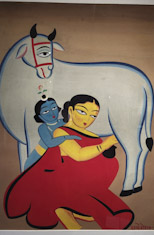
Women in art

SURVEYING THE REPRESENTATION of women by artists in a single exhibition might seem a daunting task, if not impossible. Yet, this is what the exhibition “Visible/Invisible” achieves successfully. Curated by Kamini Sawhney, Arnika Ahldag, Vaishnavi Kambadur, Riya Kumar and Arshad Hakim, this magnificent display of artworks can be viewed at the recently opened (in late February 2023) Museum of Art and Photography (‘MAP’) on Kasturba Road in Bangalore (Bengaluru). The exhibition, which is displayed in most of the rooms on one floor of MAP confines itself to works created by artists, both male and female, from the Indian subcontinent and its diaspora. However, this did not hinder the curators’ aim of demonstrating the female in art over the centuries.

The 130 artworks on show range in date of creation from the 10th century AD to the present. MAP’s website reveals that the various artworks:
“… are interwoven into four key sections based on narratives and counter-narratives: Goddess and Mortal, Sexuality and Desire, Power and Violence, and Struggle and Resistance. Each section presents how women’s lives have been portrayed, the spaces that they occupy and challenges that women have faced in the Indian subcontinent. The themes and ideas explored in Visible/Invisible hopes to encourage audience awareness of the history and role of women and gender in art.”
And the exhibition successfully raised my awareness of the multiple ways in which the lives of women have been portrayed by artists of both genders over the centuries,

The artworks include sculptures, paintings, photographs, film posters, textiles (some created by female artists and others woven in traditional patterns by craftswomen), and prints. Almost every exhibit was a joy to behold, What was particularly interesting were examples of artworks created within the last few decades that demonstrate how Indian women artist have taken control of the way they portray women and their lives, What the viewer sees is how women see themselves, which is a contrast to what has happened in earlier times when women have often been shown in the way that men have viewed their lives.

All in all, this exciting exhibition is compelling both visually and conceptually. The curators have expressed their ideas beautifully and powerfully, but not without considerable subtlety.

A masterful academic qualification

MANY INDIANS STRIVE to gain a Master of Business Administration (‘MBA’) degree. I can say little or nothing about the merits of this academic qualification, but know many friends who have been awarded it.

A long time ago, soon after we married in Bangalore, we attended an engagement party held for one of our friends. During the evening, the priest who would eventually officiate at the marriage gave a speech. He spoke in English with a strong South Indian accent. He introduced the couple as follows:
“These two dear people are well-matched. He has a yem bee yay. And she has a yem bee yay…”
Just in case you did not make sense of that, ‘yem bee yay’, it is the way that many Bangaloreans would pronounce ‘MBA ‘.

This distant memory of our friends’ engagement party was prompted by noticing a tea shop on Bangalore’s St Marks Road. It is named “MBA CHAI WALA”. Above the name are the words “India’s Most Iconic Chai Wala”. As we were in a hurry on our last day in Bangalore, we had neither the chance to sample a cup of tea nor to discover whether the place had anything to do with the MBA degree. On our next trip to Bangalore, I will investigate and get back to you.

A new museum on the map

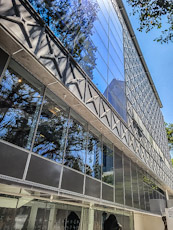
THE MUSEUM OF ART and Photography (‘MAP’) in central Bangalore has just opened (on the 18th of February 2023. Facing the Visvesvaraya Industrial & Technical Museum, MAP is housed in a brand new building with some attractive architectural features.

The edifice has five floors and a basement, which is home to an exorbitantly priced café, run by a company called Smoor. The ground floor has a reception area, a book/gift shop, and some gallery space. This is currently housing an exhibition of fascinating, attractive sculptures by LN Tallur. Some of the works of this contemporary artist allude to Hindu deities in a novel way.

The first floor is home to an auditorium, named after one of MAP’s major donors, Mazumdar-Shaw. Kiran Mazumdar-Shaw, a childhood friend of my wife, is a keen collector of art and has helped finance many other cultural establishments. On the same floor, there is a digital exhibition, whose subject matter can be chosen by the visitor.

The second floor is dedicated to offices and a library. Above this on the third floor, there is currently an exhibition of photographs by Jyoti Bhatt (born 1934), who began his artistic career in the famous art school in Baroda (Vadodara) in Gujarat. His works range from excellent straightforward documentary photography to highly creative artistic photography and collage work.

On the fourth floor, we enjoyed a beautiful exhibition called “Visible/Invisible”. Curated by Kamini Sawhney, Arnika Ahldag, Vaishnavi Kambadur, Riya Kumar and Arshad Hakim, this show explores the visual representation of women in artworks through the ages. Words alone can not do justice to the impactful nature of the display, but I will give you a rough idea of its range. In addition to paintings, modern and old, there are sculptures; photographs; tapestries,; traditional textiles; prints; and a video installation. Most of the artworks in this show were created by Indians or members if the Indian diaspora. The show successfully demonstrates how women have been portrayed over the centuries and how this has changed, especially more recently.

The fifth floor has a terrace from which there are some great views. There were some tables and chairs up there, but the café, if it exists, was not open.

Some years ago, we were in Bangalore when its branch of the National Gallery of Modern Art (NGMA) was opened in a restored palatial mansion near the Bangalore Golf Club. A beautifully designed annex was built next to the old building. When it was opened, I decided that it was a ‘must-see’ attraction in Bangalore. It remains so, but MAP in its newly constructed home will join NGMA amongst my suggestions of what should not be missed by visitors (and inhabitants) in Bangalore.

Three men and a trolley

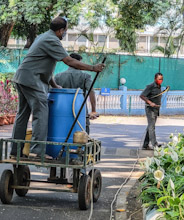
One man pulls the trolley. Another stands on the trolley, pulling a lever back and forth. The lever operates a pump that sends water from a tank (on the trolley) along a hosepipe to a third man, who is holding its end and spraying the flowers.

In India, there is no shortage of manpower and wages are not high. So, employing three men to do what a costly sprinkler system would do in Western Europe makes sense and gives employment to those who have families to feed.

Keeping on the safe side

IT IS ALWAYS WISE to ward off the Evil Eye. The Turks use characteristic amulets known as ‘nazar’. They are usually flat and almost circular with a design that resembles a stylised eye. This is now to seen on the homes of many people with no connection with Turkey. The Arabs and some Jewish people use an amulet, the ‘hamsa’, depicting a hand with five outstretched digits, to protect against the malevolent effects of the Evil Eye.

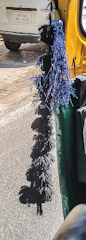
During road trips in India, I have often seen lorries (trucks) and other vehicles with thick, black, plaited tassels attached on the left and right sides of the driver’s cab. These things fly out sideways as the vehicles speed along.

One of our driver’s, the highly educated and informative Raheem, explained that these tassels are nazars. The drivers attach them to their vehicles to ward off the Evil Eye – an especially wise precaution on many roads in India.

During a recent (December 2022) visit to Panjim in Goa, my wife bought a couple of scarves from a female street vendor. The seller was so happy that my wife had bought from her that she immediately attached a bracelet on my ‘other half’s’ right wrist. The bracelet has a Turkish style Eye nazar and is made of black beads, which might well be designed also to protect against the Evil Eye.

Even more recently, I noticed that an autorickshaw, which we had hired in Bangalore, was adorned with two hefty black tassels just like those seen on lorries. I was struck by these because on the whole autorickshaws in the city do not have them.

I have one minor concern about vehicles whose drivers have attached things to ward off the Evil Eye. That is, I wonder whether the knowledge that their vehicles are equipped with such protection might drive more recklessly than those who do not put any faith in objects that might possibly have a protective value.

Unlocking a secret

WHEN SOMETHING GOES WRONG with a product in the UK, it is usually simpler and cheaper to discard it and buy a new one. In my experience of visiting India many times since 1994, I have discovered that there is often someone, who can mend what would normally be thrown away in the UK. Only recently, I spotted a poorly dressed man sitting by the side of MG Road (in Bangalore). He was painstakingly repairing what looked like totally decrepit umbrellas.

We use combination locks (‘number locks’ in Indian English) to secure our baggage whilst travelling. In December 2022 when we were in Panjim (Goa), we found one of ours, which would not open, even when using the correct combination. It looked as if it had become corroded.

Because we have great faith in the ingenuity of Indian craftsmen, we took it to a locksmith in Panjim. He was unwilling to work on our lock, and another lock seller advised us to throw it away. Undeterred, we carried the defective item to Bangalore.

In the Commercial Street district of Bangalore we approached a couple of locksmiths, who were unwilling to spend time on our lock. A third one accepted it, and said he would have a go. We told him the combination, and left him whilst he fiddled with the lock as if it were as enjoyable as a Rubik Cube. On the 2nd of January 2023, we set off on a long trip, returning to Bangalore on the 15th of February 2023.

A few days later, we visited the locksmith, who remembered us and fetched our lock from a glass-fronted cupboard. He had managed to open the lock, but could not remember which combination allowed him to unlock it. He said:
“You take it home and try a few numbers.”
He refused to accept any payment for his efforts.

Back at our accommodation, I tried what I remembered had been the lock’s combination, and discovered that the locksmith had rendered the once useless lock fully functional. As the tourist board slogan (Incredible!ndia) suggests, the country is truly incredible.

PS These locks are cheap to buy new in India. It was not to save money that we visited so many locksmiths, but it was for the enjoyment of the challenge to find someone to do the job that we spent the time going from one to another. Some people enjoy passing time playing games on their phones. We choose to have our timepass (Indian English) in other ways

Winston Churchill and a newspaper reading stand

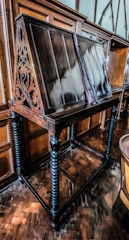
THERE IS A LOVELY old wooden newspaper reading stand is located in the formerly men only bar in the Bangalore Club. It bears the insignia “US” at one end, the S being back to front. Before about 1947, the club was the United Services Club.

Winston Churchill, who was never too fond of India, was briefly a member of the Club (in the late 1890s) , and incurred a small, but never paid debt there. I wonder whether the reading stand is old enough to have been used by Churchill.