Setting the table at a grand house in Berkshire

BASILDON PARK IS an 18th century country house in Berkshire. Managed by the National Trust, it is open to the public. The dinner table in its grand dining room was set as it would have been in Victorian times, so a guide explained to us.

The centre of each place setting is a soup bowl resting on a plate. To the left of it, there are four forks, and to its right there are three knives and a spoon. Above the plates, there is a dessert spoon and fork. Working from left to right, the forks are for seafood (often oysters), fish fork, starter fork, and then closest to the plates, main course fork. To right of the plates, working from right to left, there is a soup spoon, a fish knife, a starter knife, and the closest to the plates, a main course knife. Each place setting had four drinking glasses: sherry, white wine or champagne, red wine, and port. We were told that there was no cutlery for cheese because in the 19th century, cheese was not served at formal dinners. What I have described was typical of a Victorian table setting in a grand country house such as Basildon Park.

In the early 1990s, we were invited for lunch at a friend’s house. Each of the table settings was almost as elaborate as that which I have described above. I looked at the table, and expected that we were about to be served a multi-course feast. The first course was pasta. I was seated so that I was able to see the kitchen. I noticed that there was a light on inside the glass-fronted oven, but it was empty. When our host offered second helpings of the pasta, everyone, doubtless expecting that much more food would be arriving, declined the offer. I was the exception, and said I would love some more. That is because, having seen the empty oven, I was more realistic about the future course of the meal. I was served my second helping, and then a bowl of salad was passed around. After that, the meal was over. However, we had only used a small proportion of the cutlery laid out at each place setting. To this day, I have been puzzling over the elaborate place settings when only one course was served. Seeing the table at Basildon Park reminded me of this occasion.

West of London but not an attraction for tourists

OVER THE YEARS. We have made many visits to Slough, a town in Berkshire, just west of Heathrow Airport. It would usually not figure on tourists’ lists of places that they feel they must see. And there is little in Slough that would entice people to visit the place. Yet, since the early 1970s, we have visited there often.

My PhD supervisor, Robert Harkness, and his wife, Margaret, lived in the countryside not far from Slough. They used to travel between Slough and Paddington stations when they were travelling to and from University College London (‘UCL’). While I was studying with them, they became my close friends. Until they died in the early years of this century, I, and then later my wife and our daughter, often spent weekends in their large Victorian home, Margaret, who played the violin, was involved with the Slough Philharmonic Orchestra (Slough Philharmonic Society). For many years, she not only played in the second violin section but also, she was the orchestra’s honorary accountant. We were often invited to the orchestra’s concerts, many of which were held in concert halls in Slough. A few of the concerts were held in Slough’s ‘posh’ neighbour Eton.

Because Robert and Margaret lived near Slough and we visited them often, we hired a storage unit (‘godown’) in Slough. We could combine visiting our friends with making trips to add things to our storage place. Sadly, Robert and Margaret are now no more than fond memories. However, our storage locker remains in Slough. So, visits to the town continue.

Recently, the company that stores our stuff moved from the edge of Slough to a place closer to the centre. It has a good car park and is close to a wonderful range of food shops. Slough has many inhabitants whose ancestors hail from the Indian Subcontinent and a sizeable Polish population. On the outskirts of Slough, there is at least one large Polish sporting/country club. Near our newly located storage place, there are two well-stocked Polish food supermarkets, which sell many products including things that would not be found at the nearby halal food shops and eateries. In addition to food shops catering for people of Indian and Pakistani origins, there are gift shops where decorated Hindu idols can be bought. There is also a jewellery store whose gold and diamond-studded items are just like what I have seen in India.

Drab as Slough undoubtedly is, the ethnic mix of its inhabitants add a welcome touch of colour and exoticism to the place. Having said that, I am not sure that I would recommend going there unless you have a reason to do so.

Houses in England built with money made in India

DURING A VISIT TO Basildon Park near Reading, I spotted a display of photographs of “Nabob houses in the Indian Style”. A ‘nabob’ was someone who was conspicuously rich, having made his fortune in India. These were buildings constructed by people who had made their fortunes while working in India. for the British East India Company. Some, but not all of these, buildings incorporate architectural features derived from the architectural styles that the British found when they visited India.

Late 18th century Basildon Park, which was built by a Brit who had made his money in India, is a Nabob’s house, but without any features borrowed from the Indian subcontinent. It is a Palladian-style building. It was one of about 30 houses built in Berkshire for the nouveau-riche British ‘nabobs’, who had enriched themselves in India.

Art works by Graham Sutherland for Coventry Cathedral on display in a country house in Berkshire

ON THE FOURTEENTH of November 1940, Coventry’s cathedral was badly damaged by bombs dropped from aircraft of the German Luftwaffe. After WW2, a new, modernist cathedral was constructed next to the shell of the damaged one. Designed by Basil Spence, the new cathedral was built between 1956 and 1962. Visitors to this magnificent replacement cathedral can hardly miss seeing the enormous tapestry that hangs at the eastern end of the church. Depicting “Christ in Glory in the Tetramorph”, it was the creation of the artist Graham Sutherland (1903-1980). I have seen this work and admired it on several occasions, but little did I expect to find a connection with it when visiting a National Trust property not far from Reading – Basildon Park.

Set in lovely grounds surrounded by rolling hills that lead down to the rows of trees growing near the Thames, the house at Basildon Park was largely completed in the Palladian style by 1783. After a series of owners, including the military during the two World Wars, it was bought by Lord and Lady Iliffe (later known as ‘the 2nd Baron and Lady Iliffe’) in 1953. They restored the house, and filled it with artworks they collected. A great patron of the arts, Lord Iliffe was a friend of the artist Graham Sutherland. He and his wife were able to purchase many of the studies that Sutherland made when planning the great tapestry that hangs behind the high altar in Coventry Cathedral. Some of these were donated to the Herbert Museum in Coventry, and several of them are on display in a room on the ground floor of Basildon Park. The studies exhibited in Basildon Park demonstrate Sutherland’s great artistic talents. Each of them, although sketches of details to be included in the final tapestry, is itself a lovely work of art.

Sutherland’s studies are (for me) the highlights of the Iliffe’s artworks on show in their former home – they gave it to the National Trust in 1978. In addition to these fine works, a few others caught my attention. In one room on the first floor, there are four sketches of places in India by William Daniell (1769-1837). It is quite appropriate to find these in Basildon Park, which was originally built by Frances Sykes, who made his fortune in the British East India Company. Another, more recent, painting that interested me was a portrait of Lady Iliffe painted in the 1940s by Frank Salisbury (1874-1962). A society portrait painter, he interested me not because of his art, but because he owned a spectacular neo-Tudor mansion, Sarum Chase, on West Heath Road in London’s Hampstead. I came across him when I was doing research for my book about Hampstead.

For some reason, despite visiting many National Trust properties around it, today (the 19th of May 2024) was the first time we went to see Basildon Park. The house is worth seeing – its rooms are spacious and well-lit, and the artworks are, as I hope I have explained, of great interest. Also, it stands in beautiful grounds – an idyllic English countryside.

A bridge across the River Thames and a personal loss

JUST UNDER A YEAR AGO, we visited Cookham in Berkshire, a small town on the River Thames, with our friend ‘H’. I first met H and her widowed mother in about 1975 at the home of some dear friends, my PhD supervisor and his wife. My wife and I used to see H about once a year until about 1999 at the home of our mutual friends. Then, we lost touch. A few years ago, H and I reconnected via social media and we kept promising that we should meet up again. It was only in about July 2020 during a relaxation of the covid19 regulations that we finally met face to face. Our meeting was in Cookham, where we enjoyed an exhibition at the small Stanley Spencer Art Gallery. After having coffee together – it was the first time that H had been to drink coffee outside her home since mid-March, we walked through the rain to Cookham Bridge and crossed it, admiring the lovely views of the Thames.

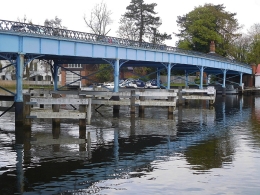
Cookham Bridge

The roadway on Cookham Bridge is so narrow that traffic must be regulated by signals at both ends of the crossing. These signals allow traffic to flow in single file in one direction for a few minutes, and then in the other. While we walked across the bridge, I noted its lovely decorative iron railings, which can be seen in a painting, “Swan Upping at Cookham” (www.tate.org.uk/art/artworks/spencer-swan-upping-at-cookham-t00525), painted in 1915-19 by Cookham’s famous artist Stanley Spencer (1891-1959).

It was not until April 2021 that we revisited Cookham with some friends and walked along the Thames Path, which passes under Cookham Bridge. It was then that I noticed what we had not seen with H: the interesting Victorian ironwork structure supporting the crossing. A sign screwed onto one of the pontic’s metal panels reads: “Pease, Hutchinson, & Co. 1867. Engineers & iron Manufacturers. Skerne Iron Works. Darlington”. The Skerne Iron Works were:

“…run by a Quaker partnership trading as Pease, Hutchinson and Ledward. The Skerne company built its reputation upon plates for ships, boilers, and particularly bridge building, and at its peak employed 1,000 workers.” (www.gracesguide.co.uk/Pease,_Hutchinson_and_Co)

The iron bridge, supported by pairs of slender iron beams (filled with concrete) with cross-bracing rods, was opened in 1867 to replace an earlier wooden bridge that was opened in 1840. The existing bridge was when it was constructed the cheapest bridge across the Thames for its size (https://en.wikipedia.org/wiki/Cookham_Bridge). Until 1947, it was a privately owned bridge for which users needed to pay a toll. It was owned by the Cookham Bridge Company. In 1947, Berkshire County Council bought the bridge, and the toll was abolished. An octagonal house still stands next to the bridge across the river from Cookham. It is the early 19th century toll house built in 1839 by a Mr Freebody (https://heritageportal.buckinghamshire.gov.uk/Monument/MBC19500).

At the Cookham side of the bridge stands The Ferry pub, close to where there used to be a ferry across the river. This old, half-timbered inn, now a mid-priced eatery, has a lovely terrace by the river, from which the bridge can be viewed as well as the waterways leading downstream to Cookham weir and the lock that bypasses it.

Recently, a close relative of H contacted me. He had found my details in the address book in H’s computer. It came as a shock to learn from him that H had passed away suddenly a few weeks ago. When we had last seen her late last year, she was looking hale and hearty. Apparently, one Saturday, she began feeling extremely unwell and on the following day she expired. We were terribly upset because we got on so well with her and were planning outings with her once the covid19 socialising restrictions were eased. They were relaxed but not in time for us to be able to see H again. As we drove through Cookham on our most recent visit, we kept seeing places that reminded us of our meeting with her last summer.

Our friend with whom we crossed Cookham Bridge last year has crossed from this world into another, where I hope that she will be reunited with her parents, our mutual friends, who introduced her to me and then later to my wife, as well as Sir Geoffrey Howe and Elspeth, his wife, with whom she worked happily for many years. H will be sorely missed.