
I FOUND A SHELF of rather tatty looking second-hand books for sale outside an antique shop in Great Dunmow (Essex). Each was being sold for 50 pence. Among them, I picked up a copy of a slender volume by Christopher Sidgwick with the title “A Fortnight in Yugoslavia”. Having visited the former Yugoslavia numerous times between 1973 and 1990, I was curious to see what was written about it when the guidebook was published in July 1955. This was only about 7 years after the country detached itself from Soviet Russian domination. In relation to this, the author wrote:
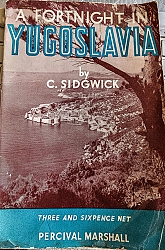
“Since the war ended, the Yugoslavs have I think been acting in perfect character. They are not a people … to be impressed by other people’s size. The war brought them victory on the side of Russia … and they set out with immense courage to re-form their way of living on copybook communist lines. But before long, of course, they found that the printed dogma of Marx did not turn out at all as they were led to expect: and instead of cooking the argument, as other communists have frequently done … their honest Yugoslav common sense came conveniently to hand: when Tito, in Moscow, realised that he was now to toe the line as a satellite country, to live in virtual starvation, while the country’s raw materials were sent off to Russia … he said to Stalin: ‘Rubbish! In that case, we might as well still be under the Habsburgs!’”
Under Tito’s leadership, Yugoslavia went its own distinct way. In his text, Sidgwick asked:
“Is the country a dictatorship? In the sense that it is nothing like Hitlerite Germany, nihilist at root, the answer is ‘no’. In the sense that it is a one-party country, with the state controlling the police, the radio, the press, and education, the answer must of course be ‘yes’.”
Further on, he added:
“… it is clear that broader and broader opinion, differing from the party line, is being permitted and even encouraged.”
And this was as early as 1955. By the time I began visiting Yugoslavia, liberal and alternative voices were becoming quite prevalent.
Although Sidgwick did not discourage the individual traveller, he believed that there was much to be said in favour of organised group travel. Visas were then required, and could be obtained for 11 shillings (55 p) at the Yugoslav Consular Department in Kensington (48 Phillimore Gardens). In 1955, £1 sterling would buy you about 840 Yugoslav dinars, and on entering the country, “…any note exceeding 100 dinars in value is liable to be confiscated from you, so don’t buy higher-value notes even at a good rate of exchange: it’s black money.”
Amongst things you were advised to pack in 1955 were: sunglasses; toilet soap (“cost up to 7/6 (37.5p) a tablet”); half a pound of tea; ear-plugs (“invaluable while travelling or while waiting for the dance-band to close down for the night”); pipe tobacco; an inflatable cushion; and a universal bath plug.
Regarding food in Yugoslavia, Sidgwick mentioned that pancakes were good, and:
“… they have no disgusting dishes – frog, snails, and so on – and local national dishes are always worth trying. Ražniči is veal on toothpicks. Ćevapčići is meat and little mince rissoles. Djuvec is a Serbian edition of Irish stew, highly seasoned with paprikas.”
Well, I have eaten frog in Yugoslavia and I had friends who harvested snails for gastronomic reasons. Sidgwick added:
“Meal-service is almost always slow by our standards, largely, I think because Yugoslavs themselves are in the habit of taking their time over food, enjoying it as a social occasion. In busy restaurants it is unwise to expect to get through dinner in less than ninety minutes.”
I have always eaten well in Yugoslavia, and with my many Yugoslav friends every meal was a joyous social occasion.
The guidebook dedicates most of its travel advice to Croatia and the Dalmatian coast (pages 32 to 51). The rest of the country was described between pages 51 and 62. In the short section on Serbia (pages 58 to 60), Sidgwick wrote:
“To describe Serbia in a page or two is like describing London on a cigarette card: insulting to the inhabitants”
He did it to keep the book short, and I suspect, because in the 1950s few British travellers to Yugoslavia ventured much further inland than the coastal regions.
Who was Christopher Sidgwick? He lived from 1915 until 1978. He wrote several guidebooks to places such as Germany and Greece. His “German Journey” was published in 1936 and his guide to Greece in 1974. “German Journey” was one of several books written by British writers who visited Nazi Germany to find out about Hitler’s regime and the effect it was having on the country. Unlike others, who judged the country mainly by what had been shown them in Berlin and reported favourably on the regime, Sidgwick wanted to avoid “… ‘thinking that what is seen in the capital […] is representative of that country’” (quoted from “Britain and the Weimar Republic” by Colin Storer). This is probably why he reported on a visit to Dachau’s concentration camp before WW2.
Sidgwick also wrote “Manhunt in Dalmatia”, published in 1959. Amongst his many other books, he wrote “Whirlpools on the Danube”, which was published by in 1937. This was reviewed in the journal of the Royal Institute of International Affairs by no less a historian than Carlile Aylmer Macartney (1895-1978), a specialist in the history and politics of Central Europe. I guess from this that Sidgwick must have been a significant traveller and observer in his time.
Finally, although I paid only 50 pence (in Great Dunmow) for this book about a country that exists no longer, its cheapest price on bookfinder.com is 20 times as much. My own recollections of the country and its people are published in my book “Scrabble with Slivovitz”, which is available from lulu.com, bookdepository.com, and Amazon (https://www.amazon.co.uk/Scrabble-Slivovitz-Once-upon-Yugoslavia/dp/1291457593).



 yamey
yamey 