Memories of childhood at a car show in Bangalore

MY MOTHER WAS the driver in our family. Having been injured in a bad accident during the 1930s, she was an overly cautious driver.

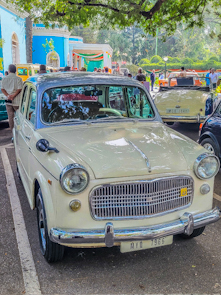
Fiat 1100

All of our family cars were Fiats. My mother believed that because there were many hills and mountains in Italy, where Fiats are made, these cars must be reliable and ‘strong’. We had a Fiat 600, then an 1100 (millecento), and then finally, a 1200.

Seeing several Fiat 1100s at a vintage car show held at the Bangalore Club (in Bangalore/Bengaluru) jogged my memories of my mother, the 1960s and 1970s, and my childhood motoring experiences.

You can read more about my late mother and her unusual attitude to motoring here:
https://www.amazon.co.uk/REMEMBERING-HELEN-MY-MOTHER-ARTIST/dp/B0DKCZ7J7X/

A festival of art incarcerated in a penitentiary in Bangalore (Bengaluru)

MANY ART WORKS are ‘imprisoned’ in museums, galleries,  and private collections.  Today, 25 January 2026, we visited a collection of art ‘incarcerated’ in a prison.


The prison is, in fact, a former prison. It is what was once the grounds of Bangalore’s Central Jail.  After it became disused, it was converted into a public  park in 2008: Freedom Park. This contains many of the former prison’s buildings, which have been restored to create a fascinating museum within a leafy park.


Freedom Park was the site of the 2026 BLR Hubba, which we visited today. The Hubba is a 10-day annual art festival held in Bangalore. Each year it is held at one of the city’s historic landmarks. This year at the former jail.

Encompassing many kinds of art including  for example,  sculpture, painting, music, theatre, and poetry, this festival is  well-attended and vibrant.


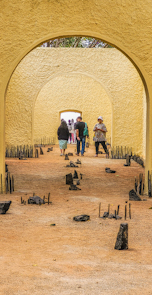
At Freedom Park, the Hubba’s artwork and events were scattered all over the site of the former jail including within the cell blocks and at the place where hangings were carried out.


On the Sunday that we visited the Hubba, there was a competent jazz band playing and a crowd of visitors. Everyone seemed to be enjoying the art and themselves.

 In comparison with the rather disappointing 2025/26 Kochi Muziris Biennale,  which we attended in early January, the Hubba was wonderful: a well curated, excitingly appealing festival of art. Although the Hubba contained far fewer things than the much larger biennale, it produced a far more impressive impact on us than what we saw in Kochi

Views from the top of a building in Bangalore

Just before leaving Bangalore (for Bombay), my friend Mansoor Ali took me to see the BLR Design Centre. It is located on the top floors of a building on the corner of Church Street and Museum Road, and is a fine example of good modern design.

According to the centre’s website, the institution is:
“A collaborative workspace focussed on transforming urban living environments through architectural partnerships, cultural dialogue and design-driven solutions.”

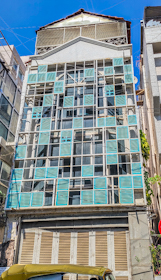
The views from the centre’s roof terrace are wonderful. What particularly intrigued me were the reflections of buildings that can be seen on the glasswork of the Sobha Mall, which is across the street from the BLR Design Centre.

An artist who expanded the art of playing cards

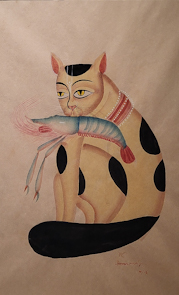
GANJIFA IS A traditional art of decorating playing-cards. Ganjifa cards originated in Persia and spread to India. They can be rectangular but are often circular. Traditionally,  the Indian cards were decorated with scenes from the Ramayana.


By Raghupati Bhat

In the 1980s, Indian artist Raghupati Bhat revived the Mysore tradition of ganjifa painting. The Victoria and Albert Museum in London has a set of his ganjifa cards. Images of these are projected on a wall of Kaash Space,  a gallery in Bangalore’s Berlie Street.  They form part of a superb exhibition of later works by Bhat, all of which are developments of his earlier ganjifa artworks.


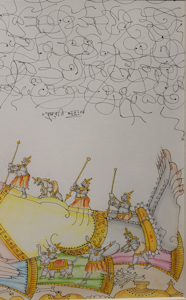
Raghupati Bhat’s drawings and paintings depict  mythological stories from the Ramayana.  All of them are exquisitely executed and filled with minute details. A set of four painted miniatures are painted with dyes made from natural products, using single hairs from paint brushes to achieve the great detailing within them. In many of his line drawings, Bhat included delicate, beautiful ‘doodles’ in addition to the pictures’ main subjects. All in all, the exhibition includes a fine selection of the artist’s intricately executed creative interpretations of episodes and  characters in the Ramayana.


In addition to Bhat’s works, the exhibition includes three other artists’ works: some photographs, some paintings, and two beautiful inlaid wood panels. These other artists’ works were inspired by those of Raghupati Bhat.


This wonderful exhibition continues until 21 December 2025, and should not be missed if you happen to be in Bangalore.

Bricks and design at an art school in Bangalore (Bengaluru)

THE HUMBLE BRICK is a much used material in the construction of many kinds of building. It can be used unimaginatively, as it often is, or imaginatively to create visually intriguing textures.


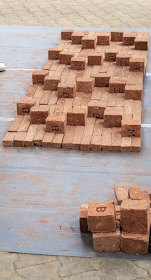
During a visit to one of Bangalore’s art schools,  the Chitrakala Parishath,  we watched architecture students participating in an outdoor “brick techtonics” workshop. This was being supervised by the noted Indonesian architect Andy Rahman.


We watched small groups of students arranging bricks so as to make interesting patterns, following plans drawn up by Andy Rahman. As they worked, Mr Rahman moved from group to group, discussing with them what they were doing.


All around the area where the workshop was taking place, labourers were working noisily on a construction site where new buildings were being built for the art school. Thus, the architects working on realising theoretical bricklaying design ideas were surrounded by real life applications of established building practices.


I hope that when the budding architecture students begin designing ‘for real’ that they will recall the interesting brickwork creativity that Mr Rahman was introducing to them. For he was showing them that even the humble brick can become a component in a visually fascinating design.

Problems with identifying gender in London and Bangalore (Bengaluru)

WHEN OUR DAUGHTER was about two years old and able to walk unassisted, she often wore overalls (jump suits), rather than girlish frocks. One day we were walking in London’s Kensington Gardens when we passed a couple of elderly ladies.  One of them looked at our child, and said to us: “What a cute little boy you have”

We replied:

“Actuually, she is our daughter.”

To which one of the ladies said to her friend: “it’s so difficult to tell one from the other these days.”


The former Men’s Bar at the Bangalore Club

Some months later, we were in India at the Bangalore Club (in Bangalore). In those days, the late 1990s, the club had a Men’s Bar, to which only men were admitted. Its wood panelled walls bear hunting trophies and archaic weapons.

One day, I was having a drink in that bar with my father-in-law, when our daughter arrived in the adjoining room with my wife. Excited to see us, our daughter,  dressed in her overalls, dashed into the Men’s Bar. An elderly gentleman, seeing a child in the bar, said to our daughter:

“You are too young to come in, young man. When you are 21, you will be welcome here.”

To which, my wife standing close to the entrance, said: “She’s our daughter.”

The gentleman then responded: “In that case, you will never be able to enter our bar”.

 How wrong he was.

Sometime during the early twenty-first century, the rules changed: now both men and women can use what had been the Men’s Bar.  Now, this bar has been renamed: it is simply The Bar.

Today, almost 28 years later, nobody would have any difficulty identifying our daughter as a young lady.

Getting fixed in Bangalore (Bengaluru), India

KALIM REPAIRS JEWELLERY in Jewellers Street in the Commercial Street district of Bangalore (Bengaluru). He sits on the pavement on the shaded east side of the street in the morning and in the afternoon,  he moves to the west side to keep out of the sun. He can mend almost every kind of jewellery. When restringing necklaces, he uses both his hands and his feet, to keep the thread taut.


Kalim at work

Kalim is one of many people we visit in the Commercial Street area to get repairs done. These craftsmen include tailors, a bag repairer, dyers, darners, watch repairers, locksmiths, and jewellers. We have known all of them for years.


The great thing about these skilled workers is that they will skilfully repair almost anything. On the UK,  people like this are few and far between.


You can read about these wonderful people in and around Commercial Street in my book “88 DAYS IN INDIA: A JOURNEY OF MEMORY AND DISCOVERY”.

The book is available from Amazon https://www.amazon.co.uk/88-DAYS-INDIA-JOURNEY-DISCOVERY/dp/B0FKTFBFM2/

A Hindu temple that incorporates a banyan tree

ON THE CAMPUS of Bangalore’s Chitrakala Parishath art college, there is a small Hindu mandir, the Ganapathi Temple. Dedicated in 1984 and built by Mandelia Parmarth Rosh, it contains an effigy of Ganesh and not much else.

What makes this small religious building both fascinating and charming is that its construction incorporates branches of a large, living banyan tree. The tree is growing through part of the temple.

Man, nature, hills, and mountains in the Western Ghats of India

WE VISITED BANGALORE’S Chitrakala Parishath, an art school, on the last day of an exhibition called “Hidden Gems of the Western Ghats”. We were alerted to it by a good friend, Ajay Ghatage, who posted something about it on Facebook.


The Western Ghats are a line of hills and mountains that separate the Deccan Plateau from the western coastal strip of India, the shore of the Arabian Sea. The ghats are in the most part forested.


The exhibition included sculptures, many of them beautiful stone carvings, paintings, and a few ‘installations’. Each work expresses its creator’s reaction to the nature and its exploitation (and/or despoliation) by mankind. And the majority of the artworks on display did this well, beautifully, and often highly imaginatively.


Amongst the installations, there was one by Shivanand Shyagoti that particularly attracted my attention. It consisted of a tree trunk into which hatchets had been stuck. On the wooden handles of each of these choppers, there were line drawings of the woodland creatures whose habitat would be disturbed by deforestation.


The other works on display were at least as imaginative as the one described above. What was impressive about the majority of the artworks was that although they often conveyed messages about the fragility of the natural environments of the Western Ghats, they did it subtly, creatively, and,  most importantly, beautifully.