Magnetism, Mecca, and an artist from Arabia

IT IS THE AMBITION of many Muslims to make a pilgrimage to Mecca. Part of this involves visiting a sacred black stone, the Ka’abah, which is cuboidal in shape. One part of the annual pilgrimage, the Haj, involves pilgrims circling the Ka’abah seven times clockwise – a ceremony known as the ‘Tawaf’.

The artist and physician Ahmed Mater, who was born in Saudi Arabia in 1979, has created artworks based on the pattern created by the pilgrims circling the Ka’abah, as seen from above. Some of these are aerial photographs, but others are based on magnetism. Those who have studied physics even at an elementary level will be familiar with the demonstration of the shapes of magnetic fields that can be achieved by scattering iron filings near a magnet on a sheet of paper. The magnet arranges the filings in a pattern that corresponds to the shape of its magnetic force field.

What Ahmed Mater did was to create a cubic magnet in the shape of the Ka’abah. Then he scattered iron filings around it on a sheet of paper. The filings then arranged themselves according to the magnetic field of the cuboid magnet. Next, the artist gave the magnetic miniature Ka’abah a twist. This caused the filings to rearrange themselves into swirls, which when viewed from above, resemble the pilgrims encircling the sacred stone in Mecca.

This simple artwork demonstrates not only the fascination of magnetism, but also the spiritual magnetism of the Ka’abah, which draws Muslims to Mecca. In discussing this work of art, Tim Mackintosh-Smith makes an interesting point:

“But Ahmed Mater’s magnets and that larger, Meccan lodestone of pilgrimage can also draw us to things beyond the scale of human existence, and in two directions at once – out to the macrocosmic, and in to the subatomic. In the swirl of Ahmed’s magnetized particles and the orbitings of the Mecca pilgrims are intimations of the whirl of planets, the gyre of galaxies.” (www.ahmedmater.com/essays/magnetism-tim-mackintosh-smith).

The artworks based on magnetism and the Tawaf, are just a small selection of the intriguing, beautiful works by Ahmed Mater, which are currently being exhibited at Christies in King Street (London) until the 22nd of August 2024.

A Nigerian artist near London’s Edgware Road

OTOBONG NKANGA WAS born in Kano (Nigeria) in 1974. Her artistic training was carried out in Ile Ife (Nigeria), then in Paris (France). Now, she lives and works in Antwerp (Belgium). I doubt that I would have come across her work had we not visited the Lisson Gallery near London’s Edgware Road, where some of her artworks are on display until the 3rd of August 2024.

The exhibition contains sculptures, two attractive tapestries, and several framed works on paper. The sculptures, which are pleasant enough, are made with materials including clay, glass, and fibres. A leaflet with a text written by the artist describes how she is portraying her connections with nature. Without this text, I would have been hard pressed to realise what she described.

What impressed me most in the exhibition were Nkanga’s delicately executed framed works on paper. These, more than the other exhibits, convinced me that she is a highly talented artist. As I compared them to the sculptural works, I was remined of my thoughts about the artist Damien Hirst. At first, I thought that his works were interesting although often gimmicky, and did not display his deepest artistic feelings. I changed my mind about his inherent talents when, some years ago, I saw an exhibition of his paintings at the White Cube Gallery in Bermondsey. Great artists like Picasso and David Hockney, who are known for their experimental exploration of artistic expression, were, in their younger days, highly skilled exponents of what might be considered ‘traditional’ composition style. This was what I felt about the framed works on paper by Nkanga – although she clearly enjoys experimenting with a variety of media (including with recorded sounds – a soundscape, which is included in the exhibition), she is clearly able to express herself beautifully in the traditional art of sketching and painting.

Had we enough wall space and sufficient spare cash, I would have happily bought several of Nkanga’s lovely works on paper.

A COMMANDER OF THE BRITISH EMPIRE AND THE ARTISTIC INTERPRETATION OF COLONISATION

THE ARTIST YINKA SHONIBARE was awarded the prestigious CBE in 2019. In case you do not know what these three letters stand for, it is ‘Commander of the British Empire’ – not that Britain has much of, if any, empire left to boast of. For much of its long existence, places in the British Empire witnessed many injustices and inhumanities. This was especially true before the abolition of the slave trade in the early 19th century. Yinka Shonibare, who was born in London in 1962 and brought up between that city and Lagos in Nigeria, uses his artistic skills to explore Britain’s lengthy history of imperialism imaginatively and creatively. Even without knowing that he does this, his art works are in themselves visually exciting and fascinating to the viewer. The pieces on display until the 1st of September 2024 at the Serpentine South gallery in Kensington Gardens are well worth seeing both for their inherent beauty and for the way that Shonibare expresses his interpretation of Britain’s colonial past and its legacy.

For more information about the exhibition, please visit: www.serpentinegalleries.org/whats-on/yinka-shonibare-cbe-suspended-states/

A colourful tunnel with paintings beneath Waterloo Station

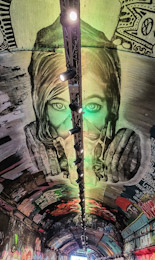
LEAKE STREET RUNS beneath the platforms and tracks of London’s Waterloo Station. It is 300 yards long and its walls and ceiling are covered with colourful graffiti created with cans of paint spray. The artwork creation in this street that runs in a tunnel was inaugurated in May 2008 during the Cans Festival, which was organised by the artist known as Banksy.

Unlike many public places in London, painting the walls in Leake Street is legal. Walking along this highly decorated street is a magnificent experience, which you can repeat often because the images on the wall are frequently changed. If you are lucky, you can watch the artists in action.

Subversion at the Serpentine art gallery: ways with words

THE ORIGINAL SERPENTINE Gallery in London’s Kensington Gardens is housed in a former tea pavilion that was built in 1934. It began to be used as a contemporary art exhibition space in 1970. Since then, it has been showing modern and contemporary artworks in a series of temporary exhibitions. I have been visiting this gallery and its newer branch, Serpentine North, regularly since the 1990s (the North branch opened in 2013). Almost without exception, the art displayed in the Serpentine galleries has been both exciting and adventurous – sometimes quite challenging. The latest exhibition, which is on until the 17th of March 2024 in the original gallery, is of artworks by the American (USA) artist Barbara Kruger, who was born in Newark (NJ) in 1945.

Kruger’s art is not purely visual. It is designed to convey ideas that challenge the viewer to question commonly held contemporary beliefs in an eye-catching, often witty way. The exhibition, “Thinking of You. I mean Me. I mean You” consists of 12 art installations that reference or parody everyday things such as advertising, magazine illustration, video art, social media, the Internet, and other media that bombard us on a daily basis. Each of them present messages that subvert political ideas, the moral code, and the meanings of words. Kruger makes much use of video techniques. Several of the exhibits have words projected sequentially to make up sentences. Often, the words change on the screen to alter the perceived meaning of the text being projected. However, her art is not simply all about words and their meanings in different textual environments. The words are harmoniously accompanied by intriguing visual images, often continuously changing.

Although the exhibition is about words and their usage and varying meanings, words alone cannot describe this exhibition adequately. Therefore, if you can, it is worth taking a look at this interesting – nay, challenging – show. Having viewed the show, I was heartened to discover this artist from America who is perceptive enough to see where her country is heading and brave enough to criticise the political direction in which it appears to be moving. After seeing her exhibition, I would hazard a guess that she will not be voting for Mr Trump.

Blowing in Bermondsey

IT IS UNNECESSARY to travel from London to Venice to see masterpieces of glass bowing. You need only make your way to Bermondsey Street in south London where you will find London Glassblowing. It is both a gallery and workshop set up by Peter Layton, who is now over 80 years old and still creating beautiful artefacts. Layton was born in Prague and grew up in England. After studying ceramics at London’s Central School of Art and Design, he taught ceramics at the University of Iowa in the USA. It was there that he discovered glass blowing and took to it. When he returned to England in 1976, he established his London Glassblowing in London. It has been located at its present address for about 15 years. Before that, he was in Leather Yard. Apart from creating works of art in glass, he also teaches and mentors other glass blowers.

Whenever we visit Bermondsey Street, we make a point of visiting Layton’s establishment. Always the works on display are both beautiful and highly inventive. Occasionally, if we reach the place at the right time, we can watch glass blowers at work in the invariably hot workshop behind the gallery. Unlike the workshops we have visited on the island of Murano (near Venice), the works produced in Bermondsey Street – both sculptural and functional – are tastefully contemporary and often avant-garde.

Anselm Kiefer at the White Cube in Bermondsey

TODAY, I MADE MY second visit to the Anselm Kiefer exhibition, which is on at the Bermondsey White Cube gallery until the 20th of August 2023. I was pleased to visit it again because after my first visit, I left it feeling oppressed and somewhat depressed. This might be what the artist (born at the end of WW2 in Germany) intended when he created the extraordinary series of scenes of dereliction and decay on show in Bermondsey. My second visit (on the 15th of August 2023) left me with a slightly more favourable impression, but my opinion that the artist has depicted an image of a world of confusion, conflict, and decay, remains unchanged.

The works, which are distributed in several rooms and the central corridor of the gallery, are, so I read in an information sheet, Kiefer’s reactions to, and representation of, a novel by James Joyce – “Finnegan’s Wake”. The artist has written short quotations from the book on many of the items that together make up the amazing art installations. As I have not read the book, I cannot comment on the appropriateness of what he has created.

In one room of the gallery, there are mainly huge paintings, which I found attractive. On close examination, one can see that the paint has been applied to that it is far from flat. The three-dimensional surfaces create interesting illusions, which change according to from where you view the pictures.

Another room has a huge pile of sand littered with discarded, corroded supermarket trolleys – an impressive but sad sight. In yet another room, most of the floor is covered with barbed wire and huge pieces of concrete – the ruins of a large building. As a friend of ours said, it looked as if it had been imported straight from a bombsite in Ukraine.

Would I recommend visiting this exhibition? It is certainly inappropriate for people who suffer from claustrophobia or depression. However, if you are of an adventurous frame of mind, do head for this show before it ends.

Barbie and Bhabhi in Coventry

WE HAD TICKETS to watch the new “Barbie” film yesterday (the 7th of August 2023) at 5.50 pm at the Gate Cinema in Notting Hill Gate. We watched the advertisements and then the trailers for forthcoming films. Halfway through the trailers, emergency lights were switched on, the soundtrack disappeared, and the pictures being projected shrunk in size. There had been a power failure, and everyone was asked to leave after having been given complimentary tickets for a future screening of any film. We left without watching “Barbie”.

The next day, we travelled to Coventry to see the cathedral and the Herbert Art Gallery & Museum. At the Herbert, we saw several excellently curated exhibitions. They were far better than many we have seen in London in recent months. They were imaginatively and intelligently conceived, as well as being superbly displayed.

One of these shows was called “Divided Selves”. In simple terms, it consist of mostly recent works of art by various artists, which deal with conflicts between different groups of people all over the world.

One of the exhibits is by an artist and filmmaker Hetain Patel. Part of the artwork are three sets of plastic dolls. Each doll is contained in a cardboard box with a transparent plastic window, just like the containers in which dolls are often sold. One pair of dolls was labelled ‘Bhai anmonthshi’, Bhabhi means sister-in- law in Hindustani and Bhai means brother.

We missed Barbie yesterday, but seeing Bhabhi today almost made up for not seeing the film.

Artists as artworks in London’s East End

BRICK LANE IN east London has been home to immigrants from various parts of the world. Currently, many of the people who live and work in the area are of Bangladeshi heritage. In the last few years, the area has attracted the ‘trendy’ set, whose interests are mainly in the attractions north of the former Truman Brewery. Some years ago, my friend David, visiting from Atlanta (Georgia), and I paid a visit to Brick Lane and were surprised to find a bit of ‘Ye Olde England’ almost hidden amongst the predominantly Asian businesses. It was the The Pride of Spitalfields London – a real old-fashioned ‘boozer’. Stepping into it, it was difficult to imagine you were not in a country pub, but in the heart of east London. It is on Heneage Street next door to what had once been part of a brewery.

In 2015, the Trustees of the Gilbert & George Centre, a charity, acquired the building next door to the pub. On the 1st of April this year (2023), the converted buildings were opened to the public. They have been beautifully transformed by the SIRS Architects practice and they house artworks by the duo Gilbert and George (‘G&G’), who both trained at London’s St Martins School of Art. According to the G&G website (gilbertandgeorgecentre.org):

“The property was purchased with the idea to create a permanent home for works of the artist and to enrich London’s cultural offering thus further.”

G&G produce often very colourful works, all of which include the pair of creators within their images. As artists, they are also the subjects of their creations – they are almost always depicted in all their works. Their works deal imaginatively with a wide variety of things that we all face in our daily lives – some of them often considered too distasteful to be discussed or displayed. But G&G boldly bring them to our notice in a dramatic way.  As Michael Bracewell, a Trustee, wrote on the website:

“Gilbert & George maintain an ideological opposition to formalistic art theory and the reference of art to the history or theory of art. Asserting instead the power of emotion and actuality, their art addresses subjects that are culturally excluded, neglected or disowned. Their art questions social taboos and morality. By looking at difficult subjects the art and vision of Gilbert & George is intended to ‘de-shock’ rather than seeking to shock. Its aim is not the simple task of ‘shocking’ a viewer, but the difficult task of interrogating a subject and themselves … Unchanging, they have the appearance and countenance of modern sober-minded, anonymous citizens, who have embarked on the astral journey of their own Divine Comedy: purgatory, Heaven and Hell as they find it and perceive it in our world, in nature and in themselves.”

Whether or not you like the creations of G&G, the new Centre is well worth visiting, even if only to see the fine design of the buildings containing it. If the art is all too much for you, you can pop into the pub next door and seek liquid relief. And if you loved the place, which we did, you can visit the boozer to celebrate the arrival of this superb new addition to the London art scene.