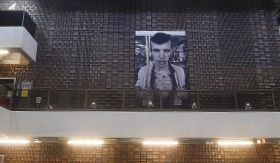
Art beneath your feet

MOST VISITORS TO London’s Tate Britain and National Gallery tend to look at the paintings hanging on the walls and sculptures on pedestals. Fewer people look down to see what they are walking on. The floors of the main entrance portico of the National Gallery and of Gallery II at the Tate Britain are well worth examining.

National Gallery, London (UK)

The mosaics on these floors were created by the Russian artist Boris Vasilyevich Anrep (1883-1969). Born in St Petersburg, he studied law at the Imperial School of Jurisprudence in that city, graduating in 1905. In 1908, he abandoned law and went to Paris (France) to study art. Between 1910 and 1911, he studied at the Edinburgh School of Art. While in France, Boris met several British artists and intellectuals, many of them members of the Bloomsbury Set. His fascination with mosaics began in about 1904 after seeing the early Christian mosaics in Ravenna (Italy). In 1917, Boris settled in England, where he created many of his mosaics.

The floor of Gallery II at what is now the Tate Britain, but was formerly ‘The Tate Gallery’, was damaged by bombing during a Zeppelin raid in WW1. In 1921, Anrep was commissioned to make a mosaic floor for this gallery. By 1923, it was ready. The dramatic-looking creation consists of scenes representing William Blakes “Proverbs”. Each of the vignettes in the octagonal gallery, which used to house pictures by Blake, includes one of Blake’s proverbs. They are surrounded by a depiction of the flames of Hell.

The floors of the Portico at the national contain a much greater area of mosaics than that of the gallery in Tate Britain. Anrep created the mosaics between 1926 and 1952. Some of them are becoming worn out after having been walked on for so many years since the were put in place. A website (https://artuk.org/discover/artists/anrep-boris-18831969) explained that the mosaics in the National Gallery consist of:

“… four floors on and around the main staircase, executed between 1926 and 1952. The subjects are ‘The Awakening of the Muses’, ‘The Modern Virtues’, ‘The Labours of Life’, and ‘The Pleasures of Life’; portraits of many well-known contemporaries are incorporated in them, for example the philosopher Bertrand Russell representing Lucidity and the film actress Greta Garbo as Melpomene, the Muse of Tragedy.”

Sir Winston Churchill is also depicted, as are other well-known personalities (for details, see: https://mikepitts.wordpress.com/2016/06/10/lookdown-boris-anrep/).

The attractive, intriguing mosaics at both the National and the Tate Britain are far less famous than many of the works to which most visitors make a beeline. However, Anrep’s mosaics should not be overlooked. In fact, I believe they are worth lingering over at least as long as one might when viewing, say, a Rembrandt in the National, or a Turner in the Tate.

Incidentally, after Anrep died, his body was cremated at Golders Green Crematorium, a place which I have described in my book “Beneath a Wide Sky: Hampstead and its Environs”.
Hepworth and Mondrian in Salisbury

IN THE 1930s, both the sculptor Barbara Hepworth (1903-1975) and the painter Piet Mondrian (1872-1944) lived in Hampstead (north London). Hepworth and her two successive husbands lived and worked in the Mall Studios near Parkhill Road. Mondrian lived at 60 Parkhill Road. According to one of Hepworth’s biographers, Eleanor Clayton, writing in “Barbara Hepworth. Art and Life”:

“The beginnings of a friendship between Hepworth and Mondrian can be seen in her letters to Nicholson at the time: ‘so glad Mondrian said nice things about me & work. Goodness U did learn a LOT.’”

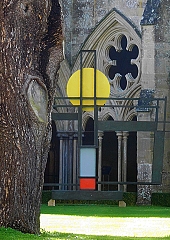
Visitors to the cloisters of Salisbury Cathedral can see an abstract sculpture at the southeast corner of the grassy space enclosed by them. At first sight, it looks like a sculptural version of a painting that might have been created by Mondrian. It is a sculpture by Barbara Hepworth called “Construction (Crucifixion)”. This bronze artwork was created in 1966, and then donated by the artist to the Cathedral in 1969. It is according to a notice by the sculpture:

“… Hepworth’s response to Christ’s Crucifixion …”

The interpretation of the piece’s symbolism is far from simple, as a website text (https://www.salisbury.anglican.org/news/the-crucifixion) explained:

“What we see are 3 verticals linked by a single horizontal bar, and by 2 other horizontals at different heights.

A large circle, attached to the intersection of the horizontal and vertical lines, is painted citrus yellow on one side and blue on the other. At the bottom of the central vertical, we see red on its own beneath the blue side of the circle, and red and white beneath the yellow. On the yellow side, a metal hoop encircles the point of crossing.

Hepworth wrote that she found it ‘very serene and quiet’, but that doesn’t have to guide what we make of this piece. We could see the yellow circle as the sun, the blue circle as the moon, the red paint as blood, the 2 verticals on either side as the crosses of the 2 men crucified with Jesus.

Or we could contemplate its hardness, weight, size (12ft tall and 2-and-a-half tons) and stark simplicity. We could seek to find meaning here, or we could stand before it and try to imagine the experience of meaningless horror and sheer emptiness which brutality of any kind must impose on those who witness it. For us, it need not seem ‘serene and quiet’ as for Hepworth. On the contrary this cross might confront us with the tragic lack of meaning which has so often afflicted humanity since the cross of Christ was first set up.”

Whatever its symbolism, Hepworth’s piece is attractive and looks good surrounded by the gothic architecture of the cloisters. Above all, its appearance immediately brings to mind thoughts about thw works of art created by Mondrian. One website (https://artistscollectingsociety.org/news/barbara-hepworth-sculpture-returns-salisbury-cathedral-permanent-display/) describes the piece as “Construction (Crucifixion): Homage to Mondrian” and then continued as follows:

“The sculpture is thought to explore the duality of Jesus Christ in its use of geometric symbols and features bold colours borrowed from the palette of ACS member Piet Mondrian, referenced in the artwork title.”

I was very pleased to see this work once again in March 2022, soon after publishing my book about Hampstead, past and present, in which I have included a substantial chapter about the modern artists who lived and worked in the area between the two World Wars. There is a good chance that Hepworth’s encounters with Mondrian and his work whilst they were both in Hampstead is reflected in the appearance of this abstract Crucifix, which stands in the cloisters at Salisbury.

PS My book, “Beneath a Wide Sky: Hampstead and its Environs” is available from Amazon (https://www.amazon.co.uk/dp/B09R2WRK92).

A magnet for modernists: Hampstead

YESTERDAY, 22nd February 2022, we saw an exhibition at the Pace Gallery in central London’s Hanover Square. The gallery stands facing a conventional sculptural depiction of William Pitt the Younger (1759-1806), created in bronze by Sir Francis Chantrey (1781-1841). I have been reading a great deal about Pitt in a wonderful, recently published biography of King George III by Andrew Roberts. What is being shown in the Pace gallery until the 12th of March 2022 is far from purely representational, as the exhibition’s title, “Creating Abstraction”, suggests.

By Barbara Hepworth

The exhibition contains works by seven female artists: Carla Accardi (1924-2014), Leonor Antunes (b. 1972), Yto Barrada (b. 1971), Saloua Raouda Choucair (1916-2017), Kim Lim (1936-1997), Louise Nevelson (1899-1988), and Barbara Hepworth (1903-1975). Most of these names were new to me apart from Nevelson and Hepworth. The latter interests me greatly not only because one of her sculptures is near the gallery on the southeast corner of John Lewis’s Oxford Street department store, but also because for a while she lived and worked in an area that fascinates me: Hampstead.

There are several of Hepworth’s works on display at Pace. One of them, “Two Forms”, was created in 1934. By then, she had been living and working in Hampstead for about seven years. For the first few years, she was living with her first husband, the sculptor John Skeaping, and then after 1931 with her second, the painter Ben Nicolson. In 1939, she left Hampstead.

Hepworth was not the only ‘modern artist’ living in Hampstead in the 1930s. I have described the active and highly productive artistic scene in the area in my new book “Beneath a Wide Sky: Hampstead and its Environs”. I have also explained why it was that artists like Hepworth, her contemporary Henry Moore, and many others were attracted to Hampstead between the two World Wars. Their reasons for congregating in the area differed somewhat from those of earlier artists, such as Constable and Romney, who were attracted to the place many years before. Read my book to discover why Hampstead easily rivalled Montmartre in Paris as a ‘mecca’ for artistic activity. The book is available as a paperback and a Kindle e-book from Amazon: https://www.amazon.co.uk/dp/B09R2WRK92
A great art gallery near the sea

UNTIL WE WENT to Southend (in Essex) in February 2022, it was not the first place to spring to mind when thinking about art galleries. To my mind, Southend was mainly associated with its spectacular pier, which is over one mile in length. Now, to the pier I will add the Beecroft Art Gallery to the good reasons for visiting Southend.

The gallery has been housed in a distinctive 20th century building on Victoria Avenue since 2014. Its current home was formerly Southend’s Central Library. The edifice was designed by Borough Architect R Horwell and opened in 1974. Prior to moving there, the gallery was housed in a large Edwardian house on Station Road in nearby Westcliffe-on-Sea.

The permanent collection of art in the gallery was donated to the town in 1952 by a local collector, a solicitor called Walter Beecroft, who worked in Leigh-on-Sea. His paintings ranged from the 17th century to the late 19th, and a few from the 20th. A selection of these was on display in the first-floor gallery of the Beecroft when we visited. Newer additions, mainly on long-term loan, to the gallery’s collection were hung alongside examples donated by Beecroft.

We went to the Beecroft to see a temporary exhibition of 20th century artists from London’s East End. It was excellently curated. I will write about this in the future. There were also temporary exhibitions of Pakistani wedding outfits and feminism during the covid19 lockdown. The basement of the Beecroft is currently dedicated to the history of jazz.

All in all, the Beecroft Gallery is well worth visiting. The quality of the exhibitions we saw there puts to shame a few of the better-known art galleries in London.

A NEW book about Hampstead in north London

AVAILABLE FROM AMAZON WEBSITES:

e.g.: https://www.amazon.co.uk/dp/B09R2WRK92

Hampstead is one of the highest places in London. There, the heavens are vast
and wide. Beneath this expanse of sky is an area with an eventful past and a
vibrant present. This book takes a fresh look at the locality and shows that
Hampstead is richly imbued with historical memories and has been home to a
multitude of fascinating and noteworthy people. Many books have been written
about Hampstead. Doubtless, there will be more. This one is different. It looks
at Hampstead from unusual as well as familiar viewpoints and gives the reader
a richer appreciation of what makes the place both delightful and intriguing.
This volume explores a wide variety of subjects, familiar and obscure, as well as
some which have never been described in other books about the locality. Here
is a fresh and at times quirky look at this place on a hill, one of London’s
treasures: a district, which is familiar to many people, yet full of surprises.
Although the bulk of this book is about Hampstead, there are also sections
describing some of its environs.

By reading this book, you can find out why John Constable, Samuel Johnson, Boy George, Mohammed Ali Jinnah, Mahatma Gandhi, Peter Sellers, Henry Moore, Maxim Litvinov, General de Gaulle, Stanley Spencer, Thomas Masaryk, Lee Miller, Agatha Christie, Jim Henson, Ian Flemming, Ernő Goldfinger, and many others, both famous and familiar, were all connected with Hampstead.

The book has several sections:
1. a brief survey of Hampstead’s general history and geography.
2. an introduction to Hampstead’s main thoroughfares with some
reminiscences of the area as it was during my youth.
3. the largest section of the book is a collection of chapters about
various aspects of Hampstead’s past and present. Recently, a friend of mine
bemoaned the fact that Hampstead High Street and Heath Street are lined with
branches of shops and cafés that can be found all over London. He is right. So,
if you wish to capture the true character of Hampstead, you need to stray into
the side streets and explore, which is what I hope this book will stimulate you to
do.
4. The last few sections of the book deal with some places of interest near to
Hampstead: Primrose Hill, North End, Go
lders Green, and Highgate.

TABLE OF CONTENTS

PREFACE … 7
INTRODUCTION: OH NO, NOT IN HAMPSTEAD … 7
SOME GEOGRAPHY AND HISTORY … 13
HEATH AND HIGH STREETS WITH SOME MEMORIES … 25
SATURDAY STROLLS … 25
PERRINS LANE, THE EVERYMAN, AND LOUIS … 34
DISCOVERING HAMPSTEAD … 41
A HOUSE ON HEATH STREET AND THE KIT CAT CLUB … 41
A CHURCH ON HEATH STREET … 45
FLASK WALK AND THE HAMPSTEAD SPA … 46
MORE ABOUT THE SPA … 56
THE VALE OF HEALTH … 60
POETS AND THE VALE OF HEALTH … 70
FRENCH CONNECTIONS AND ST MARYS ON HOLLY WALK … 76
ARTISTS IN HAMPSTEAD: ROMNEY, CONSTABLE, AND OTHERS 84
MODERN ARTISTS AND THE ISOKON … 95
BOLSHEVISM AND HEATH STREET … 109
A SINGER AND A PHILOSOPHER ON BRANCH HILL … 114
JUDGES WALK … 118
WHITESTONE POND … 122
EAST HEATH ROAD AND SOUTH END GREEN … 126
SIR HARRY AND ROSSLYN HILL … 137
PILGRIMS LANE AND MORE ON ROSSLYN HILL … 143
NEW END, CHOLERA, AND GROVE PLACE … 150
FITZJOHNS AVENUE AND SWISS COTTAGE … 155
SHEPHERDS WELL … 171
CHURCH ROW … 174
GRACIE FIELDS, FROGNAL WAY, AND FROGNAL … 179
WEST HEATH ROAD AND PLATTS LANE … 187
WEST HAMPSTEAD … 193
SHOOT UP HILL … 198
PRIMROSE HILL … 201
NORTH END AND GOLDERS GREEN … 211
NORTH END AND GOLDERS HILL PARK … 211
POETS AND GOLDERS GREEN … 228
LIFE AND DEATH ON HOOP LANE … 232
HIGHGATE … 241
CODA … 273
SOME BOOKS CONSULTED … 275
ACKNOWLEDGEMENTS … 278
INDEX … 279

Great exhibition at Kew Gardens

Well worth seeing: a visually and philosophically fascinating exhibition by Zadok Ben-David at Kew Gardens until 27th of March 2022. See more at:

https://www.kew.org/kew-gardens/whats-on/zadok-ben-david-natural-reserve.

The artist uses delicate models of the natural world to illustrate that life simultaneously has its dark and light aspects. This innovative exhibition has to be seen to be believed. It makes for an intriguing accompaniment to the lovely botanical gardens.

Noguchi on show in London

AT FIRST GLANCE, the lower floor exhibition space at the Barbican art gallery in London resembles the lighting department of a furniture store such as Habitat. It is full of lighting units with Japanese-style paper and bamboo shades. After a moment, you will notice that these lighting units are not run-of-the-mill illuminations; they are interestingly shaped works of art lit up from within. These lamps are part of an exhibition of the artistic creations of Isamu Noguchi (1904-1988). Born in Los Angeles, he was the son of a Japanese father and an Irish American mother. The first 13 years of his life were spent in Japan, where he began learning carpentry whilst helping his mother building their family house. From these early skills, it was not long before he embarked on what was to become a highly productive creative career, making works from a wide variety of materials from wood and stone to metals and plastics and … you name it.

Noguchi studied sculpture at the Leonardo da Vinci Art School in New York City. In 1927, he was given a grant to travel to Paris. It was there that he was apprenticed to the Romanian-born sculptor Constantin Brâncuși (1856-1957), who introduced him to abstraction. After learning much from the great sculptor in Paris, Noguchi abandoned pure abstraction and moved towards depicting the living world. However, his experiences working with Brâncuși influenced his artistic output for the rest of his life. After Paris, Noguchi travelled extensively, learning about techniques and philosophies, especially Chinese and Japanese. In 1929, he first met the architect and inventor Richard Buckminster Fuller (1895-1983), whose ideas about science and technology chimed with his. In the exhibition, there is a shiny chrome-plated bronze bust he made of Buckminster Fuller in 1929. There are also a couple of models he created in collaboration with Buckminster Fuller.  Noguchi’s interest in science was not only expressed in sculptures but also in stage settings for ballet performances choreographed by Ruth Page and for performances by Martha Graham.

During WW2, although it was not required for him to enter one of the camps where the Americans ‘cooped up’ potential Japanese enemy aliens – Japanese who lived in the USA – Noguchi volunteered to be confined in a camp in Arizona. By doing so, his aim was to create an arts programme that would ease the lives of those confined in the camp. The barren landscape surrounding his camp proved to be yet another influence on his creative output.

Amongst the many exhibits in the Barbican’s show, there are, in addition to the lighting units, several pieces of furniture designed by Noguchi. One of these is a triangular plate glass tabletop supported by two interlocking timber supports. I have seen this elegant item for sale in upmarket furniture shops, but until I saw the exhibition, I had no idea it had been designed by Noguchi as long ago as 1944. It is still being made today.  The wonderful variety of lighting sculptures, which at first reminded me of lampshades that were trendy in students’ rooms in the 1970s, are examples of ‘Akari’. Noguchi began creating them in the early 1950s, and despite their fragile nature, they are still in good condition now. One of the gallery invigilators told us that the translucent paper used to construct these lamps is made from mulberry tree bark. Known as ‘Washi’, this handmade paper can also be made from the bark of some other tree species.

As with other exhibitions at the Barbican gallery, the artworks are well-displayed and beautifully lit. If you go to this exhibition, you should not miss the video film in which Noguchi talks about his life and art very eloquently. And while you are watching it, you can sit on stools and a bench Noguchi designed. Prior to visiting this show, I had heard of Noguchi and seen a few of his works. The exhibition, which continues to the 23rd of January 2022, has truly opened my eyes to what a magnificent artist he was.

Pictures at an exhibition

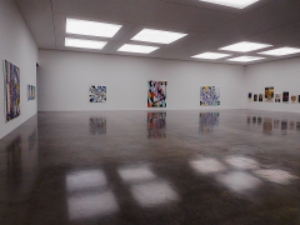
Overlooked by The Shard,the White Cube Gallery in Bermondsey Street, near to London Bridge Station, provides wonderful expanses of well-lit exhibition space. One can explore works of contemporary art in an uncluttered, airy environment. This is so much better than many traditional exhibition spaces such as in 19th century galleries, or even in the relatively recently constructed Tate Modern. Visiting the White Cube in Bermondsey is a worthwhile experience not only because of its wonderful spaciousness but also because it often displays exciting works of art. And when you have had your fill of art, there are plenty of places in Bermondsey Street where you can find a wide variety of food and drink.

Here is some information about the building from https://www.dezeen.com/2011/10/14/white-cube-bermondsey-by-casper-mueller-kneer/:

144–152 Bermondsey Street is an existing warehouse and office building, set back from Bermondsey Street via an entrance yard. The building dates from the 1970s and has a modernist industrial appearance, with long horizontal window bands and a simple cubic shape. The outer walls of the building are constructed from dark brown engineering brick, with a concrete and steel framed internal structure…

The new gallery spaces were inserted as self-supporting freestanding volumes, barely touching the envelope of the existing building.The powerfloated concrete floors can take loadings up to 100 KN/m2. Walls and ceilings are constructed as steel cages allowing art to be installed at almost any point within the space. Structural exclusion zones allow the punching through of walls at selected locations to allow entry points into the exhibition spaces to be coordinated with the ever-changing displays.”

From Madras to Kensington

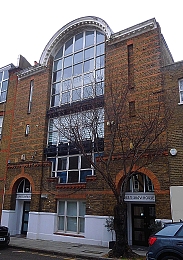
CAMPDEN STREET IN Kensington is a short thoroughfare running between Kensington Church Street and Campden Hill Road. On it, there is a distinctive building called Byam Shaw House. Until 1990, this edifice with its large centrally placed, north facing window was the Byam Shaw School of Art, which opened in 1910. Named at first as ‘Byam Shaw and Vicat Cole School of Art’, after its founders, Rex Vicat Cole (1870-1940) and John Liston Byam Shaw (1872-1919), it soon became known as the Byam Shaw school.

John Liston Byam Shaw is also known as ‘Byam Shaw’. He was born in British India, in Madras (now ‘Chennai’), where his father was registrar of the High Court at Madras. In 1878, the Shaws moved back to England, where they lived in Kensington. At an early age, he showed artistic promise and at the advice of the artist John Everett Millais (1829-1896), he entered an art school in London’s St Johns Wood. As he grew older, Byam’s works attracted less interest and he turned to teaching to earn a living. In 1910, he and Cole founded the art school in Campden Street. Sadly, Byam Shaw died during the great influenza epidemic that followed WW1.

The school in Campden Street has produced several significant artists including Winifred Nicholson (first wife of Ben Nicholson), Bernard Dunstan, Yinka Shonibare, Mona Hatoum, as well as stage designers, stained-glass makers, and actors. The inventor James Dyson also studied there. In 1990, the school moved to larger premises in Archway, and in 2003, the school was absorbed into the Central Saint Martins College of Arts and Design. Byam Shaw would have been pleased to know that his school produced such fine alumni.  Guy Burch, who studied at the school between 1981 and 1984, wrote:

“The innovative independent Art School founded in the early 1900s, Byam Shaw had an open studio policy that suited my inability to fit into categories marked ‘painter’ or ‘sculptor’. Most art schools at the time made you choose one or other with cross-media working tending to be discouraged. Their studios allowed you to move between them. I was in the ‘Image Studio’, and worked on collage, painting and mixed media installations.” (http://www.guyburch.co.uk/?p=4358)

I feel it is a shame that the building in Campden Street, which has now become a block of flats, is without any notice commemorating its former use.