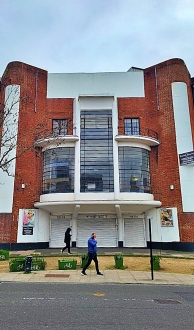
A modern style
It was so several years back
Art Deco it is

A modern style
It was so several years back
Art Deco it is
OUR FRIEND GEETHA Mehra has her art gallery on 2nd Pasta Lane, near Colaba Causeway in Bombay. On one of our visits in November 2025, she had organised an exhibition, “Behind the Façade”, which consisted of works by the contemporary artist Teja Gavankar. The artefacts on display were almost architectural, some using brickwork and others containing other materials, As the gallery’s website explained:
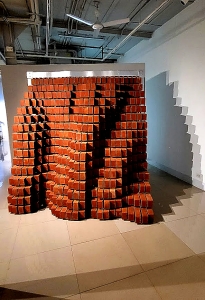
“Gavankar is interested in dual states, in forms that appear rigid, where solidity gives way to softness and movement. A dialogue between natural and built environments unfolds, stemming from the artist’s experience of living in Mumbai’s suburbs. Gavankar observes the contours of the city during her commute, seeing organic forms emerge in its industrial undertones.”
Whereas architects make structures which are functional, Gavanka created architectural structures that were artworks designed to challenge the viewers perceptions of space. Seeing the brickwork sculptures and the patterned brick façade she designed for the gallery reminded me of the brick workshop we saw in progress at the Chitrakala Parishad in Bangalore a few days earlier (see: https://adam-yamey-writes.com/2025/11/20/bricks-and-design-at-an-art-school-in-bangalore-bengaluru/).
ALTHOUGH WE HAVE visited Ahmedabad (in Gujarat) at least 4 times, we had never been to the hectically busy Manek Chowk area in daylight, which is why we had never noticed a fine building until today, when we went to the area in the morning. After dark, the area is so busy that one needs to be wary of the numerous autorickshaws and motorised two-wheelers whizzing around to notice the architecture of the buildings overlooking the frenetic bazaar.

The building we noticed this morning (1 December 2025) has a facade with some neo-classical detailing and jharokhas (projecting windows). Overall, this edifice, which is far more elegant than its neighbours, has a European appearance. Above its main entrance, you can see the following words (in English): “The Ahmedabad Share and Stock Brokers Association”.
According to a website (https://www.knocksense.com/ahmedabad/exploring-the-history-of-ahmedabad-stock-exchange-a-symbol-of-entrepreneurship-since-1894), until 1996 :
“… Ahmedabad Stock Exchange functioned in a building constructed in 1919 when the Bombay Share and Stock Brokers association collaborated with the Ahmedabad Share and Stock Brokers association. And that heritage style building served as ASE’s home before it was shifted to Kamdhenu complex in 1996.”
The Kamdhenu Complex is in the outskirts of Ahmedabad.
Following the establishment of the Bombay Stock Exchange in 1875, the Ahmedabad Stock Exchange (‘ASE’) was set up in 1894. At that time and until well after Independence, Gujarat was part of the former Bombay Presidency. According to an article in Wikipedia, at first:
“… stock exchange functioned under the framework of the Bombay Securities Contracts Act, 1925. Following the passage of The Securities Contract Regulations Act, 1956 the Gujarat Share & Stock Exchange, Indian Share and General Exchange Association and Bombay Share and Stock Exchange, Share and Stock Brokers Association merged with the Ahmedabad Share and Stock Brokers Association and gave rise to ASE.”
The ASE was India’s second oldest stock exchange, the oldest being in Bombay. As already noted, the ASE functioned in the elegant, now disused edifice we saw at Manek Chowk today.

I love Art Deco
Much of it to see in Bombay
I wonder why
THE HUMBLE BRICK is a much used material in the construction of many kinds of building. It can be used unimaginatively, as it often is, or imaginatively to create visually intriguing textures.
During a visit to one of Bangalore’s art schools, the Chitrakala Parishath, we watched architecture students participating in an outdoor “brick techtonics” workshop. This was being supervised by the noted Indonesian architect Andy Rahman.
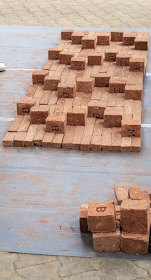
We watched small groups of students arranging bricks so as to make interesting patterns, following plans drawn up by Andy Rahman. As they worked, Mr Rahman moved from group to group, discussing with them what they were doing.
All around the area where the workshop was taking place, labourers were working noisily on a construction site where new buildings were being built for the art school. Thus, the architects working on realising theoretical bricklaying design ideas were surrounded by real life applications of established building practices.
I hope that when the budding architecture students begin designing ‘for real’ that they will recall the interesting brickwork creativity that Mr Rahman was introducing to them. For he was showing them that even the humble brick can become a component in a visually fascinating design.
EXAMPLES OF THE ART DECO style that was popular during the era between the two World Wars can be found all over London. In the newer part of Hampstead Garden Suburb (north London), there are a few examples of this style.
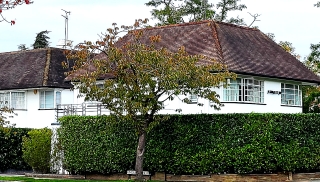
Kingsley Close, which leads west from Kingsley Way, contains only houses built in the Art Deco style.
You can read more about these and other examples of this style in Hampstead Garden Suburb in my book about the Suburb, which is available from Amazon: https://www.amazon.co.uk/GOLDERS-GREEN-HAMPSTEAD-GARDEN-SUBURB/dp/B0BHG873FB/
THREE MILES NORTH of Basingstoke, there is a magnificent stately home, The Vyne, which is now owned by the National Trust. Set in fine grounds alongside a long, thin lake, this edifice is a wonderful mixture of architectural styles and features.

The present house began its life as a Tudor mansion built between 1500 and 1510 for William Sandys, 1st Baron Sandys, Lord Chamberlain to King Henry VIII. It remained a possession of the Sandys family for most of the time from when it was constructed until 1653, when it was sold to Chaloner Chute (died 1659), who was a lawyer and the Speaker of the House of Commons during the Commonwealth. Because he felt that the Vyne was too big for his requirements, he had much, but not all, of the Tudor mansion demolished. Fortunately, several of the beautiful rooms with elaborate wood panelling were saved, along with the Tudor chapel.
The rest of what remained of the original building was converted to a version of the Palladian Style. This included adding a neo-classical portico to the north side of the hose, facing the lake. In the eighteenth century, one of Chaloner’s descendants, John Chute, influenced by his friend Horace Walpole, redesigned the interior of the chapel, adding trompe l’oeil features and also installed a very spectacular staircase in the house. The staircase is in the neo-classical style. It must have impressed those who visited the Chutes, and it still dazzles the visitor today. Although there are many fine artefacts to be seen in the house, this staircase was, for me, the ‘star of the show’.
When John Chute died childless, The Vyne was inherited by his cousin Thomas Lobb, who then changed his surname to Chute. After that, few changes were made to the house. The house remained in the Chute family until 1958 when Charles Chute bequeathed the estate to the National Trust.
ALTHOUGH THE MAIN attraction of Dulwich Picture Gallery is the collection of works of art by famous painters, there is a small but fascinating feature that should not be missed. And that is the mausoleum. This small chamber houses the sarcophagi containing the remains of the gallery’s founders, Sir Peter Francis Bourgeois, Noel Desenfans, and his wife Margaret.

Like the rest of the gallery, the mausoleum was designed by Sir John Soane (1753-1837). Working in an age before electric lighting was available, he was a master of maximising the use of natural illumination to get light into his buildings. The galleries at Dulwich are provided with clear glass ceilings that are sufficient to provide adequate lighting of the artworks. However, this is now supplemented with electric lighting. Light enters the mausoleum through glass windows at the top of it. Instead of plain glass, he used amber coloured glass. The light passing through this gives the mausoleum a warm glow, making it feel a spiritual place.
The mausoleum was badly damaged during an air raid in WW2. However, it was restored and is said to look exactly as it did before the war. Although it was designed as a final resting place, it is occasionally used to house art installations and films about temporary exhibitions being held in the galleries.
VISITORS TO LONDON (and residents of the city) should not miss visiting Kenwood House, which is in north London between Hampstead and Highgate. Not only does it contain a magnificent collection of Old Master paintings that can be compared favourably with what can be seen in Britain’s finest public art galleries, but it also has a beautiful library.

In my book about Hampstead, “Beneath a Wide Sky: Hampstead and its Environs”, I wrote:
“The first house to stand on the site of the present one was built in brick by John Bill (1576-1630), printer to King James I. He bought the Kenwood Estate (which was known as ‘Caen Wood’) in 1616. After several changes in ownership, the Estate was bought in about 1747 by a former Prime Minister and King George III’s close associate, John Stuart, third Earl of Bute (1713-1792). In 1754, Bute sold the property to the lawyer and law-reformer William Murray (1705-1793), who became the First Earl of Mansfield, and was Lord Chief Justice of the King’s Bench from 1756 to 1788. In 1778, he was a supporter of the Roman Catholic Relief Bill that led to the violent protests described above. During the First Earl’s stay in the House, he employed the architect Robert Adam (1728-1792) to make improvements.”
The library was one of the improvements that Robert Adam created at Kenwood. The library or Great Room was constructed between 1764 and 1774. It was intended both as a reception room and a library, which might explain why so little of this large room’s wall space is occupied by bookshelves. Most of the wall space is occupied by mirrors and windows. Lord Mansfield would have been used to host guests, hold dinners, and for music performances.
The library’s architecture is based on that of Roman public bath houses. John Summerson (1904-1992), the architectural historian, wrote of its design in his “The Iveagh Bequest, Kenwood : a short account of its history and architecture” (published 1988):
“This is one of the finest Adam rooms in existence … The shape of the room, with its curved ceiling leading into two apsidal ends, on the chords of which are pairs of columns, is one which Adam used for several of his most stately interiors. Apart from the plan, a great innovation for England was the flat arched ceiling which Adam frankly describes as ‘extremely beautiful …”
Although the library is the finest of Adam’s creations at Kenwood, there are others that deserve to be admired. These include the orangery, the entrance hall with its magnificent stucco ceiling, and the library’s anteroom. In this piece I have concentrated on the interior of Kenwood House, but a visit to this wonderful place should be accompanied by a stroll in the place’s superb, landscaped gardens.
VICTORIA MIRO WAS born in London in 1945, Her parents, who were keen on cultural pursuits, saved their money and took Victoria for holidays in Italy to see art there. My parents did the same thing for me and my sibling. Victoria studied painting at the Slade School of Fine Art (at UCL), and then became an art teacher at a secondary school. In the 1970s, she married a businessman, Walter Miro. After bringing up her children for a few years, she opened an art gallery in 1985. It was in Cork Street. In 2000, she moved to larger premises near Hoxton and Old Street. The gallery is housed in a converted former furniture factory. Since then, Mrs Miro has opened another smaller gallery in Venice.

To celebrate the fortieth anniversary of her gallery, the Victoria Miro has put on a special exhibition in her London establishment. It will continue until 1 August 2025. The show includes works by many of the artists that have exhibited at Victoria Miro since 1985. They are displayed beautifully in the large galleries within the converted factory. The list of artists can be found at https://www.victoria-miro.com/exhibitions/656/ . Some of the works, for example by Paula Rego, are now old, but many of the other artworks were created especially for the exhibition.
To see the entire exhibition, you must be prepared to climb many stairs, including an impressive 72 step staircase, because some of the works are on the upper floors of the building, which have never before been used as exhibition spaces. It is worth seeing the whole show because moving through the gallery spaces allows one to appreciate the converted factory’s elegant architecture. The interior was designed by architect Michael Drain in collaboration with Claudio Silvestrin. At the rear of the building, there is a terrace beside a pond shaded by trees.
Although the works in the anniversary exhibition are wonderful, it is the gallery’s interior design that steals the show. It does not overpower the artworks, yet it does compete with them for one’s attention. I must admit that the design of the spaces and the way they interconnect fascinated me more than what was on display. Whether your interest is modern art or modern architecture, a visit to the gallery will be well worthwhile. Its precise address is 16 Wharf Road, London N1 7RW.
 yamey
yamey 