Saved from the funeral pyre: an airport is named after this remarkable queen

AHILYABAI HOLKAR WAS born in 1725. She married Khanderao Holkar (1723-1754), the only son of Malhar Rao (1693-1766),  the founder of the kingdom of Indore.
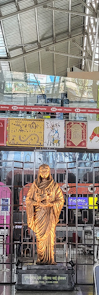
 

Statue of Ahilyabai Holkar at Indore airport

When Khanderao was killed in battle, his devastated wife wanted to commit sati: to throw herself onto his funeral pyre. However, her father-in-law and the subjects of the kingdom successfully persuaded her not to commit suicide. Following that, her father-in-law trained Ahilyabai in military matters. Khanderao’s only son, Malhar’s successor, Male Rao Holkar, ruled from 1766-1767. After his brief reign, cut short by illness, Ahilyabai became ruler of the Kingdom of Indore, which was part of the Maratha Empire.


Ahilyabai was one of the world’s most remarkable queens. As Wikipedia summarised:

“She is renowned for good governance, social welfare, and humanitarian work along with religious, educational, and cultural advancements. She contributed to the growth of Indian architecture through the commission of various temples, Ghats, and Dharmshalas. Ahilyabai’s Matha, or charitable endowments, spread across India.”


As a result, she is now revered as a saint. Apart from her philanthropic activities, she was also involved with military matters (in 1765, she commanded the artillery during an attack near Gwalior), and transferring her capital from Indore to the holy town of Maheshwar.  As if this were not sufficient,  she also transformed Indore into a modern city where commerce and industry were encouraged.


In view of the above, it is very apt that Indore’s airport bears her name. It is called Devi Ahilya Bai Holkar Airport. We flew from it to Bombay. A statue of Ahilyabai greets passengers as they arrive in the hall with the airline check-in desks.

  The airport is smallish, but lovely. The departure lounges are spacious and airy, and there is a good variety of refreshment counters. Some of the walls of the airport have fine examples of art in the style practised by the tribal Gond people. Compared with many other airports I have used, that serving Indore is one of the most pleasant. Ahilyabai would have been pleased to have this place named in her honour.

Only one airport,  only one flight

THE FORMER FRENCH colony,  now a Union Territory of India,  Pondicherry,  has its own small domestic airport. It is just over 3 miles from the city centre (as the crow flies). However, because of the traffic and the winding nature of our route, it took almost 30 minutes to reach the airport.   


After we had booked a flight from Pondicherry to Bangalore,  our daughter, who had taken the same flight twelve months earlier,  warned us that the airport at Pondicherry had limited resources but no refreshment facilities.


Prior to arriving at the airport,  I wondered if it would be even more rudimentary than the tiny airport at Khandla (in Kutch, Gujarat). Even that airport has a refreshment kiosk. With these thoughts in mind, and armed with a bag full of snacks and soft drinks, we headed off to Pondicherry Airport.


To my great surprise (and relief), we found that the passenger terminal at Pondicherry Airport is housed in a large, airy, well-ventilated, modern, comfortable, cylindrical building. And it has a refreshment kiosk, which sells only soft drinks.


The airport was first opened in 1989, and used for two years. However, lack of financial success caused it to be closed in 1991. After reconstructing the airport and its runways, it was reopened in 2012. The new terminal was inaugurated in 2013. Currently, Indigo Airlines operates flights to and from this airport. There is one daily flight : Bangalore to Pondicherry to Hyderabad, and another from Hyderabad to Bangalore via Pondicherry.  We took the latter. The propellor plane on which we flew was an ATR 72-600 (built by a French company, ATR), which can carry 78 passengers.


What I particularly liked about the airport is that instead of reaching the aircraft by an air-bridge or on a bus  we simply walked across the tarmac from the terminal to the ‘plane.


As we drove from Pondicherry to the airport, Shiva (our taxi driver) casually remarked about Pondicherry:

“Only one airport,  only one flight.”

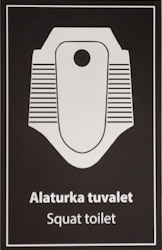
A toilet in the airport of Istanbul

I FIRST VISITED Turkey in the early 1960s. It was then that our family first came across squatting toilets. For want of a better name, we called these hole in the floor lavatories ‘Turkish loos’.

Today, in April 2024, we landed at Istanbul’s vast new airport. As nature was calling, I visited one of the many toilets in the airport building. You can imagine my surprise and satisfaction when I saw on the door to a cubicle containing a squatting toilet a sign that read in Turkish “Alaturka tuvalet”, and beneath it, the English words “Squat toilet”. So, it seems that we were right to christen these types of toilets ‘Turkish loos’.

Almost paperless at the airport in Calcutta

OUR TAXI PULLED up outside the departure section of Calcutta’s huge airport terminal on the 20th of January 2024. We were dismayed to see the extremely long lines of people waiting with trolleys laden with assorted baggage. They were all waiting to pass through the police security check points to enter the terminal.

We soon realised that even if we were to have been at the head of one of these queues, we would not have been able to pass through the checkpoint without having first registered with DijiYatra.

If you have not flown from an Indian airport recently, you will be as puzzled as we were. DijiYatra is an electronic system depending on AI facial recognition to allow passengers to pass the various checkpoints on their way to the ‘plane without having to keep on showing paper documents at each point.

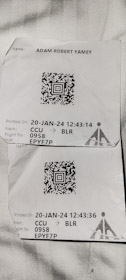
An app exists for DijiYatra, but we did not have this on our telephones. Looking perplexed, an airport official working for our airline, Indigo, led us to some electronic terminals. A man standing by it entered our PNR code, and took pictures of our faces. Following thus we were each handed small flimsy squares of paper bearing our names, flight details and a QR code. We were directed to a policeman standing nearby.

The policeman scanned our DijiYatra paper slips and checked our passports against the faces now recorded in the system. After this, we were sent to one of the checkpoints next to the entrance to the terminal. There was only one person in front of us. After having our small paper slips and our faces scanned, gates opened and we could proceed to the baggage drop-off counters.

At another checkpoint at the entrance to the security checking area, we scanned our DijiYatra slips once again. When the system matched the slip to a scan of our faces, we proceeded into the security control area.

The idea behind DijiYatra is to reduce the use of paper checking and to replace it by facial recognition systems. All well and good, but in our experience the system did rely on keeping two easy-to-lose tiny bits of paper. I guess that had we downloaded the app, the paper slips would not have been required.

What puzzled me were the long queues. Everyone in them had registered for DijiYatra.

My trip from Bangalore to Calcutta began with a bang

OCCASIONALLY, I HAVE A YEARNING for ‘fast food’ – low taste, I know! While waiting at Bangalore’s Airport (terminal 1) for a flight to Calcutta, I felt the urge for a junk food snack, and headed for the KFC outlet in the departure lounge. I placed my order,and was asked to wait for 5 minutes – so much for so-called fast food.

I noticed that the foodstall was right next to a bookstall, run by the Relay company. With my KFC receipt in one hand I hurried towards a glass door that led into the shop. Either it was locked or I misjudged its position. Regardless of the reason, my forehead hit the glass door with great force. The glass remained intact, but not I.

I cursed loudly, and headed for another entrance to the bookshop. As I entered the shop, I touched my forehead and found my fingers reddened with blood. The charming young shop assistants, seeing me and my wound, found a stool and a first aid box, and began stemming the bleeding. With copious amounts of Dettol and Povidone Iodine solution, they cleaned me and my wound. They were very attentive and concerned about me. I was touched and impressed by their gentle and efficient care.

A few days after the accident, with a smaller plaster

When an enormous elastoplast had been applied and I had assured them that I was feeling OK, I returned to KFC, clutching my bloodstained receipt. I carried my meal back to where we were sitting, and tried to reassure my wife that things were not as bad as they looked. Then, I consumed my delicious chicken offering, which the KFC staff had kindly kept warm during my long absence from their stall.

After about 30 minutes, the manager of the Relay stall came up to me to check that I was alright. Then, he took a photograph of my boarding pass. Incidentally, whilst his staff were treating me, they also photographed me and my wound.

The flight took off only 30 minutes late, and I have been enjoying Calcutta since we arrived. I can truly say my trip to West Bengal began with a bang.

A new airport terminal in Bangalore

DURING THE FLIGHT from Dubai to Bangalore (Bengaluru), the overhead baggage lockers on the ‘plane were filled to capacity with a diverse variety of often bulky carry-on luggage. This was in sharp contrast to what I observed on the flight from Heathrow to Dubai. On the whole, the passengers on this longer flight carried modest amounts of cabin baggage, and there was no problem accommodating it.

After a smooth flight from Dubai, we landed at Bangalore on time. I was excited to discover that we were being disembarked into the new terminal. Its construction was still underway when we left Bangalore in February 2023. It has been in use for no more than about 3 months.

I have only seen the arrivals section of the new terminal, and will have to wait before seeing, what I have heard, are the visually spectacular departure areas.

As for what I was able to see as an arriving passenger, I was neither amazed nor disappointed. The place has a feeling of great spaciousness and has much natural lighting. However, although much effort has been made to use ‘natural’ materials and plant-derived matter. For example, the immigration desks are lit from above by electric lamps in giant basket work shades. The desks are decorated with an external latticework of what looks like thin strips of bamboo. I wondered how long this would last before it becomes damaged by frequent wear and tear.

After passing through passport control, passengers enter a duty free shopping area. Its flamboyant decor seems to have been inspired by the ‘over the top’ interiors in Dubai’s airport terminals. Beyond this retail area, one reaches the baggage reclaim area, which seemed more spacious than what exists in the older terminal.

Despite not being overwhelmed by the visual nature of the new terminal, I must say that our passage through it was smooth and quicker than any of my many other arrivals at Bangalore’s airports, both old and very much older.

Wonderful new highways link the new terminal to the main road onto the city of Bangalore. However, after about 20 minutes speeding along, you are plunged into tthe city’s characteristic noisy, slow moving, congested traffic.

His struggle available in India

INDIA IS FILLED with excellently stocked bookshops, many of which would put some highly acclaimed British bookshops to shame. Everywhere I have visited in India, with the exception of most parts of Gujarat, has shops selling a wide range of books in English, written both by Indian and non-Indian authors.

At Kochi Airport

One of the foreign authors, famous for only having written one book, is that monster Adolf Hitler, who was born in the year that the Eiffel Tower was completed and during which my preparatory school in London’s Swiss Cottage was established – 1889. He not only brought most of Europe to its knees but was also responsible for murdering many millions of innocent civilians. Fortunately, he killed himself in 1945.

Adolf’s book “Mein Kampf” (my struggle), which I have neither read nor plan to even peruse, is available in its English translation in almost every bookshop I have visited in India. Several different Indian publishers have produced paperback (usually) editions of the published thoughts of Herr Hitler. This and the wide prevalence of the work in bookshops suggests to me that there is still a demand for the book. This is surprising because as Vaibhav Purandare points out in his book “Hitler and India”, Hitler held India and the Indians to be beneath contempt. I wonder how many bookshop browsers in India know this.

I am not sure why some Indians have some admiration for Hitler. Some might consider him to have been a tower of strength, rather like Hercules, without knowing what an evil person he was. There is even a Hitler lock company. Presumably, the name was chosen because it suggests that their locks are extremely strong. There might be other reasons for Indian interest in Hitler, but I am not yet sure what they are.

Maybe the book is available because there is a market for books by or about noteworthy persons. Whatever the reason for its frequent appearance on the shelves of bookstores, seeing the book might cause some European eyebrows to be raised in surprise.

My latest sighting of “Mein Kampf “ was in one of the two handsomely stocked bookshops in Terminal 1 of Kochi International Airport. If you desperately want to read about ‘his struggle’, it will not be much of a struggle to find a brand new copy anywhere in India.

Catching a ‘plane in Kutch (Gujarat)

AIR TRAVELLERS CAN FLY to the former Kingdom of Kutch (Kachchh), now part of Gujarat, by two routes. There is a scheduled flight between Ahmedabad and Bhuj, and another between Mumbai and Kandla, whose airport is close to Anjar.

Kandla, was developed as a seaport on the early 1950s at the instigation of a member of the by then former royal family of Kutch. It lies on the coast of Kutch southeast of Karachi, a port that was incorporated into Pakistan in 1947, and northwest of Mumbai. It is now the largest port in India when measured by the volume of cargo handled there.

Cattle on the road

From Mandvi to Kandla Airport is 95 Km by road. We set off from Mandvi three hours before our flight to Mumbai was due to depart from Kandla. Our hosts, who use the airport frequently, told us that on average the road journey is 1 ½ hours. For the first hour of our journey, the highway was almost devoid of traffic. Along the way, we frequently switched lanes because heavy vehicles often move slowly along the outside lane without giving way to faster vehicles. We wove our way between slower vehicles, constantly overtaking and ‘undertaking’. Then after speeding along steadily, we headed towards a static queue of heavy lorries.

QuIck as a flash, our driver made a three point turn and we drove in the opposite direction tobthe rest of the traffic until we reached a gap in the central divider of the dual carriageway. We were not alone in making this manoeuvre. There were even some of the heavy goods vehicles making cumbersome manoeuvres to head away from the traffic jam. We continued our journey on the wrong side of the divider until we reached a turn off that allowed us to go under the highway and back into the correct lane.

Soon, we encountered another jam. A transporter carrying a tank as wide as one side of the motorway was inching its way onto the main road. Our driver took us off the road onto a dirt track, but this was also blocked. Another u-turn and we drove beneath the highway to a narrow, poorly tarmacced road that ran parallel to the highway. This led to a bridge beneath the main thoroughfare to reach another narrow lane that ran alongside the part of the highway running towards Kandla.

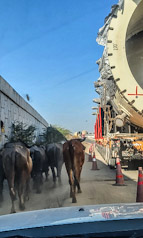
This lane offered other obstructions including large trucks and a herd of slow moving cattle. We squeezed past them and eventually rejoined the highway.

Meanwhile, the time was ticking away, and we wondered whether we would miss our flight. My spirits rose when we turned off the highway and on to a road leading to the airport. Soon, my hopes were dashed. We encountered yet another jam. However, our skilful driver managed weave his way between them. Soon, we arrived in front of the tiny airport terminal building.

Kandla Airport is primarily a military air base. Passengers use it for the one flight a day to and from Mumbai. When we disembarked there a few years ago, we walked from the aircraft to a shelter, where passengers’ check-in baggage was ready to be retrieved.

The check-in and security check is carried out in a part of a small room, the rest of which is part of the departure lounge (with a snacks stall). This hall leads to another room with seating. It is here that the departure gate is located. This simple departure lounge reminded me of Venice’s Marco Polo Airport as it was in the early 1960s.

We boarded the Spicejet two engined propellor plane after walking across the apron. The aircraft (a Q400 made by the Bombadier Company) has its own retractable staircase that we used to enter and later leave the ‘plane. After an uneventful flight lasting 1 hour and 15 minutes, we disembarked at Mumbai.

We were lucky only to have arrived a few minutes later than the scheduled time. Only three days earlier, my wife’ cousin’s flight from Mumbai to Kandla was delayed by almost 5 hours because of a technical problem discovered on the ‘plane minutes before it was due to take off. We were also fortunate because our quick-witted driver skilfully reduced the time spent stuck at significantly awful traffic jams.

Three years later, little has changed…

WHEN WE LANDED at the huge airport that serves Kolkata (Calcutta), it looked much as it did 3 years ago. Only one of the 6 or 7 baggage retrieval conveyor belts was in use and the vast airport seemed almost empty. The situation was the same when we last used it in December 2019.

We made the long ride from the airport to South Kolkata in a vehicle that was not available 3 years ago: an electric taxi. While being driven in this advanced form of vehicle, I wondered whether much else had changed in the city. Although there is much new construction at the periphery, it seems that delightful old Kolkata simply looks a little older.

A visit to the busy New Market (aka ‘SS Hogg Market’) revealed little obvious change. Our first port of call was at the excellently and tastefully stocked Modern Book Depot, where we chatted with the owner and made a few purchases.

Our search for a small funnel took us around the market buildings. A small store crammed full of kitchenware was able to fulfil our quest. We had been looking for this simple item in three other cities – in vain.

To our great relief, Nizam’s restaurant looked much as it has done for many decades, although an additional dining area has been added. The walls of the two older eating areas are decorated with framed theatre (English and Bengali plays) and cinema posters (mainly films made in India).

Nizam’s was founded in 1932, and has been well-known for its tasty kabab (‘kathi’) rolls ever since. A paratha is fried in oil on a tava, and cooked mutton or chicken is placed on it plus or minus a a beaten egg. When the paratha is ready, it and its contents are rolled up and wrapped tightly in paper. According to the customer’s choice, chillies can be added before the paratha is rolled. The management of Nizam’s states that the paper wrapped rolls were invented so that in the era prior to Independence, British men and their casual, temporary, female companions could eat the rolls without getting grease on their fingers. Whatever their history, these kabab rolls are highly enjoyable.

From where we were sitting, we were able to see the paratha dough being strenuously kneaded by a young man rhythmically thrusting his hands into the stiff paste. I was also able to watch other men threading meat onto metal skewers and others grilling the meat on glowing charcoal. The dough is formed into spheres a little smaller than tennis balls . These spheres are then flattened to make circular discs, which are then fried on the tava as already mentioned.

Walking around New Market and driving between it and south Kolkata revealed that the centre of the city I love has not succumbed to the often tasteless modernisation that has affected many other cities. I enjoy the unchanging appearance of Kolkata, but many people who have lived there bemoan the fact that it is a dying city. This is not say that Kolkata lacks vitality. It is still full of life, but as far as business opportunities are concerned, both the present and the future are not looking particularly optimistic.

Welcomed to India with coffee

BECAUSE OF THE COVID19 pandemic, we had not stepped onto Indian soil for two years and nine months. This was unusual for us because after we married in early 1984, we have been visiting India on average twice a year. For family related reasons, we have almost always landed in Bangalore.

When a new international airport was opened near Devanahalli village (at the northern edge of Bangalore) a few years ago, a line of eateries and cafés opened alongside the main landside of the terminal building. Being outside the terminal, which can only be entered by holders of air tickets, these outlets can be used by passengers and those who are not travelling by air.

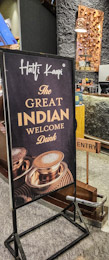
One of these stalls is a grand affair partly decorated with copper sheeting. It is called Hatti Kaapi. The ‘kaapi’ in the name refers to the way local Bangaloreans pronounce ‘coffee’. This particular coffee stand provides excellent quality South Indian filter coffee. It is so wonderful that whenever we visit the airport, either arriving (from the UK or from places elsewhere in India) or departing, we always make time to drink a coffee served by this superb stall.

So, after what was for us an abnormally long absence from India and what has been a disastrous period for everyone, it was wonderful to discover that it was ‘business as usual’ at Hatti Kaapi. And since our last trip 2 ¾ years ago, a new sign has appeared at Hatti Kaapi. It reads:
“HATTI KAAPI The great Indian welcome drink.”


Seeing that sign after 2 ¾ years made us feel much more welcome than its designers could have ever imagined.