Dining with the dead in Ahmedabad

IN CENTRAL AHMEDABAD, a large city in India’s state of Gujarat, there is a curious café called Lucky. This popular eatery, founded in 1950, is unusual not because it does not serve coffee but because its tables and chairs are placed between Moslem graves. Also, the trunk of an old tree is contained within the restaurant. Its base is within the eatery and it passes out of the place through a hole in Lucky’s ceiling.

Tree trunk and a grave at Lucky

Lucky’s is sited on an old Moslem graveyard, but this does not put off a steady flow of customers from enjoying a wide variety of vegetarian meals and snacks in this eatery. Closer to home, near the south side of London’s Lambeth Bridge, there is another café sited on a former graveyard.

A mosque on the road to the Delhi Gate of Ahmedabad

THE CITY OF Ahmedabad was founded in 1411 AD when Ahmad Shah I of the Gujarat Sultanate moved his capital to the already existing settlement of Ashaval. He renamed the place as Ahmedabad. During the fifteenth and sixteenth centuries, many fine mosques were built in the city. During previous visits to Ahmedabad,  we have looked at many of these edifice.


Today, 29 November 2025, we came across a mosque we had not seen before. It, the Rani Rupamati (aka Rupavati) Masjid, is beside the main road (Mirzapur Rd) that leads from the Sidi Saiyed mosque in the city centre to the Delhi Gate.


The Rani Rupamati Masjid was constructed  in the fifteenth century,  possibly Sultan Mahmud Begada for Rani Rupamati,  whom he married. The mosque and the dargah next door to it are connected with Sunni Sufism.


Architecturally,  the mosque shares many features in common with other mosques built in Ahmedabad and the rest of Gujarat in the fifteenth and sixteenth centuries.  Built in the so-called Indo-Saracenic style, this mosque and others  built in the same era contain architectural and decorative features often found in Hindu and Jain temples. Although rich in decorative ornamentation, the mosques, unlike the temples,  are devoid of representations of people and animals. Floral and leafy motifs can be found at the Rupamati Masjid,  as well as at other mosques built in the same era. The highly decorated bases of two minarets can be seen  but the tall upper parts of the minarets were listed during an earthquake in the early nineteenth century.


 Beside the mosque and within its grounds, there is another structure, topped by two domes. This pillared hall contains the tombs of Rupamati and other worthies.


The mosque is a protected historical monument, but is still used by worshippers.  Although it is an attractive  building,  it does not seem to be on the main ‘tourist trail’.

Riding from Udaipur to Ahmedabad: a road trip

TODAY WE TRAVELLED by road from Udaipur in Rajasthan to Ahmedabad in the neighbouring state, Gujarat. The 158 mile journey took us about 4.5 hours with a brief stop for tea.

South of Udaipur in Rajasthan

The hilly scenery between Udaipur and the frontier between Rajasthan and Gujarat was pleasant. It was mostly rural with few industrial buildings.

On entering Gujarat, everything changed. The terrain became flat and the countryside was liberally dotted with industrial structures, both small and large. In addition, there were plenty of fields for growing crops. Many of these fields were equipped with elaborate irrigation systems. Compared with the delightful, almost ar arcadian landscape in south5 Rajasthan, the landscape in the part of Gujarat north of Ahmedabad is far from attractive.

Until we reached the outskirts of Ahmedabad, the traffic on the dual-carriageway highway was light. Most of the vehicles we met were trucks. We saw only a few private cars.

After passing Ahmedabad airport, we entered the old city via the recently constructed Sabarmati Riverside road. This passes beneath a bridge being constructed for the new Ahmedabad to Bombay superfast railway, which should e running in about 2 years time.

Although the journey was not the most fascinating we have made on Indian roads,we were driven enough superbly by Rajesh, a driver engaged for us my the helpful Mr Yashwant of PP Tour and Travels in central Udaipur.

An artist who loved Gujarat (in western India)

THERE IS A SUPERB collection of modern art from south Asia, which is being exhibited at Phillips auction house in London’s Berkely Square until 31 July 2025. Amongst the artworks on display are several paintings by the late Maqbool Fida Husain. As you can read in the following excerpt from my book about the first journey I made to Gujarat in western India in 2018, the Husain was keen on the area. We were in Ahmedabad when we stumbled across a restaurant called Lucky.

“We ate lunch at Lucky, an unusual restaurant near our hotel. This vegetarian eatery is divided into two sections: one serving sandwiches and Punjabi-style dishes, the other serving mainly south Indian dishes. In one of them, we noticed a framed painting by the famous Indian painter MF Husain (1915-2011), who was born in a Bohri Muslim family in Maharastra. He often travelled to Gujarat to paint. The picture in Lucky, and the place is truly lucky to have it, is a gift which the artist presented in 2004. This was the second original work by Hussain that we had seen in a restaurant. Earlier, we had seen a sketch by him in Bombay’s Noor Mohammadi Hotel, which serves Bohri dishes. When Hussain’s art works began to offend the extremist nationalist sentiments of some Hindus in India and they threatened his life, he felt forced to exile himself. He lived the last few years of his life in the Gulf States and the UK.

The curious thing about Lucky is not the MF Hussain painting, but its location in a disused Muslim cemetery. Its chairs and tables are placed between unmarked Muslim gravestones, painted green and surrounded by low metal railings painted white. The manager thought that these graves were over 300 years old. In addition to the graves, the thick trunk of a tree grows through the middle of the restaurant. The food and service are both good in this busy but peculiar place.”

You can read about my first trip to Gujarat and the two former Portuguese colonies, Daman and Diu, in my paperback book “Travels through Gujarat, Daman, and Diu” (https://www.amazon.co.uk/TRAVELS-THROUGH-GUJARAT-DAMAN-DIU/dp/0244407983)   and the kindle version “Travelling through Gujarat, Daman, and Diu” (https://www.amazon.co.uk/TRAVELLING-THROUGH-GUJARAT-DAMAN-DIU-ebook/dp/B07GLWZPHD/)

A slow journey in the west of India

OUR JOURNEY FROM Bhuj to Baroda (Vadodara), both in Gujarat, began yesterday at 650 am and ended at our hotel just after 8 pm. The distance we travelled was about 265 miles. There are direct trains between Bhuj and Baroda, but these were fully booked on the day we wanted to travel (i.e., 30th November 2023).

The first ‘leg’ of our journey was on a train that carried us from Bhuj to Sabarmati Junction – one of Ahmedabad’s several railway stations. The other passengers in our compartment were 4 young girls and a couple of young men returning to university after their Diwali break. We noted that the girls talked to each other. So, did the boys. But the girls and boys did not converse with each other and showed no interest in each other. The train rattled at high speed through the flat countryside and arrived at Sabarmati only about 8 minutes late. Unlike many Indian trains I have been on, the Bhuj to Sabarmati Superfast had no vendors wandering up and down the train.

It is a few miles between Sabarmati Junction and Ahmedabad’s centrally located main station. We hired an autorickshaw to take us between Sabarmati Jn and the Moti Mahal restaurant near the main station. Our driver tore through the heavy traffic narrowly missing numerous collisions. The eatery proved to be a scruffy but extremely popular place – noisy and lively. We enjoyed a good light lunch before walking to the station.

Although it was only about 200 yards between the restaurant and the station, it was necessary to cross an incredibly busy road with fast moving vehicles. We asked an autorickshaw driver if he would drive us there. He refused, but kindly offered to help us across the road, which resembled a disorderly road race. Using his arms like a traffic policeman he shepherded us across the thoroughfare. Even with his help it was a hair-raising experience.

We had to wait for our next train for about two hours on platform 6. The train we were about to catch was the Porbandar Shalimar Superfast. This train leaves Porbandar in Saurashtra (part of Gujarat) at 850 am on day 1 and arrives at Shalimar (a station in Calcutta) at 3.35 am on day 3 – having travelled a distance of 2544 km. Our journey on this train lasted just under two hours, arriving in Baroda about 20 minutes late.

She sells mats to passengers in the train

Unlike the train from Bhuj, the train to Shalimar was well populated by vendors. The seemingly endless procession of sales people were offering: bottled water; hot tea; snacks including biryani and bhel poori; bags of apples; and mobile phone chargers and cables. One lady in a colourful sari was selling attractive square mats at 10 Rupees each. Every now and then, a deformed invalid literally scuttled along the filthy floor of the corridor. He stopped at each compartment and banged his collecting pot ominously on the ground. Only a few passengers gave him coins.

The sun had set when our train pulled out of Ahmedabad. Through the open window, I saw many small villages, many of them with Hindu temples adorned with coloured lights – many of them flashing decorously. I could also see many brightly lit shops. Within the train, I had an excellent view of the door to one toilet. Even when it was closed it vibrated furiously as the train sped along. Many passengers peered inside the loo, but few dared to enter it.

The train seemed to travel even faster than the one from Bhuj, and it was a relief to disembark in Baroda’s lovely station. After another autorickshaw drive, we arrived at our comfortable hotel. Our reception there was a little reminiscent of an episode from “Fawlty Towers”. Once this was, over, things went smoothly and we enjoyed a good dinner in its dining room.

She sells papers on the pavement in Ahmedabad

WE HAVE VISITED AHMEDABAD (Amdavad) at least five times since our first visit in 2018. We have always stayed at a small friendly hotel close to the House of MG. This former mill owner’s mansion is now a luxury hotel, which tries to create the kind of India that most foreigners have as an imagined preconception. It achieves that, but is rather too precious for my liking. On the road immediately outside this Disney like themed hotel is the ‘real’ rather than the sanitised India, which can be experienced within the House of MG.

Ever since we first stayed in Ahmedabad, we have seen a lady who sits on the pavement outside the compound of the House of MG. When we first met her, she used to sit beside her overweight husband. Sadly, he died during the covid19 pandemic. On our recent trip in November 2023, she could not be seen, and we were worried that she had also passed away. However, she appeared after several days of the Diwali holiday, and greeted us as old friends.

The reason for her temporary disappearance was that during the Diwali holidays newspapers are not printed. And she sits outside the House of MG for a good reason. She sells newspapers. When her husband was around she and he used to be surrounded by untidy piles of newspapers. We used to buy “The Hindu” from her every day. I noticed on our recent trip that her stock of newspapers was smaller and more tidily arranged than in the past. As “The Hindu” is no longer delivered to newspaper sellers in Ahmedabad, we have had to make do with “The Times of India”.

‘Our’ newspaper lady, the friendly autorickshaw drivers who hang around near her, the man who sells screwdrivers from his simple barrow, the faithful in the Sidi Saiyedd mosque opposite the luxury hotel, and the elderly Moslem gentleman watching the world go past his wheelchair are in my mind the real India and what makes it so endlessly fascinating for me.

By road and by rail through rural Gujarat

WE HAD DECIDED TO travel to Mandvi (in Kutch, a part of Gujarat) by taking a train to Gandidham, then going by road the 98 kilometres between there and Mandvi.

The Indore to Gandidham Express arrived 30 minutes late on Ahmedabad Junction’s platform 4. Getting on to our carriage was a veritable scrum. The problem was that people, including us, wanted to board before those alighting at Ahmedabad had reached the carriage entrance. Someone behind us shouted “Hurry up and get inside.” When a passenger who was trying to leave the train replied “We want to get off”, the irritating lout behind us shouted “You should have started getting out quicker.” We struggled along the carriage and found our window seats eventually.

We had reserved seats numbers 73 and 76. A man was sitting in seat 76. When we said it was one of ours, he said that he was occupying his alloted seat, namely seat 77. It took some considerable persuasion before he understood that seat 77 did not have the number ‘76’ above it. This incident reminded me when I used to travel by train in Italy during the 1960s.

Whenever we travelled by intercity trains in Italy long ago, my parents always reserved seats – always in the first class carriages – in advance. Invariably, our reserved seats would be occupied by passengers who should not have been in them. It was o lying after the train conductor had been summoned that the people yielded our seats to us. Moments later, these obstinate people would engage in friendly conversation with us.

Returning to the Indore to Gandidham Express, before it started, vendors selling fruit and bottled water roamed along the platform looking for customers. Meanwhile, a hot tea seller moved along the interior of the train. He and others remained on board during the journey, as did a couple of snack vendors.

Once we got going, the train sped along. There was only one intermediate station where we stopped briefly during the 4 and a 1/2 hour journey. As we traversed the flat plains of Gujarat, we saw many neatly cultivated fields and numerous industrial units of varying sizes. In the area where eastern Kutch begins, we passed vast expanses of land being used as salt pans. Every now and then, we saw conical mounds of grayish white harvested salt.

Many trains passed us, travelling in the opposite direction. Almost all of them were freight trains. The line along which were moving leads to and from the busy port of Kandla on the south coast of Kutch. What little we saw of Gandidham and its outskirts was unattractive.

The air temperature at Gandidham station was well over 30 degrees Celsius and there was little shade. To exit the station, we had to use an escalator. Once again it was a scrum trying board it. Some passengers were too frightened to step on it which made using it even more difficult.

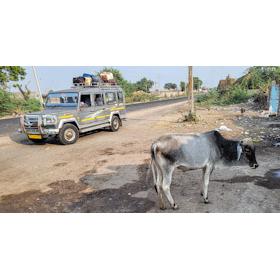
Our host in Mandvi had kindly booked us seats in a shared taxi to travel from Gandidham to Mandvi. This vehicle was like a jeep. It had a front row of seats – sofa like – and behind that there was another similar seating arrangement. Behind that, there was a far less comfortable seating space that accommodated any number of people that could be squeezed in. We were booked into the seating behind the front seats and in front of the rear ‘compartment’.

Although the middle seating had been booked for my wife and me, Lopa invited one of the three passengers who had squeezed in the front seat next to the driver to join us. He turned out to be a friendly chap. He and his friends were returning home from several days of a religious pilgrimage. Our new companion was a trader in rice, sugar, etc. He bought commodities and sold them for export. During our journey, he received a telephone call. He told us that soon after getting home, he had to go to Bombay for some urgent work. He and his business partner would have to drive for 11 hours through the night to reach Bombay from near Mandvi.

Our driver decided not use the 4 lane highway between Gandidham and Mandvi because of heavy traffic. Instead – and it made the journey far more interesting – he took us along a “short cut”, using country roads, some of them minor. This added fascination because we passed through rustic villages. At one of these, we were stopped by an elderly lady standing beside the road. She wanted to go to Mandvi, and was invited on board.

At another place, we stopped and the driver picked up a bundle tied in cloth, which he delivered to someone in another village we passed through later. After about an hour, to my great relief because my mouth was parched, we stopped for about 20 minutes at a stall where snacks and cold drinks were available.

At one point early during our journey, someone in the rear compartment asked our new companion to dial a certain number on his phone. Some conversation in Gujarati ensued. It turned out that there were some labourers travelling in the rear compartment. As they had not yet been paid by their employer, they claimed that they did not have the 300 Rupees needed to pay for the ride. Our friendly sugar trader allowed the employer to electronically transfer the required amount to his account. Our neighbour then suggested that he could electronically transfer that fare money to the driver’s account. However, the driver wanted to be paid in cash, which the trader kindly agreed to do.

Most of the way, the driver used one hand to steer, and the other to hold his mobile phone to his ear. Despite this hazardous practice, there were no scary moments along the way. We arrived at our destination safely, but somewhat cramped.

When we sat inside our host’s air-conditioned large saloon car to drive to his house, it felt as if we had moved from a stone seat into a feather bed. Never before has a modern saloon car felt so comfortable.

Despite moments of discomfort, our rail and road trip was enjoyably interesting. By the end of the journey we felt as if we had been truly travelling – a feeling that air travel often fails to provide.

Late night shopping a the Law Garden in Ahmedabad

THE LAW GARDEN in Ahmedabad was developed into a park in about 1997. Previously, it had been a vast triangular vacant plot in the heart of an affluent residential area. Named after an adjacent college of law, it was an undeveloped, rather disreputable bit of land. In 1997, it was tidied up and turned into what is now a pleasant place for people to relax and ‘take the air’.

Market stalls can be found along the street on one side of the park. After dark, a busy night market springs to life. This existed even before the park was completed.

Many of the stalls sell clothing made using colourful traditional patterned textiles – both embroidered and printed. Several stalls were selling cloths embroidered with small mirrors – work from Kutch.

In addition to clothing, there were hawkers selling toys and balloons. Foodsellers pushed small barrows from which they sold fruit, confectionery, and soft drinks.

This lively market reminded me a little of Fashion Street in Bombay, but it is somewhat smaller and offers less variety. The Law Garden night market is well worth a visit.

Bengali art before it was affected by influences of Europe and the Far East

THE INDUSTRIALIST KASTURBHAI Lalbhai (1894-1980) filled his Ahmedabad home (built 1905) with works of art. One of his relatives had married a member of the famous Tagore family of Calcutta. When the Tagores decided to sell their fabulous collection of Indian art in the 1940s, Lalbhai purchased it and thereby saved it from being sold to buyers who did not live in India. These works are on display in the house, which is now known as the Kasturbhai Lalbhai Museum.

The Museum houses works of Indian art dating from as early as about the 4th century AD to the 1940s. Visitors to the museum are obliged to go on a prebooked informative guided tour through the rooms of the museum. Although a bit of a speedy experience, one leaves having seen an enlightening cross-section of the history of art in India. Photography in the museum is not allowed.

In the special exhibition

In the beautiful grounds of the museum, there is a recently constructed annex, where temporary exhibitions are held. We were treated to a show entitled “The Babu and The Bazaar”. It is a collaboration with the Delhi Art Gallery.

This fascinating exhibition contains a display of images created by Bengali artists, who painted in traditional styles that prevailed before art in Bengal became influenced by British art schools, Western European art, and the art of China and, especially, Japan. These external influences were most famously introduced by figures such as Rabindranath Tagore and his nephews Gagendranath and Abanendranath.

During my visits to India, I have seen plenty of paintings by Bengali artists who incorporated non-Indian artistic styles into their creations, but I cannot remember having seen such a large collection of Bengali paintings and other works in vernacular styles derived more from tradition than from outside influences. Most, but not all, of the artworks depicted Hindu religious subject matter. Many of the paintings were by artists I had never heard of, or were by unidentified painters. The well-labelled exhibits, which were beautifully displayed, were refreshing eye-openers.

Designed by a disciple of Le Corbusier but it stands disused

THE BUSTLING KHWAJA Market in the heart of old Ahmedabad (Gujarat, India) stretches from the Bhadra Fort to the three-arched Teen Darwaja – a magnificent medieval gateway. Between the two, on one side of the marketplace, there is a 20th century edifice that is hard to miss. Built in the Brutalist style, this massive concrete building is the Premabhai Hall.

Premabhai Hall in Ahmedabad

It was completed in 1972. Its architect was Le Corbusier’s disciple and collaborator, the late BV Doshi (1927 – 2023). His building – an auditorium -replaced an earlier meeting hall, which had been built during the British occupation of India.

Looking like a giant piece of moder sculpture Doshi’s building hardly clashes with the mediaeval buildings on either side of it. Sadly, because of concerns about fire hazards, the Hall ceased being used in the 1990s. Luckily, it is still standing, but when looked at closely, it is showing signs of deterioration.

I hope that one day, the Premabhai Hall will be restored to its former glory.