The lion of Lendy in Sunbury-on-Thames

THERE IS A LOVELY walled garden, open to the public, in Sunbury-on-Thames. We were introduced to it today (20th August 2023) by our friends, Sue and Imtiaz, who live in Richmond. The large garden is well-tended and awash with flowers including a wonderful crop of late flowering roses. In the centre of the square garden, there is a carved stone lion on a plinth.

The lion commemorates the deaths of Captain Charles Frederick Lendy on the 15th of January 1894, aged 30. And his brother Edward August William Lendy on the 23rd of December 1893, aged 25. Charles died in Bulawayo (now in Zimbabwe) during the Matabele Campaign. And Edward, who was a captain in the Sherwood Foresters and Inspector General of the Sierra Leone Frontier Police, died in Warina (in Sierra Leone). According to a website (https://victorianweb.org/sculpture/warmonuments/9.html), he died as a result of ‘friendly fire’, and Charles died “from the effect of the Matabele campaign”, whatever that might mean. According to another website (www.photosunbury.com/lendymemorial4.htm), Charles

“… collapsed and died of peritonitis on 15th January 1894. Elsewhere, another interpretation places him at the Tati Hotel (in Botswana) where his illness was attributed to a heavy bout of drinking and eating.”

The brothers were the only sons of French born Major Auguste Frederic Lendy (1826-1889), a Royalist, who came from France as an exile, and settled in Sunbury-on-Thames. He ran his Practical Military College in nearby Twickenham, which prepared young men for entry into the major British military academies. He also wrote some books about warfare, and encouraged the British to be well prepared for military encounters. His sons’ military careers, though prematurely ended, were a credit to his teaching and philosophy.

Both brothers were in Africa to assist in the preservation and growth of Queen Victoria’s British Empire. One of them died because of friendly fire, and it seems that the other died of illness rather than during fighting. I doubt that their father would have been too pleased to know that neither of them had died whilst attempting something demanding bravery.

Apart from the Lendy memorial, there is a café in the walled garden, and next to that there is a small gallery. The gallery contains a fascinating embroidery on which most of the old houses in Sunbury-on-Thames are depicted beautifully and in great detail.

In addition to the walled garden and its contents, Sunbury-on-Thames has many old houses and a magnificent church (St Marys), which was designed by the Victorian architect Samuel Sanders Teulon (1812-1873), son of a French Huguenot, and built in 1857. I am very grateful that our friends introduced us to this charming place on the Thames.

In the Shadow of Freedom: Indians in Nazi Germany

Subhas Chandra Bose (1897-1945) is probably the most famous Indian to have spent time in Nazi Germany. Less well-known is Ayi Ganpat Tendulkar (1904-1975), who spent much longer in Germany than his illustrious compatriot. While studying in Paris, he married Sasha Alexandra Passini in about 1924. Soon after this, the marriage ended, and Tendulkar began studying in Berlin. He married one of his professor’s daughters – Eva Schubring. In 1933, after Hitler had come to power and Tendulkar had divorced again, he began a close relationship with the screenwriter Thea Von Harbou (1888-1954). Thea had just divorced her second husband, the great film director Fritz Lang (1890-1976) – one of my favourite film directors.  The relationship between Tendulkar and Von Harbou was very close, and had Hitler’s racial laws (against marriages between ‘Aryans’ and others) not been enacted, there is a good chance that they would have married.

Tendulkar returned to India just as WW2 broke out. There, he met and fell in love with Indumati Gunaji (died 2006). From the start, her family were against the relationship, and Indumati ran away from home to live with Tendulkar. Both were followers of Mahatma Gandhi – she more than he. Soon, Tendulkar, who had published anti-British articles in Berlin and elsewhere and was under suspicion because of his long stay in Germany, was imprisoned by the British. Meanwhile, Indumathi helped the villagers where she lived. Her life was not easy, and she missed Tendulkar greatly.

Eventually, Indumathi and her family, who were concerned about her and her romantic attachment to Tendulkar, became reconciled to some extent. Her father, a Gandhian, suggested that they ask Mahatma Gandhi what he thought of the relationship. His reactions to the situation were far from simple, as is revealed in the pages of “In the Shadow of Freedom” by Laxmi Tendulkar Dhaul – the daughter of Indumathi and Tendulkar.

Ms Dhaul’s well-researched book is a fascinating read. It covers the extraordinary lives and relationships between Tendulkar, Indumathi, and Thea Von Harbou, both in Germany and in India – before and after independence. Despite some unfortunate errors missed by the proofreader, this is an un-put-downable book. It opened my eyes to the interesting subject of Indians living in Nazi Germany as well as Gandhi’s rather intriguing views on the purpose of marriage.

A magnificent shopping arcade in Nottingham

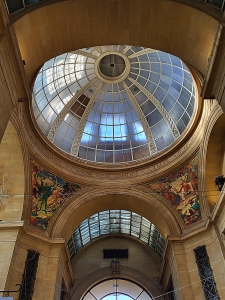
DURING A BRIEF VISIT to Nottingham made especially to view the centrally located Nottingham Contemporary art gallery (opened 2009), we spent a few minutes looking at some of the fine old buildings nearby. One of these is a shopping mall or arcade that reminded me a little of the superb Galleria Vittorio Emanuele II in Milan (Italy). Not as big as the structure in Milan, Nottingham’s Exchange Arcade is surprisingly grand.

Built between 1927 and 1929, it was part of a major civic construction project, which included the nearby Council House. It was opened by the then Prince of Wales, who became King Edward VIII briefly before abdicating to marry Wallace Simpson.

Shops in the Exchange are arranged along a long central corridor and two shorter side corridors. Together, these wide walkways make a ‘T’ shape. Where the long corridor meets the two shorter ones is beneath a glazed dome. The dome is supported by four sloping walls, upon each of which there is a colourful fresco. One of these depicts a local hero, Robin Hood, firing his bow and arrow.

When it first opened, the Exchange housed Joseph Burton’s emporium, Nottingham’s version of London’s Fortnum & Mason. By the early 1980s, the arcade had become shabby, and was renovated. Now, it contains 17 retail stores. Although I am pleased that we saw the Nottingham Contemporary, I am glad we also managed to visit the magnificent Exchange arcade.

What a relief after watching Barbie

AFTER WATCHING THE film “Barbie”, which I did not enjoy and even bored me at times, we walked west from the Genesis Cinema along Mile End Road towards Whitechapel Underground station. On our way, we passed Trinity Green, which is surrounded by the picturesque Trinity Green Almshouses (‘TGA’).

Probably the second oldest surviving almshouses in London, the TGA was built in 1695 by the Corporation of Trinity House. The oldest is The Charterhouse. The purpose of the TGA was to provide housing for poor captains and ship’s masters, and/or their widows. In about 1895, the TGA was threatened with demolition, but saved by a public campaign to preserve them. The buildings were the first to be placed on a preservation register, the forerunner of the ‘listed buildings’ system that protects historic structures from alteration or demolition.

Buildings that flank the two sides of the entrance gate are adorned with sculptures of sailing vessels, complete with masts and rigging. On each of the gatehouses, there are plaques recording the fact that the TGA was built in 1695 on land donated by Henry Mudd of Rattcliff and his widowed sister-in-law. At the end of the rectangular lawn that is surrounded by the dwelling units, there is a chapel, Sadly, the compound was locked up and could only be viewed from the street. It appears that people are still living there.

Seeing the beautiful, nay elegant, TGA was a great relief after having subjected ourselves (voluntarily) to a film, chock full of unsubtle sophomoric (‘sixth or even fifth form’) messages, which many of our intelligent friends have enjoyed greatly. Maybe, we missed something that endeared the film to them. The one good thing I have to say about the film is that I am certain that its box office takings will help keep cinemas we like, including Genesis, in business after the disastrous years of the pandemic.

Blowing in Bermondsey

IT IS UNNECESSARY to travel from London to Venice to see masterpieces of glass bowing. You need only make your way to Bermondsey Street in south London where you will find London Glassblowing. It is both a gallery and workshop set up by Peter Layton, who is now over 80 years old and still creating beautiful artefacts. Layton was born in Prague and grew up in England. After studying ceramics at London’s Central School of Art and Design, he taught ceramics at the University of Iowa in the USA. It was there that he discovered glass blowing and took to it. When he returned to England in 1976, he established his London Glassblowing in London. It has been located at its present address for about 15 years. Before that, he was in Leather Yard. Apart from creating works of art in glass, he also teaches and mentors other glass blowers.

Whenever we visit Bermondsey Street, we make a point of visiting Layton’s establishment. Always the works on display are both beautiful and highly inventive. Occasionally, if we reach the place at the right time, we can watch glass blowers at work in the invariably hot workshop behind the gallery. Unlike the workshops we have visited on the island of Murano (near Venice), the works produced in Bermondsey Street – both sculptural and functional – are tastefully contemporary and often avant-garde.

Anselm Kiefer at the White Cube in Bermondsey

TODAY, I MADE MY second visit to the Anselm Kiefer exhibition, which is on at the Bermondsey White Cube gallery until the 20th of August 2023. I was pleased to visit it again because after my first visit, I left it feeling oppressed and somewhat depressed. This might be what the artist (born at the end of WW2 in Germany) intended when he created the extraordinary series of scenes of dereliction and decay on show in Bermondsey. My second visit (on the 15th of August 2023) left me with a slightly more favourable impression, but my opinion that the artist has depicted an image of a world of confusion, conflict, and decay, remains unchanged.

The works, which are distributed in several rooms and the central corridor of the gallery, are, so I read in an information sheet, Kiefer’s reactions to, and representation of, a novel by James Joyce – “Finnegan’s Wake”. The artist has written short quotations from the book on many of the items that together make up the amazing art installations. As I have not read the book, I cannot comment on the appropriateness of what he has created.

In one room of the gallery, there are mainly huge paintings, which I found attractive. On close examination, one can see that the paint has been applied to that it is far from flat. The three-dimensional surfaces create interesting illusions, which change according to from where you view the pictures.

Another room has a huge pile of sand littered with discarded, corroded supermarket trolleys – an impressive but sad sight. In yet another room, most of the floor is covered with barbed wire and huge pieces of concrete – the ruins of a large building. As a friend of ours said, it looked as if it had been imported straight from a bombsite in Ukraine.

Would I recommend visiting this exhibition? It is certainly inappropriate for people who suffer from claustrophobia or depression. However, if you are of an adventurous frame of mind, do head for this show before it ends.

A movable gallows in Rutland

IN YEARS GONE BY, punishment by hanging was not a rare occurrence. The museum in Oakham, the capital of Rutland county, includes amongst its exhibits a mobile gibbet. This apparatus for hanging criminals is one of the few surviving movable gibbets (gallows) in Britain. When needed, it was moved from village to village. Unfortunately, it was designed badly. It had insufficient drop. This meant that the victim was strangled but not killed. I do not know what method was used to ‘finish off’ the unfortunate victims.

Impressions of India in preparation

At the moment, I am preoccupied with carrying out the final editing of my latest book, which I have described briefly below. When I publish it, which I hope will be soon, I will post more about it here in my blog and elsewhere.

A lock made by Hitler; Bollywood encounters; jackals on the golf course; teamakers and politicians; banyans and monkeys; Gandhi’s optician; coracles and crocodiles; and Denmark in India: these are just a few of the topics covered in Adam Yamey’s collection of 101 intriguing vignettes of life in India. This book with illustrations is the author’s love letter to India, a country he has been visiting frequently for almost 30 years.