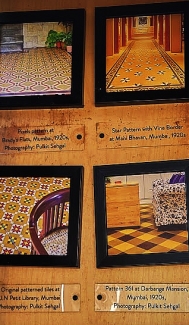
WHEN WE WERE in Bombay in November 2025, we saw exhibition related to the Bharat Tile Company. Founded in 1922, this company produces cement floor tiles. It pioneered this manufacturing process in India as part of the Swadeshi Movement, which encouraged self-sufficiency as opposed to a dependence on goods manufactured abroad, notably in Britain. It was part of the road to Indian Nationalism and independence from British rule. Bharat’s aim was to produce high quality tiles that reduce or replace imports and meet the highest international standards. In this it was successful. The company captured the Indian market, and as its website noted:
“Our craftsmanship graces the palaces of Maharajas, Raj Bhavans, distinguished residences, prestigious hotels, vital hospitals, vibrant clubs, bustling offices, bustling factories, cooperative housing societies, esteemed educational and religious institutions, as well as busy airports and railway stations.”
The exhibition displayed the types of tiles, how they are made, their designs, examples of their usage, and how they have been exported to destinations all over the world. The patterned floors that can be created with these tiles, and there are many of them to be seen in buildings all over India, are described in the exhibition as “tapestry in cement”.
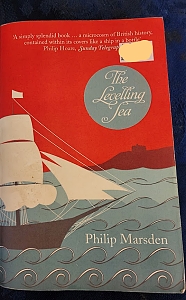
I HAVE JUST finished reading “The Levelling Sea” by Philip Marsden. By describing many aspects of the history of the town of Falmouth in Cornwall, he not only brings the town’s colourful and important past to life but also gently introduces the reader to many facets of English maritime history.
I have visited Falmouth many times. This book makes sense of many things I have seen there. It has also introduced me to many features of the town, past and present, that I had not known about. Likewise, it has enlightened me on aspects of English maritime history that were new to me.
The book is well-researched, yet is not stolidly scholarly. “The Levelling Sea” is beautifully written. Although not poetry, its prose feels almost poetical.
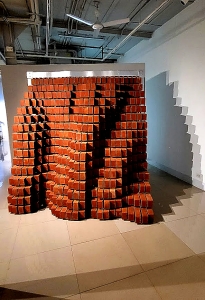
OUR FRIEND GEETHA Mehra has her art gallery on 2nd Pasta Lane, near Colaba Causeway in Bombay. On one of our visits in November 2025, she had organised an exhibition, “Behind the Façade”, which consisted of works by the contemporary artist Teja Gavankar. The artefacts on display were almost architectural, some using brickwork and others containing other materials, As the gallery’s website explained:
“Gavankar is interested in dual states, in forms that appear rigid, where solidity gives way to softness and movement. A dialogue between natural and built environments unfolds, stemming from the artist’s experience of living in Mumbai’s suburbs. Gavankar observes the contours of the city during her commute, seeing organic forms emerge in its industrial undertones.”
Whereas architects make structures which are functional, Gavanka created architectural structures that were artworks designed to challenge the viewers perceptions of space. Seeing the brickwork sculptures and the patterned brick façade she designed for the gallery reminded me of the brick workshop we saw in progress at the Chitrakala Parishad in Bangalore a few days earlier (see: https://adam-yamey-writes.com/2025/11/20/bricks-and-design-at-an-art-school-in-bangalore-bengaluru/).
CURRENTLY MANY MUSEUMS in the ‘Western World’ are pondering over the idea of returning some of their exhibits to the territories from where they were obtained. A controversial example of this quandary are the fragments from Athen’s Parthenon, which are known as the Elgin Marbles.
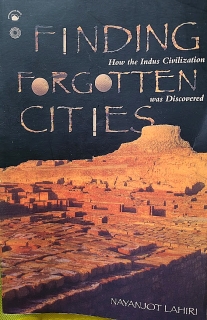
From 1899 to 1905, Lord Curzon was the Viceroy of British India. In her book “Finding Forgotten Cities”, Nayanjot Lahiri describes how Curzon was concerned about preserving and conserving India’s many archaeological and historical sites, and promoting the work of archaeologists in what was to become the Archaeological Survey of India (‘ASI’). Concerning artefacts removed from India, it was Curzon who arranged for some ancient artefacts to be returned from the British Museum to where they came from in India. The most important thing that Curzon did in relation to Indian archaeology was to appoint the archaeologist John Marshall (1876-1958) to supervise and plan archaeological activities within the Indian subcontinent. It is Marshall and his highly trained colleagues including many Indians such as Rakhaldas Banerji, DR Bhandarka, KN Dikshit, and DR Sahni, who are important protagonists in Lahiri’s story about how the extensive remains of Harrappan (or Indus Valley) civilisation came to be discovered. The book also includes much information about the Italian archaeologist Luigi Pio Tessitori (born 1887 in Udine, Italy, died 1919 in Bikaner, Rajasthan), whose discoveries eventually contributed much to the unravelling of the mystery of Harrapan civilisation.
Apart from the above-mentioned, Lahiri describes the lives and archaeological work of a whole host of other people working in India. She describes how the earlier archaeologists were fixated on finding remains of places mentioned in early texts including the Vedas, classical author’s histories of Alexander the Great’s incursions into the Indian subcontinent, Buddhist and Jain sources, and accounts by early Chinese travellers in India. When the remains of what is now recognised as the very old Harrapan civilisation (as early as about 3000 BC) began to be discovered, it was gradually realised that these were not compatible with the stories written in the ancient texts. Although at first nobody knew the age of these findings, the fact that they were discovered deeper beneath the ground than the artefacts that could be dated, Marshall and his colleagues believed that they had stumbled on remains from a time far earlier than had been hitherto discovered by archaeologists in India. Amongst these and at various different locations, seals inscribed with pictograms or symbols began to be discovered. Later, these seals became important in dating the Harrapan civilisation.
Lahiri’s well-documented, scholarly account reads like a thriller. Not only does she relate the story of the discovery of the Harrapan civilisation and the archaeologists who found it, but also she tells of the difficulties that Marshall encountered ensuring that the ASI was adequately funded. And she tells of the remarkable way that the ageing of the civilisation became possible after Marshall had published his findings with many illustrations in the widely read, non-scholarly Illustrated London News in 1924.
I never believed that I would read a book about archaeology and find it un-put-downable, but Lahiri’s fascinating book was just that. It is a book that should interest both archaeologists and lay readers. I began reading it soon after revisiting one of India’s major Harrapan sites, that at Dholavira in Kachchh (Gujarat), and I am pleased that I did.
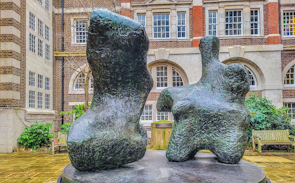
RECENTLY I NOTICED a sculpture close to Tate Britain but not within it.
When the Chelsea School of Art – now the Chelsea College of Art and Design – moved from Chelsea to Millbank next to Tate Britain, so did this sculpture by Henry Moore (1898-1986). Called “Two Piece Reclining Figure No 1” and created in 1959, this was originally placed in the Chelsea campus of the art school, where for a time in the 1930s Moore was Head of Sculpture. When the college relocated to Millbank, the Sculpture moved with it.
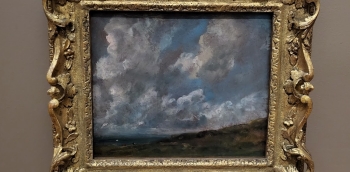
THE TATE BRITAIN art gallery in London is holding a special exhibition of the works of John Constable (1776-1837) and John Mallord William Turner (1775-1851) until 12 April 2026. Amongst the many magnificent paintings on display, there are several small paintings of clouds by Constable. I was particularly interested to see the cloud studies because I had written about them in my book “Beneath a Wide Sky: Hampstead and its Environs”. Here is an extract from my book. It deals with Constable and his interest in clouds:
“One of Hampstead’s attractions for Constable was its wide expanse of sky, which, as Barratt wrote, the artist:
‘… regarded as the keynote of landscape art, and so assiduously did he study cloud, sky, and atmosphere in the Hampstead days that Leslie, his biographer, was able to become possessed of twenty of these special studies, each dated and described. Constable was a man of Wordsworthian simplicity of character, fond of all things rural, and devotedly attached to birds and animals.’
The website of Cambridge’s Fitzwilliam Museum reinforces what Barratt wrote:
‘While living at Hampstead, Constable made a series of oil sketches of the sky alone, each one marked with the date, time and a short description of the conditions. His interest in clouds was influenced partly by the work of the scientist Luke Howard, who had in 1803 written a pioneering study, classifying different types of cloud ...’
In ‘The Invention of Clouds’ by Richard Hamblyn, a biography of the chemist and amateur meteorologist, who devised the modern classification of clouds (cumulus, nimbus, etc.), Luke Howard (1772-1864), it is noted that Constable, who was familiar with Howard’s work, focussed his concentration:
‘… on the extension of his observational range and clouds were the means that he had chosen for the task. After years of searching for an isolated image, seeking a motif upon which to weigh his technical advancement as a painter, he had found it at last in the unending sequences of clouds that emerged and dissolved before his eyes like images on a photographic plate.’
During the summers of 1821 and 1822, Constable made over one hundred cloud studies on the higher ground of Hampstead and its heath. Writing in 1964 in his ‘The Philosophy of Modern Art’, the art critic Herbert Read (1893-1968), who lived in Hampstead, commented that Constable was:
‘… rather a modest craftsman, interested in the efficiency of his tools, the chemistry of his materials, the technique of his craft. His preparatory ‘sketches’ are no more romantic than a weather report. But they are accurate, they are vividly expressed, they are truthful.’
And here the extract from my book ends. It is because of Constable’s ‘connections’ with Hampstead and the clouds above it that I chose the title “Beneath a Wide Sky …” I had seen a few of Constable’s cloud studies before, but never so many together as I viewed at the Tate Britain exhibition. My book is available both as a paperback and a Kindle from Amazon: https://www.amazon.co.uk/dp/B09R2WRK92
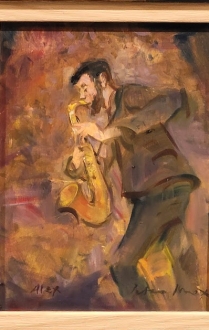
AT TWO TEMPLE PLACE, which is close to Temple Underground station, there is an exhibition, “The Weight of Being”, showing until 19 April 2026. The theme of the exhibition is “vulnerability, resilience, and mental health in art”. The show contains a good number of paintings and other creations by the artist John Wilson McCracken (1936-1982), an artist who is new to me. The reason for his inclusion in the show will become obvious soon.
From an early age, McCracken, who was born in Belfast and educated in Birmingham, displayed artistic talent. In 1956, he applied to enter London’s prestigious Slade School of Fine Art, and was accepted as a student. One of his teachers there was the artist Lucien Freud, who was a visiting tutor at the school. Soon, McCracken became a regular at the Colony Room, a drinking hole in Soho. It was here that leading artists including Freud, Francis Bacon, Frank Auerbach, and others met to drink, discuss, and argue. McCracken found himself in one of the epicentres of the world of then modern British art, and valued his encounters in this inspiring artistic milieu.
Near the end of his second year at the Slade, disaster struck. McCracken had a severe nervous breakdown. He was hospitalised, and diagnosed with schizophrenia. In the late 1950s and early 1960s, being diagnosed with ‘mental disease’ was a great social stigma, and an impediment for a young artist hoping for success in the London art world. His mother decided that the family should move away from London to the northeast, far away from London’s temptations and the intense atmosphere of the city’s art scene. They moved to Hartlepool, where the family had relatives.
McCracken continued his art education at West Hartlepool College of Art, where later he became a teacher. In addition, he worked in the town’s public Gray Art Gallery. While there, he not only arranged for a Lucien Freud exhibition to be brought from London to the gallery, but also got the gallery to acquire a wide range of then modern artworks by artists including LS Lowry, Frank Auerbach, John Bratby, and others. At that time, the works of these now very famous artists were affordable, and by purchasing them, McCracken ensured that the gallery acquired an important collection of modern British art. In addition, he formed a collective of artists called Front Group, whose members believed that contemporary art should not be confined to galleries in London.
While all this was going on in Hartlepool, McCracken never stopped painting. Most of his work depicts people. But like Francis Bacon, whom he knew, his subjects often are in awkward poses. Whereas Bacon distorted his subjects in a modern expressionist way, McCracken depicts them more realistically. As Angela Thomas, the curator of the exhibition, wrote in the catalogue:
“Like Freud he captured the humanity of his subjects: their gestures, postures, and unspoken stories, rendered with empathy and attentiveness.”
I am not greatly enthusiastic about Lucien Freud’s art, but what I have seen of McCracken I much prefer. Freud does not seem to like the people he portrays; he highlights their less attractive features. In contrast, McCracken appears to see what is likeable about his subjects, and gives them an empathetic rendering.
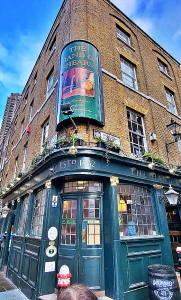
The Hand and Shears pub near London’s Smithfield Market is a delightful, old-fashioned drinking hole. It was granted a licence in 1552, but may have been in existence before that date. The building housing the pub was constructed in about 1852, and its interior has hardly changed since then. Apart from selling booze, the pub used to be a place where meetings were held, as well as coroner’s inquests.
The pub’s name derives from the that the building in which it is located was used by cloth merchants to settle arguments and other matters relating to their business.
Its centrally positioned bar serves customers in each of four rooms surrounding it. The rooms are separated from each other by partitions, but all of them face the bar which they surround. We visited the pub on a weekday at lunchtime. Many local business people were enjoying a sociable pint or two while chatting amongst themselves.
The Hand and Shears is what I believe a pub should be.
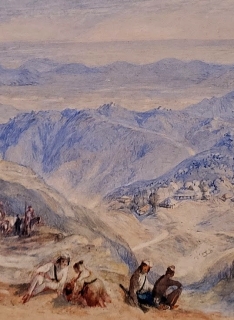
ALTHOUGH THE ROYAL Academician John Zoffany (1733-1810) visited India and created paintings there, the younger and more famous Academician JMW Turner (1775-1851) never visited the country. Yet, an exhibition at the Tate Britain in London, which is showing until 12 April 2026, contains two of Turner’s depictions of Indian landscapes.
Both Zoffany and Turner lived and worked before the birth and full exploitation of photography. Travellers could record their impressions of places both by writing and by sketching or painting. Amongst the many who went out to India in the nineteenth and earlier centuries, there were plenty of officials (both military and civilian) who recorded what they saw by sketching and with paints. It would seem that these people were skilled artists probably because art was included in their education. The images created were important for surveying and topographical purposes as well as, perhaps, a way of passing time in outposts where there was little else to do when the work of the day was over.
Turner, who had become a successful artist, was often commissioned by print publishers to create images that could later be reproduced as mass produced editions of engravings. He painted images of places he had visited as well as places he had never been to. India was one of the latter. However, he created beautiful watercolour depictions of Indian landscapes based on sketches that had been made by British army officers when they were based in India. The two ‘Indian’ watercolours on display in the exhibition are “Musooree and the Dhoon from Landor” (painted in 1835) and “Rocks at Colgong on the Ganges in Bihar” (painted c1835). Both are exquisitely executed and less ethereal than some of his better-known paintings.
“Turner was a great and inventive colourist. If you look at his work from the beginning to the end of his life, the early works are quite dark and sombre, but the later ones are full of colour – brilliant yellow, red, blacks, crimsons, blues. Even if he hadn’t been to somewhere like India, he lived in a place where a lot of people had and they were bringing back descriptions of a more colourful place than England, which was smoky and dark and dull and raining all the time. People were coming back to this England with memories of a place that was full of colour. This was bound to change people’s ideas. In Sir John Soane’s museum in London, there is a bright yellow living room, almost an Indian yellow. That was a yellow that was introduced in Turner’s lifetime, much brighter than anything available before. The tastes for those colours would definitely have been brought back from the empire.”
Even if we cannot be certain, it is possible that some of the pigments brought back from India might have found their way on to his glorious canveses.
The two Indian landscapes form only a minute part of a large, well-attended show setting the works of Constable and Turner side-by-side. Yet, seeing them really helped make the exhibition a ‘hit’ for me. Soon, I will write about other aspects of this show that caught my interest.