Order and chaos portrayed in South London’s Peckham

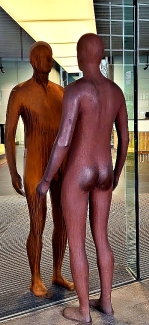
THE ARTIST LEONARDO Drew was born in 1961 at Tallahassee, Florida (USA), and now works in Brooklyn (New York City). Until 7 September 2025, an entire, large room at the South London Gallery in Peckham is occupied by a work by Drew, which has the name “Ubiquity II”.

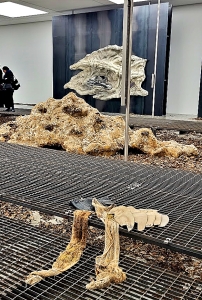
At first sight, the viewer is confronted by what looks like the chaotic result of a big explosion. The room is filled with fragments of wood, some of which is piled in heaps leaning against the walls, and the rest scattered on the floor, on which visitors tread. On closer examination, it can be seen that there are fragments of mirrors amongst the debris, and almost every piece of wood has paint or some other modification on it.

Despite looking like disorganised chaos, it is not. The artist carefully selected each of the fragments, modified them (often with paint), and then carefully arranged them to produce what the viewer sees. He has created the depiction of chaos and destruction in a most careful orderly way. As the gallery’s website put it, Drew:

“… creates reflective abstract pieces that play on the tension between order and chaos. Transforming and eroding materials by hand in the studio, he explores the cyclical nature of life and decay.”

And given what is happening in the world today, this powerful depiction of order and chaos is particularly relevant.

A warehouse filled with wonderful artefacts in east London

MANY MUSEUMS INCLUDING London’s Victoria and Albert (‘V&A’) own far more items than they have room to display them. The objects for which there is no gallery space to display them usually lie hidden away in museums’ storerooms. Following the example of a museum in Rotterdam, the Museum Boijmans Van Beuningen, the V&A has created an open access storeroom, where members of the public can see many of the objects that were formerly hidden away from view in the museum’s old warehouses.

V&A East Storehouse, which was designed by the American studio Diller Scofidio + Renfro, opened its doors to public visitors on 31 May 2025. It is in the Queen Elizabeth Olympic Park near East London’s Stratford Station and West Ham’s football stadium.   We had to queue for about 20 minutes before gaining admittance on a sunny Sunday afternoon. It was well worth waiting to see this incredible creation.

The parts of the Storehouse which are open to the public are arranged on three floors. The upper two are on galleries that overlook the lowest floor. Stepping into this edifice is rather like entering a huge B&Q or Ikea warehouse filled with shelving. However, there the similarity ends. The shelves are covered with an amazing variety of artefacts, ranging from ancient to modern times, and sourced from all over the world. There is also a viewing platform that allows visitors to watch the museum’s conservators working. Another room houses only one exhibit: an enormous backdrop that Picasso painted for the 1924 performance of the ballet, “Le Train Bleu”. It measures 10.4 by 11 metres, and is the artist’s largest known painting.

Without going into much detail, it seems that whoever arranged the artefacts in the Storehouse had a great sense of humour. For example, a twentieth century chair is placed right next to a rococo chest of drawers, and a fragment from a mediaeval church is placed immediately above an early example of a television. Few of the artefacts are labelled apart from bearing their museum inventory numbers. Dotted around this contemporary Aladdin’s Cave of cultural treasures, there are several exhibits with labels that explain various aspects of running the V&A and its curatorial philosophy.

With good transport connections to central London, there is no excuse not to visit the city’s latest fascinating cultural experience: the V&A Storehouse.

Your comments about this introduction to a new book about India would be very welcome

I am at present writing a book about my recent travels in India. I would be most grateful if you would read through this draft of my opening paragraph, and send me your observations about it. Would you want to read further? The paragraph is beneath this photograph taken in Jaipur.

Early one morning in February 2025, our British Airways Boeing 777 jet began moving away from the oddly designed, apparently ‘eco-friendly’, Terminal Two at Bangalore’s International Airport. As the aeroplane taxied smoothly towards the runway, I watched the parched airport terrain and its assortment of buildings, some painted with red and white checkerboard patterns, slipping past. Then with a certain suddenness heralded by an increase in the noise of our jet engines, we accelerated along the runway. Soon, we became detached from the soil of India. As the aircraft rose higher and higher, random memories flashed through my mind. These included eating laal maas on a rooftop in Jaisalmer; a distraught restaurant owner in Jodhpur; a Dutch cemetery on the Coromandel Coast; hawkers wandering up and down a railway carriage in West Bengal; riding through Bangalore in a Jesus autorickshaw; blessing a newly married couple in Pondicherry; tasting homemade nolen gur in Murshidabad; attending an aarti on the Ganges; eating ravioli in Auroville; the ghost of Tipu Sultan; and much more. After flying over the west coast of India, all these experiences and a whole host of others that we had enjoyed during our 88 day stay in India (between November 2024 and February 2025) became, like the Indian coastline over which we flew, distant memories which I hope will remain etched permanently in my mind. In the pages of this book, I will revive these and a whole host of other reminiscences and explore them in detail. I want my readers to enjoy and understand what we experienced during our almost three month long stay in India.

The art of demolition in London’s Dering Street

THE ANNELY JUDA Fine Art Gallery is currently in London’s Dering Street, but it will soon be moving to a new location in Mayfair’s Hanover Square. To celebrate the gallery’s forthcoming departure from Dering Street, its final exhibition at that address is called “Demolition”. It is a collection of artworks created by Tadashi Kawamata (born 1953 in Japan). He lives and works in Paris (France).

The name of the exhibition describes what the viewer will see: demolition. The artist has dismantled the gallery’s walls and panelling and used the fragments and debris from them to create a series of art works, which together make the gallery look like a building site. This might sound ridiculous, but the sculptural forms he created from the fragments of the gallery’s structure are both intriguing and exciting. It looks like someone had exploded a bomb within the gallery. However, certain elements remain untouched: cctv cameras, light switches, smoke detectors, and electrical sockets. Kawamata is well known for his site-specific creations. In addition to the sculptural ensembles that he created using the fabric of the gallery, there are several beautifully intricate three-dimensional maquettes of other projects the artist has planned or carried out.

Now, Annely Juda is a commercial gallery. I asked a member of its staff whether the amazing works that were on view in the gallery were for sale. He said that they are, and the artist will recreate the works for clients in their own spaces.

This amazingly unusual exhibition will continue until 5 July 2025.

A relic of a monastery in Dorset

A SMALL SIX-SIDED stone structure stands in the heart of the town of Sherborne in Dorset (UK). It is built with a yellowish stone in the mediaeval gothic style. Open to the elements on each of its six sides, its ceiling is a perfect example of gothic fan vaulting. Although it looks like a small kiosk or somewhere to shelter from the rain, it was not built as such.

Sherborne is famous for its magnificent gothic abbey church, which stands a few yards from the structure mentioned above. Until 1539, the church was attached to a Benedictine monastery. The latter was dissolved by Henry VIII in 1539, when most of the monastic buildings were either destroyed or sold. Some of them now form part of the venerable private Sherborne School.

Like most monastic institutions, that at Sherborne had cloisters. The six-sided structure, now known as ‘The Conduit’ was originally built in the early 16th century as part of the cloisters, to serve as a washing place for the monks. It survived the demolition of the monastery, and now forms pat of the quaint urban landscape of central Sherborne.

Why are some post boxes in Britain not coloured with red paint?

PETER WILSON WAS born in the English county of Dorset in 1968. In the 2012 Olympic Games, he won a gold medal in a shooting event.

To celebrate Britons who won gold medals in the 2012 Olympic Games and Summer Paralympics, the Post Office painted several letter boxes with gold-coloured paint. It was originally planned to be a temporary measure, but as the public gave it much approval, the boxes have remained gold,

Peter Wilson’s Olympic achievement is celebrated by a gold letter box that stands in Sherborne, in Dorset. It can be found on Cheap Street. A plaque attached to it is there to remind people why the letter box is gold rather than the usual red.

Depicting a sea creature at a garden in Devon

DESPISED BY MARINERS whose boats are fouled by these creatures that attach themselves firmly to the hulls of vessels, they are important in the seawater eco-systems. I am referring to barnacles, which are arthropods of the subclass Cirripedia. The mature barnacle attaches itself to surfaces including boats, seashells, sea creatures including whales, and rocks, using an incredibly strong glue that they secrete. Once stuck in place, they feed by filtering the water through their bodies, extracting plankton from it. Thus, barnacles assist in the purification of seawater. For those who are concerned with ecological matters, barnacles are a useful indicator of water quality in coastal environments.

Our daughter, who is the curator at UP Projects, an organisation that commissions and executes public art works, has been involved in producing a sculpture, “I travelled 66 million years to be with you and then you came”, created by the artist Anne Duk Hee Jordan. It was unveiled on 4 June 2025. The sculpture is a depiction of the bodies of barnacles, greatly enlarged, perched on a pile of slate stones on which shapes of fossils have been carved. The barnacles are sculpted in porous materials that, like real barnacles, filter and purify water that passes through them. As UP’s website explained, the barnacle forms:

“… are made from materials with water-filtering properties, including Roman concrete, a plant-based version of activated charcoal known as biochar, shell fragments, zeolite minerals and iron oxide …”

By using these materials, the barnacle sculptures not only resemble the creatures’ forms but also their filtration functions.

The sculpture is being displayed in the garden of A La Ronde, a curious eighteenth-century house near Exmouth in Devon for a few months. Maintained by the National Trust, this (almost circular) building has sixteen sides and a central octagonal lightwell. It was built in 1796 by two cousins, Jane and Mary Parminter. With fine views of the River Exe and its estuary, the eccentrically designed house is filled with curiosities collected by the Parminters. These objects include many natural items such as seashells, bird feathers, fossils, bones, and rocks. No doubt some of these specimens have the shells of dead barnacles attached to them.

It is quite appropriate that Duk Hee’s modern sculpture, which simultaneously celebrates the importance of barnacles and purifies water falling on it, has been placed in the garden of a house once owned by two ladies who, judging by their extensive collection of seashells and other natural objects, had a great interest in the environment in which they lived. The artist’s creation serves as an object on which to concentrate while contemplating the importance and fragility of the eco-system that supports life as we know it.

A garden of great beauty in Wiltshire

THE COURTS GARDEN is in Holt in Wiltshire. The gardens surround a house that was built for a clothier in about 1720, although some parts of the structure were built 200 years earlier.

In 1900, the house was purchased by the architect Sir George Hastings. It was he who laid out the magnificent gardens surrounding the house. The property changed owners in 1910 and then again in 1920, when it was purchased by Major TCE Goff and his wife Lady Cecile. She was influenced by the garden designer Gertrude Jekyll, and created various new features in the garden. The Goffs donated the house and gardens to the National Trust in 1943.

Well-maintained, this beautiful garden is well worth a visit.