King Alfred gazes over Winchester

KING ALFRED RULED the West Saxons from 871 to c886 and king of the Anglo-Saxons from c886 to 899. He was known as ‘Alfred the Great’. Amongst his many achievements was encouraging education and proposing that primary education was taught in (Old) English, rather than Latin. Winchester was Alfred’s capital and the place where he was buried there for a while. After the Norman Conquest in 1066, his remains were removed to Hyde Abbey near Winchester. This was destroyed in 1538 during the Reformation. Despite this, his grave remained intact until 1788, when the land where he was interred was redeveloped to build a jail. Since then, the whereabouts of his remains is unknown.

Despite, the disappearance of his bones, King Alfred dominates the centre of Winchester in the form of a huge statue near to the city’s cathedral, rich in gothic features, and its Guildhall, which is richly adorned by Victorian gothic features. The statue was erected in 1899. A plaque at its base reads:

“To the founder of the kingdom and nation D. October DCCCI. Winchester and the English name MDCCCI”

DCCCCI, being Roman for 901 and MDCCCCI, being Roman for 1901.

The tall bronze statue was designed by Sir William Hamo Thornycroft (1850-1925), a sculpto who might have been unknown to me had I not become aware of him whilst walking near London’s Holland Park back in 2017. He was an important figure in the New Sculpture movement, whose members’ oeuvres bridged the gap between the neo-classical tradition, popular during the 19th century, and early modernist trends at the end of the 19th century and beginning of the next.

I was roaming around Kensington taking photographs of buildings of interest prior to writing a piece about them when I spotted a plaque on a house in Melbury Road. Number 2a was Thornycroft’s studio, which was designed by his friend, the architect John Belcher (1841-1913).

Although I did not realise that they were created by Thornycroft before I wrote this today, I am familiar with two of his other creations: the statue of Oliver Cromwell outside The Houses of Parliament and “The Sower” at Kew Gardens. His Alfred statue is far larger than the other two.

I wonder what the great king would have thought if he knew that at his feet today, there is a short-term car park and that his capital’s cathedral now charges a fee for visitors to enter within it.
A chapel that became a barn

PHILIP’S NAVIGATOR BRITAIN is a detailed (1 ½ miles to the inch) road atlas covering England, Scotland, and Wales. It is extremely useful for finding one’s way through Britain’s maze of narrow country lanes if, like us, you do not make use of GPS systems. One of the many features of the maps in this atlas is that it marks old buildings and other sites of interest in both towns and deep in the countryside. Recently (June 2021), we were driving around in rural Wiltshire, having just visited the small town of Bedwyn when I spotted that there was an old chapel nearby, close to the hamlet of Chisbury.

The area in which Chisbury is located is the site of an ancient hill fort in which archaeologists have found artefacts from the Palaeolithic era, as well as the Neolithic and Bronze Ages. The fort, whose earthworks are still discernible, was later used by the Romans. Long after the Romans had left England, the manor house of Chisbury was built within its site.

In the 13th century, the Lord of Chisbury Manor built a ‘chapel of ease’, St Martin’s, close to his manor house. According to Wikipedia, such a chapel is:

“…a church building other than the parish church, built within the bounds of a parish for the attendance of those who cannot reach the parish church conveniently.”

The chapel of ease at Chisbury was built to serve the household of the Manor House as well as villagers nearby, to save them having to travel to the nearest parish church which was in Great Bedwyn.

In 1547, during the Reformation of The English Church, the chapel, like many other places of worship in Henry VIII’s realm, ceased to be used. Instead of being demolished, as so many ecclesiastical buildings were at that time, the chapel was re-used as a barn. The barn continued to be used over several centuries until 1925, when it was designated a building of historical importance. Now, it is maintained by English Heritage. This re-purposing of a place of worship reminded me of what I saw when I visited Albania in 1984. At that time, religion of any sort had been made illegal by the Stalinist regime led by Enver Hoxha. Mosques and churches had either been demolished or re-purposed as sports halls, cinemas, and for other non-religious uses.

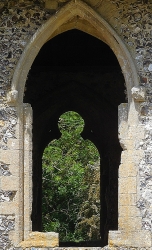
The chapel of Chisbury is beautiful. The glass has been long lost from its windows. Trees can be seen from within the chapel through its carved stone gothic windows. The ceiling of the chapel is timber framed, but I suspect that these are no longer the original timbers. The roof is thatched. The floor is at two levels, higher at the west end than the east. Steps lead from one level to the next. The two levels might reflect the fact that the chapel is built on a steeply sloping hill.

On the inside of the west wall of the building, close to the way into the chapel, there is a faded red painted circle enclosing a cross. Symbols like this were painted on to the walls of buildings during the consecration ceremonies of building about to become churches. What you can see in the chapel at Chisbury must have survived many centuries. Maybe, it has been touched up from time to time.

It is written that Jesus Christ was born in a kind of barn surrounded, as the story goes and many artist have depicted, by farm animals. I wonder whether this went through farmworkers’ heads as they used the former chapel as a barn for a variety of agricultural purposes.

Had it not been for builders working nearby, the chapel would have been silent except for birdsong. I am glad we made the small detour to see this delightful relic of mediaeval life in England.

Afternoon by the canal

THE VILLAGE OF APSLEY, now a suburb of Hemel Hempstead in Hertfordshire, has no connection with Apsley House at London’s Hyde Park Corner. The house, once home to The Duke of Wellington, derives its name from Apsley in Sussex. The place in Hertfordshire, which we visited with friends today, derives its name from an Anglo-Saxon word meaning ‘aspen’ (a kind of tree). We had lunch with our friends at a waterside pub called The Paper Mill.

Although the pub appears to be of recent construction, its name recalls the fact that it is built near the site of a once innovative paper making establishment. John Dickinson (1782-1869) was the inventor of a machine that made paper continuously as opposed to the previous manual methods that produced sheets of paper rather than rolls of it. He also invented a range of other practical products including security paper impregnated with silk threads, which was known as ‘penny post’, and, still in use today, the envelope with a gummed flap.

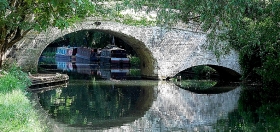
During the early part of the 19th century, Dickinson bought several mills in and around Apsley. He converted these for the manufacture of paper products. Only one of his three mills still stands today. The mills were located close to the then recently built Grand Junction Canal (now ‘Grand Union’). The canal provided a practical mode of transport for raw materials and finished products. The pub where we ate lunch is named to honour the memory of what was once a thriving industry in Apsley. It is located next to the canal and contains a framed family tree of John Dickinson’s family.

After a lazy lunch in the sun by the waterside, we took a leisurely stroll along the canal. Modern housing developments line parts of the stretch of water flowing through Apsley. Other parts are lined with shady trees and dense bushes, which hide modern office buildings that are served by a main road running parallel to the canal. Unlike other stretches of the canal, which we have walked along, there was a notable absence of waterfowl, except for a couple of swans with their four cygnets, and a pair of ducks. Other signs of life on the canal were the occasional slow moving narrow boat and the inhabitants of stationary craft moored along the banks and in a marina near the pub.

It was a hot afternoon and being beside the canal was pleasant. Occasional gentle gusts of cool air added to our enjoyment.

Take me to the Tivoli

WIMBORNE IS A CHARMING small town in Dorset, a little north of Poole and Bournemouth. Famed for its Minster church with its mediaeval chained library, the place is rich in old buildings. One of these, looking less old than many of its neighbours, houses the Tivoli Theatre. It attracted my attention because of its (heavily restored) art deco features.

Housed in what was originally the 18th century Borough House, the theatre-cum-cinema was created in 1936 to the designs of Edward de Wilde-Holding, a prolific architect. The cinema was closed in 1980 and was threatened with demolition for a road scheme, which fortunately was abandoned. It was restored by a group called ‘Voluntary Friends of the Tivoli’ and reopened in 1993. In addition to showing films, the theatre is used for live events on its stage.

The Tivoli was not the only art deco cinema we spotted on our recent trip to the area around Winchester. 28 miles northeast of Wimborne, there is another one, The Plaza in Romsey, which was built in 1931 as a cinema but is now used as a theatre. Unlike the Tivoli in Wimborne, which occupies an old building, the Plaza in Romsey was purpose-built as a cinema.

Ideas and appearance

EVERY YEAR SINCE 2000 (except 2020), the Serpentine Gallery in London’s Kensington Gardens has commissioned a temporary pavilion to be constructed next to it. A website (www.inexhibit.com/case-studies/serpentine-galleries-pavilions-history/) explains:

“The pavilions, which last for three months and should be realized with a limited budget, are located in the heart of the Kensington Gardens and are intended to provide a multi-purpose social space where people gather and interact with contemporary art, music, dance and film events.”

The architects chosen to design these temporary structures have not had any of their buildings erected in London prior to their pavilions. Some of the architects involved over the years included Zaha Hadid, Smiljan Radić, Sou Fujimoto, Herzog & de Meuron and Ai Weiwei, Kazuyo Sejima and Ryue Nishizawa, Frank Gehry, Olafur Eliasson & Kjetil Thorsen, Álvaro Siza, and Eduardo Souto de Moura with Cecil Balmond, and Oscar Niemeyer.

With a very few exceptions, I have liked the pavilions and admired their often visually intriguing, original designs. My favourites were the 2007 pavilion by Olafur Eliasson & Kjetil Thorsen; 2009 by Kazuyo Sejima and Ryue Nishizawa; 2013 by Sou Fujimoto; and 2016 by Bjarke Ingels.

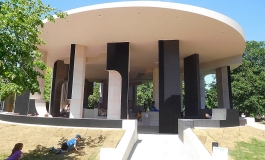
This year, the pavilion was designed by an architectural practice, Counterspace, based in Johannesburg (South Africa) and led by Sumayya Vally, who is the youngest architect to have become involved in the Serpentine pavilion project. According to the Serpentine’s website (www.serpentinegalleries.org/whats-on/serpentine-pavilion-2021-designed-by-counterspace/) the 2021 pavilion is:

“… based on past and present places of meeting, organising and belonging across several London neighbourhoods significant to diasporic and cross-cultural communities, including Brixton, Hoxton, Tower Hamlets, Edgware Road, Barking and Dagenham and Peckham, among others. Responding to the historical erasure and scarcity of informal community spaces across the city, the Pavilion references and pays homage to existing and erased places that have held communities over time and continue to do so today.”

Well, maybe this was the designers’ aim, but it does not convey that concept to me. This circular, building coloured black and white, immediately conjured up in my mind images of often disused municipal structures such as bandstands and public conveniences that might have been constructed on provincial British or even South African seafronts in the 1930s to 1950s. It might have been conceived with high-minded ideas in the architects’ heads, but I felt that the structure is lacking in visual interest both in detail and in its entirety. Compared with many of the previous pavilions erected on its site, this is one of the dullest I have seen. It is a shame that the pavilion’s creators did not put more effort into its appearance than into the message(s) it is supposed to convey.   To my taste, it is a disappointment but do not let me put you off: go and see it for yourself.

A peculiar post office

WHEN I WORKED AT MAIDENHEAD, I used to travel there by train from London Paddington. Many of the trains terminated at a station called Bedwyn, which serves Great Bedwyn. I visited this small town on the Kennet and Avon Canal for the first time only recently.  While driving through the place, I noticed a building covered with gravestones and other ornamental carving. My curiosity was aroused.

The name ‘Bedwyn’ might have been derived from ‘Biedanheafde’, an Old English word meaning ‘head of the Bieda’, which referred to a stream in the area. In 675 AD, “The Anglo Saxon Chronicle” recorded the battle of ‘Bedanheafeford’ between Aescwine of Wessex and King Wulfhere of Mercia, which is supposed to have been fought near the present Great Bedwyn. The will of King Alfred the Great (c848-899) makes reference to Bedwyn. In short, Bedwyn has been a recognizable settlement for a long time.

Bedwyn’s combined post office and village shop can be found in a long, rectangular brick building on Church Street. The wall at the east end of the edifice carries a depiction of the Last Supper and above it, God on a throne, surrounded by saints and angels. These sculptural panels are in white and blue and somewhat resemble the kind of things produced by the Florentine sculptor Luca della Robia (1400-1482). Three gravestones are attached to the west facing end of the post office. A wooden gate next to this end of the building is labelled ‘Mason’s yard’. The front of the building, facing the street, is adorned with carved funerary monuments including gravestones, some of which bear humorous inscriptions.

The shop is attached to a house with a front door framed by a gothic revival porch. A carved panel in the porch reads: “Lloyd. Mason.” I asked some of the customers queuing up to enter the shop/post office if they knew anything about the curious decoration of the building. I was told that the place had once been the workshop of a stone mason who specialised in funerary items. My informant said that most of the carvings attached to the building were test pieces made by the stonemason’s apprentices; rejected or uncollected items; and offcuts.

Benjamin Lloyd (1765-1839), who died in Bedwyn, started his stonemasonry business in 1790 (www.mikehigginbottominterestingtimes.co.uk/?p=2825). He was responsible for some of the work done during the construction of the Kennet and Avon Canal, which began before he was born and was eventually completed in 1810. The company still exists. Now, it is run by John Lloyd, the seventh generation of the family to maintain the business (www.johnlloydofbedwyn.com/about-us). However, his premises have moved away from Bedwyn’s post office.

Benjamin Lloyd is buried alongside his wife Mary (1764-1827) in St Mary’s Church Burial Ground in Great Bedwyn. I do not know, but I would like to imagine, that their gravestone was made in the company Benjamin created.