My uncle and the USSR

THE MARXIST SOCIETY of the University of East Anglia had just held a meeting around it, so we were told by someone working in the Sainsbury Centre for Visual Arts on the university campus in Norwich. The object around which the political gathering was held is a 35 feet high model of a structure that was never built full size. The Russian architect Vladimir Tatlin (1885-1953) had planned to build a futuristic tower in Petrograd (aka ‘Leningrad’ and ‘St Petersburgh’), an example of Constructivism. The tower, which was to have been 1300 feet high, was planned to celebrate and house The Comintern (3rd International). Hoping to rival Paris’s Eiffel Tower and to symbolise the modernity of Soviet Russia, the tower was never built.
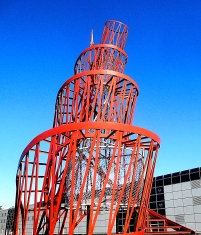
Model of Tatlin’s tower with the Sainsbury Centre behind it

Sometime, back in the early 1970s, it was decided to construct a model of the Tatlin Tower near the Hayward Gallery on London’s South Bank. This was not a simple task because the structure is complex, and proper detailed blueprints were unavailable. To make a model of the Tatlin Tower that was faithful to the designer’s original idea, and which would not topple over, the services of a structural engineer were required.  My uncle Sven, who worked for the firm of Felix Samuely and Partners, proved to be the man for the job. Working with the project’s director, Jeremy Dixon, my uncle had to unravel the plans of the structure using photographs of a 17-foot model of the tower that Tatlin had created in 1920 and a few existing images of plans that Tatlin had prepared. There were inconsistencies between Tatlin’s plans and the model produced in 1920. In 1971, Dixon:

“…built small models in balsawood to get it right, and he worked with Sven Rindl of consulting engineer Felix J Samuely & Partners, who generated detailed freehand drawings as they talked” (quoted from “Blueprint”, December 2011)

Dixon wrote about this in Sven’s obituary as follows:

“I particularly remember working with him on the reconstruction of the remarkable tower that Vladimir Tatlin produced as a monument to the Third International, the communist organisation founded in 1919, for the Art in Revolution exhibition at the Hayward Gallery in 1971. The project required us to go back to first principles to reinvent its extraordinary geometry and structure.

Sven would sit listening and commenting during our complex voyage of discovery, and at the same time he would be drawing. These drawings would be remarkable, elegant, three-dimensional sketches straight off the sketch pad, finished and complete. They were graphic works of art as well as documentation of engineering ideas.”

(https://www.theguardian.com/news/2007/apr/30/obituaries.mainsection)

The model was built with timber inside the Hayward Gallery before being exhibited outside it in 1971 as part of an exhibition called “Art in Revolution: Soviet Art and Design since 1917”.

Forty years later in 2011, another model of the Tatlin Tower was produced, this time made of a more durable material, steel. Once again, the project was overseen by Jeremy Dixon. The completed model was first displayed in the courtyard of London’s Royal Academy. In an advance notice of the project (www.architectsjournal.co.uk/archive/ra-unveils-tatlins-tower), my uncle, who had died in 2007, was given a prominent mention:

“The 10.5m high steel structure in the Annenberg Courtyard was designed by architects Jeremy Dixon of Dixon Jones Architects, Christopher Cross, Christopher Woodward and engineer Sven Rindl. The tower will form part of the Royal Academy’s forthcoming exhibition, Building the Revolution: Soviet Art and Architecture 1915-1935 which opens on 29 October 2011.”

I remember going to view the model and then seeing a small exhibition about it and its construction. The exhibition, which was held inside the Royal Academy, included images of some of the beautifully drawn plans and diagrams created by my uncle.

The steel model of the Tatlin Tower, which was exhibited at the Royal Academy in 2011, has been lent to the Sainsbury Centre by the academy. Painted in red, this model of an experiment in futuristic architecture stands outside and close to the magnificent building that houses the Centre. The edifice, which is now over 40 years old, but looks like new, was designed by the architects Norman Foster and Wendy Cheesman.

We had no idea that there was a model of Tatlin’s tower next to the Sainsbury Centre when we visited it in September 2021. My wife and I were pleased to see this reminder of a much-missed relative whom we both loved dearly.
A bridge in suspense

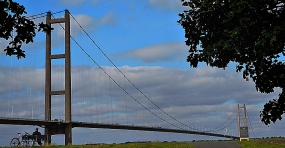
MY WIFE WAS studying to become a chartered accountant in the mid-1970s. As a trainee, she was required to carry out audits for her company in many parts of the UK. One of these was the building site where the Humber Bridge, which crosses the River Humber and links north Lincolnshire with the East Riding of Yorkshire. The bridge has a long span suspended between two tall concrete towers. When my (then future) wife arrived to audit the accounts of the entity involved in the construction, the towers had already been erected but there was no span for carrying the roadway across the river. A precarious looking cradle, attached to cables suspended between the towers, was used to cross the river. Some of the construction workers used it to traverse the Humber.

Being a keen and extremely assiduous trainee accountant, my wife wanted to inspect the construction site in considerable detail. Respecting her desire to examine the site properly, the managers on the site ensured that this happened. After carrying out the audit, she returned to London satisfied and has always held a special affection for the then yet to be completed bridge.

It was only a few years after my wife qualified as a chartered accountant that the bridge was eventually opened for use in mid-1981. The bridge is 1.38 miles in length and is currently the world’s eleventh longest bridge of this design (https://en.wikipedia.org/wiki/Humber_Bridge). A small toll is payable to cross it, which is what we did while travelling from Yorkshire to Lincolnshire in September 2021. After driving across the elegant, impressive bridge, we drove through the small town of Barton-upon-Humber to reach a bridge viewing park. There, my wife and I enjoyed snacks whilst gazing at the bridge for which she still harbours a soft spot. There is no accounting for taste!

A curious sundial

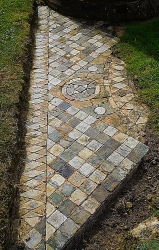
Standing on the central stone at noon, the person’s shadow is cast on the stone marked ‘XII’

AN INTERESTING SUNDIAL in the gardens of Blickling Hall, Norfolk consists of numbered stones laid out around a larger central stone. When someone stands on the central stone, his or her shadow will fall on the stone bearing the hour of the day.. This is an example of an ‘anellematic’ sundial.

Digging for riches

SWAFFHAM IS A SMALL town in Norfolk, west of Norwich. Two of its former inhabitants enriched their lives by digging. One of them is more widely known than the other. The lesser known one was a pedlar, who lived in the 15th century and was most probably called John Chapman.

The pedlar had a dream in which he was told to go to London Bridge to receive some good news. He ignored it at first but after it had recurred several times, he set off for London with his pack on his back and his dog at his side. When he reached London Bridge, he found nothing, and received no good news. After a few days of lurking on the bridge, one of the shopkeepers on that ancient crossing of the Thames asked him what he was doing. The pedlar related his dream and the shopkeeper replied:

“How foolish you are. You should not believe such dreams. Why, only last night I dreamt that I should go to Swaffham in Norfolk and dig under an apple tree where a pot of treasure was buried. Do you think I should believe that? Of course not, my friend. If I were you, I would go home and ignore such dreams.”

Hearing this, the pedlar realised that he had just heard the good news for which he had come to search.

Back in Swaffham, the pedlar dug beneath his apple tree and discovered a pot of gold. After emptying the pot, he added it to the wares he was peddling. The pot had a label attached. As the pedlar was illiterate, he asked a local priest to read it to him. The words on the pot said:

“Beneath me, thou shalt find even greater riches.”

The pedlar returned to his apple tree and began digging again. Lo and behold, he discovered another pot filled with gold, far more than in the first.

Whether or not this tale is true, there was a John Chapman in Swaffham, who lived in the town and was a church warden in 1462, at the time when the parish church was being rebuilt. He donated a huge amount of money towards building both the church’s tower and its north aisle.

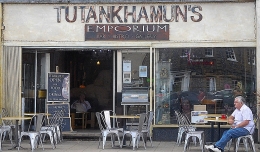
The existence of the digging pedlar and his story might possibly be questioned by sceptics, but that of Swaffham’s other famous digger is beyond doubt. When we visited Swaffham recently, it was hard to miss seeing an eccentric looking café-cum-curio shop called ‘Tutankhamun’s Emporium’, with the subtitle  ‘Bar, Bistro, Gallery’. In addition to a Russian restaurant called Rasputin, the choice of an Ancient Egyptian’s name for a café in Norfolk struck me as odd until we visited the town’s small museum.

Samuel John Carter (1835-1892), a noted Victorian animal artist and illustrator, was born in Swaffham. After studying at the Royal Academy, Samuel lived both in London and Swaffham. He married Martha Joyce Sands, born in Swaffham, and the couple produced 11 children, the youngest of whom was named Howard. They lived most of the time in London, where Howard was born (in Kensington). Howard, a sickly youngster. Was sent from London to live with Samuel’s sisters in Swaffham.

Howard Carter (1874-1939) spent most of his childhood in and around Swaffham. Like his father, Howard had great artistic talent. He used to visit local country houses with his father when the latter was up in Norfolk. One of these was Didlington Hall near Swaffham. Its owner, William Amhurst Tyssen-Amhurst (1835-1909), an MP, was a great collector of books and antiquities. The collection included many Ancient Egyptian artefacts, which fascinated young Howard. In 1890, the Amhursts were visited by Percy Newberry (1869-1949), who worked for the Egypt Exploration Fund. Discovering Howard’s talents as an artist and interest in history, Newberry invited him to work at the British Museum, copying tomb and other wall paintings that had been discovered in Egypt. Soon, Carter was sent out to Egypt on archaeological expeditions to work alongside the archaeologists. In 1922, Howard discovered the tomb that contained the remains of the boy king (pharaoh) Tutankhamun (c1341-c1323 BC). This discovery brought great fame to Howard: a digger brought up in Swaffham.

The local museum in Swaffham has displays relating to Carter and Tutankhamun. Both might be flattered if they were to learn that a small town in Norfolk, many thousands of miles away from the River Nile, has a café named after the short-lived pharaoh. As for the pedlar, the town is full of images of him trudging along with a pack on his back. In the parish church, which he might well have helped to finance, there are woodcarvings of him and his dog.

We visited Swaffham whilst travelling around Norfolk because we had read that it has an attractive parish church and an unusual 18th century circular market cross. However, learning about the pedlar and the archaeologist, two famous diggers, were unexpected bonuses for us.

Party in a Tudor hall

WE ATTENDED A WEDDING in a most attractive location today, the 25th September 2021. The ceremony was held in the great hall of a palace favoured by Queen Elizabeth I. Built in 1497, most of the palace was demolished but this superb hall, a masterpiece of Tudor architecture, remains. The great hall has a newer neighbour, a triumph of Jacobean architecture: Hatfield House built in about 1608 and incorporating material from the former palace of which only the great hall remains. The Jacobean edifice was built for Robert Cecil (1563-1612), First Earl of Salisbury. Some of his descendants still reside in the house.

With about 250 people attending and dining at long tables, it was not hard to imagine such joyous festivities occurring during the Tudor heyday of the great hall.

The first, the best, and the only

DURING THE PENULTIMATE year of our daughter’s time at secondary school (i.e., high school), we, her parents, were invited to several early evening meetings to hear about options for her higher education. At one of these, representatives from three US universities gave talks about the delights and advantages of studying at universities in the USA. One of the Americans explained that when applying, you should only include things that you were the first to do; things that you were best at; and things that only you have done. She emphasised this by saying:

“You have to be the first, the best, and/or the only.”

Well, our daughter chose not not to move to the USA to study, but, chose to study at Cambridge University. Recently, we visited a country house managed by the National Trust, which can easily claim to be the first and the best, and maybe the the only. The property is in Norfolk and is called the Blickling Estate. Its last owner was Philip Henry Kerr, 11th Marquess of Lothian (1882-1940), who was instrumental in getting the National Trust Act passed by Parliament in 1937. At his death, he bequeathed the Blickling Estate to the National Trust. It was the FIRST large Jacobean house to become a property run by the National Trust.

Built in the 1620s for a wealthy London lawyer, Sir Henry Hobart (died 1626), who did not live long enough to see it completed, Blickling Hall is the BEST Jacobean building in the care of the National Trust. As for fulfilling the ONLY criterion, as advised by the above-mentioned lady from an American university, this is more difficult because like all other National Trust properties, Blickling Hall is unique; it is the only Blickling Hall.

However, apart from many things that makes Blickling Hall so special, there is one other aspect of it that gives it some extra kudos. Currently, it has the largest second-hand bookshop of all such outlets run by the Trust. But this is a place well worth visiting for its interiors, exteriors, and fine gardens, both formal and otherwise. I feel that it is one of the first places you should see in Norfolk, as well as being one of the best, but only you can judge whether I am right.

Out on the tiles in North Yorkshire

YORKSHIRE IS RICH in the ruins of abbeys and other religious institutions, which were all dissolved (closed down) by Henry VIII in the 16th century and left to decay. The better known of Yorkshire’s ruined abbeys include those at Fountains, Rievaulx, and Whitby. In the North Yorkshire district of Ryedale, there are the extensive ruins of a former Cistercian abbey, founded in 1137 and called Byland Abbey. Having visited ancient but still intact and well-preserved Cistercian monasteries in various places in France, I have a reasonable idea of what these places look like. What I particularly liked about the ruins at Byland was that although much of the old stonework has been taken away and incorporated in other buildings, sufficient remains not only of the abbey church but also of the many buildings (e.g., the refectory, the cloisters, the chapter house, and the abbot’s house) that made up the monastic settlement. Having seen the monasteries in France I was able in my mind’s eye to create an image of how Byland might have looked in its heyday.

Apart from its great beauty as a ruined church, the abbey’s vast former church has something that I cannot recall ever having seen at other ruined abbeys I have visited. Exposed to the open air and risking being trod upon by visitors are many quite large expanses of mediaeval floor tiling. Many of the fired clay tiles still bear their coloured glazes. There are patches of tiling where they are laid out in circular geometric patterns. It was surprising to see such a great number of these tiles because even in many of the still intact British churches and cathedrals, such ancient flooring is quite rarely preserved to such an extent as in the ruined Byland Abbey.

I was told that when the abbeys were dissolved by Henry VIII, their roofs were removed, and this ensured that the buildings became unusable and fell into decay. The west end of Byland’s huge church contains the remains of a masonry circle that was once the frame for an enormous rose window, believed to be a prototype for the rose window that still can be seen at York Minster. While the Minster is a sight not to be missed, so is Byland Abbey. The latter might not have such a spectacular location as the ruins at Whitby and Rievaulx, it is, in my opinion, a far more interesting place to explore.

Only the name is the same

AFTER A SUNNY DAY spent at Whitby in North Yorkshire, we stopped for a drink at sundown in a small pub for a pre-prandial alcoholic beverage. Behind and slightly above the pub, we could see a well-maintained 12th century parish church with later modifications and a square tower. Below the pub, a narrow stream, lined with bushes and trees, ran alongside the main road. Apart from the infrequent passing car, the place was silent except for some pleasant birdsong. From where we sat on the terrace of the hostelry, we could see a small, sloping village square with a simple war memorial, some parked cars, and a small post box. At first, I did not realise where we had stopped. Then, I noticed that the village is called Kilburn.

Kilburn, North Yorkshire

There is another Kilburn about 215 miles south of the lovely village where we stopped for an evening drink. The latter is in North Yorkshire and the place with the same name many miles south of it is in north London. Apart from sharing the same name, London’s Kilburn is anything but rustic and peaceful, as many Londoners will know. London’s Kilburn is not really picturesque in conventional people’s eyes; it might appeal to lovers of urban sprawl.  It is a crowded metropolitan area with much commercial activity and a racial profile infinitely more diverse than that of the village in North Yorkshire.

I am not sure which of the two Kilburns is the oldest. North Yorkshire’s village was mentioned in the Domesday Book of 1086 and named ‘Chileburne’. London’s Kilburn was a settlement on an ancient Celtic route, a track between the places now known as St Albans and Canterbury. A priory was constructed on a stream that flowed through where London’s Kilburn now stands. The stream was known variously as ‘Cuneburna’, ‘Kelebourne’, and ‘Cyebourne’.

Whatever the origins of these two Kilburns, I know which of them is the place where I would prefer to linger in front of a glass of bitter.