
Rusting but floating
She waits in the still water
For what? I know not

Rusting but floating
She waits in the still water
For what? I know not
THE CITY OF CHELMSFORD is the county town of the English county of Essex. It is a place that until November 2021 we felt. without any reason, was not worthy of a visit and have tended to avoid, skirting it on its by-pass. It was only recently that we realised that the place is home to a cathedral. Being nearby on a recent tour in Essex and curious about its cathedral, we paid a visit to Chelmsford and were pleasantly surprised by what we found.
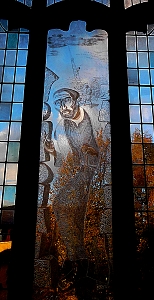
The cathedral, which I will discuss later, is housed in what used to be the parish church of St Mary. The edifice is in the centre of a pleasant grassy open space. One of the buildings on the south side of this green bears a plaque commemorating Thomas Hooker (1586-1647), who was the curate and ‘Town Lecturer’ (a position established by the Puritans) of Chelmsford between 1626 and 1629.
Hooker was born in Markfield, a village in Leicestershire (www.britannica.com/biography/Thomas-Hooker) and studied at the University of Cambridge (https://connecticuthistory.org/thomas-hooker-connecticuts-founding-father/). At Cambridge, he underwent a moving religious experience that made him decide to become a preacher of the Puritan persuasion. He became a well-loved preacher, first serving the congregation of a church in Esher (Surrey) before moving to preach at St Mary’s in Chelmsford in 1626. A preacher in a neighbouring parish denounced Hooker to Archbishop Laud (1573-1645), a vehement opponent of Puritanism, and was ordered to leave his church and to denounce Puritanism, which he was unwilling to do. In 1630, Hooker was ordered to appear before The Court of High Commission. Soon, he forfeited the bond he had paid to the court and, fearing for his life, fled to The Netherlands.
In 1633, Hooker immigrated to The Massachusetts Bay Colony, where he became the pastor of a group of Puritans at New Towne (now Cambridge, Mass.). To escape the powerful influence of another Protestant leader, John Cotton (1585-1652), Hooker led a group of his followers, along with their cattle, goats, and pigs, to what was to become Hartford in what is now the State of Connecticut. They arrived there in 1636.
When Hooker and his followers reached the Connecticut Valley, it was still being governed by eight magistrates appointed by the Massachusetts General Court. In 1638, Hooker preached a sermon which argued that the people of Connecticut had the right to choose who governed them. This sermon led to the drawing up of a document called “The Fundamental Orders of Connecticut”, which served as the legal basis for the Connecticut Colony until 1662, when King Charles II granted The Connecticut Charter that established Connecticut’s legislative independence from Massachusetts. Hooker’s importance in this process has led him to be remembered as “the father of Connecticut.”
In 1914, the church of St Mary in Chelmsford, was elevated to the status of ‘cathedral’. The reason for this is slightly complex but is explained in a well-illustrated guidebook to the cathedral written by Tony Tuckwell, Peter Judd, and James Davy. In the mid-19th century, London expanded, and the size of its population grew enormously. Many previously rustic parishes that became urbanised were absorbed from the Diocese of Rochester into the Diocese of London. This resulted in a denudation of the Diocese of Rochester. To compensate for this, Rochester was given parishes in Hertfordshire and Essex. The Archbishop of Rochester lived in Danbury, Essex, which was closer to the majority of his ‘flock’ than anywhere in Kent. In 1877, the county of Essex was transferred into the new Diocese of St Albans in Hertfordshire. However, by 1907, 75% of the population of this new diocese were living in Essex. A further reorganisation led to the creation of two new dioceses, one in Suffolk and the other in Essex. After some acrimonious competition between the towns of Barking, Chelmsford, Colchester, Thaxted, Waltham Forest, West Ham, and Woodford, it was decided that Chelmsford should become the cathedral seat of the new Diocese of Essex. St Mary’s, where Hooker of Connecticut once preached in Chelmsford, became the new cathedral. In 1954, the cathedral’s dedication was extended to include St Mary the Virgin, St Peter, and St Cedd, whose simple Saxon chapel can be seen near Bradwell-on-Sea.
The cathedral, of whose existence we only became aware this year, is a wonderful place to see. Its spacious interior with beautiful painted ceilings contains not only items that date back several centuries but also a wealth of visually fascinating art works of religious significance created in both the 20th and 21st centuries. To list them all would be too lengthy for this short essay, so I will encourage you to visit the church to discover them yourself.
Having just visited Chelmsford, its cathedral, and its tasteful riverside developments, my irrational prejudice against entering the city and preferring to avoid it by using its bypass has been demolished. Although Chelmsford might not have the charm of cathedral cities such as Ely, Canterbury, Winchester, and Salisbury, it is worth making a detour to explore it if you happen to be travelling through East Anglia.
As a last word, it is curious that although there are places named Chelmsford in Massachusetts, Ontario, and New Brunswick, there does not appear to be one in Connecticut; at least I cannot find one.
MALDON IN ESSEX was home to a truly remarkable man. Edward Bright (1721-1750) was short lived but easily recognisable. In his younger days, he was a post boy riding between Maldon and Chelmsford (www.itsaboutmaldon.co.uk/edwardbright/). He had to give up this job when at the age of 12 years, his weight had reached 12 stone (www.bbc.co.uk/essex/content/articles/2008/05/15/fat_man_maldon_feature.shtml).

Later, Edward became a candle maker and grocer in Maldon. His business operated from rented premises opposite the Plume Library, a converted church in the heart of Maldon. He died at the early age of 29, which might not come as surprise when you learn that when he was 28, he weighed nearly 42 stones (265 kilogrammes). A year later, he had put on another two stones. By that time, he was 5 foot and 9 inches in height, his chest measurement was 5 foot and 6 inches, and his stomach measured 6 feet and 11 inches (about 210 centimetres). These measurements necessitated special clothing to be made to fit him.
On the first of December 1751, a bet was made at Maldon’s King’s Head Inn. A prize of a ham, some chickens, and several gallons of wine, was to be awarded if nine men were able to fit inside Bright’s enormous waistcoat. The nine men, whose names and professions are listed on a memorial in Maldon, were easily accommodated inside the vast waistcoat. The memorial, located in an alleyway that connects the High Street with a car park, has a depiction of this occasion, a bas-relief sculpted in bronze by Catharni Stern (1925-2015) in 2000.
Bright fathered at least one child, also named Edward Bright. The parish burial register records that when the overweight man was buried at All Saints’ Church:
“’A way was cut through the wall and staircase to let it down into the shop; it was drawn upon a carriage to the church and slid upon rollers to the vault made of brickwork, and interred by the help of a triangle and pulley. He was a very honest tradesman, a facetious companion, comely in his person, affable in his temper, a tender father and valuable friend.” (www.itsaboutmaldon.co.uk/edwardbright/)
Although there was much of Edward Bright to be seen when this larger than average character lived in Maldon, this pleasant town has much more to offer the visitor including a lovely promenade alongside the estuary of the River Blackwater.
ONCE LONDON’S HAMPSTEAD had two pubs or taverns named ‘The Flask’. This should not come as a great surprise as Flask used to be a common name given to pubs. One of them, The Upper Flask, used to be located at the top (northern) end of East Heath Road and the other, The Lower Flask’ was (and still is) on Flask Walk, a street leading off Hampstead High Street.
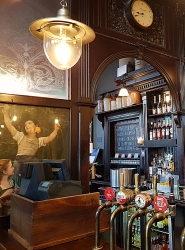
The Upper Flask used to be a remarkable establishment. Once called ‘The Upper Bowling Green House’ because of its good bowling green, it was a meeting place favoured by fashionable and ‘cultured’ men (mainly) and women during the 18th century. It was a summer meeting place for The Kit Kat Club, which thrived in the early 18th century and whose members included literary figures and political personalities, who supported the Whig Party. The Upper Flask figures several times in “Clarissa”, a lengthy novel by Samuel Richardson (1689-1761), first published in 1747. The place ceased operating as a hospitality business in the 1750s, when it became a private residence (www.british-history.ac.uk/vch/middx/vol9/pp81-91). In 1921, it was demolished to clear the site for building the Queen Mary Maternity Hospital (https://ezitis.myzen.co.uk/queenmaryhampstead.html), which has since become the site of a luxury housing complex.
The Lower Flask (in Flask Walk) is also mentioned in “Clarissa”, but unflatteringly as:
“… a place where second-rate persons are to be found often in a swinish condition,” (quoted from “Old and New London”, by Edward Walford, about 1880).
Unlike the lost Upper Flask, the formerly named Lower Flask is still in business, but much has changed since Richardson published his novel.
Located at the eastern end of the pedestrianised stretch of Flask Walk, the former Lower Flask, renamed The Flask, was rebuilt in 1874 (and extended in 1990; https://historicengland.org.uk/listing/the-list/list-entry/1322190). Formerly, it had been a thatched building and was a place where mineral water from Hampstead’s chalybeate springs was sold. It and Keith Fawkes’ second-hand bookshop are the only things in Flask Walk, which were in existence when I used to visit Hampstead regularly in the 1960s and 1970s. In those, now far-off, days, I remember that there used to be another second-hand bookshop and a butcher, both on the south side of the passageway. Before the 20th century, there used to be a fair held for a few days in August on the triangular open space a few yards downhill from The Flask pub. Close to The Flask, also on Flask Walk, miscreants could be found languishing in the parish stocks. Both the stocks and the fair are now but long distant memories recorded only in books published many decades ago.
Oddly, despite visiting Hampstead literally thousands of times during the last more than 65 years, it was only on Halloween 2021 that I first set foot in the Flask pub, and I am pleased that I did. The front rooms of the pub retain much of their Victorian charm and the rear rooms are spacious. Although we only stopped for a drink, I could see that the Sunday lunches being served to customers around us looked delicious. We hope to return there soon.
LANCASTER GATE IS ten minutes’ walk or a three-minute bus ride away from where I have lived for over 29 years. I have passed it innumerable times, yet I have never explored it. Yesterday, the 30th of October 2021, I decided it was high time that I took a closer look at the place. The name refers to an entrance to Kensington Gardens as well as a nearby network of streets. The network includes a long street extending from east to west between Craven Terrace (near Paddington Station) and Leinster Terrace. The section of road between Craven Terrace and Bayswater Road is also called Lancaster Gate. Midway along the long east-west section of the Gate, there is a wide street, almost a square or piazza, that leads to Bayswater Road. This rectangular piazza is south of a rectangular loop to the north of the east-west section, in the centre of which there is a 20th century building called Spire House. If this sounds confusing, then please look at a map!

What I have called the ‘piazza’ opens out onto Bayswater Road. In the middle of it, there is a monument topped with the weather worn sculpture of a seated child, probably male. The sculpture sits above a bas-relief depicting the western façade and the dome of London’s St Paul’s Cathedral. Below, on the south side of the pedestal, there is a bas-relief, depicting the face of a man with a bushy moustache and a long luxuriant beard. Weather and/or pollution has worn away details from his portrait. At first sight, I thought that it was a representation of George Bernard Shaw as an old man, but it is not. It is, according to the almost undecipherable inscription beneath it, the face of Reginald Brabazon, the 12th Earl of Meath, who lived from 1841 to 1929. The words on the plinth include that he was “a patriot and a philanthropist”.
Brabazon was Anglo-Irish and born in London (https://en.wikipedia.org/wiki/Reginald_Brabazon,_12th_Earl_of_Meath). Educated at Eton, he became a diplomat, but resigned from the Diplomatic Service in 1877. Ten years later, he joined the House of Lords as a Conservative peer. Reginald and his wife, Mary, devoted much of their lives to relieving human suffering and ameliorating social conditions. Amongst his many good works was the establishment (in 1882) of a charity called the Metropolitan Public Gardens Association, whose aim was the preservation of public open spaces and the creation of new ones, which might explain why the memorial to him faces Hyde Park. The Portland stone monument, known as The Meath Memorial, was designed by Joseph Hermon Cawthra (1886-1971) and unveiled in 1934.
A few feet north of Brabazon’s memorial, which stands on a wide traffic island, there is a slender stone column topped by an ornate octagonal structure surmounted by a shiny metal crucifix. The base of this column reveals that it is was built as a WW1 memorial. In the pavement between the two memorials, the City of Westminster has set several informative panels about the history of Lancaster Gate. The development of Lancaster Gate, originally known as ‘Upper Hyde Park Gardens’, began in the late 1860s, an initiative of the developer Henry de Bruno Austin. Many of the houses he built have rich stucco facades and porches supported by neo-classical style pillars. Quite a few of them are now hotels. These buildings are interspersed with a few newer buildings, presumably where the originals were bombed during WW2. However, most Lancaster Gate’s houses are those built in the 19th century.
The name Lancaster Gate was chosen to honour Queen Victoria, who was amongst many other things, the Duchess of Lancaster.
Before Lancaster Gate was developed, it was mostly agricultural land. Until 1775, the composer, actor, botanist, and playwright John Hill (1716-1775) had his Physic Garden here. By 1795, visitors flocked to the area to enjoy the springs and fresh air at the Bayswater Tea Gardens, which later was renamed the Flora Tea Gardens, and then the Victoria Tea Gardens. This establishment closed in 1854.
At the southern end of the loop and towering above the plaza with its two monuments, there is a tall church tower with a spire. This is all that remains of the Christ Church, Lancaster Gate, whose construction began in 1854. The last service to be held in the church was in 1977, by which time the roof was badly infected with dry rot. The church was demolished, but the tower retained. Where the body of church stood, there is now a block of flats. Opened in about 1983, it is appropriately named Spire House. Its 20th century architecture is quite attractive and contrasts dramatically with the stuccoed Victorian buildings that face its west, north, and east sides. Spire House has external concrete supporting pillars that suggest an updated version of the flying buttresses used in mediaeval church architecture.
Lancaster Gate is a relatively unspoilt example of mid-Victorian town planning and worthy of a short visit. While walking around the area, I only spotted one blue plaque, commemorating a resident worthy of note. It recorded that the “Chemical Scientist” Sir Edward Frankland (1825-1899) lived in Lancaster Gate from 1870 to 1880. He was one of the founders of organo-metallic chemistry and a discoverer of Helium. Also, he took an active interest in the problem of pollution of rivers and the quality of London’s water. I trust that he would be pleased to know that fish have returned to London’s once filthy River Thames.
After exploring Lancaster Gate and its sea of stuccoed facades, head east into Craven Street, where you can find several cafés and at least one pub.

To stroke a street cat
Gives enjoyment and gladness
To both man and beast

I HAVE WATCHED AND GREATLY enjoyed many plays by Tom Stoppard. So, it was with high expectations and great excitement that I booked good tickets for his latest play, “Leopoldstadt”, which is about a tragic period during Austria’s history, a time that interests me greatly. The play follows the history of a Jewish family living in Vienna between the late 19th century and about 1955. Like many Jewish families living in Germany and Austria, they were determined to appear increaslingly less Jewish and ever more like their gentile neighbours, a process known as ‘assimilation’. As Amos Elon demonstrates in his wonderful book, “The Pity of it All”, the more assimilated the Jewish people became, the less they were tolerated by their mostly anti-Semitic neighbours. Stoppard’s play attempts to portray this sad state of affairs in “Leopoldstadt”. His play was more like a history lesson than a compelling work of drama.
“Leopoldstadt” was being performed in London’s magnificent Wyndhams Theatre. Frankly, although there were a few wonderful scenes in the play, I was mostly disappointed. Although it was clearly a heartfelt and moving exploration of part of his family’s history, Stoppard has written far better and subtler plays in the past.
IN CENTRAL AHMEDABAD, a large city in India’s state of Gujarat, there is a curious café called Lucky. This popular eatery is not unusual because it does not serve coffee but because its tables and chairs are placed between Moslem graves. Lucky’s is sited on an old Moslem graveyard, but this does not put off a steady flow of customers from enjoying a wide variety of vegetarian snacks in this eatery. Closer to home, near the south side of London’s Lambeth Bridge, there is another café sited on a former graveyard. Unlike Lucky in Ahmedabad, which is housed in an architecturally unremarkable building, the café in Lambeth, The Garden Museum Café, is a marvellous example of contemporary architecture.

The café, completed in 2018, is at the east end of the Church of St Marys, Lambeth, which now serves as the home of The Garden Museum. The church stands next to the main Tudor entrance of Lambeth Palace. The tower was built in about 1378. The rest of the church contains structural elements that were built in later eras. Appropriately for a museum dedicated to gardening history, the repurposed Church of St Mary’s is the burial place of the famous gardener and plant collector, John Tradescant the Elder (c1570s-1638). It is also the final resting place of Captain William Bligh (1754-1817) of The Bounty Mutiny (1789) fame. This famous mariner owned a house in Lambeth. Customers of the café do not sit on the graves of these two well-known persons, but on gravestones that, unlike the graves at Lucky in Ahmedabad which are raised above the ground, are level with the rest of the café’s floor.
The graves at Lucky in Ahmedabad are coffin shaped and probably contain the remains of the deceased. I am not sure whether there are human remains beneath the grave slabs in the floor of the café in Lambeth. A young waiter, whom I asked, was concerned to reassure me that he believed that there are no skeletons beneath the gravestones upon which customers walk and sit. I wonder whether this is really the case.
The Garden Museum was founded in 1977 by Rosemary and John Nicholson in order to preserve the church, which was due for demolition (https://gardenmuseum.org.uk/the-museum/history/). In 2015, the museum was closed for a year and a half whilst it was being redeveloped. Part of the improvements made was the construction of an extension at the eastern end of the retired church. The new construction, designed by Christopher Bradley-Hole and Dan Pearson, includes the café and other structures that together surround a new courtyard that contains a lovely garden, The Sackler Garden designed by Dan Pearson. It contains several tombs including that of the Tradescant family and of Captain Bligh.
The café borders the western side of the courtyard. Its mainly glass walls provide good views of the garden, the buildings across the river and the leafy remains of the churchyard west of the café. Where there is no glass, the walls are covered with overlapping brown coloured metal panels. Serving great coffee and both snacks and meals, the legs of the chairs and tables rest on the gravestones that form part of the floor.
Compared with Lucky, which is in a very busy part of Ahmedabad, the Garden Museum café, although close to a busy main road, is far more peaceful. However, both are delightful places to enjoy refreshments.

THE CORONET CINEMA in London’s Notting Hill Gate was renamed The Print Room a few years ago. Once a cinema, it is now a theatre. Like other theatres, it was closed for a long time during 2020 and early 2021 because of the covid19 lockdowns. During this prolonged period of closures, a statue was placed upon the dome that stands above the theatre’s main entrance. In my book “Walking West London” (freely available as a pdf file from https://adamyamey.co.uk/walking-west-london/), I wrote about the Coronet/Print Room as follows:
“… the former ‘Coronet Cinema’. This was designed as a theatre by WGR Sprague (1863-1933) who designed many of London’s theatres. It opened in 1908. By 1923, the Coronet had become a cinema, and remained so for many years. Apart from the screen, the fittings inside the auditorium were those of an unmodernised Edwardian theatre. Until smoking was banned in all public places, the Coronet was one of the last cinemas in London which permitted smoking (but only in the balcony seating). Between 2004 and 2014, the Coronet doubled up as both a branch of the Kensington Temple Church and, also, as a cinema. And, in 2015 the Coronet reverted to being used as a theatre, now called ‘The Print Room’. This sensitively restored theatre puts on interesting plays, which are well-produced. The bar, which is located beneath the stage in what was once the stalls area of the cinema, is worth visiting to see its ever changing, tastefully quirky décor. In 2020, the theatre was redecorated and a statue by the British sculptor Gavin Turk (born 1967) has been placed upon the dome above the building’s main entrance. The new artwork replaces one that was removed many decades ago.”
When I wrote this, the sculpture was enshrouded in a tarpaulin. Only recently, the covering has been removed and the sculpture can be seen in all its glory. The artwork depicts the artist Gavin Turk posing as the famous artist Sir Joshua Reynolds (1723-1792) just as he appears his sculptural in the Annenberg Courtyard of Burlington House in the grounds of the Royal Academy. When seen from the east, the new sculpture looks like a painter holding a palette and his brush. However, when seen from the west, the viewer might be led to believe that the statue is of a man holding a gun. I feel that the sculpture is a great addition to the landscape of Notting Hill Gate, but a bit too high above ground level to be able to see it easily with the unaided eye.
PARLIAMENT’S HOME IS OPPOSITE a wall that runs along the northern edge of the grounds of London’s St Thomas’s Hospital. The wall is separated from the River Thames by a walkway, the embankment between Westminster and Lambeth bridges. Almost every square inch of the river facing side of the wall, which is about 440 yards in length, is covered by hand-painted hearts of various sizes and in various shades of red and pink. Many of the hearts have names, dates, and short, sad messages written on them.

Each of the many thousands of hearts painted on the wall (by volunteers) represents one of the huge number of people who died because of being infected with the covid19 virus. The wall is now known as The National Covid Memorial Wall and work on the painting commenced in March 2021. The mural that records the numerous tragic deaths was organised by a group known as Covid-19 Bereaved Families for Justice. The names and other information added to the hearts is being done by people who knew the bereaved person being remembered. When we walked past the wall today, the 27th of October 2021, we saw a young lady carefully writing on one of the hearts. Seeing this and the wall with all its reminders of the pandemic-related deaths was extremely depressing. On our return journey, I insisted that we crossed the river and walked along the opposite embankment on which the Houses of Parliament stands. Even from across the river, the reddish cloud of hearts on the wall is visible. Certainly, this would be the case from the riverside terraces accessible to those who work and govern within the home of Parliament.
It is ironic (and maybe deliberately so) that the wall with its many tragic reminders of deaths due to covid 19 is facing the Houses of Parliament (The Palace of Westminster), where had different decisions been taken, sooner rather than later, many of the names on the wall might not have needed to be written there.
 yamey
yamey 