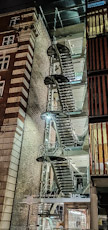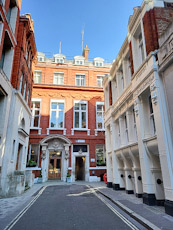
I HAVE WALKED past London’s Victoria Coach Station many times without looking at it particularly carefully. Yesterday, the 28th of September 2022, I was early for a meeting at the Embassy of Albania, which is not far from Victoria Station. So, I walked slowly, stopping to look at the Coach Station. I had never noticed before that it is a fine example of Art Deco architecture.
The Coach Station, which opened for use in March 1932, was designed by Wallis, Gilbert, and Partners.
I suppose that my interest in Art Deco buildings was initiated by visits to Bombay (Mumbai), where there are many splendid examples of this style of architecture. Gradually, I am discovering that London also has a rich collection of Art Deco buildings. The Coach Station is a fine and well-maintained example.
KNOLE HOUSE IN KENT is filled with marvellous things for the visitor to enjoy. The orangery contains an item that at first sight did not seem to be of great interest. It is a tall, bulky black iron heating stove. Undoubtedly impressive in both size and appearance, it was its inventor that interested me.
The stove, which used to heat Knole’s Great Hall, was patented by its inventor in 1765. The example at Knole was manufactured in 1774. The man who invented this kind of stove was Abraham Buzaglo (1710-1782), born in Mogador (Morocco), son of a rabbi who served in that town. In 1762 after many years travelling, Abraham settled in England.
Buzaglo’s stoves were multi-tiered devices, suitable for heating large spaces. He may have got the idea for his design having seen similar stoves whilst travelling on mainland Europe, particularly in Germany where multi-tier heating stoves were in widespread use. Coal was burnt in the bottom tier of the stove and a vent with a pipe conducted smoke and any fumes and smoke away from the oven without allowing them to enter the room where it was being used. How Buzaglo’s invention differed from earlier multi-tier stoves, I have not yet discovered. However, his stoves were in great demand. One of his trade cards, kept in the British Museum, reads as follows:
“Buzaglo Patent Warming Machine Maker To Their Majesties, Strand, London. N.B. Lately finished, a very Large and Elegant Warming Machine, with one fire only will agreeably Warm the Largest Church Hall, &c. and render any new Edifice immediately habitable, with a variety of others.”
Following the invention of his heating system, Buzaglo invented a therapeutic method that made use of the heat emitted. Patients waited near a stove until they were sweating profusely, and then undertook muscular exercise. This therapy, it was suggested, was especially good for alleviating the symptoms of gout. Buzaglo also invented a heater to warm carriages.
The Buzaglo stove at Knole was in use until the 19th century, when it was moved to be stored in the orangery. Apart from being an attractive bit of ironmongery, this rare example of a surviving Buzaglo heater introduced me to an 18th century inventor, whom I had never heard of before.
THE DISCOVERY OF Canada by Europeans is not usually at the forefront of my mind, especially just after an airflight landing in Venice. Yet when we disembarked from the waterbus that carried us from Marco Polo Airport to the city, I noticed a building that surprised me at the south end of the Via Garibaldi (in the Castello ‘sestier’ of Venice). It has one plaque commemorating Giovanni Caboto (c1450-c1500) and his son Sebastiano Caboto (c1450-c1557). Giovanni is better known (to me) as John Cabot. I had no idea that Cabot, the ‘discoverer’ of Newfoundland was from the Italian peninsular. Sebastiano was also a maritime explorer. His most famous work was done in South America.
Cabot(o) lived here in Venice
Giovanni Caboto’s birthplace is unknown, but is likely to have been in the Province of Genoa. By 1476, he had become a Citizen of Venice. He was a trader there. Getting into financial difficulties, he left Venice for Spain in the late 1480s. After seeking financial support for a trans-Atlantic expedition, which never happened, he set off for England in 1495. Cabot, as he became known in England, went to Bristol. From that seaport, he led at least three expeditions to explore the east coast of North America. During these voyages, he set foot on what is now called Newfoundland and probably also on parts of what is now Nova Scotia. One of his later expeditions is believed to have been one of the earliest attempts to discover a Northwest Passage.
Cabot received a reward for his services from England’s King Henry VII. Where John Cabot died is uncertain. It might have been during his last expedition to North America during the period 1498-1501, but no one knows for sure whether he died at sea, or in North America, or after his expedition had returned to England.
A monument on the house in Via Garibaldi, which was placed in 1982 by the Canadian Province of Newfoundland, records that John’s discoveries in 1497 were made with his son Sebastiano. The house that bears this monument (written both in English and French) and another one in Italian, is said to be the house where John Cabot lived in Venice. From many of its windows, the great explorer would have had a good view of the lagoon and the quays, where trading vessels might well have been loaded and unloaded.
Our rented apartment was on a narrow street leading off the Via Garibaldi. I was pleased to see that this is close to a narrow alleyway called Ramo Primo Caboto.
THERE IS A ROOM in Knole House (near Sevenoaks in Kent), which contains several portraits painted by Joshua Reynolds (1723-1792). One of them is a self-portrait. Near to this, there is a portrait of a man with a red cap, seated cross-legged. His youthful face has Chinese features. The sitter is Wang-y-tong (‘Huang Ya Dong’: born c 1753). Reynolds painted him in about 1776.
Wang was one of the earliest known Chinese people to have visited England. He came over following in the footsteps of an earlier Chinese visitor, the artist Tan-Che-Qua (c1728-1796), who arrived in London in 1769. Tan met King George III, and his work was shown at the Royal Academy in 1770. In about 1770, Wang was brought from Canton to England by John Bradby Blake (1745-1773), an employee of the East India Company. Blake was a naturalist and was interested in Wang’s knowledge of cultivating Chinese plants, and their uses. Wikipedia noted:
“Wang visited the Royal Society on 12 January 1775. In a letter of 1775, he is said to be about 22 years old. He was visited at Blake’s house, where he discussed the manufacture of Chinese ceramics with Josiah Wedgwood, and acupuncture with physician Andrew Duncan.”
It also describes how Wang became a page to Giovanna Bacelli (1753-1801), who was a mistress of John Sackville, 3rd Duke of Dorset, who owned Knole House. Wang lived at Knole, and was educated at the nearby Sevenoaks School. He returned to China by 1784, at which date he was working as a trader in Canton.
Wang’s portrait hangs amongst those of many famous men painted by Reynolds, including Samuel Johnson and David Garrick, as well as the 3rd Duke. The latter is said to have paid Joshua Reynolds 70 guineas (almost £76) to paint Wang’s excellent portrait. Wang was well-received in England. It would be interesting to learn what he thought about life as he found it at Knole and other places he visited in England.
I PRACTISED DENTISTRY in North Kensington’s Golborne Road between late 1994 and about 2000. When I first began working there and for a year or so afterwards, the practice faced a double-fronted, old-fashioned fruit and vegetable shop. It was run by the friendly Hicks family.
Later, Hicks closed. Their premises were acquired by their neighbour the Portuguese Lisboa Delicatessen, which continues to flourish today. Lisbon use the former Hicks shop as a warehouse. Whenever I have been able to peer inside the former fruit and veg shop, I have noticed that it’s current users have displayed e little if anything to change its interior appearance.
Hicks is just one of several shops on Golborne Road that have retained aspects of their original facades despite changes of ownership and usage.
UNTIL THIS SEPTEMBER (2022), I had only visited Knole House (near Sevenoaks in Kent) once, and that was in about 1972.
I remember three things about that visit. First, it was a grey, drizzly day. Second, in those far-off days, visitors were taken on a guided tour of the house. Third, was the miserable guide. He was an elderly man who did his best to seem unenthusiastic about Knole House. He took us from room to room, stopping at various exhibits, saying things like:
“This is a Jacobean cupboard. Quite interesting if you like that kind of thing”
And:
“Here is a Queen Anne clock. Quite interesting if you like that kind of thing.”
And:
“This is a carved wooden staircase, if you like that kind of thing.”
He made similar comments, always lacking in enthusiasm, each time he pointed out an exhibit or feature. What with the dull weather and the depressing commentary provided by the guide, I believe that subconsciously I avoided revisiting the place.
It was only recently, when we were on our way to visit some friends who live in Kent, that my wife said that she had never visited Knole, and that we should see the place. I agreed, thinking that it would be a good idea to see Knole again: to give it another chance. We went on a sunny afternoon. We walked at our own pace from room to room in the building that was the country home of an archbishop of Canterbury in the 15th century, and later (for over 400 years) the home of the Sackville family, which still resides there. In each room, there were knowledgeable National Trust volunteers who answered our questions and, unlike the guide I met on my first visit, inspired us with enthusiasm for the fascinating place.
Whereas after my first visit to Knole and the poor impression it made on me, I used to be reluctant to recommend people to visit it, but having seen it again, I would put into my top 10 places to visit in Kent.
AT THE END of a four day stay in Venice, a city, which I have loved ever since my early childhood days, I felt sad at the prospect of departure for home. Wandering about the city brought back happy memories of visits there with my parents as well as giving me the chance to experience familiar sights and to make new discoveries. Although Venice is a little overrun with tourists, its history as a gateway to points further east remains fascinating and evocative. So, the anticipation of leaving filled me with sadness.
We left Venice on a waterbus, which arrived punctually and was not overcrowded. After a lovely 70 minute voyage, which included stops at the Lido, the Fondamente Nove, and a couple of stops on the island of Murano (famous for its glass production), we arrived at Marco Polo Airport. And that is where our journey became wearying.
First, we had to queue to reach the baggage depositing facility for our airline Easyjet. Next, we discovered that our departure would be delayed by about 30 minutes. Then, we sat in a crowded waiting area without knowing from which gate we would be boarding our ‘plane. It was important to know this because there are two sets of passport control points, each leading to a separate set of gates. Once the gate was announced, another queue. This time, we had to wait (not too long) to have stamps placed in our non-EU passports. On arrival at the departure gate, we were told that boarding was beginning. What this meant was that everybody had to stand up, to show our boarding passes, and then to stand in a long sloping corridor for at least 10 minutes before we were invited on-board. The 1 hour 55 minute flight to London’s Gatwick Airport was pleasant, although delayed.
At Gatwick, we disembarked at a point distant from the immigration hall. The latter was reached after a good 15 minute walk. The passport control area was chock-full of people, some of them inebriated. Unlike in the EU, where EU and non-EU passport holders are separated, at Gatwick (and Heathrow), both kinds of passport holders and those from several other countries (e.g., Australia, NZ, and Japan) queue together to use the automated passport checking machines. The process, which might save spending on labour costs, is not user-friendly. Many passengers had difficulty using the machines and had to be helped by other passengers and a few members of airport staff. Fortunately, because it had taken so long to get through the immigration control, our suitcase had arrived in the baggage collection hall.
After one more short, but fast-moving queue, we reclaimed our car keys, and soon began the 1 hour drive home. Although I was so sad leaving Venice, after the many hours spent at airports and the numerous lines in which we waited, I was glad to be home. Years ago, when I was a child, leaving wherever we had spent our holiday was always sad, but even worse was returning to everyday routines of school and life in the staid Hampstead Garden Suburb, where we lived.
GIOVANNI BATTISTA TIEPOLO (1696-1770) is one of my favourite artists. I have been familiar with his works ever since my childhood, when we visited Venice annually from the late 1950s or early 1960s onwards. My parents took me from church to church to see the great master’s paintings, which I prefer to the somewhat more photograph-like paintings of Canaletto.
We used to stay in a pensione on the Fondamente Zattere, a waterfront facing across a wide canal to the Giudecca island. The Gesuati church was a few yards from where we resided in Venice. It contains ceiling panels and a wall painting, all created by Tiepolo. Often, we passed the church and almost always entered it to gaze up at Tiepolo’s ceiling. I cannot remember it, but my sibling recalls that almost every morning, early, my father used to stand quietly and alone in the church for a few minutes.
I became so keen on Tiepolo that I broke my train journey between Ostend and Vienna to spend a night in Würzburg in order to see Tiepolo’s paintings in the city’s Residenz (a palace).
This September (2022), I was walking along a narrow passageway (Calle S Domenico) when I spotted a commemorative plaque above an archway leading into a long narrow courtyard surrounded by tall residential buildings. The plaque recorded that in the courtyard there was the house in which Tiepolo was born on March 1696. Exactly in part the courtyard, the Corte S Domenico, the artist was born, I could not determine. However, I had never seen this place before and was thrilled to have stumbled across the place where one of my favourite artists was born.