
Can you tell me
If the cat’s happy or sad
By the shape of its tail?

Can you tell me
If the cat’s happy or sad
By the shape of its tail?
SAINT THOMAS MOUNT in Chennai is best known for being the place where St Thomas was martyred (by whom I have no idea). A friend in Bangalore, John Fernando, told me that apart from the much-revered saint, another notable person is commemorated on the summit of the Mount. His bust can be found near the east end of the church almost hidden away between a couple of banyan trees. The bust is a depiction of the British Colonel, William Lambton (1753-1834).

It is appropriate that the soldier Lambton is commemorated on the summit of the Mount. For, it was from this lofty place that in 1800 he commenced his trigonometric fieldwork for his project, a great trigonometric survey of India.
To quote Wikipedia, Lambton’s:
“… initial survey was to measure the length of a degree of an arc of the meridian so as to establish the shape of the Earth and support a larger scale trigonometrical survey across the width of the peninsula of India between Madras and Mangalore. After triangulating across the peninsula, he continued surveys northwards for more than twenty years. He died during the course of the surveys in central India and is buried at Hinganghat in Wardha district of Maharashtra.”
Lambton’s assistant was George Everest (1790-1866), who succeeded him as Surveyor General of India. Everest is associated with a famous Peak in the Himalayas. However, it was not him but two others, Andrew Scott Waugh and Radhanath Sikdar, who ascertained the mountain’s height.
I am grateful to John for mentioning Lambton’s memorial to me. Even without seeing this bust, a visit to Saint Thomas Mount is worthwhile as there is much of interest to see there including an old church built by the Portuguese, gravestones and paintings with Armenian script on them, and the vibrant nature of Indian Christianity.
THE GOVERNMENT MUSEUM in Chennai has a magnificent collection of mostly early medieval Hindu and Buddhist bronze sculptures. One of these wonderful religious artworks was exceptionally interesting. At first sight, it seems like a sculpture of a human figure, but soon you will notice many odd things about it.
The figure has two right arms and one left arm. It’s left breast is female in form. The right is male. The right side of the torso has male characteristics, but the left side has sensuous female curves. As for tthe shapes of the buttocks, the right one is different from the larger left one. The right leg is largely unclothed, but the left is covered with a depiction of a cloth covering.
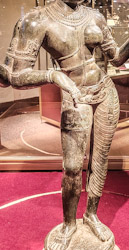
The statue I gave been describing is half male and half female. According to an information panel nearby, this sculpture is an 11th century depiction of Artanarishvara. It is a composite of Shiva (right half) and Parvati (left half). It represents the belief that the Godhead, Shiva, and his consort, Parvati, cannot exist without each other. It also shows that without the coexistence of male and female, human life cannot be propagated and continued. No doubt, there is much more meaning encompassed in this interesting sculpture, but I am not competent to discuss this further. Suffice it to say, seeing this unusual sculpture gave me food for thought.
Until today, I had never seen an Artanarishvara. This beautifully crafted work was one of many lovely pieces in the bronze collection of Chennai’s version of the British Museum.
ONE OF THE FIRST things that a visitor sees when entering Chennai’s Fort St George is a cupola supported by eight fluted pillars topped with Ionic capitals. It looks as if it ought to contain something, but it is empty.
In 1792, after losing a military campaign against the army of the British East India Company, the ruler of Mysore, Tipu Sultan, surrendered two of his sons as hostages to be held by the British. They were handed over to the British commander Lord Cornwallis. Tipu’s sons were taken to be held by the British until he had paid them an enormous sum of money, deemed to be reparations for damages that were supposed to have been inflicted on his British opponents. He managed to pay this ‘ransom’ after a couple of years, and his sons were returned.

Cornwallis was regarded as a great hero by the British. In about 1800, Thomas Banks sculpted an enormous stone statue of Cornwallis standing on a tall stone cylindrical base. The base has figures sculpted in bas-relief. The bas-relief depicts the moment when Tipu’s sons were handed over to Cornwallis.
At first, the statue was housed in the above-mentioned cupola. Later, it was moved indoors, first to the Long Room of the Connemara Library, and then later to the museum in Fort St George. It was moved indoors from its original position beneath the cupola, because, to quote an informative panel near it:
“… of ill feeling caused by certain reliefs on its base.”
Well, at least it was never toppled to the ground as was the case with, for example, statues of Stalin, Enver Hoxha, and the Bristol slaver Edward Colston.
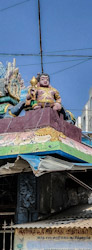
High on a corner
Watching life passing by
The deity sits still
THE CHURCH OF ST MARY in Fort St George in Chennai (Madras) was constructed by 1680, when it was consecrated. It is the oldest Anglican church east of Suez.
The church contains a memorial to the founder of the famous American Yale College – Eliahu Yale. He had been Governor of Chennai’s Fort St George, where the church is located, between 1687 and 1692. He had also been the vestryman and treasurer of St Mary’s church.

The font within the church is made of a form of black granite known as Charnockite. This stone is named after Job Charnock (c 1630-1693). A member of the British East India Company, he is credited with founding a British settlement at a pre-existing village on the bank of the Hooghly River. Although the place had already been settled long before his arrival, Charnock’s establishment grew into what is now Kolkata (Calcutta).
In about 1678, Job entered a romantic relationship with a Hindu woman, whom he called Maria. They produced a son and three daughters. The daughters were baptised in the font in St Mary’s in Chennai in August 1689. A few years later, Job died. His funerary monument is in Kolkata, where he passed away. Like the font in Chennai, Job’s tomb, which is housed in a mausoleum in Kolkata, is made of Charnockite. This form of granite can be found in the south of India. It was local to Chennai but far from Kolkata. This type of rock was first described in Tamil Nadu and was named in honour of Job Charnock.
Apart from the font and the memorial to Yale, the church of St Mary’s has many fascinating sculpted monuments to Britishers who died in India or on their way to or from it.
PARKS ARE SAID to be a city’s lungs. They are places where one can escape from the noises and fumes mainly created by traffic. On New Year’s Day 2023, we took a walk in Bangalore’s Cubbon Park. Almost as soon as we had entered it, the air seemed cleaner, and we experienced an uplifting sense of serenity.

Cubbon Park was laid out in 1870 under the direction of Major General Richard Sankey, British Chief Engineer of Mysore State. Initially named after Sir John Meade, it was later renamed to honour Sir Mark Cubbon (1775 – 1861), the longest serving Commissioner of Mysore State. The name was changed again in 1927 to Sri Chamarajendra Park, in honour of Sri Chamarajendra Wodeyar (1863–1794), ruler of Mysore State when the park was created. There is a statue of this man in the park. Despite that change of name, the place is still popularly known as Cubbon Park. Even the recently built metro station at the northern edge of the park has that name.
The popular park has plenty of trees that provide shade. Many different species grow in the park, several of them flowering trees. Footpaths cris-cross the park, but visitors do not need to be confined to them. A main road winds its way through the verdant landscape, but this is closed to vehicular traffic on Sundays.
Words are inadequate to convey the joys of Cubbon Park. Only by entering this lovely island of nature in Bangalore’s ocean of urban development can one appreciate the beauty and delightfulness of this city’s important green lung.
WHEN MRS BRONSON OPENED her 10 bed boarding house in Bangalore in 1887, it became the city’s first hotel. Her establishment became The West End Hotel. It was, and is still, the best hotel in Bangalore. Set in beautiful grounds, the West End is home to Bangalore’s supposedly oldest letter box.

The cast-iron cylindrical pillar box is surmounted by a royal crown, below which are the words “post office”. The word “letter” is below the crown and above the slot for inserting mail. Below this slot, there is a large plate with mail collection times engraved on it. The plate seems to be newer than the rest of the pillar box.
Beneath the plate, there is a circular cartouche with lettering that has become difficult to read because it has been painted over so many times. However, I could make out the word “Greenock” and other wwords including “suttie”, “tho”, “street”, and “??thga??”. These indistinct words allowed me to direct my search of the Internet.
I discovered that Thomas Suttie of Greenock manufactured pillar boxes identical to the one at The West End in 1858. Only one of these has survived in the UK, but 7 or 8 of them can still be found in India. They are at The West End, in Vire, in Darjeeling, in Shimla, and two in Kasauli. There are also a few in Pakistan. One example, dated 1856, stands in the National Museum of Scotland in Edinburgh.
The year 1858 is of interest. It was when the Indian Uprising, which commenced in 1857, was coming to an end. It was also when the British Government decided to take over the governig of India from the East India Company.
The Suttie pillar box at The West End is still in use. Mail is collected from it three times a day. Given its date of manufacture, it is much older than The West End Hotel. Why it stands there is a mystery to me. Maybe the hotel acquired it as an antique curio. This is the third functioning historic post box I have seen in Bangalore. The other two are at the Bangalore Club and its near neighbour, The Bowring Institute.
Happy New Year!
NEXT TO THE POST OFFICE on the corner of Bangalore’s Museum and State Bank of India Roads, there is a recently opened Museum of Communication. Housed in an old-fashioned Bangalorean bungalow, it is effectively a museum of the Indian postal services. This well laid out museum contains a variety of exhibits ranging from postage stamps to large pieces of mechanised equipment. I will describe a few of the many exhibits that interested me.
There is a photograph of the world’s highest post office (somewhere in the Himalayas). There is an enormous piece of equipment, which occupies the whole of a room. It was used for transmission of money orders. Several panels described the history of the Indian freedom struggle and that of the Indian Post.

Outside on the museum’s shady verandah, there is a collection of old letter boxes. They include boxes of various shapes, sizes, and colours. One of them bears the Portuguese words “CAIXA POSTAL”. Once upon a time, it must have been used in one of Portugal’s Indian colonies, but there was no information about its original location.
Outside the museum, and still in use, there is a hexagonal pillar box, very similar to one placed at the Bowring Institute in the late 1880s. Unlike the one at Bowring, which bears the British Indian postal insignia, the box near the museum has been modified to make it look like a post-Independence Indian Post pillar box.
Next to the entrance to the museum, also on the verandah, there is aalifesize model of an Indian postman of yesteryear. Wearing a green and white uniform (including a turban) with some red trim, he has a sack slung over his left shoulder. His right hand is stretche out in front of him. In it he holds a wooden shaft tipped with a sharp metal spear tip. Four small bells are attached to the base of this tip. A lantern hangs from his right wrist.
In the past, the postman mafe his way from village to village along paths through the jungle. The spear tip and its staff were used to ward off wild animals. The lantern was used to light his way, and the bells were rung to alert villagers to his arrival.
Visiting the museum was an interesting experience. Seeing the hardships that postmen used to face should make us pleased that we can now communicate using fax, email, and other modern inventions.
WHEN I FIRST VISITED Bangalore in 1994, there was a coffee house on MG Road close to the now derelict Srungar Shopping Complex. This venerable ‘hole in the wall’ was a branch of the Indian Coffee House (‘ICH’) chain. In both appearance and atmosphere it reminded me of some of the older coffee houses I had seen in Yugoslavia when it was still a country.
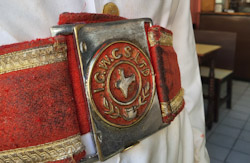
Customers sat at old wooden tables on wooden benches with upright hard backrests. Old Coffee Board posters hung on the walls. The waiters were dresses in grubby white jackets and trousers held up by an extremely wide red and gold belt with huge buckles that bore the logo of the ICB. These gentlemen wore white turbans with red and gold ribbons on their heads. On addition to rather average quality South Indian filter coffee, a variety of snacks and cold drinks were also available.
During the British occupation of India, admission to most coffee houses was restricted to European clients. In the late 1890s, the idea of establishing an ICH chain of coffee houses for Indian customers began to be considered. In 1936, the India Coffee Board opened the first ICH in Bombay’s Churchgate area By the 1940s, there were at least 50 branches all over what was then British India.
In the mid 1950s, the ICHs were closed by the Coffee Board. The Communist leader AK Gopalan (1904-1977) and the Coffee Board workers managed to get the Coffee Board to hand over the ICH outlets to them, and they formed a series of Indian Coffee Workers’ Co-operatives. The cooperative on Bangalore was formed in August 1957. There are now several branches in the city.
The MG Road branch, which opened in 1959, closed in 2009, at about the sane time as the nearby Srungar Complex began becoming closed for redevelopment, which has not yet happened.
The branch reopened in the Brigade Gardens complex on Church Street. Apart from being accommodated in a room which is rather nondescript compared to its former home, not much has changed as a result of the move to a new location. The furniture is that which was in the older site. Likewise, the old posters have been transferred. And the waiters are still attired in their stained white uniforms with belt, buckle, and turbans. The ‘atmosphere’ of the old ICH on MG Road has been recreated or maybe continued in the coffee house’s new premises. The quality of the coffee served has neither improved nor deteriorated. The ICH remains as popular as ever, and for me it is always a pleasure to enter this old-fashioned place in a city that is addicted to change.
 yamey
yamey 