
it’s round, it’s graceful,
it’s stone, its precious,
made by Michelangelo


it’s round, it’s graceful,
it’s stone, its precious,
made by Michelangelo

dendrites bifurcating
endlessly dividing:
any lovely tree
Currently, central London is infested with models of a particular wild beast
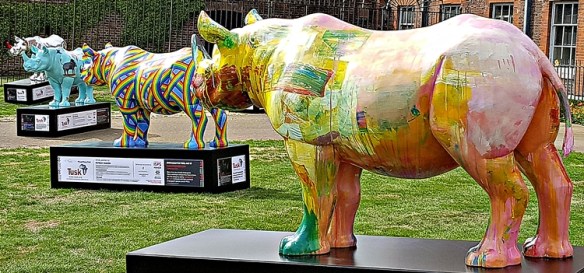
Paraded in a field
like some news, fake:
rhinoceroses glower

croque monsieur or madame
welsh rarebit perhaps
cheese on toast basically
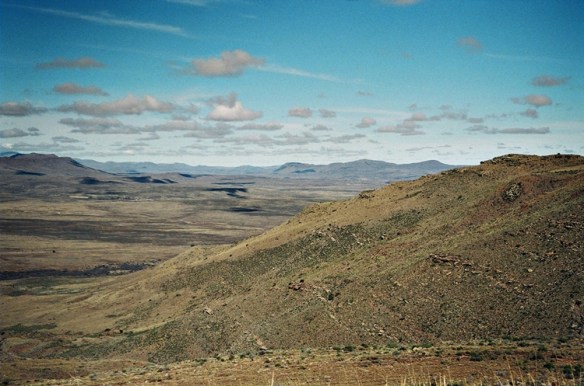
The Karoo near Colesberg
In August 2003, Adam Yamey and his family enjoyed a long motor trip, an exploration of his South African ancestry, through rural South Africa. Most of the journey was in the Cape, but a couple of days were spent just over the Orannge River in the Free State (formerly the ‘Orange Free State’)…

Octagonal church, Colesberg
…The road from Graaff-Reinet to Colesberg passes through the Karoo just missing Middelburg. Along the roadside near Middelburg, there were many people trying to sell fragile looking models, made in wire, of the ubiquitous Karoo windmills we saw along the way.
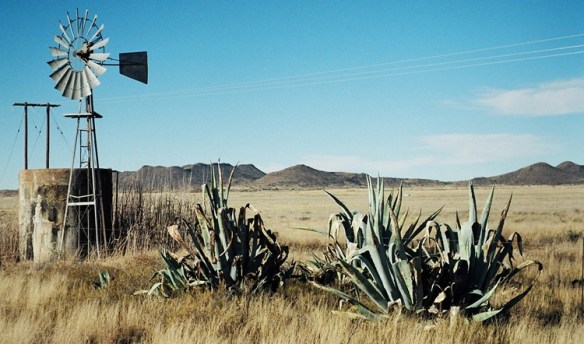
Typical windmills seen in the Karoo and the Free State
We ate lunch in Colesburg, which boasts an octagonal church.
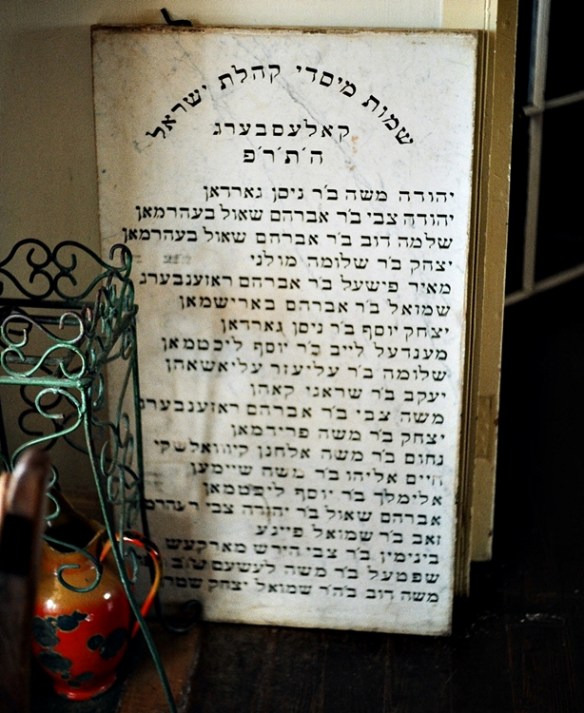
Jewish inscription, Colesberg museum
We visited the town museum housed in the building that was formerly the Standard Bank. There is a good collection of Anglo-Boer War memorabilia as well as a display of the history of the Griqua people. Upstairs there were two memorial stones, one in Hebrew and the other in English. The latter lists the founder members of Colesberg’s Congregation, dated 1920. As we were to find in many museums in small South African towns, the one in Colesberg had a selection of second-hand books (often as we discovered later with pages missing!) for sale. Under the watchful eye of an official of the Standard Bank we inaugurated use of the newest ATM to be installed in Colesberg. It worked well.
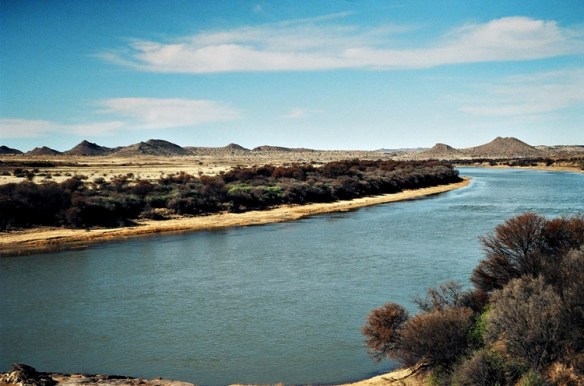
Orange River
A road from Colesberg runs north across the rolling hills of the Karoo for 60 kilometres to Philippolis (when spoken, emphasis is on the third syllable). Half way along this road we encountered the wide Orange River over which we crossed, entering the (Orange, formerly) Free State. The countryside along this road was dotted with aloes, creaking windmills, sheep and the occasional rather odd-looking cattle known as Boerebeeste.

Philippolis
If Colesberg can be described as a ‘one horse town’, then Philippolis is a ‘one horse village’. It was a village with charm and character. Signposts directed us to the Old Jail House.

Old Jail, Philippolis
Until about 46 years ago this was, in fact, the jail for Philippolis. The army then used it for about 20 years before it became a police post. For two years it remained derelict but largely untouched by vandals as the locals considered the place to be haunted.

Cells in the Old Jail, Philippolis
Its most recent owner, Harry, bought the jail and has turned it into a bed and breakfast business. He has preserved as many as possible of the jail’s features and guests may spend the night in the cells. The converted warden’s office is very popular with honeymoon couples. We stayed in a large bungalow next door to the jail.
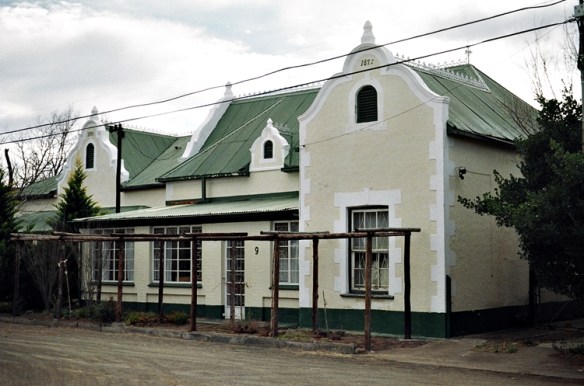
Birth place of Laurens Van der Post, Philippolis
Laurens Van Der Post was born in Philippolis. Following his death in 1996 at the age of 96, a very beautiful memorial to him has been laid out at the edge of the ‘white’ part of the village just near to the edge of the ‘black’ part.


This picture and the one above it were taken at the Van Der Post Memorial in Philippolis
A series of white concrete pillars, representing the various stages of Van Der Post’s ‘journey through life’, overlook a beautiful sunken garden made up with stones and bricks of many textures, all having various symbolic meanings. Adjoining this, there is a small guesthouse that is a very good piece of contemporary architecture. The architect of the whole memorial complex is a South African woman. Jens Friis, a PhD law student at Stellenbosch and travel writer, and his mother Naomi, showed us around.
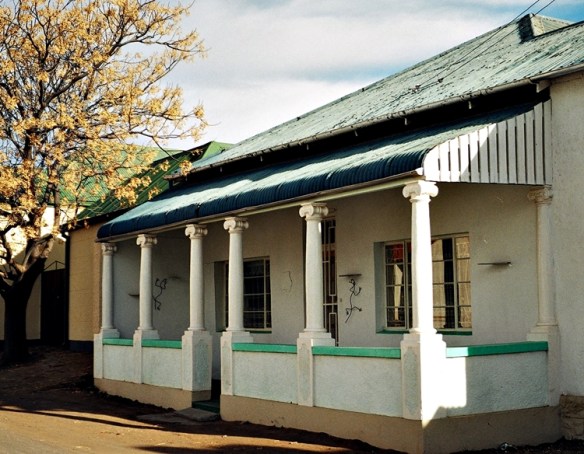
House with a stoep, Philippolis
We explored Philippolis, which is essentially a fine collection of old single-storied houses with stoeps and often adorned with decorative cast-iron work. There is no restaurant in this town, only a café, the Kokkowitz Café, which closed at 7 in the evening. Harry had arranged for us and, it seemed, all of the other guests at the Old Jail House to have dinner at the home of the Friis family, near the Van Der Post memorial. We enjoyed a bottle of very good red wine, which was produced in the Free State.
NEXT MORNING: Harry does not provide breakfast himself, but instead he told us to eat it at the Kokkowitz Café. After a very long wait, we received an excellent fried breakfast. We then walked past the simple flat-roofed house that used to be the residence of Adam Kok (1811-1875), the King of the Griquas, to see the houses that used to be owned by the father of Van Der Post, where the author was born. In Voortrekker Street we visited the Trans Garriep Museum. This museum was icily cold inside. It contains a series of rooms that attempt to reconstruct the kind of house in which white people lived in 19th century Philippolis. There is a small exhibit about the London Missionary Society that set up a mission in the town and also another about the Griqua Kingdom that thrived in the 19th century, and its successful King Adam Kok III.

View from Adam Kok’s fortress, Philippolis
The Public Library is next door to the museum and is housed in one of the town’s largest buildings. Formerly this was the home of the Jacobsohn family who owned a shop, still standing but now closed, in the town. The Jacobsohns, the last Jewish family living in the area, now live on a farm and have donated their home to the town. A very friendly and informative librarian showed us her library. Most of the books were in Afrikaans, also quite a few in English. There were also books in Southern Sotho, Xhosa, and Tswana (only two books in this language – one appearing to be a manual on woodworking). Philippolis is located in an area where several different kinds of Africans live. Many of the ‘black’ people in the area have some Griqua ancestry.
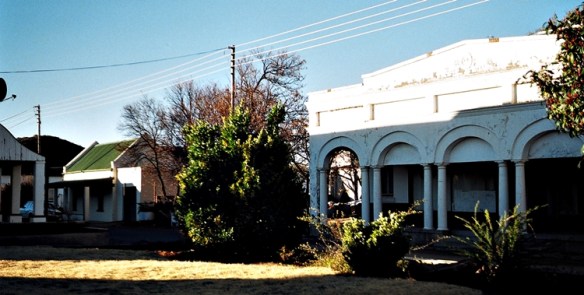
Colonnaded house belong to the Jacobsohn family, Philippolis
Behind the library, and only accessible through it, there is a pathway that takes one to the summit of a small hillock in the middle of the town from which a good aerial view of Philippolis can be obtained. The remaining three of Adam Kok’s collection of cannon perch here above the town. As we bade farewell to the librarian her parting words to us were, “Even if we all end up killing each other, South Africa is such an interesting country that no one will ever die of boredom”. Philippolis had a curious hold on us; we left with some sadness.

Library on Vootrekker Str, Philippolis
We were told that we could make a short cut by taking a dirt road to Donkerspoort, near the Garriep Dam (formerly the Verwoerd Dam, a name by which it is still known by local black African farm workers). A thirty-minute ride would, we were assured, save us much time. An hour and a half later we had completed the so-called ‘short cut’. The surface of the dirt road forced us to drive quite slowly. Our progress was further impeded by a series of closed gates across the road that separated fields through which the road passed. At each gate Lopa had to leave the car to allow us through and then to close the gate behind us. As we proceeded, the frequency of these gates increased. Had we taken the long way around, we would have reached the other end of the ‘short-cut’ in 20 minutes!

Eggs butter frying-pan
with salt pepper fire:
a tasty om-e-lettte
In the 1960s, my parents, both art-lovers, used to take my sister and me on annual trips to Florence in Italy.
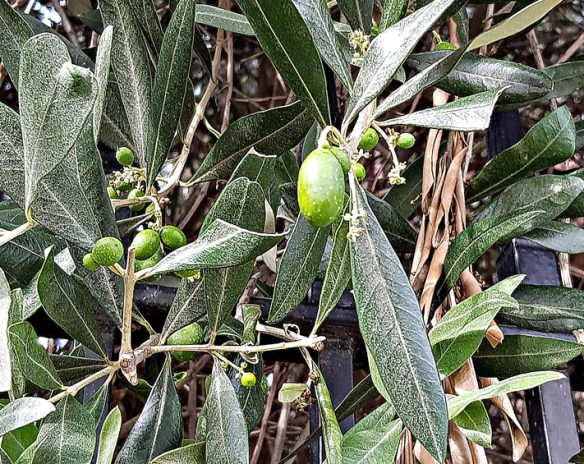
Olives growing near Portobello Rd, Sept 2018
Seeing some olives growing near Portobello Road in London reminded me of these trips. Here is what I wrote in my book, “Charlie Chaplin Waved to Me”, which is about travels I made during my childhood:
“The Oltrarno is the part of Florence on the left bank of the River Arno. It contains major sights such as the Pitti Palace, the Boboli Gardens, the Piazzale Michelangelo, the Belvedere Fortress, and the churches of S Spirito and S Maria degli Carmine. Almost every afternoon included a visit to the Oltrarno. This was made for sartorial rather than cultural reasons. My mother’s dress maker, whose name I can no longer recall, had a small shop near to S Spirito. Maybe, there is a Freudian reason for my amnesia; the visits to his shop filled me with dread. My mother had dresses made in Florence. As I have already hinted, she was a stickler for perfection. The long-suffering dress-maker in the Oltrarno must have valued her custom to have been able to put up with the unending visits we made in order to allow my mother to try the latest version of the garments that he was preparing for her. My father and us two children had to sit in the small narrow shop looking at tatty, well-thumbed magazines full of pictures of dresses whilst my mother and the tailor spent much of the afternoon dealing with the latest stage in the fabrication of her dresses. Our visits to this shop were often prefaced with my mother saying that of course we did need not wait for her there, but we knew better. Our absence would not have been well-regarded.

Adam Yamey at San Miniato, Florence, in the early 1960s
Florence was, and still is, famous for its leather work. My mother was particularly keen on one aspect of this craft: footwear. She liked good shoes, but many of them did not fit her wide feet. So, we tramped around Florence, entering many of its shoe shops and waiting patiently (or impatiently in my case) for her to try on numerous pairs of shoes. Almost all of them were unsuitable for her to wear. One shop whose name still fills me with some dread was that of Salvatore Ferragamo on the Via Tornabuoni. The fact that I remember this high-class shoe store is a testimony to the amount of time that we spent there. As was usual, if any of us showed any signs of impatience, she would tell us that we need not wait for her, but we knew that this was not what she really felt …

San Miniato, Florence. Pic by Adam Yamey in early 1960s
… Florence was not, as you may be beginning to imagine, one long round of paintings, sculptures, shoes, dresses, and brassieres. Many afternoons ended with a trip up to the Piazzale Michelangelo. This panoramic platform or terrace, which is really more of a large open space with one side overlooking the hills sloping down to the River Arno, provides a magnificent view of the city. It is a readymade vantage point for postcard makers and other photographers. A little behind the Piazzale a series of staircases flanked by pine trees leads up to a church with a wonderful black and white marble façade. This is S Miniato al Monte and was our main destination when going up into the hills. This peaceful sanctuary high above the bustling city is undoubtedly a great example of unadulterated 13th century Romanesque architecture.

Cemetery of San Miniato, Florence. Pic by Adam Yamey in early 1960s
After admiring this church, we did not return to the city centre by bus, which is how we arrived. Instead, we walked. We used to descend from the raised terrace in front of S Miniato al Monte and start walking away from the Arno along the level Viale Galileo, which follows a gently sinuous contour along the left side of the river valley. After almost a mile, we would then turn right onto the narrower Via S Leonardo. This road descends gradually, passing the walled gardens of well-separated villas. The branches of olive trees in these gardens overhung the road.
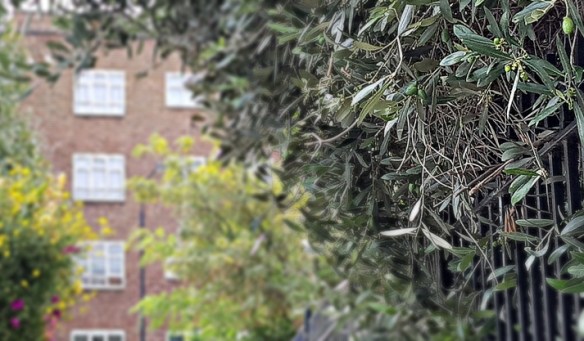
Olives growing near Portobello Rd, Sept 2018
Every year, my mother used to break off a small twig bearing greyish green olive leaves and several, usually unripe, olives. She would take it back to London to remind herself of the great pleasure that she derived from being in Florence.”
I remember finding a sprig of desiccated young olives and dried leaves amongst her possessions long after her early death in 1980.
Adam Yamey’s book “CHARLIE CHAPLIN WAVES TO ME” is a collection of tales of journeys made during the author’s childhood.
In paperback, click: HERE, please
For Kindle version, click: HERE, please
This gallery contains 12 photos.
Originally posted on GUJARAT, DAMAN, and DIU:
Before setting out on our two months of travelling through Gujarat, Daman, and Diu, we spent a fortnight in busy Bombay. Here are a few of the many photographs that I took in…
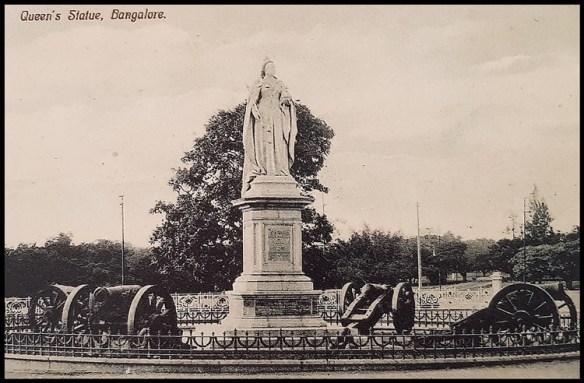
Diamond jubilee long passed
end of empire
Victoria no more

AN AUTO A VINTAGE
LOVINGLY CARED FOR
IT’S AGEING GRACEFULLY
 yamey
yamey 