Unknown's avatar

About yamey

Active author and retired dentist. You can discover my books by visiting my website www.adamyamey.co.uk .

Hitler at Hampi

By the 16th century AD, Vijayanagara in the south of India, located in what is now the State of Karnataka, was one of the world’s largest and most prosperous cities. It was destroyed by a coalition of Muslim rulers in 1565, and since then has laid in ruin. These picturesque ruins, now much visited by tourists, lie scattered around the village of Hampi, which is close to the city of Hospet.

HAMPI 1

We first visited Hampi with our seven-month-old baby in late 1995. We stayed in a hotel in the fairly non-descript town of Hospet and made daily excursions to explore the picturesque ruins of Vijayanagara, which are scattered over a large expanse of rock-strewn, almost lunar, landscape. One day, we stopped for lunch at a state-run hotel, the Mayura, in the midst of the archaeological area. The pleasant restaurant was outdoors but sheltered from the sun by a large canopy. I will write more about this hotel in a future blog.

During the meal, I paid a visit to the toilet. On my way, I passed some of the hotel’s bedroom doors. Each was locked with a padlock. I do not know what made me look at the padlocks closely, but I did. And, what I saw surprised me. Some of the locks were made by a company called ‘Hitler’.

HAMPI 2

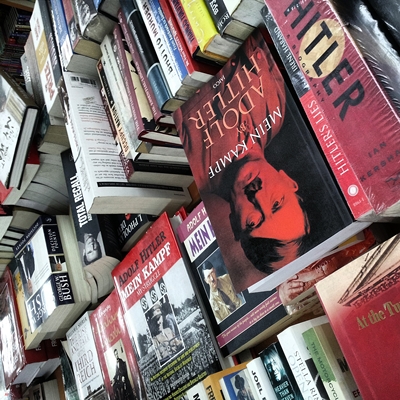
Adolf Hitler is far from unknown in India. Copies of his best-known work of literature, Mein Kampf, are to be found in practically every bookshop, often rubbing shoulders with works by less illustrious politicians such as Narendra Modi, Barack Obama and Nelson Mandela. There is at least one Bollywood film that I know of which has Hitler in its title. It is not a great film, and the Hitler in the film is neither German nor a Nazi. He is a police officer in a jail, if I remember rightly.

HAMPI 1a

I have scoured markets in India trying to find a lock seller with Hitler locks, but in vain. The Hitler Lock Company was set up in 1989. It is based in Aligarh (United Provinces).

Ephemeral Dreamscapes

OLSI 2

On the evening of the 20th of October 2018, I attended a superb orchestral concert called “Ephemeral Dreamscapes” at St Stephen’s Church at Gloucester Road (London SW7 4RL). The Albanian born conductor Olsi Qinami conducted the London City Philhamonic orchestra. They played four pieces. Three of them are well-known: Mussorgsky’s “Night on a Bare Mountain”, Wagner’s “Prelude & Liebestod”, and Ravel’s “La Valse”.  Although everything was beautifully played, the performance of the Ravel, a very difficult piece, was outstanding.

The fourth piece on the programme has rarely been performed live, as its score, written in the 1950s by Albanian composer Çesk Zadeja (1927-97), was only recently (2012) found in a Russian archive. Zadeja, who was from Shkodra, died in Rome. It was discovered by the composer’s son, who had been searching for it for many years. Described as ‘The Father of Albanian Music’, Zadeja studied in Moscow. The work performed at the concert was a stirring orchestral suite compiled from music that Zadeja composed for the soundtrack of the film “The Great Warrior Skanderbeg”. This film, an Albanian/Soviet co-production, was released in 1953. Some of the other music in the film’s soundtrack was composed by the Russian Georgy Sviridov (1915-98). Olsi Qinami’s performance of the music by Zadeja was the British concert premiere of the work. The almost full house gave it rapturous applause.

In summary, the concert was highly enjoyable. Olsi Qinami’s conducting gets the best out of his excellent players in whatever they are playing. I get the impression, having attended several of his concerts, that his orchestral players regard him with great affection. Watch out for his next concert at St Stephens, which is to be on the 9th February 2019.  

It began with a bang

First experiences of India

My wife, Lopa, and I flew to Bangalore in India in late December 1993 to celebrate our marriage with a Hindu ceremony. This was the first time that I had ever travelled further east than Cyprus.

COCO 3

We flew from London on a ‘plane operated by the Sri Lankan line, Air Lanka. The flight was memorable because the food served on board was superb. It was not the bland, insufficient fare usually provided when airborne. What we received on our trays in large metal foil containers was delicious Sri Lankan food, which tasted as if it were home-made by a cook who injected his or her love of food into the flavours.

Our first stop was at Colombo, the capital of Sri Lanka. As we descended for landing during the slowly brightening dawn light, I could see acres of palm trees below us.  This was the first time that I had ever seen groves of palms. This exotic sight made me feel that at last I had arrived in Asia.

After disembarking, we had to wait for our next flight for several hours. In those days, we took anti-malaria tablets. That morning, the only liquid we could find to wash them down was tea. Until that moment I had always drunk tea without milk. The tea stall only provided sweetened milky tea. I found it to be sickly and no help for ingesting the evil-tasting tablet. Now, after many visits to India I quite enjoy Indian milky tea.

My wife and I waited in a room along with other passengers, all of them from the sub-continent. Suddenly, one of her eyes began streaming with tears because some foreign body had entered it. Lopa began dabbing her eyes with a tissue. All the people around us glared at me. They thought that I had upset my wife!

On landing in Madras (Chennai) after walking across the tarmac from the ‘plane to the terminal, Lopa became nervous about the Indian customs examination. She told me that the officials could be very awkward. In those days, very little in the way of foreign goods were imported into India. Visitors or returning Indians were often laden with goods that then attracted high import duties at the customs. Smuggling was rife, and the customs’ officials were eagerly on the look-out for hidden treasures such as electronic goods, booze, and so on. We were not carrying anything of dutiable value. Nevertheless, Lopa was anxious.

As we approached the customs’ officials, the gods blessed us in an unusual way. Lopa’s nose suddenly began bleeding profusely. Despite using a handkerchief there was blood all over the place. The custom’s official, whom we were approaching, took one look at the bloodstained woman approaching him, and waved us through the customs barrier without stopping us.

At this point, let me tell you another thing that surprised me during my first visit to India: women police officers dressed in saris, albeit plain khaki saris. Another ‘plane took us from Madras to Bangalore (Bengaluru).

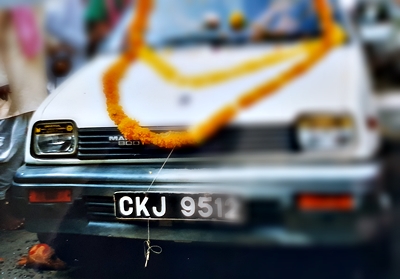
Lopa’s family met us at the airport (this was the old HAL airport east of the city, which has now been replaced by the newer Kempe Gowda Airport north of the city). After fighting our way through a crowd of taxi touts, we scrambled aboard the family’s ageing Maruti van, through its sliding side door.

By now, it was late at night, and dark. When we reached the family’s house, we disembarked, and stood in front of the main entrance. The top of the front door was decorated with leaves attached to a thread, a ‘toran’ (तोरण). Instead of entering, we all stood in front of the door. I wondered whether the front door key had been mislaid.

After a few minutes, there was suddenly a deafening sharp cracking sound, a loud bang. I thought to myself: “Oh no, we’ve been in Bangalore for just over an hour, and someone is shooting at us.” The noise that had startled me was no more than someone cracking open a coconut with an axe. Cracking coconuts is a part of Hindu traditions, especially at weddings. Amongst other things, the coconut is associated with fertility.

COCO 0

Some days later, we began the three-day long series of events connected with our Hindu wedding ceremony.

COCO 1

After the blessings by the priests, Lopa and I, connected together by several flower garlands and scarves, struggled into the back seats of a small Maruti car (not the van!). As soon as we were aboard we were driven a few feet forward. The purpose of this short journey was to drive over and thereby crack a coconut placed beneath one of the car’s front wheels.

COCO 2

I can truly say that my experience of India began with a bang.

They helped Garibaldi to unify Italy

The Arberesh of Sicily are a group of people descended from Albanians, who left the Balkans in the 15th century to escape from the Ottomans.

Palermo, the capital of Sicily, is separated from the rest of the island by a crescent of mountain ranges. After the occupation of Sicily by the Arabs in the 9th century, the Bishop of Palermo moved his seat to Monreale, a small hill town southwest of the city. There, he built a cathedral and then, later, after the Arabs had been expelled, the Normans built a Benedictine monastery. Monreale, which overlooks the metropolis, is now a suburb of Greater Palermo but in mediaeval times it was almost 5 miles away from the old walled city.

Albanian refugees landed along the coast of Sicily during the 15th century while the Ottomans were fighting in Albania, ably resisted for many years by George Kastrioti Skanderbeg (1405-68). Some Albanians landed near Palermo about twenty years after the death of Skanderbeg. In 1488, the Archbishop of Monreale granted them some vacant, disused, plague-ravished land across the mountains about 5 miles south of Monreale. They were told to make the most of it, and they did so very successfully. In exchange for this ‘gift’ of land, the Albanian settlers were required to recompense the Archbishop with taxes raised on what they were able to produce.

PI 1

The settlers established a town on the south-east facing slope of Monte Pizzuta. Originally named Piana dei Greci, it is now known as Piana degli Albanese (‘Piana’).  With a present population of about 7,000, most of the people speak an archaic form of Albanian known as Arberesh, as their mother tongue. They are also fluent in Italian and Sicilian.

PI 3

Bilingual signs (Italian/Arberesh) in Piana

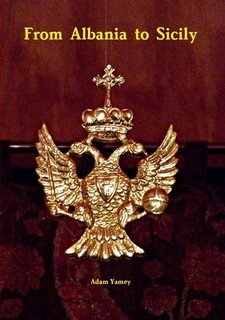
In 2014, I published a book, “From Albania to Sicily”, which describes the Arberesh communities in Piana and several other villages in western Sicily. In October this year, while staying in Palermo, we re-visited Piana for a day and a night.

The bus from Palermo to Piana winds through the mountains separating Piana from the capital. As we travelled along the sinuous road with its many hairpin bends, I looked at the slopes strewn with greyish boulders and pondered the difficulty of the terrain through which the Albanian settlers had to struggle in an era long before there were decent roads. Then, I remembered the landscape of wild, steep mountain ridges in south western Albania, south of Vlora. Travelling through the wild terrain south of Palermo must have seemed no different to what the settlers had left behind in Albania.

PI 2

San Demetrio Megalomartire

On arrival in Piana, I popped into the lovely cathedral of San Demetrio Megalomartire. This church has an iconostasis such as you would expect to find in an Eastern Orthodox church. It is home to worshippers who practise the Byzantine rites. The first inhabitants of Piana, who originated mainly in south-western Albania and the Morea (Peloponnese) were Greek Orthodox Christians. The Archbishop of Monreale allowed them to continue to worship according to the Byzantine rites, but they had to adopt the Pope in Rome, rather than the Patriarch in Constantinople, as their spiritual leader.

In 2016, we visited Himara in Albania. This beautiful seaside resort was one of the places where the Arberesh lived before escaping to Sicily. The old part of the town, high above the coastal resort, is largely abandoned, but it resembles closely the historic centre of Piana. Incidentally, Piana has a street named Via Himara, and, also, a restaurant called Valle Himara.
PI 4

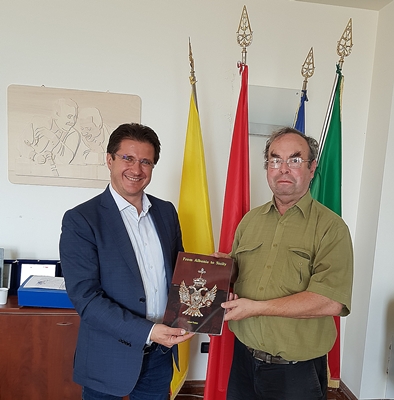
One of the reasons for our recent visit to Piana was to present a copy of my book to the town’s excellent library that occupies two storeys above Piana’s centrally located Extra Bar, which is famed for its fine canoli. We were invited to meet Ing. Rosario Petta, the town’s Mayor, who showed great interest in my volume, and even suggested that it ought to be translated into Italian.

During our visit, we met many people who remembered us from our earlier stay in Piana. They greeted us like old friends, an indication that the Arberesh have not abandoned the Albanian traditions of friendship and hospitality. They have also not forgotten other traditions they brought with them from Albania. Although they dress like other Italians for daily activities, no opportunity is lost to change into colourful, decorated traditional Arberesh/Albanian costumes. This is particularly the case at Easter time, when visitors from all over Italy flock to Piana to see great numbers of people wearing this garb.

Eric Hobsbawm remarked that the people of Piana, “… had a reputation for rebelliousness …” He quotes the words of GM Trevelyan who said that Piana “… was the hearth of freedom in Western Sicily.” I wondered why of all the towns in Sicily, Piana was one of the most rebellious. GM Trevelyan puts it down to some kind of inheritance. Maybe, those Albanians, who preferred living freely rather than under the yoke of the Ottomans and also chose to leave their homes in the Balkans in the 15th century, were perhaps endowed with something, maybe even genetic, which engendered in them a love of freedom and equality. Who can say?

The Arberesh in Piana played an important role in assisting Garibaldi in his invasion of Sicily in 1860, the beginning of a series of events that led to the Unification of Italy. When GM Trevelyan visited the town sometime before 1912, he met leading citizens of the town, “… in their circolo, where a very intelligent and just pride is taken in the history of the revolution of 1860 and the highly creditable part played in it by the ‘Albanians’ of Piana.” Garibaldi, who began his campaign to liberate and unify the Italians in Sicily, proclaimed to the Sicilian Arberesh who fought with him that: “Avete combattuto come leoni” (i.e.: they had fought like lions).

During our recent visit to the library in Piana, we met a group of highly educated librarians, who showed great interest in my book. When we began discussing Garibaldi in Sicily, they, like several people we met in Palermo, displayed unfavourable sentiments about the Unifier of Italy. They all felt that the liberation of Sicily and its incorporation into Greater Italy was a bad thing for the island. What had once been a prosperous part of the Italian lands became impoverished whilst the previously impoverished north of Italy became increasingly wealthier. Many of the people we met in Piana and Palermo suggested that the liberator Garibaldi, a northern Italian, had not only liberated Sicily from the Bourbons, but had also ‘liberated’ much of Sicily’s wealth including the contents of the vaults of the island’s banks. I have yet to check the veracity of these surprising slurs on Garibaldi’s reputation.

Returning to Piana, this delightful little hillside town is an attractive, peaceful place to stay. There is accommodation in the town and in the countryside around it. You can explore the old town with its steep streets as well as the interesting Nicola Barbato Museum, the lake, and several old churches. Energetic visitors can enjoy breathing fresh mountain air on the slopes of Mount Pizzuta and other nearby peaks. If you speak Albanian (or Italian), you will have no difficulty communicating with the hospitable Arberesh. Although the Arberesh language differs from Albanian, Albanian-speakers can easily converse with the Arberesh. If, however, you are hungry for Balkan food, Piana will disappoint.

PI 5

Various restaurants in Piana, including the first-rate Antica Trattoria San Giovanni, serve wonderful Sicilian fare. Signor Salemi, who established the Antica Trattoria, was a child in May 1947. He was present at a large public political gathering on the 1st of May at Portella della Ginestra (close to Piana), when members of a gang of bandits led by the bandit Salvatore Giuliano opened fire on the unarmed people, massacring about 12 folk including children as young as he was and a baby. But, that is a tragic story that I will save for another time.

Wherever you go in Piana, you will see the Albanian double-headed eagle and Albanian flags. Road direction signs and other public notices are frequently bilingual: Arberesh and Italian.  In the Cathedral, I noticed a huge poster recording the 550th anniversary of the death of the original settlers’ compatriot, Skanderbeg. The people of Piana retain their ancestral homeland, Albania, close to their hearts.
book cov

LEARN MORE ABOUT THE ARBERESH BY READING
FROM ALBANIA TO SICILY

by Adam Yamey.

Available on Amazon and bookdepository.com

One body, two heads

A short reflection on the use and origin(s) of birds with two heads

DHE 2 Blore

On a Hindu temple in Bangalore, Krnataka, India

The earliest archaelogical evidence of the existence of double-headed eagle (‘DHE’) or any other bird with two heads (each with its own neck) is in Bablylonian remains dating back to 3000-2000 BC.

The DHE is and has been used as a heraldic symbol by, for example: the Scythians, the Hittites, the Seljuk Turks, the Kingdom of Mysore (in India), pre-Columbian America, Cormwall (UK), Byzantium, the Holy Roman Empire, the Russian Empire, and several states in the Balkans. The Balkan states that use the DHE include: Albania, Montenegro, and Serbia.

DHE 0

Map showing some of the many places where the double-headed eagle has been employed

I find the DHE to be a fascinating symbol because unlike, forexample,  the cross, Star of David, and swastika, it is not a simple geometric construction, which could be created by random ‘doodling’. Also, it is not naturalistic like the commonly used  such as a lion,  single headed eagle, bear, fish, and hound. 

There is a Hindu mythological creature, a bird with two heads, the Gandaberunda, which has been adopted by the Government of Karnatak (formerly Mysore) as its state emblem. The origins of this creature are obscure, but it has been described in the ancient Hindu texts, the Vedas.

The DHE is an imaginary creature, a product of human thought. The Babylonians not only portrayed the DHE, but also other double-headed creatures.

DHE 1

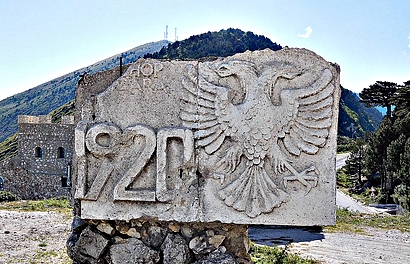
The Albanian double-headed eagle on the summit of the Llogara Pass in Southern Albania

I would like to SPECULATE that the origin of the DHE was Mesopotamia. From there, I imagine it spread through what is now Turkey to Europe, and across the Indian Ocean to India. If the DHE, or something similar appears in the Vedas, it would be interesting to know if this was by chance or as a result of some forgotten connection between Mesopotamia and the Indian sub-continent.

Gujarat and Sicily

SICILY and GUJARAT are both places where the invaders have borrowed architectural style from the conquered.

yamey's avatarGUJARAT, DAMAN, and DIU

Invaders adopting the architecture of the invaded

I have just returned from a trip to Palermo, the capital of the iskland of Sicily. This island has been invaded by different peoples numerous times. Visiting it made me reflect on aspects of my recent visit to Gujarat

FUS 1 The Zisa Palace built by the Normans near Palermo (Sicily)

In the 9th and 10th centuries (AD), Sicily was ruled by Muslim Arabs. They were displaced by Christian Norman invaders in the 11th century. Little remains of buildings erected during the Arab occupation, but people of Arabic origin remained behind in Sicily when the Normans arrived.

The Normans built castles, churches, and cathedrals in Sicily. Many of these may be viewed today. What interested me about them is that these structures contain many architectural features typical of Arabic architecture. I suspect that the Normans must have employed Arabic craftsmen during the construction of their…

View original post 249 more words

Veggie mush

I became such close friends with my former PhD supervisor, ‘Doc’, and his wife ‘Wink’, that I accompanied them on their long summer holidays in Greece.

PLAT 77 Campsite with moon

Camping at Platamon in 1977

Every year they drove down to northern Greece with their caravan, which they towed with their aged Land Rover. I accompanied them on several journeys during the late 1970s. Also, I used to join them at their favourite camping spot, a patch of uncultivated land just south of Platamon in northern Greece. This scrub-covered sandy area is now covered by a village known as Nea Pori.

On one occasion, I arrived at Platamon on a train, which I had boarded in Belgrade. It must have been almost 11 o’ clock at night when I disembarked. I was hoping that I would find my friends camping in their usual spot.

As I walked from the station through the village on my way to the camping spot, I passed the grocery shop that Doc and Wink always used. Its owners were sitting at a small table on the street outside it. They recognised me and invited me to join them in a drink. I was handed a tiny glass, such as one might use for shots of strong spirit, and they filled it with beer. We knocked glasses together and I downed the tiniest portion of beer that I have ever drunk. Then, they told me that my friends had arrived and were camping in their usual place. I walked there through the darkness, and saw them fast asleep under the awning. As silently as possible, I erected my tent and went to sleep. Fortunately, I did not disturb them.  

The railway station was at the north end of the centre of Platamon, well beyond the shops that Doc visited. Whenever we drove into Platamon, Wink would rush to it because there was a small newsagent’s stall near it. She was hoping to find a copy of an English newspaper. She did occasionally but it was always a few days out of date. Apart from her, there were few others in Platamon who would have wanted to read an English paper.

By the time that we returned from Platamon, the sun would have been setting for a while, and it was time for our sundowners and olives. Doc used to prepare supper (dinner, if you prefer). He often fried the fresh fish which we had just bought in Platamon. He was a good cook. The fish or meat, if we were eating that, was often accompanied by a mixture of vegetables that included onions, aubergines, peppers (green or red), and tomatoes. It never contained garlic because he did not like it. These were stirred together in a pot until they were cooked.

Doc referred to this dish as ‘veggie mush’ (pronounced ‘moosh’). When I told him that the dish, which he believed to be his own creation, resembled the classic French dish ratatouille, I could see that he was flattered that his own creation could be compared to something enjoyed by gourmets.  

The sky at Platamon was frequently cloudless. Where we were camping there was little ambient light so that the night sky could be seen easily. We used to stand looking up at the star-filled canopy that covered us. Shooting stars shot over us frequently, momentarily altering the map of celestial objects that twinkled down at us. Doc would stand with me and point out the various constellations.  He showed me how to identify the North Star. We stood in a glorious silence that was only occasionally interrupted on some evenings. Otherwise, we could neither hear the sea, the sound of whose waves were lost in the dunes that were between us and it, nor the trains that ran along the tracks a few hundred yards to the west of us.