Unknown's avatar

About yamey

Active author and retired dentist. You can discover my books by visiting my website www.adamyamey.co.uk .

Shaking minarets

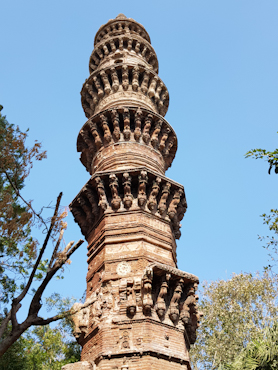
The Shaking Minarets in Ahmedabad were designed to be resistant to earthquakes many years ago. They are still standing long after the mosque to which they belonged collapsed…

yamey's avatarGUJARAT, DAMAN, and DIU

A pair of minarets is all that remains of a mosque. They stand within the precincts of the main railway station of Ahmedabad. The rest of the mosque was destroyed long ago.

Apart from being attractive, these two minarets, the SHAKING MINARETS, are special. They are able to resist earthquakes. They shake or swing instead of falling to pieces during seismic activity.

The large Jumma Masjid in the heart of Ahmedabad lost its two mighty minarets as a result of movements of the earth long ago.

No one knows why the Shaking Minarets are able to resist seismic disturbances. They are not the only minarets in the city that have this ability. When, long ago, British investigators took one of this kind of minaret to pieces, they were unable to discover the secret of its stability. They were also unable to reassemble the structure properly.

Some suggest that the Shaking…

View original post 224 more words
Ignorance is bliss

Many decades ago, ‘M’ and his then young wife ‘F’, both Indian Hindus, settled in the UK. F observed Hindu dietary practices far more than her husband. In the early days after their arrival in England, the couple were not well off. Consequently, if they treated themselves to a meal in a restaurant, they chose one which was not costly.

M used to take his wife out to a Wimpy Bar for a treat. For those of my younger readers, let me explain that the Wimpy Bars were fast food joints, rather like a very inferior version of McDonald’s.

M and F used to order hamburgers. F ate them quite happily, believing that they contained ham and not beef, which contravened her Hindu dietary restrictions. M said nothing to disabuse his wife’s misconception about the ingredients of the burgers, as she greatly enjoyed them.

Many years later, M inadvertantly revealed to F that the hamburgers that she had been enjoying during many visits to Wimpy Bars, contained beef rather than ham. She was horrified to learn this.

Nowadays after decades of happy marriage, the couple have become quite prosperous. I guess that now they would not be seen dead in a Wimpy Bar.

Better on a camel

While travelling through Gujarat in western India, I have seen many camels (? dromedaries) working as beasts of burden. They are well suited to the arid semi desert climate of Gujarat. The camels remind me of airline jokes I learnt in my childhood. Each joke gives another meaning to an airline’s name or acronym.

BEA was British European Airways. The joke version was Big Empty Aeroplanes;

TAP, Portuguese Airlines became Take Another Plane;

The Greek company Olympic became Only Like Your Money Pay In Cash;

EL AL, the airline of Israel, became Every Landing Always Late.

And this brings me to humped beasts of burden.

BOAC, which was British Overseas Airways Corporation, became Better On A Camel.

Postscript

When the petroleum company ESSO first became established in India, workers in Indian companies worked half day on Saturdays. Esso workers got a whole day off on Saturdays. So, ESSO became known as Ever Saturday Sunday Off.

Embarrassment

The 50 pence coin, a seven sided silver coloured object, had already been introduced into circulation in the UK when I was a pupil at Highgate School in North London (1965-70). In the mid to late 1960s, 50 pence had considerable purchasing power. For example, this amount of money would pay for two new paperback books.

At Highgate School, all 600 pupils ate lunch together in a large dining hall. The Headmaster, then Alfred Doulton, sat at a high table facing the long tables where his pupils and teaching staff ate.

At the end of lunch, Mr Doulton used to stand up and make brief announcements. If some money had been found lying about, he used to ask if any of us had lost it. Always, a pupil would walk up to the high table to claim the money. Before releasing it, Doulton would ask the claimant to prove that it was his.

I began worrying what I would say if I felt that I had lost the money that Doulton was asking about, especially if it were a valuable 50 pence coin.

So,whenever I had a 50 pence coin, I used a compass or dividers point to scratch my initials, “AY”, on my seven sided coin.

Luckily, I never mislaid any of my 50 pence coins. Had I done so and it had appeared in Doulton’s hand at the end of a lunch time, I would have been able to check whether the coin was mine. I still shudder to think that I would have become the laughing stock if the school had Doulton announced to the assembled pupils something like: “See how prudent Yamey has been. He has even marked his money just in case it gets lost.”

Now, remember if you are ever handed a 50 pence coin and it bears my initials, give it back to me. It’s mine!

Death on the tracks

This is a true story told to me by the man who took the upper berth on a train in India’s Uttar Pradesh state.

Our friend, who related this story, was boarding a sleeper car. He had reserved the lower berth in a compartment, but when he reached it, he found it occupied by a man who had not made a reservation. The man aggressively refused to budge from our friend’s berth. Our friend called the conductor. After a considerable and unpleasant argument, the miscreant relinquished the berth, which our friend then occupied.

Shortly after this, an old man, who had been given a reservation in the upper berth, entered the compartment. He was unable to climb into the upper berth. Out of kindness, our friend took the old man’s upper berth and gave him the lower one.

Next morning, our friend woke up. He climbed down from his upper bunk and was horrified to discover that the old man had been stabbed to death during the night. No doubt, the man who had been evicted by the conductor had exacted his revenge.

Two names, one country

The Albanians now refer to their country as “Shqipëria”. Almost everyone else calls the same country “Albania” or some variant of this.

Here is an interesting article that discusses this difference: http://www.tiranatimes.com/?p=133209

Incidentally, the national symbol of Albania is a two headed eagle. This is appropriate for a country known by two names!

Giving and receiving

I love receiving gifts. I love giving gifts especially if the recipient expresses joy, rather than gratitude.

This photograph taken in the Khanderao Market in Vadodara (India) expresses the joy of giving, which, as in the case of this flower merchant, can be greater than the joy of receiving.

Mashed potatoes

Some restaurants in India serve both veg (vegetarian) and non-veg (meat, fish, eggs) food. Recently, my wife and I were sitting near to a young lady in a very good Italian restaurant in Vadodara in Gujarat.

Our young neighbour is a vegetarian. She ordered a veg pasta and asked the waiter if she could have a portion of mashed potatoes. I know that pasta and mashed potatoes are an unusual combination, but that is what she wanted.

The waiter told her that she could not order mashed potatoes with a veg pasta. Puréed potatoes, which are pure veg, could only be served with a non-veg dish.

We overheard the waiter telling this to our neighbour. My wife, who always tries to be helpful, interrupted the waiter and told him to bring a small dish of mashed potatoes with the pasta. Eventually, and somewhat reluctantly, the waiter did as asked. Our neighbour was so happy to receive the mash with her pasta that she got up and gave my wife an affectionate hug.

I am not a vegetarian.

Although I have met numerous pure vegetarians during the 25 years I have been visiting India, I still find it hard to believe that there are so many people, who have never tasted meat, eggs, or fish.

Tastes change

Once, long before ‘political correctness’ became fashionable, when my wife was an undergraduate student, she asked two Nigerian students whether they preferred their tea “black or white “. They looked at her indignantly before answering aggresively: “with milk“.

When I was a child, I drank tea without milk. That was the way my parents preferred it. That is what I became accustomed to. If I sipped even a little tea with milk, I felt nauseous. Tea with milk, as served in England, is made by adding brewed tea to milk or vice versa depending on your preference.

My prejudice against tea with milk persisted until I began visiting India in 1994. At first, I was suspicious of the “white” tea on offer, but soon began to enjoy it. I think that this is because it is made differently from that which is served in the UK.

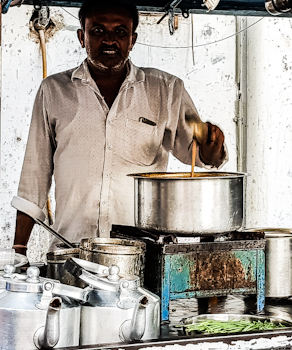
In India, tea leaves are boiled vigorously with milk. Often additives such as sugar, crushed ginger, cardamom, mint, and lemon grass are added to the hot bubbling mixture. After a while, the boiled milky tea is passed through a strainer, often cloth, and served in cups. The resulting drink is a harmonious blend of the flavour of tea and the additives. In my opinion, it tastes quite different from, and much better than what is served in England.

I have visited India many, many times since 1994. Apart from developing a great fondness for the country and its people, my tastes in food have changed for the better as a result of my exposure to life in India.