Unknown's avatar

About yamey

Active author and retired dentist. You can discover my books by visiting my website www.adamyamey.co.uk .

Biography of an idealist

gandhi blog

I have just finished reading a 660 page biography of Mahatma Gandhi. Its author, Rajmohan Gandhi, is one of his grandsons, a noted historian.

Gandhi was an idealist with a highly original mind. After a childhood in Gujarat (part of western India), he studied in London and became a barrister. After a brief return to India, Gandhi set off for South Africa to dwork as a barrister. He remained in South Africa for many years, managing his legal practice and fighting for the rights of Indians living in the country – actually, countries as South Africa was only unified in 1910. His struggles for the rights of the Indians was the proving ground for methods of non-violent revolution which he brought to India when he returned there for good in 1915.

It is no exaggeration to claim that Gandhi’s activities and his saintly persona, more than anything else, prepared the Indian masses for a desire to become liberated from the yoke of British imperial rule. Rajmohan Gandhi describes and explains this lucidly. So great was the respect for Gandhi all over India, that he was able to resolve numerous problems with the government or between different communities simply by fasting. He was willing to starve himself to death, but neither the British authorities nor most Indians were prepared to lose him. So, they gave in to his not unreasonable demands. His mass non-violent protests that were joined by thousands of ordinary people, who were prepared to be imprisoned or to be beaten by the police without offering resistance, often achieved their aims.

By the mid-1940s, the situation in India was such that the British began planning to leave it. During the lead up to Independence in August 1947 and after the Partition of India and the formation of the new state of Pakistan, India was plagued by excessively violent inter-communal conflicts: Hindus vs Muslims and Sikhs vs Muslims. Despite numerous fasts, Gandhi was unable to keep the peoples of India unified.

Gandhi’s ideals included seeing India achieve its independence. He was also keen to maintain harmony between members of India’s different religions. He did witness India’s freedom from the British, but had to suffer in the knowledge that despite his efforts, Independence was achieved whilst inter-communal violence kept increasing.

There were many in India who did not share Gandhi’s desire for inter-religious harmony. Amongst these were the so-called ‘Hindu nationalists’. It was a group of them who assasinated the Mahatma in 1948 at one of his prayer meetings in New Delhi.

Rajmohan Gandhi’s account of his famous grandfather is thorough. It gives a good idea of the Mahatma’s personality and his brilliance with dealing with everyone from the humblest harijan (‘untouchable’ or ‘dalit’) to the most pompous of politicians both Indian and British.

In brief, this book is first class and I can strongly reccommend it.


Postscript:

The book described above deals with the Mahatma’s rather eccentric, to put it mildly, relationship with women. However, it avoids mentioning his prejudices aagainst black Africans during the first few years of his sojourn in South Africa. No one is perfect! As he grew older, he could no longer be accused of holding racist views.

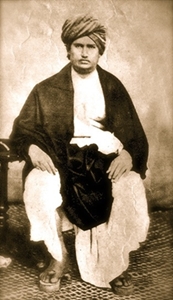
Swami Dayanand Saraswati

Here is an excerpt from my latest book, “IDEAS, BOMBS, and BULLETS”, which deals with the activities of Indian patriots (including Shyamji Krishnavarma, VD Savarkar, Madame Cama, Madan Lal Dhingra, and VVS Aiyar) in Edwardian London between 1905 and 1910 and what inspired them. The excerpt deals with an example of the ‘Ideas’ part of the book’s title. It is concerned with aspects of the life of Swami Dayanand Saraswati, a reformer of Hinduism who was born in Gujarat.

yamey's avatarGUJARAT, DAMAN, and DIU

Dayananda_Saraswati

Here is an excerpt from my latest book, “IDEAS, BOMBS, and BULLETS”, which deals with the activities of Indian patriots (including Shyamji Krishnavarma, VD Savarkar, Madame Cama, Madan Lal Dhingra, and VVS Aiyar) in Edwardian London between 1905 and 1910 and what inspired them. The excerpt deals with an example of the ‘Ideas’ part of the book’s title. It is concerned with aspects of the life of Swami Dayanand Saraswati, a reformer of Hinduism who was born in Gujarat.

Excerpt starts here:

Swami Dayanand Saraswati (‘Dayanand’; 1824-83) was an influential reformer of Hinduism and the founder of the Arya Samaj movement. He was born in Tankara, which is now in the Morbi district of the State of Gujarat. To escape from a forced marriage in childhood and disillusioned by his family’s slavish Hindu devotional practices, he wandered around India as a sannyasa (religious mendicant) for well over a decade.  During…

View original post 842 more words

If you are there, you must try…

TAHARI blogg

I had always wanted to visit Gulbarga (now ‘Kalaburgi’) in northern Karnataka (India), not far from Hyderabad, because of the richness of its medieval Islamic architectural heritage.

When my friend in Bangalore, Mansour, a great gastronome and connoisseur of fine foods, knew we were in Gulbarga, he said:

If you’re there, you must try tahari

Well, we had no idea what this dish comprised, but if Mansour reccomended it, it must be worth trying. A search on Google revealed that the Limra Tahari was highly rated. We rang to make a reservation and were told that was unnecessary. Also, we learnt that the place only took cash payments.

One evening, we hired an autorickshaw to take us to Limra. However, the driver had no idea how to find it, and eventually dropped us near a different restaurant, saying;

This is a restaurant. You can eat here.

It was a totally unsatisfactory eatery.

Next evening, we were fortunate. A rickshaw driver knew where to find the Limra. When we arrived, he told us that he would wait for us as we would not be long and, also, it was difficult to find autorickshaws in the area in the evening. We wondered why, but soon found out.

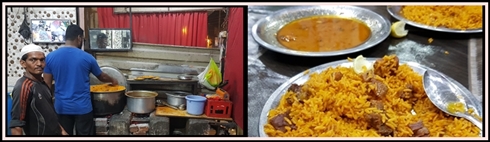
The front of the restaurant was unprepossessing, to put it mildly. The place was separated from the street by a pair of ageing red curtains, rather like that found at a theatre stage. The steps leading up to it from the street were littered with old newspaper and other rubbish. I looked at my wife questioningly. She seemed happy to enter, so we parted the curtains and stepped inside. The interior was spotlessly clean.

To the left of the entrance, an old man sat behind a small cash desk. To the right, there were a couple of men preparing food in huge metal post heated by smouldering charcoals. Limra’s dining area was simple. There were several long narrow rectangular metal tables, which were probably screwed to the floor. All of the diners were men, except my wife.

Before we had time to ask for a menu or what was on offer, a boy slid two metal plates across our table towards us. Each plate was laden with tahari. He added a third plate that contained an unappetising looking greasy sauce. We ordered a couple of bottles of mineral water and began our exploration of tahari.

The tahari consisted of spicy yellow rice which contained a few lumps of well-cooked tender meat. The sauce turned out to be delicious and not at all greasy. The tahari was very tasty and delicately spiced – a real treat. Tahari is, I later discovered, an Awadhi dish from the region of India where Lucknow is located. It is typical of a certain style of Mughal cooking. It is, as we saw when we entered Limra, slow-cooked.

When we finished our tahari, we noticed the menu on the wall behind us. It consisted of two items: tahari: full plate, and tahari: half plate. No wonder, we were served our food immediately. There was nothing to choose from here! Our bill for two full plates and two bottles of water came to only 80 Indian Rupees (about £0.90 sterling). It took us no more than 10 minutes to finish our scrumptious meal. We understood why our driver decided to wait for us, and we understood why the restaurant did not accept anything but cash as payment. So, if you are ever in Gulbarga, you must try tahari!

The FREEdom of the press

EVE STAND


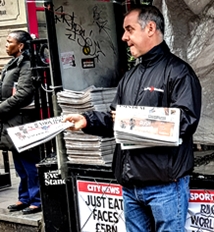
In my youth, there were no free newspapers in London. There were, and still are, daily newspapers that were available to buy every morning. In the evening, there was a choice of the Evening Standard and the Evening News. Both were available to buy for a few pennies.

The Evening News disappeared some years ago. The Evening Standard remained on sale. Then, a few years ago (in 2009), the Standard became available free of charge. In my opinion, its quality decreased a bit after it became free. Shortly before the Standard became free of charge, a morning paper, the Metro, came into existence in 1999. It was free of charge.

The Metro is a perfect read for a bus or train journey lasting 15 to 25 minutes. It covers much news and contains plenty of other interesting features. As free newspapers go, I would far rather have a copy of the Metro than the Standard.

Time Out is a weekly which provides fairly thorough information about what is happening on the London leisure scene and includes often useful reviews of films, restaurants, bars, theatres, etc. Founded in 1968, it provided a far more intelligent and edgy account of the London scene than its rivals. Until 2012, Time Out was sold to readers for a fee, which was well worth paying. Since September 2012, it has been handed out free of charge each week. For sveral years, I thought that the free version was not as interesting as the former paid version, but of late the quality of Time Out‘s contents has been improving.

These various free periodicals are great but in these days of worrying about the planet, should we not be minimising the amount of paper being used just as we are trying with plastics? Although I am not so keen about using on-line versions of newspapers, they do not involve sacrificing trees or rubbish creation.

One book, two titles

COVER GUJ a blog

The prices of books varies greatly from one country to another. In India, many books cost far less than their equivalents sold, for example, in Europe. Readers in India buying books that have to be imported from ‘the West’ often face high charges due to delivery from afar. I have tried to address this problem with a couple of books, which I have written. My solution is outlined after the following introduction to one of my books about India:

My wife, who is a fluent Gujarati speaker, was born in Bombay. Her father’s family originated in Gujarat and her mother’s in the former Princely State of Kutch, which became part of the State of Gujarat after India became independent.

Both my wife and I have visited India regularly from our home in the UK, yet neither of us had ever been to Gujarat until early in 2018. We felt that it was high time that we visited the parts of India connected with her heritage. I have published a book that describes that first trip. We did not visit everywhere in Gujarat, but the places we saw, our experiences, and the people we met ranging from autorickshaw drivers to former royalty, and our experiences, are described my book. All of these have made us want to visit the region again and to explore it further.

I have long been fascinated with tiny enclaves. I have visited places such as Andorra, San Marino, Mahe (in Kerala), Pondicherry, and Llivia (a part of Spain surrounded by France). Gujarat contains two such places, the former Portuguese colonies of Daman and Diu, territories surrounded by Gujarat but separated from it by borders. We included them on our journey and discovered that though small in area, they are filled with interest.

Gujarat was the birthplace of many celebrated persons, including Narsinh Mehta (poet), Dayanand Saraswati (philosopher), Shyamji Krishnavarma (Sanskrit scholar and freedom fighter), and politicians such as: Mahatma Gandhi, Dadabhai Naoroji, Vallabhai Patel, Morarji Desai, and Narendra Modi. Yet, undeservedly, it is a part of India less frequented by tourists than many other places in India (e.g. Goa, Kerala, Rajasthan, and the ‘Golden Triangle’). I hope that what you will read in this travelogue will whet your appetite and encourage you to make plans to visit Gujarat.

The idea of my book is to unwrap the attractions of Gujarat to make them better known to those who have not yet visited this region of India.

What I have written above is to introduce you to a book I published in 2018 with the title “TRAVELS THROUGH GUJARAT, DAMAN, and DIU”. This book is available from on-line booksellers such as lulu.com, Amazon, and bookdepository.com. When you buy my books from these suppliers, they are produced in Europe or the USA and then shipped to the buyer. If they are bought by people living in India, their prices become very large (in comparison with average Indian book costs) because of additional postal charges. For example, TRAVELS THROUGH GUJARAT, DAMAN, and DIU can cost up to 1500 Indian Rupees (‘INR’) and another book, which I have recently published, “IDEAS, BOMBS, and BULLETS” can cost purchasers in India over 800 INR.

To make my books more affordable in India and priced at a rate closer to comparably sized books in the Indian market, I have re-published the two books mentioned above with an Indian print on demand outfit called pothi.com. The travel book has been revised and I hope improved. I have renamed it “GUJARAT UNWRAPPED”. My book about Indian patriots in early twentieth century London, “IDEAS, BOMBS, and BULLETS” retains its original name.

When ordered through pothi.com and delivered in India, GUJARAT UNWRAPPED is priced at 296 INR (plus minimal postage) and IDEAS, BOMBS, and BULLETS comes to 395 INR (plus minimal postage).

To order GUJARAT UNWRAPPED FROM POTHI.COM,

click: https://pothi.com/pothi/book/adam-yamey-gujarat-unwrapped

To order IDEAS, BOMBS, and BULLETS FROM POTHI.COM,

click: https://pothi.com/pothi/book/adam-yamey-ideas-bombs-and-bullets

IMPORTANT:

It is worth nothing that purchasers ordering the books from pothi.com BUT not having their books delivered in India, face huge postage charges.


Learning the lingo: Italian

aerial photography of city


Until I was 16 years old, I accompanied my parents on annual holidays in Florence (Italy). We always stayed at the Pensione Burchianti, which was run by two ageing sisters. Almost every evening, we ate dinner in a nearby restaurant (the Buca Mario). This excerpt from my book CHARLIE CHAPLIN WAVED TO ME describes how I began to acquire some limited skill in speaking Italia. Here is the excerpt:

” … After dinner we would walk back to the Burchianti. It might have been during one of these evening strolls that my father came up with a new version of the saying ‘a penny for your thoughts’, namely: ‘a penne for your sauce’. The traffic in the streets would have quietened down by the time that we had eaten, and all of the traffic signals, or ‘robots’ as my South African parents called them, had flashing amber lights instead of the usual sequence of three coloured lamps. The pedestrian signals, which alternated between the red ‘Alt’ and the green ‘Avanti’ during the day, simply flashed both messages at the same time at night.

When we arrived back at the Burchianti, the residents, who had been eating supper, were usually still lingering at their tables. Many of them almost lived in the Burchianti. There was an elderly commendatore, who took all his meals there but slept elsewhere. There were also a number of business people who spent the week working in Florence, but resided some distance away in the weekend. They lived in the pensione during the week. One of these was a lady pharmacist from Parma who spoke Italian with a curious accent, rolling her ‘r’s in an exaggerated way.

On entering the dining room, we would be greeted like old friends, which I suppose we were. We would be invited to sit at the sisters’ table, and then I had to perform. One of the sisters would ask me in Italian what I had eaten for dinner, and I had to reply in Italian. Everyone listened to my reply which usually went something like this:
Primo piatto o mangiato spaghetti con pomodoro. Dopo o mangiato bistecca con patate fritte. E dopo, profiterole.”

It was not difficult to relate what I had eaten because every dinner I ordered the same thing or substituted lombatina di vitello (veal chop) for the bistecca. This nightly recitation gave me the confidence to try to speak in Italian, even if badly. When I did not know a word, I tried using a Latin word but pronounced it in a way that I believed made it sound Italian. Often, this worked! ...”


If you want to know whether Charlie Chaplin really did wave to me, grab a copy of my book from:

https://www.bookdepository.com/Charlie-Chaplin-Waved-Me-Adam-YAMEY/9781291845051

OR

http://www.lulu.com/shop/adam-yamey/charlie-chaplin-waved-to-me/paperback/product-21611544.html

OR Amazon or Kindle store


Photo by Josh Hild on Pexels.com

Mini on steroids

MINIS


In 1973, the economist EF Schumacher coined the phrase ‘small is beautiful‘. But, is small always beautiful?

The Mini, made by the British Motor Corporation, was first available for drivers to purchase in 1959. This compact, low-priced car, designed by Alec Issigonis, remained popular until 1986 when production ceased. I was not upset by this as the original Mini was extremely uncomfortable to sit in. Small the car was, but beautiful it was not.

In 1994, the German car manufacturer, BMW, bought the right to make cars bearing the trade name ‘Mini’. Models made from the year 2000 onwards faintly resemble the old-style Mini models, but contain many more up-to-date features. However, the BMW models look like bloated versions of the original versions. The new models look like Minis on steroids. They are not so small, and definitely not so beautiful.


The picture of the blue, old style Mini, was sourced from Flickr via Wikipedia