Unknown's avatar

About yamey

Active author and retired dentist. You can discover my books by visiting my website www.adamyamey.co.uk .

Where seven streets meet

SEVEN ROADS MEET at a point in London called Seven Dials. A column with seven sundials attached to it stands in the middle of the circle where they meet. Long ago, on the 5th of October 1694, the writer and diarist John Evelyn (1620-1706) noted that he went:

“…to see the building beginning near St. Giles’s, where seven streets make a star from a Doric pillar placed in the middle of a circular area; said to be built by Mr. Neale, introducer of the late lotteries, in imitation of those at Venice, now set up here, for himself twice, and now one for the State.”

The pillar with sundials facing in seven directions was erected in 1694 by Edward Pierce (1630-1695) and Thomas Neale (1641-1699). Pierce was a sculptor, architect, and stonemason. Neale was a Member of Parliament for 30 years; Master of the Mint; gambler; and entrepreneur. His achievements included:

“…development of Seven Dials, Shadwell (including brewing and Navy victualling), East Smithfield and Tunbridge Wells, to land drainage, steel and papermaking, mining in Maryland and Virginia, raising shipwrecks, to developing a dice to check cheating at gaming. He was also the author of numerous tracts on coinage and fund-raising and was involved in the idea of a National Land Bank, the precursor of the Bank of England. The extent of his interests – as a prominent Hampshire figure, as a member of the Royal Household, as a long-standing MP serving on dozens of Committees and as the promoter of an extraordinary plethora of projects” (www.sevendials.com/history/thomas-neale-1641-1699).

In July 1773, the column bearing the seven dials was removed because it was believed that there was a substantial amount of money hidden beneath it, so wrote Peter Cunningham in his Handbook of London (1850). None was found. Another theory suggests that the pillar was removed:

“… to rid the area of the undesirables who congregated around it. The remains of the column were later moved to the garden of the architect James Paine (Junior) at Sayes Court, Addlestone, but not re-erected.” (www.sevendials.com/resources/Seven_Dials_History_of_the_Area_by_Dr_John_Martin_Robinson.pdf)

It was not until 1989 that the demolished column was replaced. It was reconstructed according to Pierce’s original design that is lodged in the British Library. The new column was unveiled by Queen Beatrix of the Netherlands on the 29th of June 1989.

The entrepreneur Thomas Neale would have approved of a venture that commenced in his Seven Dials district in 1976. That year, Nicholas Saunders (1938-1998) opened his Whole Food Warehouse in a disused warehouse in Neal’s Yard (formerly ‘Kings Head Court’), named in memory of Thomas Neale. In Saunder’s words:

“I decided to start a wholefood shop which I would like myself – one that was cheap, efficient and would not make customers feel bad because they could not recognise a mung bean. At that time wholefood shops were mostly of the hippy style – folksy looking with open sacks and used paper bags; nice meeting places for the in-groups but hopelessly inefficient, expensive and tending to make ordinary people feel like intruders.” (https://nealsyardlondon.co.uk/history/).

His venture proved successful. Various other businesses including Neal’s Yard Remedies, Neal’s Yard Dairy, Casanova & daughters, and Wild Food Café, opened nearby. Saunders wrote:

“The Yard has developed into a social scene. Even though the businesses are each independent, everyone who works in them, and many of the regular customers, identify with the place. In fact most of the workers are customers who had asked for a job. My old idea of a village community has manifested in the form of a community of small businesses, each one individual and free to go its own way. It is rather like a family, with me as a father and the businesses as my grown-up children.”

Although we made our last visit to Neal’s Yard in the middle of the covid19 pandemic, when the place was empty and closed, it is safe to say that the Yard continues to be a vibrant ‘social scene’ and its shops are still thriving despite the fact that shops supplying ‘whole foods’ have multiplied considerably since Neal’s Yard was established. Saunders is commemorated in the Yard by a wall mounted plaque.

Apart from selling food and remedies, Neal’s Yard was home to the film studio run by Michael Palin and Terry Gilliam between 1976 and 1987. It was here that they edited the Monty Python series of films.

One of the entrances to Neals Yard is an alleyway leading from Monmouth Street (formerly ‘Great St Andrew Street’), one of the seven streets leading to the Seven Dials. The street is home to one of London’s older still existing French restaurants, Mon Plaisir, which is close to Neals Yard and was founded long before Saunders established his venture. The brothers David and Jean Viala started the eatery in the 1940s.

My parents moved from South Africa and settled in London in the late 1940s, by which time Mon Plaisir was serving customers. I do not know when my parents first ate there, but during my childhood I remember it as being one of their favourite places at which to to eat out. Until 1972, when new management took over the restaurant, Mon Plaisir occupied one shopfront. Its characteristic quirky décor rich in everyday French posters and other ephemera remains substantially unchanged since the 1940s. As a child during the 1960s, I was taken there infrequently. I remember liking it. One thing that I recall was that the toilets were approached through a doorway at the end of the restaurant furthest away from the street. An artist’s palette was nailed above the doorway. It bore the words “Le Pipi Room”. On a visit made this century to the enlarged restaurant, I noted that the sign had disappeared. When life returns to ‘normal’ again, another meal at Mon Plaisir is on our ‘to do’ menu.

During my childhood, the Seven Dials did not make any impression on me. I knew about Mon Plaisir, but never ventured south the few yards to the Dials. With the opening of the Donmar Theatre on Earlham Street, another of the roads leading to the Dials, in 1977, which we have visited often, the Seven Dials entered my London radar.

Before ending this somewhat rambling piece, here is a true story about the theatre. Soon after it opened, an American friend, a keen theatregoer who was midway in age between my parents and me, invited me to join her at a performance at the Donmar. It was a play with a Chinese theme. We were seated in the front row, literally on the stage. My friend who had long legs, stretched them out onto the stage and the actors had to take care not to trip over them. Halfway through one of the acts, my friend began fumbling in her large bag and withdrew a thermos flask. She removed the lid, which served as a cup, and gave it to me to hold. Then, she filled the cup with hot soup, which she proceeded to drink whilst the drama unfolded in front of us. I often wonder what the actors, who were so near us, thought when they saw a member of the audience enjoying her picnic in front of them.

The Seven Dials and the streets radiating from the column are full of fascinating buildings, some old and others new and there are plenty of shops to explore apart from those pioneering wholefood shops in Neals Yard. If you can manage to get a ticket to the Donmar, and this is quite hard if you are not on their advance booking scheme, then it is often worth watching a performance there.

Music by the River Thames

A ROW OF HOUSEBOATS is moored alongside the bank of the River Thames that runs past Cheyne Walk in London’s Chelsea. The floating dwellings are faced by Lindsey House, one of the oldest buildings in the Royal Borough of Kensington and Chelsea. Built in 1674 by Robert Bertie, 3rd Earl of Lindsey (1630-1701) on land that was once part of Thomas More’s riverside garden, it was remodelled by Count Nicolaus Zinzendorf (1700-1760) for London’s Moravian community in 1750. Five years later, the edifice was divided into separate dwellings. Today, they are numbered 96 to 101 Cheyne Walk. The American artist James McNeill Whistler (1834-1903) lived in number 96, and the engineers Sir Marc Isambard Brunel (1769-1849) and his son Isambard Kingdom Brunel (1806-1859) lived in number 98. My friends Kit and Sheridan lived in a ground floor flat in number 100.

Lindsey House, Chelsea, London

I first met Kit and Sheridan during one of our annual family holidays to Venice. Kit, who was a colleague of my father at the London School of Economics, and her husband Sheridan used to stay in the Pensione Seguso that was next door to the Pensione La Calcina, where John Ruskin (1819-1900) once stayed, and we always stayed in Venice. During one of our holidays when we stopped on the Fondamente Zattere to talk with Kit and Sheridan in Venice, they asked me whether I liked classical music. When I told them that I did, they said that they would invite me to their musical evenings held some Saturdays in their home. I attended quite a few of these during the second half of the 1960s.

On arrival at 100 Cheyne Walk, Kit used to welcome the guests by offering us coloured sugar-coated almonds, which she described as ‘stones of Venice’, an illusion to Ruskin’s book about Venice (“The Stones of Venice”), where the almonds had been purchased. After discarding coats, all of the guests, twenty to thirty in number, had to find somewhere to sit in the large, low-ceilinged living room. I was always directed by Kit to the same seat. She used to want me to sit next to the telephone. She always told me:

“If it rings during the music, dear, lift the receiver and say: ‘Sorry, we are having a party. Please ring again tomorrow’”

It never did ring, but I used to sit nervously in anticipation of having to perform my important duty.

Sheridan was a fine ‘cellist, who knew many professional musicians, all of them quite famous. He used to invite several musicians, anything from two to four, to perform a couple of chamber works with him. Kit knew what was to be performed at each soirée, but the invited musicians were not told until they arrived (at the same time as the audience). Without prior rehearsal, Kit and his musical guests performed chamber works, often by Brahms and Beethoven, beautifully and, except for Sheridan, from ‘scratch’. The acoustics of the 17th (or 18th) century living room were perfect for the music performed. These wonderful evenings engendered my enduring love of the chamber music of Brahms. During the music, Kit sat a few feet away from Sheridan on his right. Her eyes never wandered from him and she always smiled sweetly as he played. Whenever we saw them in Venice, they were always walking hand-in-hand like two lovers.

I believe that Kit and Sheridan married late in life. Sheridan told me once that he was pleased when he married, because as a married man he was able to perform a service, for which only married people were eligible at the time. He was at last able to become a marriage guidance counsellor.

Sheridan told me once that there was a lot of planning before putting on each musical evening. He ensured that none of his guest musicians ever played the same piece together more than once. Also, he tried to make sure that nobody in the audience ever heard the same combinations of pieces more than once. He did this by recording who had played what and who had heard what in a set of notebooks.

Two works were played at each soirée. During the interval, everyone stood up, many relieved to get off the not always comfortable seating provided. Kit served glasses of red wine and crackers with pieces of cheese that contained cumin seeds. Every soirée, the same refreshments were provided. 

A few of the musicians that I can remember hearing playing with Sheridan included the violinist Maria Lidka (1914-2013) and her son, a ‘cellist; individual players from the Amadeus Quartet; and once the pianist Louis Kentner (1905-1987). At the end of the evening when Kentner had played, Kit asked him to give me a lift part of the way back to north west London. He agreed, but as we drove together, I had a distinct feeling that this famous pianist was not at all keen about giving me a lift and said not a word to me during the short journey.

As Sheridan grew older, he became increasingly frail and began looking gaunt. During the last few concerts I attended, I noticed that he covered his hands with woollen fingerless gloves. Maybe, he had a circulation problem. Sheridan died in 1991. Kit lived on another seven years. I believe that the last time I spoke to her was just after I married in late 1993, but she showed little interest in my news. 

Whereas back in the 1960s, when I used to attend the musical evenings at Lindsey House, one could walk from the street to the front door, today this is impossible without being able to unlock a gate leading into the grounds of the house. Currently owned by the National Trust and rented to tenants, Lindsey House is rarely opened to the public. Fortunately, we did once manage to attend one of these openings, but all seemed to have changed since I last listened to chamber music being played close to the river.

Fingers in the cup: taking the water in Slovakia

THE ONLY MINERAL WATER you can get in London’s Hampstead today is bottled water from a shop or supermarket. In the 18th century, people came to Hampstead to imbibe the allegedly curative iron-rich chalybeate waters available from the spring in Well Walk or at the elegant spa rooms established on that street. Walking along that thoroughfare where once people flocked to take the water, which rivalled that which is still available at Tunbridge Wells in Kent, I remembered an experience in the Slovakian part of Czechoslovakia, before that country split into the separate Czech and Slovak republics in 1993.

With a friend, I drove to what was then Czechoslovakia in about 1992. The objects of my trip were to visit a country I had never been to before and to collect information about music in Czechoslovakia to help my friend, the late Michael Jacobs, who was writing a new edition of “The Blue Guide to Czechoslovakia”. 

Bardejov, Slovakia

The furthest east place in which we stayed was the small town of Bardejov in north-eastern Slovakia. We did venture a bit further towards the edge of the country, to the Dukla Pass where there was a Soviet Russian victory over the Germans during WW2, but only as a day excursion.  

At Bardejov, we booked into a hotel just outside the centre of the old, picturesque town. The accommodation was part of a spa complex, where people came to take the curative spring waters that issued from beneath the ground. My friend and I were keen to sample these, not because we were unwell, but out of curiosity.

The waters were dispensed in a building a few yards away from the hotel. It was late afternoon when we entered the tap room. A tubby woman in white uniform indicated that she was just about to close up for the day, but somehow, we communicated to her that we only wanted to taste one or two of the different spring waters. She was happy to oblige. She picked up a small porcelain beaker, and before filling it with some water from one of the springs, she rubbed the inside of the vessel with her (un-gloved) middle and index fingers. Seeing this, my travelling companion decided to give a miss to tasting, but I took a swig of the metallic tasting water.

I handed the beaker back to the attendant, who wiped it again with her two fingers, before filling it with water from another spring. I cannot remember that there was much difference between the tastes of the two waters I sampled. After thanking her for letting me try the waters, we returned to the hotel. At the back of my mind, I had two thoughts. One was that I hoped that I did not get ill after drinking from a glass that had been ‘wiped’ with fingers that had probably wiped many peoples’ beakers during the day. The other thought was that perhaps it was something in the lady’s fingers that gave the healing powers, rather than the spring waters themselves. I did not get ill but will probably never get to know whether my wild idea that it was the lady’s fingers that had curative properties, rather than the spring water, held even a grain (or drop) of truth.

A long time has passed since that visit to Czechoslovakia, but that brief experience at the spa near Bardejov lingers in my memory. Thinking about it makes me wonder about the  hygiene of the conditions prevailing when people came to Hampstead to take the waters in the 18th century, when not much was known about the role of microbes in the transmission of diseases.

This brings me back to the present, when in the UK cafés can only serve hot drinks in disposable cups. Often these are covered with special lids with orifices through which the drinks can be sipped without removing them. I always remove these lids for two reasons. First, I do not like sipping through a tiny hole and, second, I wonder about the cleanliness of the server’s fingers, which place the lid on the cup. I will leave you with that worrying thought.

So much history in such a small space

VISITING HAMPSTEAD IN north London is always a pleasure. Although many of its residents might disagree, this small hill town surrounded by heathland and the rest of the metropolis has retained much of its history and charm. We have taken to walking from West Heath Road to South End Green by way of Holly Hill, Hampstead High Street, and Rosslyn Hill. Each time we ramble along this route, I spot things that arouse my interest. Here are a few of them near where Pilgrims Lane meets Rosslyn Hill.

According to GE Mitton in “Hampstead and Marylebone” (publ. 1902), Rosslyn Hill was originally named ‘Red Lion Hill’ after a pub that used to stand on this thoroughfare just across the road from the western end of Willoughby Road, but was no longer in existence when Mitton was writing. Rosslyn Hill is most likely named after Rosslyn House, a mansion with extensive grounds that lay between Rosslyn Hill and the present Fitzjohns Avenue. Lyndhurst Avenue marks the northern boundary of the now non-existent Rosslyn estate. It was once the home of Alexander Wedderburn, 1st Earl of Rosslyn (1733-1805), who was a lawyer and politician. He served as Lord High Chancellor of Great Britain from 1793 to 1801.

The Red Lion no longer exists. Neither does the police station that once stood on its site. Today, a pink granite drinking fountain stands by the side of the pavement where the pub used to be. It was probably constructed in the third quarter of the 19th century. Inscribed with quotations of a Christian nature, it provides a tap and basin for humans and below it at floor level another for animals. The lower basin is surrounded by the words:

“The merciful man is merciful to his beast”.

The fountain appears to be out of action currently.  It bears no evidence of which organisation placed it there.

Further down Rosslyn Hill, we reach the corner of Pilgrims Lane, a street that leads east to Willow Road. On a map surveyed in 1895, most of what is now Pilgrims Lane, was once named ‘Worsley Road’. Only a short, curved stretch near Rosslyn Hill had its present name. The lane is not named after pilgrims in general but in memory of Charles Pilgrim or his father James (died 1813), who had once owned part of the local Slyes Manor (www.british-history.ac.uk/vch/middx/vol9/pp91-111).

A former branch of Lloyds Bank stands on the north corner of Rosslyn Hill and Pilgrims Lane. The entrance of this handsome building is on its corner. It is surmounted by a hemicircular pediment in which there is a bas-relief crest bearing the letters “LBL”. Above this there is a sculpture of a beehive, the symbol of industriousness and:

“… for Lloyds Bank from 1822 until 1884, when the bank took over Barnetts Bank in 1884 and adopted its symbol – a black horse.” (http://manchesterbe.es/index.php/2016/03/07/king-street-bees-and-beehives/)

‘LBL’ stands for Lloyds Bank limited.

The bank building, now converted to a block of flats, was designed in 1894/95 by Horace Field (1861-1948), who designed several banks for Lloyds. The architectural historian Nikolaus Pevsner, a resident of Hampstead (at North End), described the Queen Anne-revival type of building as:

“… accomplished Wrennaissance style …”

Part of the building facing Pilgrims Lane must have always been residential as the painter and printmaker Sir William Nicholson (1872-1949) lived here between 1904 and 1906. His son was the well-known artist Ben Nicholson (1894-1982), who was married to the sculptor Barbara Hepworth. Part of Ben’s education was in Hampstead at Heddon Court School, which is now in Mill Hill (www.hamhigh.co.uk/lifestyle/heritage/heritage-ben-nicholson-was-one-of-a-nest-of-gentle-3444214).

A short distance away from the former bank there is a non-descript house on Pilgrims Lane, where the ‘cellist Jacqueline du Pré (1945-1987) lived between 1970 and 1975. Opposite the bank building is number 2a Pilgrims Lane, which is a big house largely hidden by a high wall. Its door bears the name “Rosslyn Hill House”. From what I could see of it, it looks quite old, probably early 19th century (https://historicengland.org.uk/listing/the-list/list-entry/1139059). It was the home of Edward Henry Nevinson (died about 1850 in Hampstead), Paymaster to the Exchequer. At one time, this was the home of another Nevinson, the journalist and essayist Henry Woodd Nevinson (1856-1941; http://www.british-history.ac.uk/vch/middx/vol9/pp15-33 ). He married the British suffrage campaigner Margaret Wynne Nevinson (née Jones; 1852-1932). Their son, the artist Christopher RW Nevinson (1889-1946), was born in their family home in nearby Keats Grove.

Proceeding a few yards down Rosslyn Hill, we arrive at a large redbrick building with white stone trimmings on the south corner of Downshire Hill. This was built as the ‘Hampstead Police Station and Magistrates’ Court’ in 1913 to the design of architect John Dixon Butler (1861-1920), who:

“…was appointed Architect and Surveyor to the Metropolitan Police in 1895, following the retirement of his father, who had held the post since 1881. Dixon Butler was articled to his father, John Butler, and hence had an excellent education in the design and planning of police-related buildings…” (https://historicengland.org.uk/listing/the-list/list-entry/1130397).

It has been re-purposed. A doorbell next to a side door on the Downshire Hill side of the edifice is still labelled “Magistrates”.

I have described several buildings and an old drinking fountain, all with historical interest. They are all located within 100 yards of each other. I have not included the remnants of Vane House, which I have described elsewhere, nor the 18th century Cossey Cottage on Pilgrims Lane near to the ‘cellist’s former home, which are within this short distance. This concentration of places of historical interest is yet more proof of my feeling that Hampstead is richly endowed with physical evidence of its fascinating past.

Night at the opera

OPERA IS FOR THE ELITE or, at least, for those who can afford the often-high seat prices. London’s Covent Garden used to offer some reasonably priced tickets, but these only gave access to seats or standing places far away from the stage, from which one could hear the performance, but one only saw what looked like ants moving around on the stage. Once I had one of these ‘budget’ seats at a performance given by the ballet dancer Rudolf Nureyev. I was so far from the stage that, even though my eyesight was excellent at the time, it could have been almost anyone or anything flitting about in time with the music so far away from me. The best I can say is that I have spent time under the same roof as the great dancer even though I could hardly see him.

Floral Hall, Covent Garden, London

In early 1994, my wife, Lopa, became aware that a foundation was offering Covent Garden opera tickets at radically reduced prices to members of south Asian minority communities to introduce them to the joys of western European opera. Lopa decided to investigate this generous offer aimed at what the foundation assumed were ‘culturally deprived people’. She rang the organisation to ask how to become involved in the scheme. An ineffably patronising but kindly lady replied:

“Which community do you come from, by the way?”

“I am Gujarati.”

“All you need is a letter from the association that represents your community.”

“I don’t belong to such an organisation,” Lopa responded.

“Never mind, dear, why don’t you start one, and then contact us again?”

Not once did the lady ask Lopa if she had ever been to the opera. I suppose she assumed that south Asians never watched western European opera.

A short time later, Lopa sent a letter to the foundation on paper she had headed with the words: ‘Gujarati Worker’s Association of Kensington.’ Soon after this, she was accepted on to the scheme, which offered several tickets for each of a selection of top-class opera performances. These tickets were for the best seats and were priced at less than a fifth of their full price, which was still not an inconsiderable amount of money. We attended about six operas, sitting no more than three rows away from the stage. Sitting in these wonderful seats, which in 1994 cost well over £130 each, spoiled me forever. I do not think that I would be happy to attend another performance at Covent Garden unless I sat in seats with as good a view as those subsidised by the foundation.

On one occasion, we invited my father to join us. He was quite familiar the opera house at Covent Garden, having sat in the Royal Box several times with his colleague Lord Robbins, who was Chairman of the Royal Opera House. He accepted our invitation and we sat in wonderful seats watching an opera. I cannot remember which one we saw, but what happened in the interval, has remained in my memory. Dad said that he would treat us to champagne and smoked salmon sandwiches in the so-called ‘Crush Bar’, an exclusive refreshment area in the opera house.

We arrived at the Crush Bar, where a uniformed flunkey stopped all who wished to enter.

“We need a table for three,” my Dad explained.

“I am so very sorry, sir,” replied the flunkey, “all the tables are taken”.

My father reached into his pocket, and withdrew a £10 note before saying:

“Would this help you find a table?”

“Please follow me, sir,” replied the flunkey as he led us to an empty table.

Incidentally, the refreshments my father bought the three of us cost far more than we had spent on the subsidised tickets. 

At each of the subsidised performances we attended, we saw few if any other south Asian or any other people of non-European appearances in the audience. Sadly, the foundation abandoned their scheme about a year after we had joined it. There might have been other schemes that followed it, but we never found out about them.  

Oh, in case you are wondering about the Gujarati Workers Association of Kensington, whose creation was encouraged and suggested by the lady at the foundation, which shall remain unnamed, it still has only one member.

Confined in Japanese occupied Manchuria

PARTICLES OF SNOW, whisked by the breeze, were whizzing about in the air in random directions and eventually reaching the ground this early February afternoon in London. I had just finished my midday meal with some nutritious fermented cabbage and was wondering what to write. Maybe, it was the kimchi that helped me remember an old friend who spent some of his working life in Manchuria, which is close to Korea, the home of this weirdly delicious fermented food substance, or was it something else that has brought him to mind?

Sir Norman had already retired from Britain’s diplomatic service when I first met him in the mid-1970s. An accomplished musician, a string player, he used to perform in concerts given by a fine amateur orchestra based west of London, whose treasurer was both a player in it and a friend of mine. Usually, after concerts, my friend and her husband hosted a coffee party at their home for the conductor and selected patrons of the orchestra. Sir Norman was a patron, and it was at these parties that I first got to know him. The few tales that he related about his years as a diplomat fascinated me.

On graduating from university, Sir Norman had a good command of several modern European languages as well as Latin and Greek. He told me that it was typical of the diplomatic service that they decided that his first posting was to Japan, where he was to have a role in the interpreting of a language he did not know: Japanese. Being a good linguist, he was able to learn it.

During the late 1930s, he was sent to Shanghai in China for a year (1937-38). When he arrived, a war between China and Japan was in progress. He told me that every afternoon, he would sit taking tea on the roof of a building in the European cantonment of the Chinese city. As he sat there, he could see shells shooting overhead. They were being fired at the Chinese on one side of the Yangtse River by the Japanese artillery on the other side. This went on day after day for several months. Then one day, the shelling stopped suddenly and for good. Sir Norman wondered why.

Soon after the shelling ceased, he met some senior officers of the victorious Japanese forces. He asked them why the fighting that had been dragging on for so long had ended so abruptly. The officers explained that the Chinese soldiers were mostly mercenaries. Once the Japanese had ascertained how much to pay them to stop fighting, they stopped.

Later, Sir Norman was transferred to Manchuria, where he was the Acting Consul General in Dairen (now ‘Dalian’).  He was serving there when the Japanese attacked Pearl Harbour. After that incident, the Japanese authorities in the city of Dairen ordered him not to leave the consulate building, in which he lived. They cut off his telephone and forbade him to use his wireless to listen to radio broadcasts. Frequently, Japanese officers used to visit his premises to check that the radio was inactivated. Sir Norman, who told me that he had never been much of a technological wizard, told me more about the radio. He said that he had unscrewed a wire in the radio, which rendered it inoperable, and left it disconnected whenever he did not want to use the apparatus. With a smile on his kindly face, he explained to me that whenever he wanted to listen to a news broadcast, it was a simple matter to reattach the wire. During the time that he was being held under house-arrest, none of the Japanese officials who had visited to check on him had ever bothered to examine the radio properly.

In about 1942, the Japanese transported Sir Norman to Tokyo and eventually he was transferred into Allied hands. He said that at no time was he treated badly by the Japanese. In fact, he was looked after by them very well.

The last time I saw Sir Norman was not long before he died. We went to visit him at his home, whose lovely garden ran down to the bank of the River Thames.  He was in good spirits, recovering from a hip replacement. He told my wife and me that both of his hips had prosthetic joints and that every few years they required replacing.

“It’s like changing a car’s tyres, you know,” he explained cheerfully, “except that it lays you up for a few weeks each time.”

Although I did not meet Sir Norman as nearly as often as I would have liked, I feel privileged to have been able to hear about historical events from someone who experienced them first-hand.

Sir Norman died in 2002. Sitting at home today in early February 2021, watching whisps of snow swirling in the air, whipped up by a strong cold wind, had brought him to mind. I am not sure that it was because of the kimchi I had just eaten that made me think of him. I wondered if I had recalled him because just as he was confined in Manchuria, we are also being confined, or at least being restricted in our freedom to move around. Unlike him, we have plenty of access to communications from the outside world, much of which arrives in ways that Sir Norman did not live long enough to experience. However, like him, we are currently limited in our movements. We can leave home, which Sir Norman could not, but we cannot travel as far from it as we had become accustomed to doing before the onset of the covid19 pandemic. Sir Norman used to sit out the several weeks of recovery from his hip surgeries patiently. I suppose that we must also wait patiently, but for far, far longer.

Friedrich Engels and his unfortunate neighbours

FRIEDRICH ENGELS LIVED almost opposite London’s Primrose Hill at number 122 Regents Park Road. A colleague and friend of Karl Marx, he lived between 1870 and just before his death in 1895 in this large house located 360 yards west of the railway lines that run from Euston to places outside London.  His residence had been chosen for him by Jenny (1814-1881), wife of Karl Marx. Every Sunday, Engels used to hold an ‘open house’; all visitors were welcome. Liberal amounts of food and drink would be available and there was music and singing. According to Tristram Hunt, a biographer of Engels, the visitors included, for example, leaders of European socialism such as Karl Kautsky, William Morris, Wilhelm Liebknecht, Keir Hardie, Eduard Bernstein, and Henry Hindman. Hindman, who was a mentor and supporter of the Indian freedom fighter Shyamji Krishnavarma, who was active in Highgate between 1905 and 1910, nicknamed Engels ‘The Grand Lama of Regents Park Road’. Amongst visitors from Russia:

“The founders of Russian Marxism, George Plekhanov and Paul Axelrod, considered the visit to his house in Regents Park Road a necessary pilgrimage whenever they were in London. Vera Zasulitch, who lived in London was another regular visitor as indeed was Stepniak, the terrorist author of “Underground Russia”” (note 1)

The congregation of so many socialists at his home attracted the attention of the police, who frequently kept number 122 under surveillance. Lenin, who first visited London in 1902, clearly would have not been able to visit Engels at Primrose Hill.

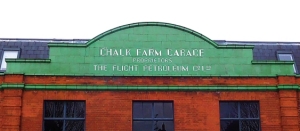
We visit Regents Park Road on some Saturdays and Sundays when parking is easy and free of charge, but, alas, we were born far too late to have been able to enjoy the stimulating atmosphere that must have reigned in the home of Engels on Sundays. Despite the absence of the great Engels, there is much to enjoy along the road where he lived, even during these restricting times of the covid19 ‘lockdown’. Apart from fresh air in plenty on Primrose Hill, there are interesting food shops and a few places that serve hot drinks to passers-by. One of these, which we favour, is Greenberry Café, which is located near to the railway lines. Almost next to this establishment, there is a building set back from the road. Its red brick façade is topped with a green tiled pediment with white lettering that reads:


Chalk Farm Garage

Proprietors

The Flight Petroleum Co Ltd

The ground floor of this building, which might once have included the workshops of the garage are closed in with modern glazing. Now used as the art gallery of the Freelands Foundation (https://freelandsfoundation.co.uk/about), this used to be a regular local petrol filling station. Flight Petroleum is a company that still exists. It is based in Mississippi (USA).  Before becoming a gallery, the former filling station was a branch of the Bibendum company that supplied alcohol not as motor fuel but in the form of wines and spirits.

Almost next to the former garage, a few feet left (i.e, west) of it, there is a curious looking white building, that was not built as a dwelling or a shop. On 19th and early 20th century maps, this is marked as being a ‘chapel’. An extremely detailed (5 feet to the mile) map of 1895 reveals that this chapel was in the grounds of the ‘Boys’ Home Industrial School’. The school’s grounds occupied much of the corner of Regents Park Road and King Henrys Road that meets the former at an acute angle. Where the former garage stands now used to be the entrance to the courtyard around which the school’s buildings were arranged.

I looked at two useful websites, www.childrenshomes.org.uk/EustonBoysIS/ and http://whispersandvoices.blogspot.com/2009/07/boys-home-regents-park-road-london.html, to learn about the school and its history. The school was originally founded by the physician and social reformer George William Bell (1813-1889) as the ‘Home for Unconvicted Destitute Boys’ in 1858 in some houses on Euston Road, where the British library stands currently. Later that year it became a certified ‘Industrial School’, which admitted boys sent by the courts for their protection as well as those who came voluntarily. In 1865, the school had to move because its premises were to be demolished in order to build a railway goods shed.

The school moved to new premises on Regents Park Road, initially a row of three houses. The chapel, one of whose pediments bears the letter ‘T’, was added after the school received a donation from a generous donor and was later superseded by the establishment of the St Marys Church on the northeast corner of Primrose Hill.  In 1868, a new school room was built on the northern side of the school’s yard. This was raised on arches, the spaces beneath them being used to store materials such as wood that was used in some of the practical classes taught in the establishment. By the 1890s, the school occupied the buildings that now form the corner of Regents Park and King Henrys Roads.

The boys learnt a variety of skills including carpentry, brushmaking, tailoring, shoemaking, and so on. They were also hired out to local residents, as Edward Walford described (writing in 1882):

“A large quantity of firewood is cut on the premises, and delivered to customers, and several boys are employed by private families in the neighbourhood in cleaning knives and shoes. The amount of industrial work done in the Home is highly satisfactory. The products of the labour of the boys and their teachers —clothes, shoes and boots, brushes of every kind, carpentry and firewood—are sold, and contribute to the general funds of the institution …”

I wonder whether any of these highly productive young boys did jobs for the household of Friedrich Engels, who lived close by. At the same time as they were beavering away, so was Engels. During his residence close to the school, he:

“ … wrote many of his famous works at № 122—The Housing Question (1872), Anti-Duhring (1877-78), the revised form of three chapters of this book published as Socialism, Utopian and Scientific (1880), Origin of the Family, Private Property and the State (1884), Ludwig Feuerbach (1888).” (www.marxists.org/history/international/comintern/sections/britain/pamphlets/1963/london_landmarks/index.htm).

Engels died in 1895. The school closed in 1920. On a map surveyed in 1938, the school’s courtyard still existed, the garage was not yet built, and the chapel was still marked as such. Today, there is no memorial to the school where it used to stand, but Engels’ house is distinguished from its neighbours by a circular plaque. Both the school and Engels were involved in social reform and the welfare of the oppressed, but few today would associate this pleasant road near Primrose Hill with those historical activities.

Note 1:

www.cambridge.org/core/services/aop-cambridge-core/content/view/F19FEAB88CAD3C1ACBB7B917B1EC1E00/S0020859000002364a.pdf/russian_emigration_and_british_marxist_socialism.pdf

Watching stars where horses drink

FOUR MILES FROM ST GILES Pound and four and a half miles from ‘Holborn Bars’, there stands a white stone milepost close to a pond at one of the highest places in north London. This pond in Hampstead got its name Whitestone because of its proximity to this white milepost.  Originally known as ‘Horse Pond’, it was a place where horses could drink and wash their hooves. The pond was supplied with ramps to allow easier access for the horses. These were preserved when the pond’s surrounding banks were extensively renovated in 2010.

The pond used to be supplied by dew and rainfall but was later kept filled by water from the mains water supply, which is fortunate given how little rain falls during some periods of the year. Being a shallow pool in an exposed location so high above sea level (443 feet), it is often covered with ice in cold weather.

A tall flagstaff stands a few feet west of the pond. This marks the spot where there was once a beacon that formed part of a network of beacons that could be lit to communicate with each other during the 16th century when the threat of invasion by the Spanish armed fleet was feared. The beacon by the Pond was the most northerly of a series of beacons which originated on the cliffs at St Margarets near Dover. This network can be seen on old maps such as that drawn by William Lambarde (1536-1601) in 1570, several years before the arrival of the famous Spanish Armada. Currently, the only purpose of the tall white pole is to fly the red and white flag of the City of London high above the pond.

High as the pond is, it is not the highest point in Hampstead. That honour goes to the small observatory on the top of the reservoir just south of the pond. This point is 449 feet above sea level. The reservoir is a:

“… wonderful example of mid Victorian architecture … The reservoir and railings were constructed in 1856 for the New River Company to serve Hampstead with the water being delivered by pipes from Highgate. The company was absorbed into the Metropolitan Water Board in 1902.” (http://www.ianclarkrestoration.com/122/Hampstead_Reservoir,_London_-_Thames_Water/).

This structure is inaccessible to the public, but the observatory perched on top of it is, in normal times, opened to the public occasionally.

The small observatory topped with a dome was established in 1910 by the Hampstead Scientific Society (www.hampsteadscience.ac.uk/astro/history.html). It can be seen best from Lower Terrace. The first secretaries of the Society were two keen astronomers, Patrick Hepburn and PE Vizard. The first telescope, a ten-and-a-half-inch reflecting telescope, was donated by Colonel Henry Heberden on condition that it be used by members of the public. In normal times, the observatory is still open to the public on clear nights. At the beginning of the 20th century, nights were much clearer than they became later and valuable observations could be made. As time passed, both dust and light pollution have rendered it far more difficult to make any observations at all. In addition to astronomical uses, the observatory is home to a collection of devices used in meteorology. The weather station at the observatory has the longest continuous record of climate measurements for any still extant meteorological site in Greater London, having begun in 1909 (www.weather-uk.com/page2.html).

Returning to the Pond, I remember that during my childhood, the traffic around it was terrible, especially during rush-hours. It became even worse when police officers arrived to try to control it. While I was studying at Highgate School, there was an extremely bright boy in my year group, ‘B-W’ was his surname. During physics classes, he appeared not to pay attention to the teacher because he was too busy designing complicated electronic circuits. When we took our physics mock-O’Level examination, he was the only person in the class to pass it, exceeding the pass mark by a large margin. My result in this test was a miserable 15%, which was five times higher than the boy with the lowest mark. In case you are wondering, I did well during the actual examination a few months later.

One morning, B-W arrived at school and showed us a complicated diagram. It was his proposal for a scheme that should allow traffic to flow smoothly around Whitestone Pond (where five major roads meet). It is a long time since I saw the scheme that he designed, but I would not be surprised if it is much the same as the much-improved traffic flow system that exists today and was only instituted a few years ago.

The Pond has been part of my life intermittently since my earliest days. In the late 1950s, and early 1960s, my parents and I used to walk past it every Saturday morning on our way to the shops in the centre of Hampstead. During the ‘80s, and ‘90s, I used to drive past it on my way to see my father and other members of my family, who lived in the Hampstead Garden Suburb, which is north of the Pond. More recently, my wife and I have been finding that visiting Hampstead, which has a rich history and many attractive old buildings, is a lovely way to pass time and enjoy fresh air. Whitestone Pond and the carpark nearby make for a good starting point for a stroll through a part of London that has to a large extent resisted the ravages of time and so-called ‘progress’.

At the sharp end

“THIS WON’T HURT A BIT” are words that I never used when I was practising as a dentist. However careful and gentle one is when giving an injection, the recipient is bound to feel at least a tiny bit of discomfort. So, I never uttered those words because to do so would be telling the patient something untruthful and that would have risked undermining his or her confidence in me. So, today, when I went to our beautifully well organised local clinic (at St Charles Hospital in London’s North Kensington) to receive the first of my vaccination ‘jabs’ to protect me from covid19, I was pleased that the clinician, who administered it did not say those words which I always avoided, but instead told me that I might experience some discomfort. Despite the needle being of a larger gauge than usual, my jab was not at all painful.

Years ago, a friend of mine, ‘X’, who was married to ‘Y’, a medical doctor involved in biological research, related her experiences of receiving vaccinations and other injections. Until she went into hospital to have her first child, she had always been given injections at home by her husband.

On arrival at the hospital, X was terrified when she was told she needed an injection. However, after it was done, her fears evaporated, but was left with a question in her mind. After she returned home with her baby, she asked her husband the question that had occurred to her in hospital. She said to Y:

“It’s really strange, dear, but the injections I had in hospital were completely painless unlike those you give me. I wonder why that should be.”

Y did not answer immediately, but after a short while, said:

“That’s easy to explain. I always inject you with the type of needles that I use for injecting, or taking samples from, experimental animals, the rats and so on.”

It is no wonder my friend found her husband’s injections painful. The syringe needles he used for laboratory animals were of a much wider bore than those normally used for administering jabs to humans. They were wide enough to be cleaned by pushing a wire along their length prior to sterilizing them.

This reminded me of the somewhat painful injections that our family doctor, Dr C, gave us when we were children in the early 1960s and before. Even though this was long ago, I can remember that his surgery had a gas fire, and its gas pipe had a small branch that fed a burner that heated a container in which he boiled his glass syringes and reusable needles between patients. These needles, like those used on animals and my friend, X, had to be wide so that they could be reamed out prior to being boiled. Furthermore, repeated boiling in water, blunted the needles and made them increasingly likely to cause pain when penetrating the skin. It was lucky that when we were vaccinated as kids, we did not come away with some infection as bad as whatever we were being protected against. There was no HIV in the 1960s, but there were other bugs, which were certainly not inactivated by boiling water.

Today, at the vaccination centre, a beautifully laid-out facility in a Victorian hospital building, I was shown the wrapped disposable syringe and needle, and felt confident that the vaccinator at St Charles had done a good job of jabbing.

Sir Harry loses his head

LOSING AN ELECTION is probably one of the worst things that happens to politicians today. Several centuries ago, a politician risked facing a far worse fate: decapitation. Such was the ending that was suffered by a 17th century politician who chose to live Hampstead in north London, close to Westminster yet surrounded by countryside.

Sir Henry Vane (c1612-1662) is often referred to as ‘Henry Vane, the Younger’ or ‘Harry Vane’. Born into a wealthy family, he completed his education in Geneva, where he absorbed ideas of religious tolerance and republicanism. His religious principles led him to travel to New England. Between May 1636 and May 1637, he served as the 6th Governor of the Massachusetts Bay Colony. While in America, he raised a large amount of money to be used for the establishment of what is now Harvard University. Soon, he came into conflict with other colonists. Barratt, an historian of Hampstead, wrote:

“…he soon found that his own ideas of religious independence and those of his friends were not in harmony. Their “tolerance” was shown in a cruel and rigid intolerance of everything that did not fit in with their own narrow Calvinistic views; Harry Vane stood for a larger humanity.”

Harry returned to England and became a Member of Parliament as well as a Treasurer to the Royal Navy (in 1639). He was knighted by King Charles I in 1640.

When the conflict between the Royalists and the Parliamentarians broke out in about 1642, it was hoped that Harry would stick with the Royalists, but he did not. He became a solid supporter of the Parliamentarians. During the Commonwealth that followed Cromwell’s victory in the Civil War (1642-1651), he regained his position of a treasurer to the navy. Harry’s views on various things differed from those of Oliver Cromwell. By this time, Harry had moved to a house in Hampstead, Vane House, where, it is believed, he used to meet with Cromwell, Fairfax, and other prominent Parliamentarians. The poet Milton was also a visitor at Vane House. Barratt relates that when the question of executing King Charles I was being decided:

“…Vane refused to be a party to the sentence, and retired to his Raby Castle property in Durham, one of the estates his father settled on him on his marriage in 1640.”

Vane had married Frances Wray, daughter of Sir Christopher Wray, who was a Parliamentarian.

Harry became concerned when Cromwell barred him from the dissolution of the so-called ‘Long Parliament’ in 1653. Let Barratt expand on this:

“When Cromwell violently broke up the Long Parliament, his most active opponent was Sir Harry Vane, who protested against what he called the new tyranny. It was then that Cromwell uttered the historic exclamation, “O Sir Harry Vane! Sir Harry Vane! the Lord preserve me from Sir Harry Vane!” Vane was kept out of the next Parliament, and, still remaining at Raby, made another attack on Cromwell’s Government, in a pamphlet entitled ‘The Healing Question’. This was a direct impeachment of Cromwell as a usurper of the supreme power of government, and led to Vane being summoned before the Council to answer for his words.”

Harry’s actions led him to be imprisoned on the Isle of Wight.

Following Oliver Cromwell’s death in 1658, Harry returned to public life and his home in Hampstead. He was striving for Britain to become a republic rather than a continuation of the dictatorial Protectorship established by Cromwell and continued by his son Richard.

When King Charles II was restored to the throne, ending the Protectorship, Harry, who had not been party to, or in favour of, the execution of Charles I, was granted amnesty and hoped to live in retirement, contemplating religious matters that interested him, in his Hampstead residence. But this was not to be. Although the King was happy to forgive Harry, some of his advisors were concerned that, to quote Barratt:

“Vane’s ultra -republicanism was probably more objectionable to Charles II. than it had been to the Protector, and Charles had not been established on the throne more than a few months when the arrest of Sir Harry Vane was ordered.”

Harry was taken from his garden in Hampstead by soldiers on an evening in July 1660. After a short spell in the Tower of London, Harry spent two years as a prisoner on the Isles of Scilly. In March 1662, he was brought back to the Tower and faced trial at the King’s Bench. The charge against him was:

“…compassing and imagining the death of the king, and conspiring to subvert the ancient frame of the kingly government of the realm…”

The judges in this unfair trial had no option but to find him guilty. He was executed at the Tower.

I would not have been aware of this remarkable man had I not spotted a brown and white commemorative plaque in his memory on an old brick gate post on Hampstead’s Rosslyn Hill. The gatepost and a short stretch of wall are all that remains of Harry’s Vane House, which was has been demolished. It was still standing in 1878, by which time it had been heavily modified and:

“…occupied as the Soldiers’ Daughters’ Home. Vane House was originally a large square building, standing in its own ample grounds.” (www.british-history.ac.uk/old-new-london/vol5/pp483-494).

This was connected by a covered arcade to a school for soldier’s daughters. The building which housed the school still stands on Fitzjohns Avenue and has been renamed Monro House. The heavily modified Vane House, in which Sir Harry resided, was demolished in 1972. Its only remains are as already mentioned.

Once again, seeing a small thing whilst strolling around in London has opened a window that has given me a first view of an aspect of history that was almost, if not completely, unknown to me.