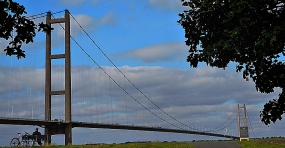
MY WIFE WAS studying to become a chartered accountant in the mid-1970s. As a trainee, she was required to carry out audits for her company in many parts of the UK. One of these was the building site where the Humber Bridge, which crosses the River Humber and links north Lincolnshire with the East Riding of Yorkshire. The bridge has a long span suspended between two tall concrete towers. When my (then future) wife arrived to audit the accounts of the entity involved in the construction, the towers had already been erected but there was no span for carrying the roadway across the river. A precarious looking cradle, attached to cables suspended between the towers, was used to cross the river. Some of the construction workers used it to traverse the Humber.
Being a keen and extremely assiduous trainee accountant, my wife wanted to inspect the construction site in considerable detail. Respecting her desire to examine the site properly, the managers on the site ensured that this happened. After carrying out the audit, she returned to London satisfied and has always held a special affection for the then yet to be completed bridge.
It was only a few years after my wife qualified as a chartered accountant that the bridge was eventually opened for use in mid-1981. The bridge is 1.38 miles in length and is currently the world’s eleventh longest bridge of this design (https://en.wikipedia.org/wiki/Humber_Bridge). A small toll is payable to cross it, which is what we did while travelling from Yorkshire to Lincolnshire in September 2021. After driving across the elegant, impressive bridge, we drove through the small town of Barton-upon-Humber to reach a bridge viewing park. There, my wife and I enjoyed snacks whilst gazing at the bridge for which she still harbours a soft spot. There is no accounting for taste!
YORKSHIRE IS RICH in the ruins of abbeys and other religious institutions, which were all dissolved (closed down) by Henry VIII in the 16th century and left to decay. The better known of Yorkshire’s ruined abbeys include those at Fountains, Rievaulx, and Whitby. In the North Yorkshire district of Ryedale, there are the extensive ruins of a former Cistercian abbey, founded in 1137 and called Byland Abbey. Having visited ancient but still intact and well-preserved Cistercian monasteries in various places in France, I have a reasonable idea of what these places look like. What I particularly liked about the ruins at Byland was that although much of the old stonework has been taken away and incorporated in other buildings, sufficient remains not only of the abbey church but also of the many buildings (e.g., the refectory, the cloisters, the chapter house, and the abbot’s house) that made up the monastic settlement. Having seen the monasteries in France I was able in my mind’s eye to create an image of how Byland might have looked in its heyday.
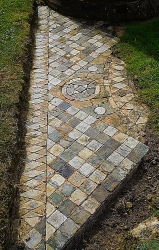
Apart from its great beauty as a ruined church, the abbey’s vast former church has something that I cannot recall ever having seen at other ruined abbeys I have visited. Exposed to the open air and risking being trod upon by visitors are many quite large expanses of mediaeval floor tiling. Many of the fired clay tiles still bear their coloured glazes. There are patches of tiling where they are laid out in circular geometric patterns. It was surprising to see such a great number of these tiles because even in many of the still intact British churches and cathedrals, such ancient flooring is quite rarely preserved to such an extent as in the ruined Byland Abbey.
I was told that when the abbeys were dissolved by Henry VIII, their roofs were removed, and this ensured that the buildings became unusable and fell into decay. The west end of Byland’s huge church contains the remains of a masonry circle that was once the frame for an enormous rose window, believed to be a prototype for the rose window that still can be seen at York Minster. While the Minster is a sight not to be missed, so is Byland Abbey. The latter might not have such a spectacular location as the ruins at Whitby and Rievaulx, it is, in my opinion, a far more interesting place to explore.
AFTER A SUNNY DAY spent at Whitby in North Yorkshire, we stopped for a drink at sundown in a small pub for a pre-prandial alcoholic beverage. Behind and slightly above the pub, we could see a well-maintained 12th century parish church with later modifications and a square tower. Below the pub, a narrow stream, lined with bushes and trees, ran alongside the main road. Apart from the infrequent passing car, the place was silent except for some pleasant birdsong. From where we sat on the terrace of the hostelry, we could see a small, sloping village square with a simple war memorial, some parked cars, and a small post box. At first, I did not realise where we had stopped. Then, I noticed that the village is called Kilburn.
Kilburn, North Yorkshire
There is another Kilburn about 215 miles south of the lovely village where we stopped for an evening drink. The latter is in North Yorkshire and the place with the same name many miles south of it is in north London. Apart from sharing the same name, London’s Kilburn is anything but rustic and peaceful, as many Londoners will know. London’s Kilburn is not really picturesque in conventional people’s eyes; it might appeal to lovers of urban sprawl. It is a crowded metropolitan area with much commercial activity and a racial profile infinitely more diverse than that of the village in North Yorkshire.
I am not sure which of the two Kilburns is the oldest. North Yorkshire’s village was mentioned in the Domesday Book of 1086 and named ‘Chileburne’. London’s Kilburn was a settlement on an ancient Celtic route, a track between the places now known as St Albans and Canterbury. A priory was constructed on a stream that flowed through where London’s Kilburn now stands. The stream was known variously as ‘Cuneburna’, ‘Kelebourne’, and ‘Cyebourne’.
Whatever the origins of these two Kilburns, I know which of them is the place where I would prefer to linger in front of a glass of bitter.
I VISITED BARCELONA in the late 1960s. One of the sights I saw was a museum dedicated to Pablo Picasso. Before entering that place, the artist’s works somewhat puzzled me. In the museum, there were some of Picasso’s earliest paintings. They were straightforward rather than abstract, and extremely well executed. The artist’s talents were immediately obvious. As I moved from room to room, the works on display became increasingly abstract. By seeing his progression from figurative to abstract, I began to appreciate his greatness as an artist, and I began to understand why he is regarded as a brilliant creator by many people. By the time I had finished looking around the museum, I had been converted from being sceptical about Picasso to becoming yet one more of his fans. More recently, I saw an exhibition showing the artistic development of Roy Lichtenstein from his earliest to his latest creations. No longer was he just a creator of entertaining pictures based on American comic strips, but I could see that he was an artist of great competence. Like the foregoing examples, a visit to the Cartwright Hall Museum in Bradford and seeing some of David Hockney’s earliest works also enhanced my appreciation of this highly prolific visual artist.
Bradford in Yorkshire is not far from the city of Wakefield, where Barbara Hepworth (1903-1975) was born. She was baptised in the city’s fine cathedral. Until today, I had mixed feelings about Hepworth’s works. There are some that I like very much, including a Mondrian-like crucifix at Salisbury Cathedral and a Naum Gabo inspired work attached to the eastern side of the John Lewis shop on London’s Oxford Street. Also, I have enjoyed visits to Hepworth’s studio and garden in Cornwall’s St Ives. However, as beautifully executed as her works are, I did not become terribly keen on her artistic output until today, the 18th of September 2021.
What converted me and increased my appreciation of Hepworth as an artist was today’s visit to the Hepworth Wakefield Museum. We arrived to discover that for the time being the whole museum is filled with works by Hepworth, beginning with her earliest and ending with her latest. The temporary exhibition, “Barbara Hepworth: Art & Life”, continues until the 27th of February 2022, and should not be missed.
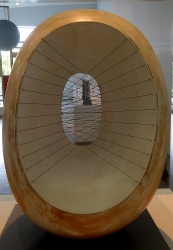
As with other abstract artists, such as Picasso, Hepworth began learning the basics of figurative representation. Her earliest carvings and drawings were created superbly competently but give no hint of which directions her creative output was soon to follow. Had she not developed any further, she would have been regarded as a skilled, if not too exciting, sculptor. However, Hepworth soon became involved artistically, and in one case maritally, with leading artists of the twentieth century. Contact with them and their ideas can be detected in some of the works she created as she moved from purely representational to highly abstract. It was particularly interesting to see a small carving with a hole in it, the first of her many works to have holes in them. The idea of the holes is to allow light to flow through her sculptures. It was not only other artists who inspired Hepworth’s creation but also the forces of nature, which unconsciously sculpt rocks, trees, and other natural features in the landscape.
It was interesting to see the life-size prototypes of some of Hepworth’s works I have admired in the past. It was wonderful, for example, to be able to get close to the full-size model sculpture which is now high up on the wall of John Lewis in Oxford Street.
Once again, seeing a collection of works illustrating the progression of an artist’s output from student days until the achievement of fame and beyond has helped me to increase my appreciation of an artist about whom I had some reservations. Today’s visit to the Hepworth Wakefield has moved Barbara Hepworth a long way up my ladder of great artists and removed any doubts I had about her works.
Finally, here is something that intrigues me. Hepworth, like Picasso and also my late mother, had what might be described as traditional basic artistic training, just like the European and western artists who created during the many centuries before the 20th, yet all three of them (and many others) moved from expressing themselves with figurative works to abstract creations. However, unlike the artists who flourished before the latter parts of the 19th century and never strayed into the world of artistic abstraction, those who created during after the late 19th century (including the Impressionists) strayed away from the purely figurative/representational. Why this happened is no doubt the subject matter of much art historical literature, which I have yet to read. As I wrote the previous sentence, it occurred to me that the move towards abstraction (and other forms of art that do not appear to give the viewer a straightforward recreation of nature) coincided with the advent of photography. The photograph can give the illusion of being a true image of the world, leaving the artist to explore other more imaginative representations of what he or she has seen.
KNOWING MY INTEREST IN INDIA, my cousin kindly sent me some photographs of a statue she saw in a small cathedral city in North Yorkshire. The statue does not commemorate a former slave owner (or even abolitionist) but (if one wants to be politically correct) a former representative of the British ‘oppressors’ of some of their subject people. The city where the statue stands is Ripon and the subject depicted is George Frederick Samuel Robinson, 1st Marquess of Ripon (1827-1909).
Lift to the Ripon Club
The Marquess (‘Ripon’) was born on the 24th of October 1827 at 10 Downing Street, the London home of his father, the Prime Minister Frederick John Robinson, 1st Earl of Ripon (1782-1859), who was the British Prime Minister between the 31st of August 1827 and the 21st of January 1828. Educated privately, Ripon was awarded a degree in civil law by Oxford University. Between 1852 and 1880, Ripon had a diplomatic career, becoming involved in matters relating to the USA and the formation of Italy. During this period, he also served several terms as a Member of Parliament for various constituencies. In addition, he held various high government positions including a brief stint in 1861 acting as Under-Secretary of State for India.
Between 1880 and 1884, Ripon was the Viceroy of India, one with more liberal views than most other holders of this post. While in India, he tried to introduce legislation that would give Indians more rights, including the opening the possibility of allowing Indian judges to judge Europeans in court proceedings. This reform did not materialise because it met with vigorous opposition from Europeans living in the Indian subcontinent. Ripon was involved in developing forestry in India as well as taking part in at least one huge hunt that resulted in massive killing of wildlife. Some of his efforts during his rule of India were beneficial to his Indian subjects, for example the Bengal Tenancy Act of 1885 and the repeal of the Vernacular Press Act of 1878. The latter, introduced by the Viceroy Lord Lytton, prohibited criticism of British policy by the Indian language (i.e. vernacular) press but it did not apply to the English language press.
Ripon returned to England, where he held various important civic and political positions. When the Liberals took power in 1905, Ripon became Leader of the House of Lords, a position he retained until the end of his life.
Ripon is still remembered kindly by a few people in modern India including in Chennai (Madras), Riponpet (in the Shivamoga district of Karnataka), Multan (now in Pakistan), and in Bombay (now ‘Mumbai’). It was in the latter mentioned place that a good friend of ours, a Parsi, took us to see the Ripon Club on the third floor of an edifice on MG Road, the NM Wadia Building, in the Fort area of Bombay.
The Ripon Club, whose membership is open to Parsis aged over 18, was founded by eminent Parsis including Sir Phirozeshah Mervanji Mehta, Jamshedji Tata and Sir Dinshaw Manackjee Petit (grandfather of, Rattanbai, the wife of the founder of Pakistan, Mohammed Ali Jinnah). All these gentlemen tried to improve life in India but had great respect for British imperial rule. The Club’s website (www.riponclub.in) informs that the place:
“…is a quaint, “Ole English-style” establishment for professionals such as Lawyers, Businessmen and Chartered Accountants to meet and enjoy their lunch. Of course, Parsi Zoroastrians from all professions are members of this beautiful club … the Ripon Club is the place to be if you whether you want to relax after a wonderful meal or entertain your guests and business associates … But time still stands still in this bustling club. The furniture from days gone by is evidence of this fact.”
It is much more than the furniture in the Club that gives the impression that time has stood still there. The building in which the Club is housed is old as is also its lift, which looks old enough to be preserved in a museum. However, it worked, and we ascended to the third floor. A pair of dark-coloured, wooden swinging doors, rather like the doors to saloon bars in films about the Wild West, serves as entrance to the Club. We entered a large dining room with many well-spaced tables and chairs, mostly unoccupied. The fittings and screens in this eating place look as if they might have been installed when the Club was founded. If this is not the case, they are certainly very old. The Club’s restaurant is famous for its Mutton Dhansak Buffet on Wednesday afternoons, a treat that I hope to enjoy some time in the future. Of course, we will need to be invited by one of our many kind Parsi friends, who is a member.Three or four people were eating lunch silently, served by a waiter, who was wearing a white shirt with black trousers. Another room we visited was also furnished with tables and chairs in addition to padded armchairs and sofas, as well as glass fronted bookshelf cabinets. This room also contained the sculpted bust of an eminent Parsi gentleman, whose name I failed to note.
The Club also occupies the fourth floor of the building, but we did not venture there to see its billiards and cards rooms and the fine view from its windows. Although we did not spend long in the Club, we were able to see that it, like many old Parsi and Irani restaurants and other establishments run by these minorities in Bombay, has resisted the tide of time. How much longer these relics of long ago will last is a worrying concern because the world’s Parsi population is diminishing in size.
I am grateful to my cousin for sending me her photographs of Ripon’s statue in the city of Ripon and thereby stimulating me to look into the story of the man who gave his name to a fascinating little club in the heart of Bombay, which was shown to us in early 2018 by a good friend who resides in the city.



 yamey
yamey 