An artist from India in a park in London

THE SERPENTINE NORTH (Sackler) Gallery (in London’s Hyde Park) is hosting a wonderful exhibition until 27 July 2025. It is displaying paintings and drawings created by Arpita Singh (née Dutta), who was born in Baranagar (now in West Bengal, India) in 1937. Between 1954 and 1959, she studied for a Diploma in Fine Arts at the Delhi Polytechnic in New Delhi. In 1962, she married the artist Paramjit Singh, and they live in New Delhi.

The works on display at the Serpentine were created from 1971 onwards. All of them were both intriguing and enjoyable to see. Even without knowing what the artist intended, I got the feeling that, apart from some abstract works, the images Singh creates are full of messages, stories, symbolism, allusions to feminism, and social comment. Though full of meanings, Singh’s works are subtle – their messages, which are left for the viewer to interpret, are not ‘full on’, but add to the visual enjoyment of the images. Her colourful paintings often lack the conventional European way of depicting perspective. In many of the paintings and drawings, the elements of the composition seem to be floating on the canvas or paper. Some of the pictures look like collages, but on closer examination what appeared to have been stuck on was in fact painted on the artwork.

The colourful artworks on display at the Serpentine are well worth seeing. It is a special show not only because it is her first solo exhibition outside India but also because Singh’s work is so satisfying to see.

Beware of upsetting wealthy benefactors: a word of warning to Donald Trump

A JAIN BANIA (BUSINESS MAN) called Hiranand Shah travelled from Rajasthan to Patna in 1652. In 1707, he financed Prince Farrukhsiyar sufficiently for him to become the Mughal Emperor (he ruled from 1713 to 1719). Manik Chand, a later head of this Jain family was then rewarded with the title ‘Jagat Seth’, which means ‘banker or merchant of the world’. By the eighteenth century, the family or house of of Jagat Seth was the largest banking house in the Mughal Empire.


The Nawabs of Bengal used the banking services of the house of Jagat Seth to pay tribute to the Mughal emperors in Delhi. William Dalrymple wrote that the Jagat Seth family were able to:

“… make or break anyone in Bengal, including the ruler, and their political instincts were sharp as their financial ones.” (quote from Wikipedia)


When the young Siraj-ud-Daulah became Nawab of Bengal in 1756, he alienated many people including Jagat Seth Mehtab Chand. Siraj demanded 30 million rupees as a tribute from the banker. When the banker refused, Siraj-ud-Daulah  slapped him. As a result, Jagat Seth took part in the conspiracy to defeat Siraj-ud-Daulah.  He and others, including Mir Jafar, helped the British, led by Robert Clive,  to defeat Siraj-ud-Daulah at the Battle of Palashi (Plassey) in 1757.  Jagat Seth’s money funded the British to help them defeat Siraj-ud-Daulah.


The Jagat Seth family was at least as influential as tycoons such as the Rothschilds in Europe and figures such as Jeff Bezos and Donald Trump’s current ‘chum’ Elon Musk. Taking the story of Siraj-ud-Daulah as an example, one could say it is best not to upset your wealthy supporters.  So, Donald, it would be best not to upset Elon!


Soon after the Battle of Palashi,  the fortunes of the house of Jagat Seth began to decline. Today, this remarkable family is commemorated by an opulent mansion, which they built in Murshidabad, sometime after it became the capital of Bengal (for 70 years during the eighteenth century). In 1980, the house was opened up as a museum, which is privately owned and run. We visited this place before we knew about the family’s involvement with the downfall of Siraj-ud-Daulah and the following capture of Bengal by the British. Like many other places in Murshidabad,  it is a fascinating reminder of Murshidabad‘s history during the era when Europeans, especially the British,  were beginning to make their mark on Bengal.

Baked earth and building Islamic places of worship

THE COUNTRYSIDE AROUND Murshidabad is dotted with brick factories. Their tall, often smoking, chimneys are surrounded by vast expanses of new bricks, usually stacked neatly. The clay that can be found in the area is particularly good for brick making.  So, it is unsurprising that many local buildings make substantial use of brickwork.


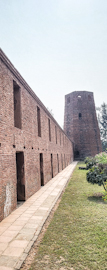
One of the towers of the Katra mosque

Near Murshidabad,  there are two famous mosques constructed not with stone or concrete, but with bricks. One of these, the Katra mosque, was constructed entirely with bricks between 1723 and 1724. This huge edifice was built not only as a mosque but also as a caravanserai. It is one of the largest caravanserais in the Indian Subcontinent.  The rooms of the caravanserai are arranged in a square that surrounds the mosque rather like cloisters in a monastery. These small rooms also served as workplaces and bedrooms for students studying the Koran and other Islamic texts. Thus, the Katra was a complex consisting of a mosque, a caravanserai, and a madrasa. At each of its four corners,  there were tall brick towers. Only two of these remain.   The tomb of Nawab Murshid Quli Khan(1660-1727) is located under the staircase leading to the main entrance of the building. Protected by the Archaeological Survey of India, the remains of the Katra complex are well conserved. This is not the case for another brick mosque nearby: the Fauti Masjid.


The Fauti was constructed in 1740 by Nawab Safaraz Khan (c1700 – 1740). However,  it was never completed. It is a large mosque, 137 feet long and 38 feet wide. If you manage to chamber within it, which I did with great difficulty despite helping hands, the remains of its five huge incomplete domes can be seen.


The Fauti is a protected building, but in a bad condition. It is possibly perilously unstable. However, because of the vegetation around it and within it, it is a picturesque ruin of the sort that eighteenth and nineteenth century European Romantic artists enjoyed portraying.


In addition to these mosques, which were built using baked clay (I.e., bricks), we have also seen some Hindu temples near Murshidabad that include terracotta in their construction.  But more about these at a later date.

A white horse, which only works for a few days each year, grazes in Bengal

This white horse, grazing outside the Nizamat Imambara, which faces the Hazarduari Palace in Murshidabad, is only required to work during the few days of the Shia Muslim festival of Muharram.

The Imambara is a Shia congregation hall, which was constructed in 1847. Only open during Muharram, it contains a shrine that houses soil brought from Mecca.

From West Bengal (India) to a floor in north London

KENWOOD IN NORTH London (next to Hampstead Heath) is a delightful place to visit at all times of the year. Amongst its attractions are a collection of fine paintings within Kenwood House; architectural features designed by Robert Adam; beautiful grounds with a lake; some modern sculptures; and a refreshment complex housed in the former servants’ quarters and stables. Close to the cafeteria, there are some toilets for use by visitors.

After visiting the ‘gents’ toilet, I looked down at the floor of the passageway leading to it, and saw a square, metal manhole cover. It had some lettering on it. Amongst the lettering, I noticed the following “KIC-INDIA”. Seeing this made me wonder if this manhole cover in north London had been made in India.

When I returned home, I looked at the Internet to see whether I could find out anything about the connection of this manhole cover with India. KIC-INDIA refers to an ironworks in India called KIC Metaliks Ltd (www.kicmetaliks.com), whose office is in Calcutta (Kolkata) in West Bengal. The company website revealed:

“K I C Metaliks Limited, founded in 1986 and headed by entrepreneur Radhey Shyam Jalan, is a leading pig iron manufacturer in West Bengal headquartered in Kolkata. Publicly listed on the BSE, the company has over 35 years of experience catering to hundreds of satisfied customers using cutting-edge technology. Its factory in Durgapur produces pig iron with a current capacity of 2,35,000 MTPA. The company takes a prudent yet ambitious approach to capacity expansion to become a dependable pig iron supplier.”

The company was formerly known as ‘Kajaria Iron Casting Limited’, and its plant is at Durgapur, 100 miles northwest of Calcutta. While searching the Internet, I came across other examples of KIC manhole covers in the British Isles, including at Bangor (County Down), South Shields (Tyne and Wear), and Plymouth (Devon).

Often when I am out walking, I look down at manhole covers. Sometimes they have interesting designs on them. When I spotted the KIC manhole cover at Kenwood today (6th of November 2024), it was the first time I had seen one made in India set into a floor in England.

Travelling beneath Kolkata

THE PRESTIGIOUS TOLLYGUNGE Club, where we are staying in Kolkata, is close to a metro station. The Club’s manager recommended that we used it to reach the city centre quickly rather than taking a much slower taxi into town.

The Kolkata metro, which now has three lines, began operating in 1984.

We travelled from Mahanayak Uttam Kumar Station, which is above ground to Park Street, which is subterranean. At the ticket office each traveller is given a circular plastic counter in exchange for the fare, which depends on the distance to be travelled. At a barrier operated electrically, the counter is placed on a designated panel, and the gate opens to admit the traveller to the platforms.

The clean trains are very efficiently ventilated with an air-conditioning system. There are sections of the carriages for ladies only. Passengers were using their mobile phones in the underground stretches of the journey, which suggests that, unlike in London either broadband or WiFi is available on the train while in a tunnel.

Electronic screens provided information about the journey and the use of the trains in Bangla, English, and Hindi. Announcements made over a loudspeaker system were in Bangla and English.

The train ran smoothly and passengers seemed very calm and polite. The journey was twice as fast as if we had gone by road. Although we travelled at a quiet time of day, the train was quite full. I imagine that during rush hours, we might not have been so comfortable.

All in all, our brief experience of the metro was very satisfactory. After disembarking at Park Street station, we bravely crossed a six lane main road to reach Park Street, which we discovered has now been renamed ‘Mother Teresa Sarani’, but most people still call it by its older name.

Hotel Tirupati

The Hotel Tirupati in New Jalpaiguri (NJP) is a few minutes walk from an important railway junction in West Bengal. Its rooms are comfortable but the hotel has several curious features.

The bedrooms we occupied on two separate occasions contain more lights, each with their own switch, than I have seen anywhere in similarly sized rooms. The lighting included unshaded blue and red light bulbs and a recessed ceiling lamp which bathed the room in a subdued eery blue light.

The rooms in the hotel are arranged around galleries overlooking a covered central light well. The ground floor of the light well, a central courtyard, contains a large effigy of the Hindu deity, the elephant-headed Ganesh (see image above). It forms part of the hotel’s large Hindu shrine. At least twice a day, bells are rung and a pooja is performed. I have not come across this before in my over 25 years of visiting India and its hotels.

The most curious feature of this hotel in NJP is the presence of CCTV cameras not only in the bedrooms but also in their ensuite bathrooms. I never dared to find out their purpose and whether these were in use!

FIRST DAY DAWDLING IN DARJEELING

ISTANBUL AND GJIROKASTER (in Albania) share something in common with Darjeeling. The three places have no shortage of extremely steep inclines. However, Darjeeling beats the other two in steepness. Its footways and streets often seem almost vertical. The thoroughfares are so narrow in many places – wide enough for only one car, and as few of them are one way streets, Darjeeling’s drivers have to be skilled in reversing long distances along them. Driving difficulties are compounded by the oft appalling road surfaces, the steep drops along edges of some streets, and deep gutters.

The Mall and Chowrasta (a square where four roads meet) are vehicle free pedestrian precincts. Some of the buildings in this area are over 100 years old and recall the ‘heyday’ of Darjeeling, when it was a high altitude resort for British colonialists. One of these old structures houses the well stocked Oxford bookshop. It specialises in books about the Himalayas, tea, and natural history.

Two long straggling bazaars start at Chowrasta: the Mall Market that is under a fabric roof supported by bamboo poles, and the Mahakal Market. The latter runs along a path which overlooks a lower part of the town. The Mahakal Temple and a Bhuddist temple perch atop Observatory Hill. These can be reached by walking up a very steep winding path, which was lined by mendicants soliciting alms, often pitifully.

We ate lunch in the very popular Kunga restaurant, which serves Chinese style food. One visit there is enough for me. The restaurant is near a large Victorian gothic edifice with a tall clock tower. Built in 1850, this used to be Darjeeling town hall.

Our quest for a Samsung service centre led us down a long, perilously steep pathway to the busy Chauk Bazaar area. This typical bustling bazaar divided into areas that specialise in one line of business, be it, for example, vegetables or tailoring or sweetmeats or shoes, is laid out higgledy piggledy on an area of level ground that is large by Darjeeling standards.

A taxi conveyed us at great speed up steep winding streets to the huge Sinclairs Hotel where our new friends from Lincolnshire kindly offered us sundowners – well, the sun had actually set long before we reached them.

Returning to our lovely homestay, our young driver forced his poorly powered tiny Suzuki Maruti car along some absolutely appalling roads, which reminded me of some of the worst byways I have experienced in rural Albania and off the beaten track in South Africa.