Walking along the path of peace along the Western Front

WHEN I SPOTTED THE book in the shelves of a charity shop in the small town of Bruton (in Somerset), I knew I had to buy it. It is written by Anthony Seldon, the youngest son of my parents’ dearest friends, Marjorie and Arthur Seldon. I have known them and Anthony since I was a very young child. The book I purchased is called “The Path of Peace. Walking the Western Front Way”.

In 2021, when Europe was in the midst of the covid19 pandemic, Anthony decided to walk from the Swiss Border to the North Sea, following the path of the Western Front such as it was during WW1. His aim was to help establish a ‘Path of Peace’, to realise the idea formulated during the war by one of the millions who died during it (in 1915), Douglas Gillespie. His idea was, so he wrote to his parents, to establish:

“… a path along No Mans Land from Switzerland to the English Channel after the war was over.”

Douglas wrote to his old headmaster at Winchester College that when the path was established:

“… I would like to send every man [woman] and child in Western Europe along that Via Sacra, so that they might think and learn what war means from the silent witnesses on either side.”

And Anthony explained that the walk he undertook was to help fulfil this noble ambition of poor Gillespie who perished in the conflict.

The book describes Anthony’s arduous walk along the Western Front. It was arduous physically, as the author explained in graphic detail. His feet suffered greatly, almost as much as those of the soldiers who had to spend long periods in the unhygienic trenches. It was also arduous for Anthony because he had recently lost his first wife, Joanna, who had succumbed to an illness (not covid19). The various governmental restrictions imposed to control the pandemic added to his difficulties. Yet, despite many businesses having shut down in France because of the virus, he managed (occasionally with difficulty) to find food and accommodation along the way.

Anthony describes many interesting aspects of the history of WW1 as he made his way north from Switzerland to the North Sea. He mentions what has become of the many places that were heavily destroyed by the artilleries of the armies fighting each other. Intertwined with these historical facts of an impersonal nature, he relates the poignant histories of his parents’ families during the war. For example, he describes how his father was orphaned when his parents died during the Spanish Flu, the spread of which was facilitated by wartime conditions. He also describes how his mother’s father was badly wounded in France and how his wife, Anthony’s grandmother, defied British officialdom and rescued her wounded husband from war torn France. These aspects of Anthony’s family history were known to me before I found the book, but what her wrote adds greatly to what I already knew.

Throughout the book, Anthony muses on the horrors of warfare and its tragic consequences. Yet, the book is not as gloomy as its subject matter might suggest. As the reader follows his progress along a frequently ill-signposted trail, he or she gets to know Anthony better: his strengths and his self-confessed weaknesses. Anthony’s book is both fascinating and moving. I am glad I bought my copy when I saw it in Bruton.

Remembering victims of war in Sandwich, Kent

Some of the WW1 names and the Falklands victim below

IN THE HEART of Sandwich in Kent, near to the deconsecrated Church of St Peter, there is a war memorial that was erected to commemorate those from the town who died in the ‘War to End All Wars’ – the First World War (1914 – 1918). Roughly 100 names are recorded on the lists of people who died during WW1. However, they are not the only people listed on this monument because ‘The War to End All Wars’ did not live up to its name.’

The memorial lists about 15 people who were killed in WW2 (1939-1945). In addition, three of Sandwich’s population perished in the Korean War (1951), and more recently, one of the townsfolk was killed in the Falklands Conflict (1982).

I sincerely hope that no more names need to be added to this war memorial as a result of the conflict in Ukraine, or any future wars.

A Boer War warrior in Warrington

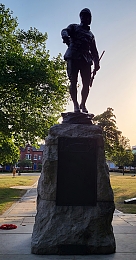
PALMYRA SQUARE IS a delightful rectangular piazza in the heart of Warrington in Cheshire. I use the word ‘piazza’ because the English word ‘square’ includes many squares which are anything but square. The centre of this open space is filled with the pleasant Queen’s Gardens, the Queen in the name being Victoria. It was near the end of her reign that the 2nd Anglo-Boer War (‘Boer War’; 1899-1902), a bloody conflict between the British Empire and the Dutch speaking colonists in what is now South Africa, occurred. In the middle of the eastern half of Palmyra Square there is the statue of a man in a helmet carrying a rifle in his left hand. His right arm points forward, as does his right index finger. The other fingers of his right hand clutch a pair of binoculars. He is wearing knee high boots, standing on a sculpture of a rock, and dressed in an old-fashioned military uniform. As soon as I saw this statue, I guessed (from the style of the uniform) it was connected the Boer War, and when I looked at the plinth upon which the military figure is perched, I discovered that I was right.

The monument was unveiled by General Sir Redvers Henry Buller (1839-1908), in the year before his death. Buller commanded British forces in South Africa during the Boer War. The man depicted on the plinth is Lieutenant Colonel MacCarthy O’Leary (1849-1900). He was killed on the 27th of February 1900 whilst leading men of his regiment (The South Lancashire) during the Battle of Pieters Hill. Richard Danes in his “Cassell’s History of the Boer War” (published 1901) pointed out that the 27th of February was Majuba Day, which was when the British were soundly beaten by the Boers at the Battle of Majuba Hill in 1881. The battle at Pieters Hill, which led to a British victory, facilitated the opening of the road to Ladysmith, which was being besieged by the Boer forces. An informative website (www.alamy.com/stock-photo-statue-of-lt-col-william-mccarthy-oleary-in-queens-gardens-warrington-54385554.html) revealed:

“The Regiment drew many of its recruits from the then-South Lancashire town of Warrington, where Colonel O’Leary was very well known. When the town erected a memorial to the men of the Regiment who died during the war, it chose to feature a sculpture of Colonel O’Leary on campaign in South Africa.”

The statue was sculpted by Edward Alfred Briscoe Drury (1856-1944). Amongst his many other creations is the South Africa Gate on The Mall in London.

The plinth upon which O’Leary stands forever motionless bears a large plaque on which the many members of the 1st and 2nd Battalions of the South Lancashire Regiment, who died during the Boer War, are recorded. These include a few officers and too many men of lower rank. Another plaque records the campaigns in which the regiment was involved. Apart from Pieters Hill, these were: Spion Kop, Vaal  Krantz, Colenso Kopjes, Tugela Heights,  Relief of Ladysmith, Botha’s Pass, Laings Nek; and the occupations of Wakkerstroom, Utrecht, and Vryheid. In other words, they took part in most of the important struggles during the Boer War.

The monument stands in a peaceful square in a small town, once in Lancashire but now in Cheshire, just about 400 yards from the River Mersey. As I stood looking at it during an unusual heatwave when the air temperature was between 35 and 37 degrees Celsius, I wondered how the brave men recorded on the plinth, who would have been encumbered with military equipment and inappropriate uniforms, managed to keep on going during the hot weather that they would have encountered whilst struggling against the Boers in the south of Africa.

War and peacefulness

THE CRANE IS a tributary of the River Thames. Named after Cranford (Middlesex) through which it flows it is about 8 ½ miles in length. It rises as Yeading Brook and flows towards its mouth at Isleworth, just opposite the southern tip if Isleworth Ait. On its way, the Crane passes east of Heathrow Airport, Hounslow Heath, Whitton, Twickenham, and St Margarets. It also feeds the man-made Duke of Northumberland’s River, which enters the Thames about 610 yards downstream from the mouth of the Crane.

The shot tower at Crane Park

The Crane flows through beautiful, wooded parkland known as Crane Park. This incredibly peaceful open space, part of which is a nature reserve, is in Whitton near Twickenham. Part of the park is in the Borough of Richmond-on-Thames and the rest in the Borough of Hounslow. The Crane, which contains a wooded island and breaks up into rivulets occasionally, is bordered on both sides by the park. The island, Crane Park Island, now a lovely nature reserve, a peaceful oasis in a busy part of London, was created for a purpose that was far from peaceful: warfare.

In the 1760s, a gunpowder works was established in what is now the west part of Crane Park. The island was created to form a millstream for operating a waterwheel connected to a mill for grinding saltpetre (nitrates of either sodium, potassium, or calcium) used to make gunpowder. It was part of a complex of buildings that housed the Hounslow Powder Mills. Before the 19th century, what is now Crane Park would have been part of the then much vaster Hounslow Heath. The website of the Twickenham Museum noted that gunpowder mills were established on the Heath as early as during the reign of King Henry VIII.  

All that remains of the Hounslow Powder Mills is a tall brick tower topped with a lead roof and a small lantern with a weathervane. It resembles a lighthouse. This was built either late in the 18th century or early in the 19th. Lying near it are a couple of circular millstones, which might have been used for grinding gunpowder. Described by some as a shot tower, it might have been used to manufacture lead shot. Molten lead would have been poured through a copper mesh near the top of the tower, and as it fell downwards, it formed into droplets, which when cooled became pellets of lead shot. This is most likely, but others suggest that the tower was part of a windmill.

Manufacturing gunpowder was a hazardous procedure, and unintended explosions were not unusual. The Twickenham Museum’s website related:

“Joseph Farington noted in his diary on Monday 25 January 1796 that: “The Powder Mills at Hounslow were blown yesterday. The concussion was so great as to break the windows in the town of Hounslow. Hoppner having been to Eaton, on his return rode to the spot where the Mills had stood, not a fragment of them remained. They were scattered over the country in small pieces. Three men were killed”… Burial records note deaths from further explosions: 5 on 17 November, 1 on 19 June 1798, 7 0n 15 July 1799, 2 on 27 June 1801, and so on through the century. Abraham Slade noted in his diary for 1859 that: “On the 29 of March the Powder Mills blew up, sending 7 poor souls into eternity in a moment. It has broken a great deal of glass in Twickenham & neighbourhood. We thought the whole place was coming down.””

The last major explosion at the Hounslow Mill was in 1915.

The powder mills passed through the hands of various operating companies: Edmund Hill, John Butts and Harvey and Grueber until 1820, then Curtis and Harvey until 1920, and then by Nobel Industries.The licence for producing explosives at Hounslow Powder Mill was revoked in 1927. In 1927, a Twickenham councillor, Frank Yates, bought the site. Later, he sold part of it for housing and the rest to Twickenham Council, who used it to create what is now Crane Park.

In addition to the impressive tower and a rusting sluice gate, several other less impressive remnants of the manufacturing complex can be seen on the island in the form of the bases of engine housings: lumps of bricks and concrete with thick metal rods protruding from them. Apart from the tower and a few other barely identifiable remnants, it is hard to believe that the sylvan and peaceful Crane Park was ever a place where the material of warfare had been produced for several centuries.

Buried in Bath

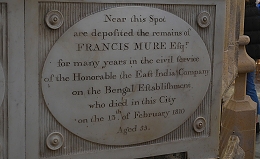
THE WALLS OF Bath Abbey are lined with memorials to the dead, many of whom are buried within the church. A remarkably large percentage of the funerary memorials commemorate the lives of people who worked in Britain’s colonies. There are monuments to people who lived and worked in the Caribbean, North America, and Asia, especially for the East India Company, which ‘ran’ and exploited India until 1858.

For example, Francis Mure Esq worked for many years in the civil service of “the Honourable the East India Company on the Bengal Establishment”. He died in Bath in 1810 aged 53. Henry Lynch Esq MD “of the island of Barbadoes” died in Bath in 1823, aged 49. Also from this place in the Caribbean was Benjamin Alleyne Cox Esq who died in Bath in 1802 aged 74.   In 1812, 78-year-old Rawson Hart Boddam also died in Bath, after having served as the Governor of Bombay in 1784. Robert Brooke Esq, who had served in the Bengal Civil Service died in 1843 aged 72 is also interred in Bath Abbey. Peter Read Cazalet, “of the Honourable East India Madras Civil Service”, who died in 1859, aged 37, is yet another old ‘India hand’, who is buried in Bath. Also in the abbey are the remains of Major General Sir Henry White KCB, part of whose inscription reads chillingly like some of the news bulletins in the current Ukraine crisis: “The judicious Position taken by his Division in the Attack on Agra Which accelerated its fall And the Reduction of The Strong Hill Fort at Gwalior By Siege Are Proofs of Zeal and Military Skill…” He died in 1822.

What puzzled me was why did so many of these men from the colonies ended their lives in Bath. Was it because they were sick and had come to the place to take the curative spa waters, which failed to cure them? Or had they retired to Bath? Or, as someone suggested, Bath is close to Bristol, which was in many ways involved with colonial affairs.

The answers to these questions must remain uncertain at present. However, I wondered why the wealthy American Senator William Bingham died in Bath in 1804, aged 49. He was involved with the Barings Brothers bank in London, which might have been a reason for him being in England at the time of his death. He left for England in 1801, when his wife was taken ill. What he was doing in Bath remains unclear.

Amongst the many fascinating memorials in the Abbey are several commemorating people who died abroad. Some of these people had been in India when their lives ended. An interesting example of this, which illustrates the hazards of warfare and the difficulties in subduing people, who have no wish to be colonized, is the monument to 1st Lieutenant George Dobson Willoughby, of the Bengal Artillery and the Commisary of Ordnance at Delhi, who died in 1857. His inscription includes the following details: “As a brave and zealous soldier he stood firm in the defence of the post intrusted to him, and when resistance failed blew up the Delhi Magazine on 11: May 1857 to prevent it falling into the hands of the mutineers and rebels. Burnt and wounded he subsequently fell a prey to the insurgents …”

Maybe, this is a lesson from which the dutiful Russian soldiers in Ukraine should take heed.

Fallen leaves amongst the fallen: Field of Remembrance

I HAVE LIVED in London for well over 60 years, but it was only this November (2021) that I first became aware of, and experienced, something that has been happening annually on the north side of Westminster Abbey since November 1928 (www.poppyfactory.org/about-us/history-timeline/#). For eight days following the Thursday preceding Remembrance Sunday, the Sunday closest to Armistice Day, the 11th of November, the day on which WW1 ended, the field bounded by Westminster Abbey and its neighbour, the church of St Margaret’s Westminster, is covered with a myriad of mostly tiny wooden memorials hammered into the grass. The memorials are mostly cross-shaped, but some are in the form of crescents, six-pointed stars, and other shapes including some that bear the Sanskrit symbol representing ‘aum’ (or ‘om’). Each of these tiny wooden items commemorates a fallen service person or other victim of war. The shapes of the wooden pieces denote the religion of the person or persons being remembered, be they Christian, Hindu, Sikh, Moslem, Jewish, or of no religion. Many of the wooden memorials have red poppies attached. Oddly, few if any of the Islamic crescents had poppies on them. The small wooden memorials are arranged in groups, according to which service or regiment or organisation the remembered people were members of, or associated with. The whole ‘event’ is organised by The British Legion Poppy Factory. This annual garden of memorials is called The Field of Remembrance.

The Poppy Factory, a charity, was founded in 1922 by Major George Howson (1886-1936) to provide employment for veterans injured during WW1. He bought a site in Richmond (south-west London), where he established a factory to manufacture Remembrance poppies and other related items to be sold to raise money for The British Legion’s Red Poppy Appeal, a charity that supports the Armed Forces community.

Apart from the small wooden memorials, there are many badges and emblems of the groups in which those remembered were members. Looking at these and the small wooden memorials is both fascinating and extremely moving. The fascination lies in the huge variety of regiments and organisations, too many to list, which lost people during military conflicts (and terrorist incidents) since the onset of WW1.

One group of memorials interested me because of their emblem that incorporates a heraldic creature, which has fascinated me for several decades. The creature is the double-headed eagle (‘DHE’), currently used as an emblem by countries including Albania, Serbia, Montenegro, the Indian state of Karnataka, and Russia. The DHE appears on the crests of some of the various regiments of The Royal Dragoon Guards. The Dragoon Guard regiments were first established in the 18th century, in 1746, and consist of mounted infantry. While the Austro-Hungarian Empire existed, it also used the DHE. In 1896, Emperor Franz Joseph I of Austria (1830-1916) of Austria-Hungary was appointed Commander-in-Chief of the 1st King’s Dragoon Guards, some of whose members are remembered in the Field of Remembrance. The emperor allowed the regiment to wear his empire’s emblem (https://web.archive.org/web/20130303033912/http://www.qdg.org.uk/pages/Uniform-1843-Onwards-81.php), the DHE. In addition, the regiment adopted “The Radetzky March” as one of its official march tunes; it is still used today. It was sad that in 1914, Franz Joseph, became the ruler of one of the powers against whom Britain and its allies were fighting. Some of those who fought in the British Royal Dragoon Guard regiments with the DHE on their headwear were killed by allies of the emperor in WW1, who had earlier been appointed their C-in-C. They are commemorated the Field of Remembrance. Judging by the small wooden memorials planted in the Royal Dragoon Guard’s section of the Field of Remembrance, members of at least four religions fell while serving in these regiments. I wondered why the DHE was retained even after Austria-Hungary became one of Britain’s opponents in war.

Returning to the Field of Remembrance as a whole, it is a poignant sight to behold. Although war is both horrific and ugly, this annual memorial is both moving and beautiful. The Field is laid out beneath trees lining its northern edge. Seeing the dead leaves from these trees lying fallen amongst the thousands of tiny memorials to victims of war seemed most apt to me.

They had no choice

ARMISTICE DAY IS celebrated annually on the 11th of November, the day that fighting came to an end in WW1. The day is to celebrate and:

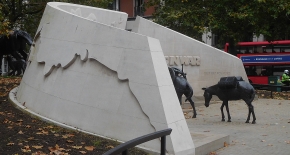
“…remember all those who gave their lives in service to their country since 1914.” (https://www.britishlegion.org.uk/get-involved/remembrance/about-remembrance/armistice-day). It was not only humans who sacrificed their lives, either willingly or less willingly, but also animals, who had been employed in warfare. A monument on a wide traffic island in London’s Park Lane was constructed to remember these four-legged creatures who lost their lives prematurely during battles from which they were unlikely to gain any benefit.

Erected by The Animals in War Memorial Fund (www.animalsinwar.org.uk/) and unveiled in 2004, this dramatic monument consists of a semi-circular Portland stone wall with a gap near its centre. Two bronze horses laden with military equipment are depicted walking towards the gap. and beyond the gap, a bronze sculpture of a running dog can be seen. The western part of the concave side of the wall has bas-reliefs depicting, horses, elephants, and camels. The eastern side of the concavity bears several inscriptions including one with the words “They had no choice”. The convex surface of the wall bears stylised silhouettes of horses. The monument was designed by David Backhouse and was inspired by the book “Animals in War” by Jilly Cooper.

“They had no choice” is a poignantly appropriate sentence on a memorial to creatures who were taken into fields of battle innocent of their likely fate. Seeing this moving monument made me think that these same four words could easily be applied to the numerous Indian participants in WW1 and WW2 who were sent to Europe as ‘volunteers’ innocent of their horrendous destination by their rulers in the Princely States of India, who wished to please the British, whom they served. Had these unfortunate servicemen known what they were about to face, some of them might have objected. That option was not one that would ever been open to the slaughtered animals commemorated on Park Lane.

St Johns Wood and the Crimea

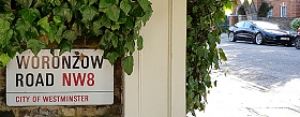
THROUGHOUT MY LIFE, I have been visiting or passing through St Johns Wood in north London. I have often noticed a street called Woronzow Road. It lies between Primrose Hill and St Johns Wood Underground Station. Whenever I have seen this road, I have wondered about the name ‘Woronzow’, but uncharacteristically I have always been too lazy to find out anything about it.

Recently, we visited Wilton House in Wiltshire, not far from the city of Salisbury. Home to the Herberts, the Earls of Pembroke, for many centuries, this is a wonderful place to visit, to see its gardens, the house itself and the outstanding collection of old master paintings within it. The decoration of the rooms that we saw is superb and is kept in good condition by the house’s present occupants, the family of the current, the 17th, Earl of Pembroke. It was whilst visiting this splendid country seat that my ears pricked up hearing the guide mention the name ‘Worontzow’.

In 1808, the widowed George Herbert (born 1759) remarried. His second wife was Catherine Woronzow (1783-1856). Her father was Semyon Romanovich Woronzow (1744-1832), Russian Ambassador to England from 1796-1806, who died in London and was buried in the Pembroke’s family vault. Catharine, who became Countess of Pembroke, did a great deal to improve Wilton House to create much of what we can see today. She is buried in the nearby church of St Mary and St Nicholas, which was built in a neo-Romanesque style between 1841 and 1844. It was built at the instigation of Catharine and her son Sidney Herbert, the 14th Earl of Pembroke (1810-1861).

Between October 1853 and February 1856, the last years of Catharine’s life, Britain was at war with Russia in what is known as The Crimean War. Between June 1859 and July 1861, Sidney Herbert was the Secretary for War in the British government. During the campaign, a supply route called the ‘Woronzow Road’, no doubt named in honour of Catherine’s noble Russian family, ran along the Crimean coast past Sebastopol. Thus, there was once a Woronzow Road in The Crimea. This was an important supply route for the British forces bringing much-needed material south from Alma and Calamita Bay towards Sebastopol. In the winter of 1854, the British lost control of this vital supply route and had to rely on goods reaching them by a far more difficult track,

One of Sidney Herbert’s great contributions to the war effort in the Crimea was his asking Florence Nightingale (1820-1910) to travel to Scutari (now, Üsküdar in Istanbul) with 38 volunteer nurses. She and her team helped to dramatically improve the treatment of the many soldiers who contracted diseases such as cholera and typhus whilst in the Crimea. Incidentally, Florence never visited the Crimea, but remained working in the Turkish city. Herbert and his wife had first met and become friendly with Florence Nightingale in Rome in about 1847.

Now let us return to St Johns Wood in London. Catherine’s father, Semyon Worontzow, lived in the district. The road, where he lived and whose name has intrigued me for decades, is now called ‘Woronzow Road’. It was named after him in 1843. It was not until 2002 that the Russians erected a monument to him on the thoroughfare named after him.

A viaduct in Cornwall and a man who died for his country

THE SMALL CORNISH village of Luxulyan has a fine old parish church, which is dedicated to Saints Ciricius and Julitta, both of whom are new to me. This edifice was built in the 15th century and restored in the 19th (https://historicengland.org.uk/listing/the-list/list-entry/1158407). The northern aisle of the church was filled with used books for sale when we visited it.  A weathered Cornish cross stands close to the west end of the church. During the 19th century, this was brought to its present location from Three Stiles (near Consence). The church and its churchyard, along with the tiny village are charming, but what caught my eye and raised my curiosity was a building bearing the name ‘Captain TC Agar-Robartes Memorial.’

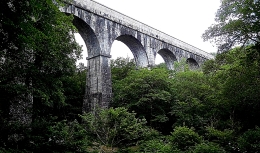
Treffry Viaduct near Luxulyan in Cornwall

The name Agar-Robartes intrigued me. My interest in it increased when I saw a small stone memorial near the River Fowey in Lostwithiel. It bore the words:

“Royal British Legion, Lostwithiel Branch, 1932-1997. Opened by Lady Robartes.”

Things became clearer after visiting the magnificent Lanhydrock House, originally constructed in the 17th century, and reconstructed quite faithfully after a huge fire in 1881. The house was created by John Robartes (1606-1685), 2nd Baron Robartes of Truro, 1st Viscount of Bodmin, and 1st Earl of Radnor. One of his many descendants, Anna Maria Hunt (1771-1861) married Charles Bagenal-Agar (1769-1811). One of their three sons, Thomas James Agar-Robartes (1808-1882), assumed the surname ‘Robartes’ in 1822 and tacked it on to his Agar surname. One of his ten grandchildren was Thomas Charles Reginald Agar-Robartes (1880-1915), the ‘TCR Agar-Robartes’, whose name is on the building in Luxulyan.

Thomas was educated at Eton and Christ Church College, Oxford. He was elected to represent the South-East Cornwall constituency as its MP in 1906. However, he was unseated a month after the election because of infringing some electoral regulations. He had been found guilty of bribery and other offences. Nevertheless, he was re-elected in 1908. His election campaign was based on support of free trade and reform of temperance laws. In August 1914, Thomas signed up as a 2nd Lieutenant in the Royal Bucks Hussars, and then in 1915, wanting to see action on the battlefront, he left for France as an officer in the 1st Battalion Coldstream Guards. In June 1915, he was promoted to become a captain. During the Battle of Loos in September 1915, he was shot in no-mans-land and never recovered.

The building, a working man’s institute and reading room in Luxulyan, which bears Thomas’s name, was first conceived in 1913, but only began to be used as such in 1924, when the edifice was completed. Naming it after Thomas is explained on a website page about the building (www.luxulyanpc.co.uk/Luxulyan_Memorial_Institute_32056.aspx):
“ Tragically, as we know, young Tommy Robartes of Lanhydrock died after receiving wounds rescuing a comrade from one of those fields of battle. He had been well known and liked in the village, often coming to visit, accompanying the land agent dealing with tenants. The village picked up its interrupted thoughts on the Institute and Reading Room idea; whether the idea of a Memorial to Tommy, or just asking the Lanhydrock estate for a piece of land came first, is not clear, but it was agreed that a piece of land from the estate for a Memorial Institute was acceptable to all.”

Having already offered £50 towards building the Memorial institute, Dr Nathaniel T Coulson then offered a further £100 on condition that Thomas Agar-Robartes’s name was on the hall. Dr Coulson, who is described in the website, interested me because of his profession:

“He was born in Penzance in April 1853, abandoned by his drunken father at the age of 10 years and bound over to the farmer at Penquite Farm, Lostwithiel. He then spent some years in the British Navy and first arrived in San Francisco in 1875. For a while he worked for a stock-broking firm and wrote for several daily newspapers. In 1884 at the age of 30, he became a student at the dental department of the University of California, where he graduated after two years, receiving his degree as a Doctor of Dental Surgery. He was a member of several fraternal organisations, and generous with donations to many worthy causes. Among others in England, he helped finance the establishment of Coulson Park, Lostwithiel, in 1907. He travelled back here on several occasions, also visiting India after his retirement…”

So, that explains the hall that we saw in Luxulyan. I am not at all sure which ‘Lady Robartes’ is the one whose name appears on the British Legion monument in Lostwithiel, which bears the words “Opened by Lady Robartes”. If a Lady Robartes opened the branch in 1932, who was she? Only one of Thomas’s brothers married, Arthur (1887-1974). His wife, Patience Mary Basset, whom he married in 1920 might have been the ‘Lady Robartes’. Alternatively, she might have been one of Thomas’s sisters: Mary Vere (1879-1946) or Julia (1880-1969) or Edith (1888-1965) or Constance (1890-1936). If on the other hand the words refer to the inauguration of the monument in 1997, then I cannot offer any suggestions.

Luxulyan is worth visiting not only to see the things I have already mentioned, but also the impressive, massive, granite combined aqueduct and viaduct near to the village. It carries water and a railway track over the River Par. Known as the Treffry Viaduct, it was completed in 1844 and designed by the engineer and mining entrepreneur Joseph Treffry (1782-1850).

Until we visited Luxulyan, I had never heard of the Agar-Robartes family. Once again, visiting Cornwall has resulted in finding places and persons of great interest. The more I see, the more I want to know.