MOST PEOPLE ASSOCIATE the name Cheddar with a cheese and a geological formation, the Cheddar Gorge. While these are both noteworthy things, there is more to Cheddar than them.
The gorge, a rock lined chasm along which a road winds, is a deservedly popular tourist attraction. It was formed 225 million years ago. The lower half of the gorge is lined with formidable cliffs. The upper half of it has tree covered slopes. The gorge is popular with walkers and rock climbers. At the lower end of the gorge, there are plenty of shops and eateries catering for tourists, who flock to the area in large numbers.
The caves in the gorge and around the village of Cheddar provide steady conditions of humidity and temperature that are ideal for making cheese. It was here that the type of cheese known as Cheddar. It was here that Cheddar cheese originated. However, nowadays Cheddar cheese is manufactured in other places in the British Isles.
The village of Cheddar, which is close to the bottom of the gorge, deserves a visit. There is a market cross, which was put up in the fifteenth century. It protrudes from a hexagonal structure that was rebuilt in 1844.
The Church of St Andrew Cheddar is near the market Cross. It was mostly built between 1350 and 1450 on the site of a Roman settlement. The tower includes Roman bricks in its structure. On the north side of the chancel, there is an elaborate canopy above the tomb of the Bristol merchant Sir Thomas de Cheddar, who died in 1443. His wife is buried in front of his tomb. Other features in the church include a fine patterned timber ceiling.
The origin of the name Cheddar is according to Wikipedia:
“Richard Coates, Professor Emeritus of Linguistics at the University of the West of England, has suggested that the name is Ciw-dor, ‘the door to Chew’, referencing an idea that the gorge marked an important routeway through at least part of the Mendip watershed, and giving access between two large and important estates which had probably been a part of the Wessex royal demesne from the 7th century.”
Whatever the origin of the name, Cheddar, its gorge, and its cheese are all worthy of note.
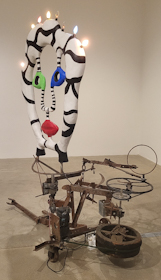
DURSLADE FARM NEAR Bruton in Somerset is home to a branch of the international commercial art gallery, Hauser and Wirth. Until 1 February 2026, there is a wonderful exhibition of artworks by Jean Tinguely (1925-1991) and his partner, wife (for a while), and long-term collaborator Nikki de St Phalle (1930-2002). Both artists produced highly original and very imaginative creations.
A collaboration by Tinguely and de St Phalle
The sculptures created by Tinguely are frequently examples of kinetic art in which elements of the sculptures are made to move by motors, which are parts of the artworks. His sculptures often resemble unusual machines. Some of his works were collaborations with Nikki de St Phalle.
Nikki’s works are often colourful, playful, and figurative. In one room of the exhibition, the viewer is introduced to an interesting method of creating artworks used by de St Phalle. She used a rifle to fire bullets filled with paint at various targets. When the bullets hit the targets, they splattered the paint contained within them. A few examples of this procedure are on display in the show.
The exhibition is held both inside and outside the buildings at Durslade Farm. The works outside were by de St Phalle. Those by Tinguely are all inside. Every 10 minutes, the sculptures with motors are activated for a few minutes. They are now too fragile to be run continuously or left in the open air.
Hauser and Wirth Somerset (at Durslade Farm) is now a popular destination not only for its art shows but also for its restaurants, garden, and pricey farm shop. However, its art exhibitions are always superb, and the current one is no exception.
I BECAME AWARE of William Thomas Beckford (1760-1844) in the late 1960s when my late friend Michael Jacobs and I were fascinated by the gothic revival that began sometime in the 18th century and continued with great vigour into the following century. Although I never read it, the ‘Gothic’ novel “Vathek” was written by Beckford, who also built the (now demolished) gothic revival style Fonthill Abbey. My interest in Beckford gradually drifted into the back of my mind and remained there until we made a visit to Bath (Somerset) in July 2024. Our hosts suggested that we visit the recently restored Beckford’s Tower, which is located on a hill just north of the Lansdown district of Bath. Kindly, they drove us there, and what we saw was interesting.
Beckford had a house in Bath’s Lansdown Crescent. It was set in extensive grounds that spread from his house to where the tower is located. The Italianate neo-classical tower was designed by the Bath-based architect Henry Goodridge (1797-1864), and completed for Beckford in 1827. It is 154 feet high and contains rooms that Beckford used as a library and living rooms. The grounds between Beckford’s house and his tower were landscaped to become Beckford’s Ride. Along the way, there is a manmade grotto, which has been recently restored.
After Beckford’s death, the tower and the land associated with it were donated to Walcot Parish, which used the area to create a burial ground. In 1931, the tower and the rooms at its base were badly damaged by fire. The cemetery was closed in 1992, and the following year, the site – tower and graveyard – were purchased by the Bath Preservation Trust, who have restored it. Between 1997 and 2000, extensive repair work was carried out on the tower. Further work was undertaken between 2022 and early 2024. This rendered the tower structurally sound and safe for it to be opened to the public. Before ascending the elegant spiral (helical, actually) staircase in the tower, the visitor can view exhibits relating to the life of Beckford in the rooms at the base of the tower. Amongst these, I spotted an early edition of “Vathek”, written it the language in which it was first published: French.
The author of “Vathek” was extraordinarily wealthy. His father, Sir William Beckford (1709-1770), was born in Jamaica, and later became Lord Mayor of London (1762-1769). His wealth, and therefore that of his son, was derived from his sugar plantations he owned in Jamaica. These were worked by the hundreds of slaves he owned. Thus, the tower was financed by the labour of these unfortunate unpaid labourers. Unlike several colonial apologists I have met and heard, the website of the restored tower, and many exhibits and notices within the edifice, emphasise the way in which the author of “Vathek” was able to pay for the tower and his extravagant lifestyle. The website (https://beckfordstower.org.uk/about/history/) includes the following:
“Through marriage and ruthless ambition over four generations, the Beckford family became one of the most powerful on the island of Jamaica. Their vast fortune was built on the profits of sugar plantations, directly created through the stolen labour of thousands of enslaved Africans.
William Beckford’s father, Alderman William Beckford, used the family’s wealth to rise through British politics, and was twice Lord Mayor of London. He presented himself as a hero of liberty for British citizens, whilst people on his plantations in Jamaica were trafficked and forced into slavery, stripped of their dignity, traditions, familial ties and African names, and given the surname Beckford.”
The Lord Mayor is commemorated by a statue in London’s Guildhall.
“William Beckford inherited 3,000 enslaved Africans in Jamaica, whom he mercilessly exploited to accumulate great wealth in Britain. His enslaved Africans were victims of routine sexual violence, torture, bodily mutilation and mass murder. Today, we recognise slavery as a crime against humanity and an unresolved stain on the national consciousness. We display this statue not because we wish to honour Beckford, but as a reminder of how we as a nation have sanitised, obscured and neglected racial capitalism and racial terror as foundational narratives of our modern history.”
In 1835, after the British Parliament had abolished slavery, former slave owners were compensated financially as the tower’s website explained:
“In 1835 following the abolition of slavery Beckford [author of ‘Vathek’] received a compensation payment of £12,803 (nearly £1.3 million today), the ‘value’ of the lives of 1,860 enslaved people. He immediately acquired the neighbouring property at 19 Lansdown Crescent and embarked upon a further period of commissioning new furniture and interiors for his home and the Tower.”
Despite its association with slavery, the unusual Beckford’s Tower, is, like the Egyptian pyramids also built with slave labour, interesting both historically and architecturally. It has been beautifully restored. During the latest round of restorative work, care was taken to adapt the tower “… for sustainable energy use …” by installing some solar energy panels on the flat roof of the building that forms the lower part of the tower.
If you are visiting (or living in) Bath, a trip to see and enter Beckford’s Tower is well worth making. And when you are there, do not miss climbing the tower’s dramatic staircase to obtain a superb view of the city of Bath and the countryside beyond it.
WHEN TRAVELLING BETWEEN London and Cornwall, we often stop at the small town of Wincanton in Somerset. Close to the A303 trunk road, it has retained a certain ‘ye olde worlde’ charm. Once. It was a town with many coaching inns, but although many of these have closed, the buildings that housed them are still recognizable. One of the buildings on the main street houses a small museum of Wincanton. Amomgst the exhibits, there was a glass case containing old objects connected with the ‘Cow and Gate’ dairy products company. Amongst these, there were two glass feeding bottles used for feeding milk to babies.
The Cow and Gate company began life in 1882 as the ‘West Surrey Central Dairy Company’. In 1904, Dr Killick Millard developed a powdered milk, which in 1908 was marketed by the company as ‘Cow & Gate Pure English Dried Milk’. In 1929, the West Surrey Central Dairy Company Limited was renamed ‘Cow and Gate’. None of this information was available in the form of a label or information notice next to the Cow and Gate exhibit. So, I asked the lady looking after the museum why there were Cow and Gate exhibits in the museum. She explained that until (before [?]) the 1990s. Cow and Gate had a large factory in Wincanton, which had its own railway line, a branch of the now closed (in 1966) Somerset and Dorset Joint Railway.
We strolled downhill to the south of the old part of the town, and came across the former Cow and Gate factory. With three storeys, a centrally located clock tower. and windows fitted with Crittall frames, it is a fine example of interwar Modernist industrial architecture. Today, many of the windowpanes are broken and the building has a deserted, neglected appearance. Boards with the name of Myakka – a design company – are attached, but there was no sign of life within the building and the yard surrounding it. We could not enter the old factory, but Myakka have posted pictures of its interior on it company website (https://blog.myakka.co.uk/home/myakka-architecture/). Although nobody seems to remember who designed it, it is a well-known landmark in Wincanton. Everyone we asked directions to it, knew it well.
Over the years, Cow and Gate expanded, and needed a fleet of vehicles to transport its products all over the country. This led to them founding a logistics company, ‘Wincanton’, which is still thriving more than 70 years after it was formed. In 1958, Cow and Gate merged with United Dairies to become ‘Unigate’, which was taken over by Irish foods firm Greencore in 2011. As for the derelict Modernist factory in Wincanton, nobody seems to know what will become of it.
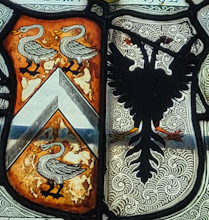
THE GREAT HALL of Lytes Cary Manor House in Somerset has some stained glass windows decorated with crests relating to the Lyte family, who owned the property between the 15th and 18th centuries. One of the crests caught my eye because the crest contains a double-headed eagle. This is a symbol that began to interest me in my teens when I first became fascinated by the Balkans. The double-headed eagle figures on the flags of Albania and some of its neighbours. The earliest known use of this peculiar creature is on seals used to secure goods in Babylon during the 3rd century BC.
The crest at Lytes Cary Manor is a combination of the Lyte family crest and that of the Worth family, which incorporates the two headed bird.
In 1592, Thomas Lyte (c1568-1638) married Frances Worth (1580-1615) who was born in Charlton Mackrell in Somerset. Thus, the double-headed eagle of the Worth family became joined with the three swans of the Lyte family crest. This marriage which was celebrated so long ago, is recorded in glass on a window of the Great Hall at Lytes Cary.
Why the Worths employed the double-headed eagle on their crest is something I would like to know, and will investigate. The double-headed eagle appears on British crests less frequently than other heraldic creatures. Possibly, andI am only guessing, it relates to the fact that a son of King John, Richard, Duke of Cornwall (1209-1272) was appointed King of The Germans, that was a senior position in the Holy Roman Empire. The symbol of that empire was the double-headed eagle.
LYTES CARY is a mediaeval manor in the English county of Somerset. This beautiful building, maintained by the National Trust, was owned by the Lyte family since the 15th century, if not earlier. The Great Hall of the manor house was built in the 1460s. The manor remained in the Lyte family until 1755, when the indebted Thomas Lyte IV surrendered all rights to their family home. Between then and 1907, the property fell into decay.
In 1907, the dilapidated Lytes Cary was purchased by Sir Walter Jenner (1860-1948) and his wife Flora, who died in 1920. They lived with their daughter Esme (1898-1932), a keen horse rider, who died of pneumonia after having been drenched in a rainstorm. Sir Walter was the son of Queen Victoria’s physician, Sir William Jenner (1815-1898), who studied at my alma mater University College in London. At his death, he left a great fortune.
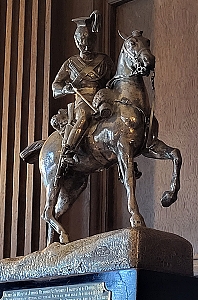
Polo trophy
Sir Walter had the house repaired and filled it with furniture and objets d’art appropriate to the age of the house. The result was a comfortable home with fascinating contents. One of the many objects that caught my eye is a trophy depicting a military man on a horse. This item bears an engraved plate:
“Major Sir Walter Jenner Bt, from Lt Colonel Forrester Colvin 1915 to commemorate joining the Ninth Lancers together December 1880. The many happy years spent therein and the following polo tournaments won by the regiment…”
Below this, there is a long list of tournaments played in India, England, Wales, and Ireland. In India, he was in the winning teams in Umballa (Ambala) in 1883 and 1884, and in Meerut in 1885. The latest tournament listed on the trophy was in Dublin in 1893.
Educated at Charterhouse School, Sir Walter became a magistrate in Somerset after retiring from the Ninth Lancers. He served in his regiment during WW1 and was awarded the DSO for his services in that conflict.
I enjoy visiting old houses like Lytes Cary and always find it interesting when I discover links between them and the history of India. Sir Walter’s polo trophy is not one of the most attractive pieces on display at Lytes Cary, but for me it was most fascinating.
THERE IS AN OLD octagonal building in the market place of Somerton in Somerset. According to a website about the town, this building is:
“… the octagonal shaped market cross; also known as the Buttercross. This was built by the Stawell family in 1673 and given the parish council in 1916 … The market place was a busy and noisy area during market day, and in extremely hot weather the dairy products such as cheese, butter and milk would soon go off. These goods would also be ruined in wet weather, and so a shelter was required that would shade and cover the products from the weather conditions. The Buttercross was the ideal solution, as it was both cool and dry. It is now listed as a Grade II ancient monument, and has been repaired on a couple of occasions during the last century.” (from: http://www.somerton.co.uk/virtual-tour/market-cross/)
It is not the only octagonal structure in Somerton. The tower of the mediaeval parish church is also octagonal.
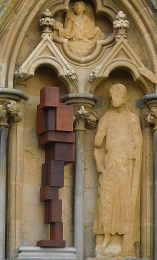
New metal sculpture by Antony Gormley at Wells Cathedral
Among the carvings
At venerable Wells Cathedral
Stands a novice
The sculptor Antony Gornley (born 1950) has added a new artwork (made of metal) to an empty niche on the west facade of Wells Cathedral in Somerset, England
A SOLITARY CHIMNEY stands in the middle of East Harptree Woods in the Mendip Hills of Somerset, not far from Bristol and Bath. This tall, not quite vertical, chimney and the surrounding uneven landscape is all that remains of the local tin and zinc mining activities in the area. Known as Smitham Chimney, this was built in the 19th century and was the exhaust for the toxic fumes created by the furnaces smelting lead-bearing materials. The unevenness of the surrounding area, now richly populated with a variety of trees, was caused by the pits and spoil heaps created during the era of mining activity. The chimney was built in 1867 and by 1870, the East Harptree Lead Works Co Ltd were producing about 1000 tons of lead per year (https://en.wikipedia.org/wiki/Smitham_Chimney,_East_Harptree).
Smitham Chimney
Today, the chimney stands amongst a fine collection of trees including conifers and birches, all growing in a sea of ferns and other bushes. Much of the woodland is mossy. Maintained by Forestry England, the Mendip Society, and Somerset County Council, the woodland has good, fairly level paths, easy on the feet. The place and its industrial archaeological feature make for a pleasant and interesting short excursion.
AN UNUSUAL CRUCIFIX hands within the church of St Mary in Bruton, Somerset. It is a sculpture typical of early 20th century German Expressionism, yet it was created in 1969, long after the heyday of this artistic trend. The creator of this religious sculpture was Ernst Blensdorf (1896-1976). He was born Ernst Müller in North Germany, but after his marriage to his first wife, Ilse Blensdorf, in 1923, he changed his surname to ‘Müller-Blensdorf’, then later to ‘Blensdorf’.
At first, Blensdorf became a seaman. After having been interned as an enemy alien by the British during WW1, Ernst travelled to Johannesburg in South Africa with a fellow internee. It was here that he made a table-top wood carving of an African village. On his return to Germany, this fine carving persuaded Ernst’s father that his son had a future as an artist and was willing to support him towards this aim. While in Africa, Ernst had seen African art first-hand and exposure to this certainly helped influenced his future creations.
After a brief spell at an art school in Barmen, he left to become apprenticed to a master joiner. By 1922, he had become a journeyman for a furniture company, which specialised in manufacturing luxury items. During this period, he was influenced by the Bauhaus artist Paul Klee and the sculptor Alexander Archipenko. The skill that Ernest acquired and developed whilst manufacturing wooden objects for the furniture company became useful as he moved from applied craftsmanship to artistic endeavours. In addition to other activities, he taught at the art school in Barmen during the 1920s. By the 1930s, he had become an established sculptor and had exhibited his works at various exhibitions in Germany, where he received both private and public commissions.
When the Nazis took power in Germany, Blensdorf became one of the first artists whose works were categorised as ‘degenerate’ by Hitler and his regime. This led to him losing his teaching post at Barmen and his studio being wrecked by the Nazi’s loutish followers. Ernst, his wife, and children, moved to Norway, where he was planning a giant peace monument to honour the Norwegian statesman and Nobel Peace prize winner Fridjtof Nansen. In Norway, he worked on this project and made a living creating and selling artistic ceramic works, alongside the Norwegian ceramicist Eilif Whist.
When the Germans invaded Norway in spring 1940, Blensdorf and his children fled to Scotland. His wife, Ilse, remained behind, saying that she was a follower of Adolf Hitler. Following his arrival in the UK, Blensdorf was once again interned as an ‘enemy alien’. Along with many others, including a good number of men with artistic talent and German nationality, he was interned on the Isle of Man (from 1940 to 1941). His children were placed in a couple of orphanages. While interned, he, along with fellow artists, were allowed to satisfy their creative urges and even to sell their creations. Using whatever materials he could find during this period of scarcity, Blensdorf’s creative output was impressively large. For the first time in his life, he had plenty of time to undertake artistic work in the absence of anxieties such as he had experienced before arriving on the Isle of Man.
Blensdorf was released from internment in 1941. He went to live with an Austrian couple, the Schreiners, whom he had met in the internment camp. They lived in Charlton Musgrove in Somerset. With him, the Schreiners planned to set up an art school, but this failed for financial reasons. Ernst remained in Somerset. His first job was teaching pottery at a school in Bratton Seymour. It was here that he met his second wife, Jane Lawson. They married in 1942 and moved into a house near Wincanton, where they were joined by his children. Blensdorf taught in various schools in Somerset including the King’s School in Bruton.
In 1943, Blensdorf and his family bought a run-down 17th century house close to Bruton. Gradually, the house was restored and improved. It remained his home for the rest of his life. Although he exhibited often and in prestigious venues, Blensdorf never realised the great reputations that other artists, such as Henry Moore, Elizabeth Frink, Anthony Caro, and Barbara Hepworth, gained in the UK and beyond. For this reason, seeing his work for the first time during my first visit to the lovely Bruton Museum in July 2021, was a wonderful surprise and an exciting eye-opener. In one corner of this small museum, there is a large glass cabinet that contains examples of Blensdorf’s sketches, ceramics, and sculptures. When I told the lady, who was looking after the museum, how much I liked what I had seen of his works, she told me about the crucifix in the local church, which fortunately I was able to see. She also sold me a copy of a well-illustrated catalogue of an exhibition of his works that was held some time ago in the Bruton Museum. It is from this publication that I have extracted much of the information above. Bruton is a gem of a town. Visiting its museum is a ‘must’ because not only does it allow you to ‘discover’ the works of Blensdorf but also to see a display of artefacts relating to the author John Steinbeck, who lived close to Bruton between March and September 1959 … but that is another story.







 yamey
yamey 