History revealed at a shop in London’s Kensington

SHOPS IN LONDON’S High Street Kensington are forever changing hands. And each time a new lessee takes over a shop, he or she brings in builders to alter the shop’s appearance. Today (in July 2025), I passed a currently empty shop undergoing a change in the appearance of its façade. The front of the shop had been stripped down, and as a result the name of one of the businesses that had formerly used the premises had been revealed. The old shop sign at number 13 High Street Kensington read “Blooms (1920) Ltd.”.

When I tried looking this up on Google, by entering various combinations of search words, I was shown a list of flower shops, none of which are at 13 High Street Kensington. And, sadly, nothing came up that revealed any information about Blooms Ltd, which had once occupied the premises. So, if anyone knows anything about the business conducted by Blooms (1920) Ltd, do please let me know.  

ONCE HE WAS THE GOVERNOR OF BOSNIA

IN THE 1980s, I used to make regular visits to see my friends who lived in the part of Yugoslavia, which is now the independent Republic of Bosnia. The influence of the Turkish occupation of the region for many years was very evident – from Turkish coffee to fine mosques.

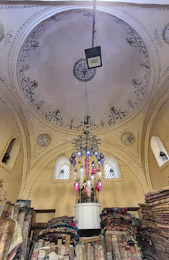
Many years before I began travelling to Bosnia, Üsküplu Gazi Yahya Paşa (died 1506) was appointed Ottoman governor of Bosnia in 1480. He also held other important positions in the empire. He married a daughter of Sultan Beyazit II. He was philanthropic. One of the many things he did for Istanbul was to build a school which stands in Kadirga, a part of Fatih district of the city. This building with two domes still stands and was recently restored by the local municipality.

The former school now houses a shop that sells traditionally designed objects – everything from earrings to large woven carpets. The walls and domes of the interior of the building have been painted so as to recreate the place’s original decor.

This building is one of a huge number wonderful relics of the Ottoman Empire, which can be found whilst strolling around Istanbul. Fortunately, many of these old buildings have informative labels attached, with information both in English and Turkish.

Perfect aim in a pharmacy shop in Calcutta

I HAVE BEEN TO many shoe shops in India. Some of these have the store room above the showroom. The ceiling of such showrooms has a hatch through which pairs of shoes can be thrown to the salesmen waiting below. The salesman asks for a particular shoe in a specific size, and someone in the store room drops the pair through the hatch. The shoes are caught by the salesman. Until yesterday, the 4th of January 2024, I had never seen such a system in shops other than those selling footwear.

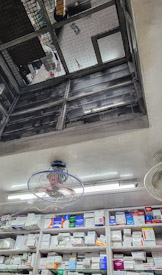
The hatch in the ceiling of the pharmacy

Yesterday, we entered a chemist shop (a pharmacy) close to Calcutta’s New Market (SS Hogg Market). The walls were lined with shelves from floor to ceiling. These shelves were filled with boxes of medicines on what seemed like considerable disarray, although I feel sure that there must have been some organisation of the products. There were 5 or 6 men serving customers from behind the shop’s counters.

Like the shoe shops described above, the chemist shop had a hatch in the ceiling. The shop’s stock room was on the floor above the sale room. At frequent intervals, the salesmen yelled names of medicines, ointments, and so on. Somebody in the room above hurled the desired product through the small ceiling hatch. The product was aimed accurately at the salesman who asked for it. Different products kept dropping from the ceiling and being caught by the salesman who had shouted up for it. Whoever it was that was dropping the medications must have recognised the voice of the person who requested it. In addition, the person dropping the products must have had an extremely good aim. He (or she) would make a good cricket player. And the salesmen below never dropped a catch.

Having seen this amazing pharmacy, I have now poked my head into a few others, but none operated this remarkable aerial delivery system. For me, seeing things like that pharmacy near New Market is what makes India seem so wonderful.

A wonderful little bookshop in Baroda

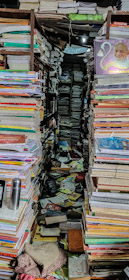
A FEW MINUTES WALK from our hotel in BARODA (Gujarat) brings you to Patel Bookstore. The owner of this small bookshop stocks ‘pre-loved’ (not ‘secondhand’) books. Some of them are arranged on surfaces under the verandah in front of his shop and on its counter. The rest of them are on shelves and on the floor of the part of his store behind the counter. The shop has a chaotic appearance, but I am sure Mr Patel knows what he has in stock.

Mr Patel, a friendly gentleman, has a huge stock of books in English – much fiction and slightly less nonfiction. He also sells books printed in Gujarati.

The owner of the shop is happy to buy back books you have bought from him. When you make a purchase, he writes the price you paid in the book, and how much he would be prepared to buy it back when you have read it. He is also happy to buy other volumes that you wish to dispose of.

Even though I could not see many books that appealed to me, I love visiting idiosyncratic bookstores like that run by Mr Patel.

A cat amongst the …

THE FIRST PLACE I practised dentistry was in Rainham, Kent. Every Thursday, we climbed into my then boss’s open-topped TR 7 sports car, and drove down the High Street to a pub called The Cricketers. There, we used to enjoy a hearty meat and two veg lunch. One of the waitresses, a middle-aged woman, was a patient at the practice and always made sure that we were given large portions. On other days, I used to eat either in the practice or in one of the other local eateries. Sometimes, I would go into the local branch of Tesco’s supermarket to buy myself a few items for lunch. These always included either a Mars bar or a chocolate covered honeycomb caramel called a Crunchie. All the cashiers in the supermarket knew where I worked, and often, whilst I was paying, they would raise the Mars or Crunchie in the air, and shout:

“Look what the dentist is eating!”

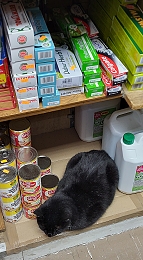
Recently, I entered a grocery shop near Portobello Road. I noticed a black cat resting on a shelf surrounded by tins, bottles, and boxes containing tubes of toothpaste. Seeing this creature reminded me of my days long ago in Rainham. There was a small ‘corner shop’ across the road from our surgery. The lady who owned it made very acceptable, generously filled sandwiches. Every now and then I used to buy one of her sandwiches for lunch. I used to accompany this with a packet of potato crisps. These packs were kept in an open topped cardboard box in no particular order. I used to rummage through its contents and select the pack that I fancied.

One day, I entered the shop to buy my lunch. When I turned to look at the box containing the packs of crisps, I saw a very plump cat comfortably curled up on top of the packets of crisps. Despite the fact that the crisps were sealed in their packets, I did not feel like choosing one. As I left the shop, I wondered where else that cat chose to rest during the day. Thinking about that put me off ever entering that little shop again.

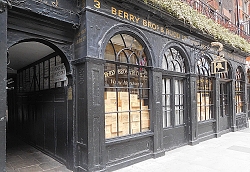
Buried behind Berry Brothers

LONDON’S NOOKS AND crannies are often worth exploring. One, which I must have passed often but of whose existence I only became aware in April 2022, is Pickering Place, a narrow, covered passageway between numbers 5 and 3 St James Street, close to St James Palace.  Immediately on entering this timber lined alleyway, I noticed a metal plaque, which commemorates the short-lived Legation of the Republic of Texas to The Court of St James. The legation existed from 1842 to 1845, whilst the Republic existed from 1836 to 1846. It rented the premises from the property’s owner, Berry Brothers.

Pickering Place was in existence by 1690, when it was then known as ‘Stroud’s Court’.  Prior to that date, the site was:

“… once home to the medieval maidens’ leper colony of St James, before playing host to King Henry VIII’s royal tennis court.” (https://blog.bbr.com/2015/04/10/the-other-no-3/)

 The alleyway leads into a small open space, a courtyard that is believed to be Britain’s smallest square. The name Pickering relates to the company of Berry Brothers and Rudd (‘Berry’s’) that occupy most, if not all of the buildings around the courtyard and on the south side of the alleyway. In 1698, a widow with the surname Bourne began the business, at first a grocery shop, now known as Berry Brothers & Rudd. Her daughter, Elizabeth, married William Pickering (died 1734). They continued the business, supplying the coffee houses of St James with coffee. The company adopted the coffee mill as their symbol. The shop at number 3 St James Street and Stroud’s Court were then rebuilt by the family. William and Elizabeth’s sons, John and William Junior, continued the running of the firm. After John died in 1754, William Junior brought a relative, John Clarke, to be a partner in the business.

George Berry, John Clarke’s grandson, joined the business in 1803 and by 1810, his name became the firm’s name. George moved the firm’s activities into focussing on wine and spirits. In 1845, his sons, George Junior and Henry, took over the firm, hence the ‘Brothers’ in the company’s name. Hugh Rudd, a wine merchant with a keen interest in the wines of Bordeaux, joined the firm as a partner in 1920. His arrival in the company greatly increased its expertise in the wine trade. In 1923, the company created a new whisky which they called Cutty Sark Scotch. Its label was designed by the artist James McBey, whose studio was at the top end of Holland Park Avenue. The firm is still run by the Berry and Rudd families and flourishes.

Immediately after leaving the covered alleyway, you will see an orrery and beyond it, a carved stone portrait of a man with his head facing towards his left. Nobody we asked seemed to know whom it portrays. Various websites suggest it depicts the politician and former Prime Minister Lord Palmerston (1784-1865), who lived in Pickering Place for some time. The author Graham Greene also lived in Pickering Place for a while.

Doorways in the courtyard lead to various underground rooms including the Pickering and Suffolk Cellars. Once used to store wine and other products sold by Berry’s, parts of them are now also used as a wine school, as well as for banquets and similar gatherings. One of the cellars is named The Napoleon Cellar, after the exiled Napoleon III (1808-1873), a friend of George Berry Junior. In 1846, fearing assassination, the exiled Frenchman hid in the Berry Brother’s cellar, now named in his memory. Number 3 Pickering Place, built in the 1690s, is a well-preserved example of a William and Mary era townhouse.

Part of the tiny courtyard has outdoor tables and chairs. These can be used by patrons of the St Jacques restaurant, which occupies number 5 St James Street whose southern wall forms the northern wall of the alleyway. The southern wall of the passage is part of the wall of number 3, which houses the original Berry’s shop. This well-preserved historical shop is lined with wood-panelling and contains much of the old shop fittings.  These include old desks, shelving with old bottles, and a large hand-operated coffee grinder. Suspended from the ceiling, there is a large grocer’s weighing scales. According to Berry’s detailed company history (www.bbr.com/about/history):

“It was in the time of William Jr. and John Clarke that the famous grocer’s weighing scales began to be used to weigh the shop’s many notable customers, a fashionable pastime that continues to this day.”

Had it not been for noticing the alleyway which I have passed often without noticing it, and then spotting the portrait in the courtyard, I doubt we would have ever entered the old shop at number 3. Incidentally, if you wish to purchase wines or spirits from Berry’s, you will need to walk around the corner into Pall Mall, where the company has a newer shop … or, less interestingly, you can make purchases online.


The Apple of my eye in Regent Street

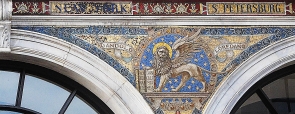
LONG BEFORE IT became the Apple Store on Regent Street in central London, I used to look at the colourful mosaics on its building’s façade. Running in a line along the top of the mosaics, which are above the four arches of the shopfront, are the names of several cities including St Petersburg. This used to intrigue me a lot in the years before Communist rule ended in Russia and the city was then called Leningrad.

The mosaics contain depictions of several coats-of-arms including and two lions, each resting a paw on an object. One of the lions has wings and rests its paw on an open book on whose pages are the words: “PAX TIBI MARCE ENVANGELISTA MEUS”. For, this creature is the lion of St Mark, symbol of Venice and its former empire. On both sides of the lion, there are depictions of streamers. One reads “DANDOLO” and the other “LOREDANO”. Both are the names of important patrician families in Venice. Two other crests also appear, one on each side of the winged lion and the two names. One is for the island of Murano and the other for the island of Burano. These two islands in the Lagoon of Venice, especially Murano, are known for their glassmaking activity.

The mosaics were originally installed when the Venetian glass-making company Salviati opened its store in this building, designed by GD Martin, on Regents Street in 1898. The business made both fine glassware and mosaics. Soon after the firm was founded in 1859, it began to be established in England. According to a company history (www.salviati.com/en/our-story/):

“It was also in London, on 21st December 1866, that the “Società Anonima per Azioni Salviati & C.” was established with the support of diplomat Sir Austen Henry Layard and historian William Drake.”

Fortunately, the lovely mosaic has survived and has been kept in good condition. I have always marvelled at it when wandering along Regent Street, but I wonder how many people rushing into Apple’s attractive looking shop notice it.

At Liberty in London

BEFORE WE MARRIED in 1993, many of our kind friends wanted to give us wedding presents. A large proportion of them wanted to choose gifts from a ‘wedding list’. For those who are unfamiliar with this kind of list, let me explain. A ‘wedding list’ is a list of items, usually available from a shop chosen by the bride and groom, from which those wishing to give wedding presents can choose. As the items are bought, the shop removes them from the list so that the likelihood of duplicate purchases is reduced.

We were a little reluctant at first, but people insisted that it would be helpful if we compiled a wedding list. We chose to have our list at a shop that we both enjoy visiting: Liberty on Great Marlborough Street, very close to Regent Street.

Above an entrance to Liberty shop

From the outside, Liberty looks like an extremely well-preserved example of Tudor architecture, too good to be true. It is not because it was completed in 1924.

Liberty was founded by Arthur Lasenby Liberty (1843-1917), son of a draper. In 1875, he opened his own shop on Regent Street. According to the Liberty website (www.libertylondon.com), he wanted:

“… a London emporium laden with luxuries and fabrics from distant lands, his dream was to metaphorically dock a ship in the city streets. To this day, a voyage of discovery awaits on the good ship Liberty, with history hidden amongst six floors of cutting-edge design, unexpected edits and beautiful wares from the world’s greatest craftspeople. In 1875, Arthur borrowed £2,000 from his future father-in-law and took a building on Regent Street, London with just three dedicated staff and plenty of ambition.”

By the time that Liberty opened his shop, the British public was fascinated by Japan and other parts of Asia. In 1885, he brought 42 villagers from India and set up a temporary ‘living village’ of artisans in the shop.

The website added:

“Liberty’s collection of ornaments, fabric and objets d’art from around the world proved irresistible to a society intoxicated at the time by Japan and the East and Liberty effected social change in interior design and dress, so much so that the Art Nouveau period in Italy is called ‘Liberty Style’.”

Liberty died before his new shop was completed. Designed by Edwin T Hall and his son Edwin S Hall, it was built in the Tudor Revival style that achieved great popularity in the 1920s.  Not only is the shop’s exterior in the Tudor Revival style, but also its interior. A great dela of wood was used in the construction as the shop’s website revealed:

“… the builders Messrs Higgs & Hill were given a lump sum of £198,000 to construct it, which they did from the timbers of two ancient ‘three-decker’ battle ships. Records show more than 24,000 cubic feet of ships timbers were used including their decks now being the shop flooring: The HMS Impregnable – built from 3040 100-year-old oaks from the New Forest – and the HMS Hindustan, which measured the length and height of our Liberty building.”

Even if you do not wish to purchase anything from our long out-of-date wedding list, a visit to Liberty is rewarding not only to see the wonderful range of beautiful products on sale but also to narvel at the building and its many finely crafted decorative features.

Books in Buxton

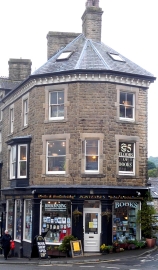
ONE OF THE SEVEN WONDERS of the Derbyshire town of Buxton has to be Scrivener’s bookshop. Located on the town’s High Street, this shop displays books on five floors including the basement. Many, but by no means all, of the books are second-hand (pre-loved). At first sight, the books seem to be crowded together in no particular order, but the reverse is true: they are arranged systematically rather than chaotically.

The books are far from being at bargain prices, but they are priced fairly, not outrageously. Those of you, who know my addiction for acquiring books, will be relieved to know that I purchased only two volumes. There were plenty more that I might have been tempted to buy had I not already embarked on on a project of carefully reducing the number of books in my possession.

Shopping surprise in Suffolk

WE TRAVELLED TO HADLEIGH in Suffolk to see its church, its mediaeval guildhall, and its Deanery Tower. After viewing these buildings on a drizzly afternoon, we walked along the High Street, looking at some of the lovely old buildings along it. Several of them have coloured pargetting (decorative plasterwork).  Then, we spotted MW Partridge &Co on the corner of High Street and George Street. From the outside, there is nothing remarkable about this hardware store.

Stepping inside Partridges is like entering an enormous. well organised Aladdin’s cave. Apart from food and plants, there is almost nothing that cannot be found in the shop. One room leads to another, and then another, and yet another, each filled with everything that you might ever need to maintain your home and garden. Remarkable as this is, what is truly fascinating is that apart from one room built as an annexe in the 20th century, the rest of the shop is supported by old-fashioned timber beams and pillars.

According to the company’s history (www.partridgeshadleigh.co.uk/index.php?main_page=about_us), there has been an ironmongery business on the spot since 1823, if not before. In 1823, the ironmonger and iron founder Thomas Pritty acquired the business from a Charles Pretty (or ‘Pritty’). After passing through a couple of other owners, Maitland Walter Partridge and Daniel Partridge of Kersey bought the concern in 1929. This partnership did not last long, and in 1934 Maitland and his sister Edith registered the name M W Partridge & Co. Partridges have been in business ever since.