Epstein, Gill, and Moore on Broadway

THE ARCHITECT CHARLES HOLDEN (1875-1960) designed many stations for the London Underground, mainly on its Piccadilly Line. Each of these incorporates features of Art Deco and Modernism. Holden designed a new headquarters building for the forerunner of London Underground, the Underground Electric Railways Company of London. Now known as 55 Broadway, it was built between 1927 and 1929. The Underground company occupied it from 1933 until 1984, when it became the headquarters of London Regional Transport, and then its successor Transport For London. After 2020, it has served other purposes. The ground floor is occupied by both a shopping arcade and the entrance hall to St James Park Underground Station.
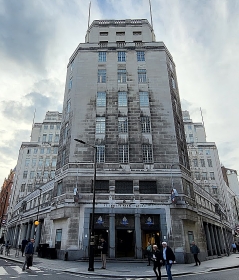
55 Broadway is a tall, cruciform building surmounted by a clock tower. One of the reasons for this shape was to ensure that all of the offices within the cruciform tower, the bulk of the edifice, were close to the external walls, and therefore had access to plenty of daylight. Apart from looking impressive, the building is not highly decorative, and not as attractive as some of its architect’s designs for Underground stations.  Having said this, it is not entirely devoid of decorative features.

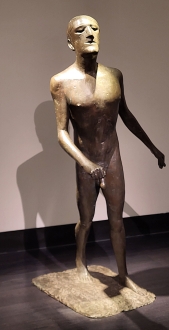
What makes 55 Broadway of special interest is the set of sculptures attached to its exterior. Near to ground level, there are two large figurative works by the artist Jacob Epstein (1880-1959), one called “Day” and the other “Night”. When they were unveiled, prudish members of the public objected to them, as is revealed in an article on Wikipedia:

“The modernism and graphic nakedness of these sculptures created public outrage on their unveiling. Newspapers started a campaign to have the statues removed and one company director, Lord Colwyn, offered to pay the cost. Frank Pick, the managing director of the UERL at the time, took overall responsibility and offered his resignation over the scandal. In the end, Epstein agreed to remove 1.5 inches (38 mm) from the penis of the smaller figure on Day and ultimately the furore died down.”

Much higher up the building, between the fifth and sixth floors, there are bas-relief sculptures depicting the four winds. Two are by Eric Gill (1882-1940), one is by Samuel Rabinovitch (Samuel Rabin: 1903-1991), and another by Henry Moore (1898-1986). And within the Underground station, I noticed four mosaic panels. Called “Angels of History”, they were created by London-based Hannah Quinlan and Rosie Hastings, and installed in 2024.

What was once an important headquarters building is still a place where fascinating works of art can be seen, as well as being an example of Modernist architecture in London. Soon after 55 Broadway was completed, Holden designed the University of London’s Senate House. Like 55 Broadway, it impresses the viewer, but lacks the visual appeal of Holden’s Underground stations.
A Nigerian who created artworks for a British daily newspaper

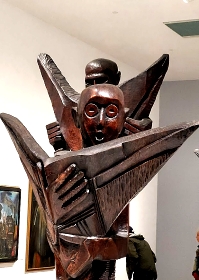
SEVEN CARVED WOODEN figures stand in a line at an exhibition in London’s Tate Modern gallery. Each of them is depicted holding something that looks like an book or a pair of wings. Their faces are all different, as are their expressions and heights. They were carved by the Nigerian artist Ben Enwonwu (1917-1994), and form part of a superb exhibition, “Nigerian Modernism”, which is showing until 10 May 2026.

Ben Enwonwu was born in Nigeria. His father was a traditional sculptor. Ben studied art first at Government College in Ibadan (Nigeria), and then at Government College Umuahia. At both places, he studied art under Kenneth Murray (1902-1972). In 1944, Ben was awarded a scholarship that allowed him to study both at The Slade School of Art in London and at The Ruskin School in Oxford. Also he undertook postgraduate studies in West African anthropology at the University of London. Thereafter, he taught art in Nigeria, where he created many of his sculptures and paintings. Since completing his education, Enwonwu has received international acclaim for his work.

In 1960, Ben proposed making a sculpture to commemorate Queen Elizabeth II’s visit to Nigeria in 1956. It was to be placed in the Nigerian House of Representatives in preparation for Nigeria’s independence in 1960. At the Tate’s exhibition, there is a photograph of Enwonwu working on this sculpture in the studio of his friend, the sculptor William Reid Dick (1878-1961), who was Sculptor in Ordinary for Scotland to Queen Elizabeth. At around this time, Ben received another commission in England.

The British newspaper, the Daily Mirror, commissioned Ben to create 7 sculptures for their headquarters. Carved in ebony, these are the works mentioned above. The diversity of their forms and expressions is supposed to represent the variety of people reading thepaper. According to a label in the exhibition, Enwonwu said:

“I tried … to represent the wings of the Daily Mirror, flying news all over the world.”

The statues were placed in the headquarters public courtyard in Holborn. Currently, they are in the Tate Modern, but after having been lost for several years, they were sold at public auction. They are now owned by Access Holdings PLC, a Nigerian company.

In addition to what I have already described, there are many more works by Enwonwu in the exhibition, both paintings and sculptures. Each one of them is wonderful. His works show the influence of European Modernism, but at the same time they reflect the artist’s African background and his involvement in the traditional art of his homeland. He was sympathetic to the Négritude movement, an anti-colonial cultural and political movement founded by African and Caribbean students in Paris in the 1930s, but was also affected by twentieth century artistic movements in Europe and the USA. It was fascinating to see how the modern art trends of the mid-twentieth century were successfully integrated with the artist’s desire to portray the life and traditions of Africa.

An Epstein from New York (NYC): Jacob not Jeffrey

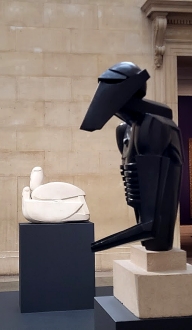
THE DUVEEN GALLERIES in London’s Tate Britain provide a wonderful space to display sculptures. The rooms are wide, long, and have high ceilings. Their walls are plain and do not distract the viewer. Until 30 March 2026, these magnificent spaces contain a selection of sculptures by Jacob Epstein (1880-1959), who was born in New York City. He joined the Art Students League in New York, before moving to Paris in 1902, where he studied sculpture at the École des Beaux Arts and Académie Julian. He settled in London in 1905. Both in Paris and London, he studied non-European sculpture, and what he learned from it often influenced his work. Some of the stone carvings in the Duveen Galleries are evidence of this. Soon after arriving in London, he began receiving important commissions to produce sculptures for significant institutions in London such as the British Medical Association (now Zimbabwe House). He became naturalised as a British citizen in 1910.

The collection of sculptures in the Duveen Galleries includes several stone carvings in different styles. The Tate’s website noted:

In the 1910s, Epstein became a key figure in the ‘direct carving’ movement in Britain. This approach emphasised a ‘truth to materials’, in which sculptors worked directly with the stone, using its natural qualities rather than making wax or clay models first. He was influenced by the techniques and imagery used in ancient Egyptian, West African and Oceanic carvings, which he collected. At the time, his portrayal of sexuality as well as the simplified forms of his monumental figure carvings drew both admiration and intense criticism, limiting his opportunities for public commissions.

Some of the sculptures on the former British Medical Association (now Zimbabwe House) building were criticised as being too explicit for Edwardian tastes, when they were completed in 1908. Sadly, these sculptures that can still be viewed from the Strand are badly damaged by being exposed to the weather and pollution.

The stone carvings in the Duveen, which vary from figurative to almost abstract, were all new to me. The bronze busts of famous and not-so-famous people include portraits of family members, artists, writers, entertainers and other public figures. These are the works that I tend to associate with Epstein. So, seeing his stone sculptures was a new and pleasant revelation for me. Each of the sculptures on display is accompanied by an informative panel. The works are well spaced so that each one can be admired in splendid isolation. This is an exhibition worth seeing.

On display outdoors in London’s Regents Park

I ENJOY VIEWING sculptures displayed in the open air. Every autumn, there is an exhibition of sculptures in London’s Regents Park.  It is part of the annual Frieze art fair. Sculptures by various artists are provided by the commercial galleries who deal with them.

This year’s exhibition was small and somewhat disappointing. It seemed to me that the galleries had not exhibited their better works or works by their better-known artists. Maybe they are worried about them being vandalised or stolen. Whatever the reason, the 2025 outdoor show is not nearly as exciting as similar shows in previous years.

AN artist born in Egypt who makes sculptures in Switzerland

THE WADDINGTON CUSTOT Gallery in Mayfair’s Cork Street puts on excellent exhibitions and the current show, which goes on until 10 April 2025, is no exception. It is an exhibition of sculptures by Yves Dana, who was born in Alexandria (Egypt) in 1959. He moved with his family to Switzerland in 1961. It is there that he lives and works. In the early 1980s, he set up a sculpture studio in Lausanne (Switzerland). In 1996, he paid a return visit to Egypt. Following that, his approach to sculpture changed dramatically. The sculptures on display at Waddington Custot were made long after that visit to the land of his birth; they date from 2004 until 2024.

Each of the works we saw, both at the gallery and outdoors in Smithson Plaza (near Bury Street), is pleasing to the eye. Many of the sculptures allude to the art of Ancient Egypt in subtle ways. Several of the artworks brought to mind the simple beauty of Cycladic sculptures and others evoke the harshness of desert climates.  The gallery’s website revealed that Dana:

“… sources the best quality stone from around the world, including limestone from Egypt, France and Turkey, serpentine from Italy and diabase from Germany. He combines innovative carving techniques with traditional tools to create precise planar forms. With each work created over several weeks or months, the physicality of carving stone, with deep sensitivity to its tones and texture, is evident in the subtlest details of each work.”

This is very evident as one looks at the often sensuously shaped abstract forms of his sculptures. Where there is an interesting detail inherent in the material, he shapes the sculpture so that the viewer’s eyes are drawn to it. Although Dana imposes his artistic will on the materials he employs, he is also sympathetic to their original forms and textures and does not force them to submit totally to his compositional ideas. `Put another way, it seems that Dana’s compositions are guided by the physical properties and shape of the materials he is using.

As you can gather from what I have written, brief though it is, I enjoyed seeing this show and getting to know the work of an artist, whom I had not known about before.

Dwarfed by dogs in Mayfair’s Dover Street

SOME SAY SMALL is beautiful. But can colossal also be beautiful? This is something that can be explored at the Thaddeus Ropac Gallery in London’s Dover Street until 2 April 2025, where three much larger than life realistic looking sculptures of dogs are on display. These dogs, each about 10 feet high, have been created by the artist Ron Mueck, who was born in Australia in 1958. He now works in the UK.

As the gallery’s website explained:

“Over a career spanning three decades, Mueck is celebrated for exploring the physiological implications of scale. Whether miniaturised or enlarged, his use of scale heightens our awareness of the relative spaces our own bodies occupy, as he charts the full spectrum of human experience with striking perceptiveness.”

The three dogs on display in the exhibition ought to feel menacing, but I did not experience this sensation. I was more amused than over-awed.

Some sculptures at an auction house in London’s Mayfair

THE FAMOUS SCULPTOR Elisabeth Frink (1930-1993) was a regular visitor to our family home in Hampstead Garden Suburb during the 1960s. During that period, I met her whenever she was invited home for dinner, but then I was too young to realise how famous an artist she had become. She was a good friend of my mother, Helen Yamey (1920-1980), who was also a sculptor. Elisabeth and my mother got to know each other when they were both creating art in the Sculpture Department of the St Martins School of Art, when it was in Charing Cross Road.

By Elisabeth Frink

Today (15th of November 2024), I was reminded of my mother’s friendship with Frink when we entered Christie’s auction house in Mayfair. We always enter this place when we are passing near it to see some of the works of art that are on display prior to being auctioned. You never know what gems you are likely to see. Today, there was a small collection of British art created during the past 100 years. Amongst the works on display were two by Elisabeth Frink. There were also some pieces by Henry Moore (1898-1986) and by Barbara Hepworth (1903-1975). One of the works by Hepworth was a painting, the other two were sculptures. Each of these artists has become some of the greatest of 20th century British artists.

During the first half of the 1960s, my mother’s sculptures were chosen to be exhibited in prestigious exhibitions, mainly in London. In these various exhibitions, her work was selected to be exhibited alongside the creations of the three artists mentioned above, as well as other artists, who have now achieved fame (e.g., David Hockney, Paula Rego, Michael Ayrton, and Bridget Riley). Despite this, my mother’s artistic work is now largely forgotten. In my recent book about her, “Remembering Helen: My Mother the Artist”, I describe her life, her character, and consider why her art, which was judged worthy of display with the best artists of the time, has faded into obscurity.

[The book is available from Amazon: https://www.amazon.co.uk/REMEMBERING-HELEN-MY-MOTHER-ARTIST/dp/B0DKCZ7J7X/]

A sculptor who uses both her digits and digital technology

THERE IS AN EXHIBITION of sculptures by Lynda Benglis (born 1941) at the Turner Gallery in Margate (Kent). They are produced using a combination of traditional modelling and modern technology.

First, she makes small versions of these in clay. Then she scans them digitally. Using computer software, she magnifies the 3D (three-dimensional) scan. Next, she uses a 3D printer to create exact but greatly enlarged plastic replicas of the original clay models. These are then used to create the final metal casts – the sculptures seen at the exhibition.

Art from India displayed amongst the plants

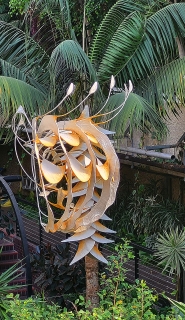
I ENJOY SEEING SCULPTURES displayed in gardens or other plant-filled locations. Until March 2024, the wonderful conservatory in London’s Barbican Centre is hosting a selection of sculptures by Ranjani Shettar. She was born in Bangalore (Bengaluru, India)) in 1977, and now lives and works in rural Karnataka. Her current exhibition in the Barbican is called “Cloud Songs on the Horizon”. The works on display were made especially for this site.

Her works are made of various materials (wood, stainless steel, muslin, and lacquer) and she employs techniques that have been adapted from traditional Indian crafts. Ms Shettar’s organic sculptures look like magnified plants or parts of plants. As she said once:

“Nature’s beauty is ever present, art helps to uncover, perceive and appreciate it.”

Seeing her exhibits in the Conservatory, certainly confirms this. However fine the artworks, putting them amongst plants helps emphasise the greater beauty of nature’s creations. The beauty of the sculptures competes with that of the plants, but the latter almost always win. So, placing one’s artworks within an area rich in plant life is a brave thing to do. I felt that Ms Shettar had done it successfully. Her creations have a harmonious relationship with the plant life surrounding them.

Whether or not you visit the exhibition, which I enjoyed, seeing the Barbican’s Conservatory – the second largest in Greater London – is always a worthwhile experience.

One at each corner of the square

NOW FILLED WITH TOURISTS and pigeons, the area which is currently Trafalgar Square was where Royalty kept their hawks between the 13th century and 1534. In that year the Royal Mews, where the hawks were kept, burnt down, and were replaced by stables for the royal horses. The stabling was moved to Buckingham Palace in the reign (1820-1830) of King George IV. In 1826, the clearance of the stables from the area began, and following the plans of John Nash, a new square began to be laid out. Initially named in honour of King William IV, it was later named Trafalgar Square to commemorate Nelson’s victory at the Battle of Trafalgar in 1805. Nelson’s Column (145 feet tall) was erected in May 1854.

At each of the four corners of the Square there is a stone plinth designed to support a sculpture. At the northeast corner, the plinth supports a statue of King George IV. Major-General Henry Havelock (1795-1857), who was involved in suppressing the First Indian War of Independence, is perched on the southeast plinth. He died of dysentery in Lucknow after relieving Kanpur from a siege. General Sir Charles James Napier (1782-1853) is portrayed sculpturally on the southwest plinth. His mother was the great-granddaughter of King Charles II. As a Major-General in the Bombay Army, he led the British conquest (1843) of the Indian province of Sindh. It is said that on achieving this, Napier reported in Latin “Peccavi”, which means ‘I have sinned.’

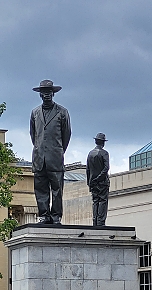
The fourth plinth on the northwest corner of the Square was destined to have a statue of King William IV. Because of insufficient funds, the king’s statue was never made, and the plinth remained empty until 1999 when the Royal Society of Arts (‘RSA’) conceived the idea of using the plinth to display a series of artworks by contemporary artists. Three artists displayed works between 1999 and 2001 on what is now known as The Fourth Plinth. Since 2005, under the supervision of London’s Lord mayors, a series of artworks by different creators have been displayed on the Fourth Plinth. Currently (since September 2022), the plinth (see photograph) displays a sculpture, “Antelope”, by Samson Kambalu. Recently, I heard this highly intelligent artist speak at a conference. His work on the plinth, based on a photograph taken in 1914, portrays the Baptist preacher and pan-Africanist John Chilembwe and the European missionary John Chorley. As the website www.london.gov.uk explained:

“The photograph was taken in 1914 at the opening of Chilembwe’s new church in Nyasaland, now Malawi. Chilembwe has his hat on, defying the colonial rule that forbade Africans from wearing hats in front of white people. A year later, he led an uprising against colonial rule.  Chilembwe was killed and his church was destroyed by the colonial police.

On the plinth, Chilembwe is larger than life, while Chorley is life-size. By increasing his scale, the artist elevates Chilembwe and his story, revealing the hidden narratives of underrepresented peoples in the history of the British Empire in Africa, and beyond.”

Kambalu’s piece is a powerful work of art, and its message of resisting colonialism, makes stark contrast to the exploits of the other people portrayed on the Square’s plinths.