
A bust of Epstein and the USSR (Soviet Union)

I HAVE JUST VISITED London’s Wallace Collection to view a small exhibition called “The Wallace Collection at War”. It continues until 25 October 2026. Small though it is, it contains several artefacts that resonate with the research I did when writing my book about north London’s Hampstead district.

During WW2, the valuable artworks that comprised the Wallace Collection were removed from their home, Hertford House on Manchester Square, and hidden in caves and cellars so that they would neither be damaged by bombing nor found by the enemy should they have managed to invade the UK.

In 1942, in order to raise money to send medical equipment and clothing to Soviet Russia, Lady Clementine Churchill (Sir Winston’s wife) organised the “Artists Aid Russia” exhibition, which was held in the then empty Hertford House. Some of the exhibition stands and other display arrangements were designed by the architect Erno Goldfinger, whose creations include Trellick Tower in North Kensington, and his own residence in Hampstead. For five years, I practised dentistry in the shadow of Trellick Tower. I have also visited his Hampstead home several times.

The 1942 exhibition included 900 works by living artists. A few of these works are currently on display in Hertford House. They include artworks by John Skeaping. Carel Weight, Ethel Léontine Gabain, and Charles Murray. There is also a poster by Henri Kay Henrion. He was married to the artist Daphne Hardy Henrion. One of their two sons went to the same school as I did in the 1960s. For a while they lived in Hampstead.

The “Artists Aid Russia” exhibition was launched in late 1942 by Soviet Ambassador Ivan Maisky (1884-1975) and his wife Agniya. The first time I encountered his name was while writing my book about Hampstead. In “Architect Errant”, the autobiography of the architect Sir Bertram Clough Williams-Ellis (1883-1978), he wrote of the artist George Romney’s former home, where he resided:

It was a splendid house for large parties and we gave a lot of them – dances every so often, a show by Ballet Rambert … We also gave a party to meet the Russian Ambassador, M[onsieur]. Maisky, who made a speech from the gallery balcony …”

As part of my research, I acquired a copy of “The Maisky Diaries” (edited by Gabriel Gorodetsky). Although there is no mention of the visit to Hampstead, there is much which is relevant to one of the items in the current exhibition at Hertford House. This artefact is an excellent bronze sculpture depicting Maisky’s head. It was made in 1941 by the renowned artist Jacob Epstein (1880-1959). The diaries contain much about this work of art and its execution.

On 14 February 1941, Maisky wrote:

Jacob Epstein has convinced me to permit him to make my bust. I warned the sculptor that the USSR is a country of genuine democracy, so Soviet ambassadors are not able to pay artists of the capitalist world the fees they are accustomed to. Epstein was insistent …”

Maisky was intrigued by the creative process, which required at least six sittings. He described how Epstein gradually formed his head out of grey clay.  He wrote:

Let’s see what happens next. I’ll have five or six sittings in all. With such original artists as Epstein, you never know what will come out in the end – you yourself or a monster.”

The ambassador described the artist’s studio at 18 Hyde Park Gate:

A large bright room with two enormous windows … Astonishing artistic chaos. Scattered over tables, chairs, and benches and the floor are statues, heads, arms, legs and other parts of the human body in clay and plaster of Paris … The figure of the sculptor moves quickly and deftly amidst the vast chaos. His baggy grey trousers are stained with clay and plaster of Paris. Epstein is quite a charming man …”

Eventually, the bust was completed.

While he was in London, Maisky became very popular. As Gorodetsky noted at the end of the extracts from Maisky’s diaries:

Neither Stalin nor Molotov could watch with equanimity the popular cult of  Maisky in London, which reached dimensions second only to the cult of Stalin himself … While flattered by the cult evolving around him, Maisky was anxious to keep it on the back burner. He was quick to turn down an invitation by the sculptor Epstein to attend the private viewing of his works at Leicester Galleries …”

Despite the risk of trouble from Stalin in Russia, Maisky sat for a portrait by Oskar Kokoschka. He sat for this portrait shortly before he was recalled to the USSR in July 1943. This picture is now in the Tate Gallery’s collection.

As you can see, the small exhibition at the Wallace Collection proved to be of great interest, especially as so many of the exhibits overlapped with things that have interested me in the past.
Epstein, Gill, and Moore on Broadway

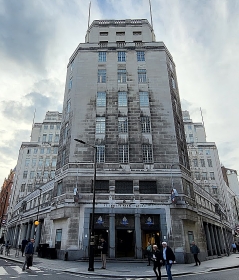
THE ARCHITECT CHARLES HOLDEN (1875-1960) designed many stations for the London Underground, mainly on its Piccadilly Line. Each of these incorporates features of Art Deco and Modernism. Holden designed a new headquarters building for the forerunner of London Underground, the Underground Electric Railways Company of London. Now known as 55 Broadway, it was built between 1927 and 1929. The Underground company occupied it from 1933 until 1984, when it became the headquarters of London Regional Transport, and then its successor Transport For London. After 2020, it has served other purposes. The ground floor is occupied by both a shopping arcade and the entrance hall to St James Park Underground Station.

55 Broadway is a tall, cruciform building surmounted by a clock tower. One of the reasons for this shape was to ensure that all of the offices within the cruciform tower, the bulk of the edifice, were close to the external walls, and therefore had access to plenty of daylight. Apart from looking impressive, the building is not highly decorative, and not as attractive as some of its architect’s designs for Underground stations.  Having said this, it is not entirely devoid of decorative features.

What makes 55 Broadway of special interest is the set of sculptures attached to its exterior. Near to ground level, there are two large figurative works by the artist Jacob Epstein (1880-1959), one called “Day” and the other “Night”. When they were unveiled, prudish members of the public objected to them, as is revealed in an article on Wikipedia:

“The modernism and graphic nakedness of these sculptures created public outrage on their unveiling. Newspapers started a campaign to have the statues removed and one company director, Lord Colwyn, offered to pay the cost. Frank Pick, the managing director of the UERL at the time, took overall responsibility and offered his resignation over the scandal. In the end, Epstein agreed to remove 1.5 inches (38 mm) from the penis of the smaller figure on Day and ultimately the furore died down.”

Much higher up the building, between the fifth and sixth floors, there are bas-relief sculptures depicting the four winds. Two are by Eric Gill (1882-1940), one is by Samuel Rabinovitch (Samuel Rabin: 1903-1991), and another by Henry Moore (1898-1986). And within the Underground station, I noticed four mosaic panels. Called “Angels of History”, they were created by London-based Hannah Quinlan and Rosie Hastings, and installed in 2024.

What was once an important headquarters building is still a place where fascinating works of art can be seen, as well as being an example of Modernist architecture in London. Soon after 55 Broadway was completed, Holden designed the University of London’s Senate House. Like 55 Broadway, it impresses the viewer, but lacks the visual appeal of Holden’s Underground stations.

An Epstein from New York (NYC): Jacob not Jeffrey

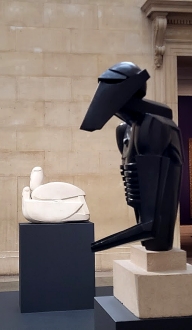
THE DUVEEN GALLERIES in London’s Tate Britain provide a wonderful space to display sculptures. The rooms are wide, long, and have high ceilings. Their walls are plain and do not distract the viewer. Until 30 March 2026, these magnificent spaces contain a selection of sculptures by Jacob Epstein (1880-1959), who was born in New York City. He joined the Art Students League in New York, before moving to Paris in 1902, where he studied sculpture at the École des Beaux Arts and Académie Julian. He settled in London in 1905. Both in Paris and London, he studied non-European sculpture, and what he learned from it often influenced his work. Some of the stone carvings in the Duveen Galleries are evidence of this. Soon after arriving in London, he began receiving important commissions to produce sculptures for significant institutions in London such as the British Medical Association (now Zimbabwe House). He became naturalised as a British citizen in 1910.

The collection of sculptures in the Duveen Galleries includes several stone carvings in different styles. The Tate’s website noted:

In the 1910s, Epstein became a key figure in the ‘direct carving’ movement in Britain. This approach emphasised a ‘truth to materials’, in which sculptors worked directly with the stone, using its natural qualities rather than making wax or clay models first. He was influenced by the techniques and imagery used in ancient Egyptian, West African and Oceanic carvings, which he collected. At the time, his portrayal of sexuality as well as the simplified forms of his monumental figure carvings drew both admiration and intense criticism, limiting his opportunities for public commissions.

Some of the sculptures on the former British Medical Association (now Zimbabwe House) building were criticised as being too explicit for Edwardian tastes, when they were completed in 1908. Sadly, these sculptures that can still be viewed from the Strand are badly damaged by being exposed to the weather and pollution.

The stone carvings in the Duveen, which vary from figurative to almost abstract, were all new to me. The bronze busts of famous and not-so-famous people include portraits of family members, artists, writers, entertainers and other public figures. These are the works that I tend to associate with Epstein. So, seeing his stone sculptures was a new and pleasant revelation for me. Each of the sculptures on display is accompanied by an informative panel. The works are well spaced so that each one can be admired in splendid isolation. This is an exhibition worth seeing.