Stark naked and crouching on a pedestal in London’s Mayfair

MY PARENTS HAD a small collection of works of modern art in our home in London’s Hampstead Garden Suburb. These included an engraving by the Italian artist Emilio Greco (1913-1995). I have no idea where this image is now, but having grown up with it I was familiar with the artist’s name even if I knew nothing about him.

Today (14 July 2025) while walking near the Connaught Hotel in Mayfair, we passed a modern fountain, and close to it, a bronze sculpture of a naked woman, perched on a cylindrical stone pedestal. On the pedestal are carved the words: “A gift to the City of Westminster from the President of the Italian Republic. 20th November 1987. Sponsored by the Italian Bank in London.” The President at that time was Francesco Cossiga (1928-2010).  There was no mention of the creator of this artwork on the pedestal. However, at the base of the sculpture I could make out: “Emilio Greco 1977”. It had been made by the artist, whose engraving used to hang on the wall of our living room.

A website (https://pssauk.org/public-sculpture-of-britain/biography/greco-emilio/) provides some information about the artist, and his sculpture in Mayfair, which is a bronze casting of his sculpture “Crouching Figure No. 4”, created in 1973.  

The sculpture is a great addition to the area, and is sometimes referred to as ‘Mayfair Lady’!

Sculptures hidden by the mist in Bangalore

When we arrived in Bangalore in November 2025, our friend Harsh, an architect and curator who is based in Ahmedabad, sent us a message about his exhibition in Bangalore at a gallery, of whose existence we had been hitherto unaware. The privately owned gallery is called KAASH. It is housed in a beautifully restored old-style bungalow such as were built (mostly) between the 1860s and 1930s. They are a colonial ‘take’ on English country cottages. The gallery’s bungalow at number 2 Berlie Street is complete with perfect examples of ‘monkey tops’ (screens of closely spaced vertical wooden slats placed over porches and windows).  

The exhibition that Harsh had curated at KAASH was a collection of contemporarily designed devotional objects, mainly diyas (oil lamps used on Hindu ceremonies). There were also some almost abstract depictions of Devi created by Jayshree Poddar, and a few items of folk art from various countries in Africa. The artworks were tastefully displayed in rooms within the bungalow.

In the garden surrounding the building, we saw several sculptures. As the sun set, a worker moved around the garden spraying a fumigating smoke that created an eery mist. The sculptures were temporarily partially hidden, becoming rather like peaks partially concealed by low clouds. Gradually, they reappeared as the insecticidal smoke dispersed. Having seen the KAASH gallery, we decided that it would become a place we visit whenever we happen to be in Bangalore.

Self portrait as a stack of books near London’s Barbican

THE ARTIST ANDREW Salgado was born in Canada in 1982. He graduated at Chelsea College of Art with a Masters Degree in Fine Arts. He lives and works between London (England) and New Brunswick (Canada). Until 28 June 2025, there is a wonderful exhibition of his imaginative, colourful paintings at Beers gallery in Little Britain, close to the Barbican and Smithfield Market.

The exhibition has the artist’s chosen title “Self-portrait as a Stack of Books”. Several of the paintings on display and one sculpture portray books. Salgado is an avid reader, and he says he has been influenced by some of the authors he has read. Whether they contain books or not, his creations are intriguing and hint at confused imagery of dreams. As to the artist’s intentions in the collection of works at Beers, the gallery’s hand-out noted:

Asking Salgado about the intentions, symbolism, or directive in this collection of paintings – because it’s obviously ripe with his (now) trademark imagery – he becomes deferential, ambiguous, and almost evasive about everything from idea to technique, to presentation, and even the compelling title piece: a rare venture into sculpture which seems – whether through its books or its chair, or its uncanny, discombobulated human parts – to reference the paintings and even the act of painting itself. But also books. Words. Memory. Fallability. That head at the apex is glass. It’s his.”

It is right that the artist is evasive. He leaves the enjoyment of interpretations of his works to the viewer, and that is admirably democratic.

If you have not come across Beers gallery already, it is always worth visiting their exhibitions. The works they display are often joyfully colourful and never dull.

Where there was wool there was wealth

HADLEIGH IS A SMALL town in Suffolk (England). Like many towns in East Anglia, it was enriched by the wool trade in mediaeval times. Evidence of this included magnificent, cathedral-like churches and fine civic buildings. Hadleigh is no exception. Its fifteenth century half-timbered market hall (now a part of the town’s guildhall complex) is on one side of a graveyard that separates it from the south side of the large, fifteenth century parish church.

In one corner of graveyard there is a modern sculpture made of metal (mild steel). It depicts a sheep. Created by Benjamin Bramma, it was placed in the churchyard in 2015. That year, Hadleigh celebrated its rich heritage by holding a festival called “The Year of the Sheep”. As part of the festival, forty sheep were herded through the town.

The sculpture is a fitting tribute to the memory of the creatures that once brough wealth to Hadleigh.

The art of demolition in London’s Dering Street

THE ANNELY JUDA Fine Art Gallery is currently in London’s Dering Street, but it will soon be moving to a new location in Mayfair’s Hanover Square. To celebrate the gallery’s forthcoming departure from Dering Street, its final exhibition at that address is called “Demolition”. It is a collection of artworks created by Tadashi Kawamata (born 1953 in Japan). He lives and works in Paris (France).

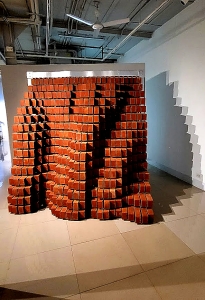
The name of the exhibition describes what the viewer will see: demolition. The artist has dismantled the gallery’s walls and panelling and used the fragments and debris from them to create a series of art works, which together make the gallery look like a building site. This might sound ridiculous, but the sculptural forms he created from the fragments of the gallery’s structure are both intriguing and exciting. It looks like someone had exploded a bomb within the gallery. However, certain elements remain untouched: cctv cameras, light switches, smoke detectors, and electrical sockets. Kawamata is well known for his site-specific creations. In addition to the sculptural ensembles that he created using the fabric of the gallery, there are several beautifully intricate three-dimensional maquettes of other projects the artist has planned or carried out.

Now, Annely Juda is a commercial gallery. I asked a member of its staff whether the amazing works that were on view in the gallery were for sale. He said that they are, and the artist will recreate the works for clients in their own spaces.

This amazingly unusual exhibition will continue until 5 July 2025.

Depicting a sea creature at a garden in Devon

DESPISED BY MARINERS whose boats are fouled by these creatures that attach themselves firmly to the hulls of vessels, they are important in the seawater eco-systems. I am referring to barnacles, which are arthropods of the subclass Cirripedia. The mature barnacle attaches itself to surfaces including boats, seashells, sea creatures including whales, and rocks, using an incredibly strong glue that they secrete. Once stuck in place, they feed by filtering the water through their bodies, extracting plankton from it. Thus, barnacles assist in the purification of seawater. For those who are concerned with ecological matters, barnacles are a useful indicator of water quality in coastal environments.

Our daughter, who is the curator at UP Projects, an organisation that commissions and executes public art works, has been involved in producing a sculpture, “I travelled 66 million years to be with you and then you came”, created by the artist Anne Duk Hee Jordan. It was unveiled on 4 June 2025. The sculpture is a depiction of the bodies of barnacles, greatly enlarged, perched on a pile of slate stones on which shapes of fossils have been carved. The barnacles are sculpted in porous materials that, like real barnacles, filter and purify water that passes through them. As UP’s website explained, the barnacle forms:

“… are made from materials with water-filtering properties, including Roman concrete, a plant-based version of activated charcoal known as biochar, shell fragments, zeolite minerals and iron oxide …”

By using these materials, the barnacle sculptures not only resemble the creatures’ forms but also their filtration functions.

The sculpture is being displayed in the garden of A La Ronde, a curious eighteenth-century house near Exmouth in Devon for a few months. Maintained by the National Trust, this (almost circular) building has sixteen sides and a central octagonal lightwell. It was built in 1796 by two cousins, Jane and Mary Parminter. With fine views of the River Exe and its estuary, the eccentrically designed house is filled with curiosities collected by the Parminters. These objects include many natural items such as seashells, bird feathers, fossils, bones, and rocks. No doubt some of these specimens have the shells of dead barnacles attached to them.

It is quite appropriate that Duk Hee’s modern sculpture, which simultaneously celebrates the importance of barnacles and purifies water falling on it, has been placed in the garden of a house once owned by two ladies who, judging by their extensive collection of seashells and other natural objects, had a great interest in the environment in which they lived. The artist’s creation serves as an object on which to concentrate while contemplating the importance and fragility of the eco-system that supports life as we know it.

Two interesting artists at a farm in Somerset

DURSLADE FARM NEAR Bruton in Somerset is home to a branch of the international commercial art gallery, Hauser and Wirth.  Until 1 February 2026, there is a wonderful exhibition of artworks by Jean Tinguely (1925-1991) and his partner, wife (for a while), and long-term collaborator Nikki de St Phalle (1930-2002). Both artists produced highly original and very imaginative creations.


A collaboration by Tinguely and de St Phalle

The sculptures created by Tinguely are frequently examples of kinetic art in which elements of the sculptures are made to move by motors, which are parts of the artworks. His sculptures often resemble unusual machines. Some of his works were collaborations with Nikki de St Phalle.


Nikki’s works are often colourful, playful, and figurative. In one room of the exhibition, the viewer is introduced to an interesting method of creating artworks used by de St Phalle. She used a rifle to fire bullets filled with paint at various targets. When the bullets hit the targets, they splattered the paint contained within them. A few examples of this procedure are on display in the show.


The exhibition is held both inside and outside  the buildings at Durslade Farm. The works outside were by de St Phalle. Those by Tinguely are all inside. Every 10 minutes, the sculptures with motors are activated for a few minutes. They are now too fragile to be run continuously or left in the  open air.


Hauser and Wirth Somerset  (at Durslade Farm) is now a popular destination not only for its art shows but also for its restaurants, garden, and pricey farm shop. However, its art exhibitions are always superb, and the current one is no exception.

Superb sculptures at a gallery in South London

HE WAS BORN in Chicago (Illinois) in 1935 and as a child was often taken by his mother to public galleries in the city. Maybe at least partly because of this Richard Hunt, who died in December 2023, became an artist. In 1953, he was awarded a scholarship to study at School of the Art Institute of Chicago. It was there that his interest in working with metal began and that he became acquainted with the work of the leading modernist artists of the 20th century. He taugh himself welding, and many of his fascinating sculptures that are on display at the White Cube Gallery in Bermondsey (until 29 June 2025) can be seen, beautifully displayed.

Many of the sculptures consist of bits of waste metal that Hunt salvaged, modified, polished, and welded together. Other sculptures are made of cast metal. Many of Hunt’s works are abstract, but suggest to the viewer that they might also depict transformations of organic forms. Each of the sculptures is intriguing and original. The influences of other artists might be subtly evident in some of them, but they are not at all obvious. The gallery’s website noted:

“Hunt developed a sculptural language that was both deeply personal and richly associative, drawing on a broad array of influences: the forms and rhythms of the natural world; the mythic narratives of Greek and Roman antiquity; his cultural heritage and global travels; the formal vocabulary of European modernism and the legacy of African American civil rights leaders who shaped his time.”

 As one looks at the works on display, many of the things in the quote above become apparent.

Although some of the works at White Cube are quite small, Hunt has produced many huge works – too large to be within the White Cube – that are displayed in public places. I thought that Hunt’s sculptures were wonderful, and was surprided that until visiting this show I had not been aware of his work.  The show at the White Cube was quite a wonderful eye-opener for me and I can strongly recommend seeing it.

Wood as art and the art of woodwork

DURING THE EASTER weekend, we visited two exhibitions. Unlike many exhibitions I have written about lately, neither of them finish soon. Both shows relate to wood and trees. One is being held at the Serpentine South Gallery in Kensington Gardens and it ends on 7 September 2025, and the other is at Japan House in High Street Kensington and continues until 6 July 2025. So, there is plenty of time to see both exhibitions.

By Giuseppe Penone

The show at the Serpentine is of artworks by the Italian artist Giuseppe Penone. I have already written a bit about him (https://adam-yamey-writes.com/2025/04/15/boulders-lodged-in-trees-at-a-park-in-london/). I did this after seeing those of his works that are on display near the outside of the Serpentine Gallery. I have now seen what is on display within the gallery, and was pleasantly surprised. Penone is fascinated by the intricate relationships between humans and nature, and this is what inspires his artworks. Many of the artefacts (paintings, installations, and sculptures) on display relate to trees and their leaves. The walls of the central hall of the Serpentine Gallery are lined with containers that hold thousands of dead laurel leaves. Another exhibit consists of semi-abstract sculptures that resemble human forms, and these are entwined with living plants growing out of large flower pots. Other works are formed from pieces of wood and twigs. One particularly effective work consisted of living branches with leaves and twigs. One of the twigs has been forced through a hole cut in a photograph of a man’s face in such a way that the twig seems to have grown from within the centre of the eye. I like this piece because it encapsulates what Penone does: he sees nature through his eyes and is inspired by what he sees.  

In contrast to Penone’s work at the Serpentine, which is art for art’s sake, the exhibition at Japan House is designed to illustrate how man can create artistic yet functional artefacts from wood. Called “The Craft of Carpentry: Drawing Life from Japan’s Forests”, the show sets out (successfully) to illustrate the amazing skills of traditional Japanese carpentry. This informatively labelled exhibition has exhibits showing the variety of tools used, the types of wood employed, the range of joinery methods, templates for cutting shapes, and some of the final products including a life-size replica of the Se-an teahouse in a temple in Kyoto. Although everything on display is related to creating functional products, each exhibit is so beautiful that it could be considered a work of art in its own right. As with every exhibition I have seen at Japan House, the exhibits are displayed imaginatively and beautifully. The exhibitions themselves are works of art.

I recommend visiting both exhibitions not only because they are fascinating but also because they illustrate two completely different approaches to dealing with trees and their wood.