WALKING ALONG THE ALBERT Embankment upstream from Lambeth Bridge, most people’s eyes will probably be focussed on the River Thames and the lovely views of the Houses of Parliament, Millbank Tower, and the Tate Britain. However, it is worth turning your eyes inland in order not to miss a wonderful example of, in my uninformed opinion, art-deco or, if you are fussy about distinctions, art-moderne architecture, whose decorative façade faces the river. Just in case you were wondering how these styles of architecture from the same time period differ, deco lays emphasis on ‘verticality’ and moderne on ‘horizontality’ (http://theantiquesalmanac.com/chicvssleek.htm). Important as this distinction might be to connoisseurs, the building on Albert Embankment is worth at least a few minutes’ examination.
The building in question is the former London Fire Brigade Headquarters, still a functioning fire station. The structure is built of bands of bricks separated by thin horizontal lines of white stone that form the top and bottom frames of the lines of windows, each consisting of lattices of rectangular windowpanes which are wider than they are tall. These design features help define the building’s horizontal sleekness, which is why it is considered by at least one authority (https://historicengland.org.uk/listing/the-list/list-entry/1392337) to be ‘moderne’ rather than ‘deco’. However, it was not this that first attracted us to the building but its decorative panels at various levels and dramatic doorways at ground level.
The doorways, which are wide enough to admit the passage of vehicles are closed with sets of folding doors, consisting of four panels, each of which has a brass window covering (grille) with a geometric design. Some of the building’s decorative panels depict firefighters at work. These are in bas-relief and made of a white coloured stone. These were made by Nicholas Babb (probably Stanley Nicholson Babb; 1873-1957). Other panels, at a higher level, adorn the central section of the façade. These are also bas-relief in white stone but have backgrounds formed of gold coloured mosaic tiles. Created by Gilbert Bayes (1872-1953), who studied alongside Babb at the Royal Academy, their subject matter is borrowed from ancient mythology.
The building itself was designed by EP Wheeler, architect to the London County Council. He was assisted by G Weald. Wheeler also designed the ‘horizontalist’ building on Charing Cross Road in 1939, which was the former home of St Martins School of Art (www.designcurial.com/news/foyles-war-4354398), where my mother worked as a sculptor during the 1960s. The Fire Brigade building was opened by King George VI and his wife on the 21st of July 1937, not a moment too soon, given what was in store for London soon afterwards: the WW2 Blitz, which put great strain on the Fire Brigade.
To the left of the façade, there is a yard in which stands a tall brick tower. This is the so-called ‘drill tower’, used for training firefighters. The building, in addition to having been the Brigade’s headquarters, was also a training centre. The rear of the building, which I have not yet seen, has three layers of balconies, from which members of the public used to be able to observe parades and displays of firefighting skills. Today, the edifice is still used as a fire station but not as the HQ of the Brigade, which is now in Union Street, Southwark.
I enjoy seeing art-deco (and ‘moderne’) architecture. While there are plenty of examples of this in London, which you can spot if you keep your ‘eyes peeled’, the greatest concentration of this style of building that I have seen is in central Bombay in India. Both the Marine Drive and the Oval Maidan in south Bombay are treasure troves for lovers of this style. So, as a lover of this style that broke away from traditional architectural styles in the 1920s and 1930s, I was delighted to have stumbled across the wonderful Brigade building on the Albert Embankment.
TEARING DOWN STATUES or defacing them is nothing new, as some might believe after hearing about dunking Edward Colston’s toppled statue into a river in Bristol.
Violette Szabo
When I visited Albania in 1984, I saw statues of Josef Stalin and the Albanian dictator Enver Hoxha prominently placed in public spaces. Neither of these two gentlemen can be seriously considered to be God’s best gifts to humanity. Many of their actions caused great fear and suffering in both the former USSR and in Albania.
In 1991, Albania’s long (1944-1991) Communist regime crumbled ignominiously. In February 1991, citizens of Albania’s capital, Tirana, attached cables to a huge statue of Enver Hoxha, an admirer of Stalin, and pulled it down. Many of the police guarding the huge monument to repression assisted the people to cause this bronze statue to topple to the ground.
Years later, in 2016, we visited Albania. In the centre of Tirana, there is a national museum of art, which was present when I visited the city in 1984. Back then, and even in 2016, there was a good collection of fine works created in the Social Realism style, so popular amongst Communist regimes. After seeing the gallery in 2016, we happened to bump into one of the museum’s curators. I showed him a picture of a sculpture I had taken in 1984 and asked him if he recognised it. Without answering, he invited us to follow him to a yard at the rear of the gallery.
There, in the yard, stood the sculpture I had photographed in 1984. More interestingly, it was not alone. It stood next to a giant statue of Lenin and another one of Stalin and another large object wrapped in cloth tied down with ropes. The curator explained that these statues, although they depicted people whose ideas and actions had done much harm to the Albanian people, were valuable works of art, not simply because of their great scrap metal value but, more importantly, they helped record the country’s history. In addition, he explained that they were fine examples of their genre. The bundled-up object standing in that yard was, he explained, too sensitive to uncover as it would upset many people viewing it. It was part of an enormous statue of Enver Hoxha, who had not yet been forgiven by many Albanians. Clearly, Lenin and Stalin were thought to be less disturbing as they were not covered up, but sufficiently upsetting to be confined to a relatively unvisited yard behind the gallery open to the public.
Both Trafalgar and Parliament Squares in London contain statues that might cause offense to those whose knowledge of history is more than superficial, yet their actions have not always been 100% reprehensible. Fortunately for these monuments, many of the kind of people who might be inclined to topple statues do not usually read much detailed history.
There are some statues or monuments, which remember people, whose actions cannot rationally be called into question. One of these is that of Edward Jenner (1749-1823), whose work formed the foundation of something on which we are currently becoming extremely dependent: vaccination. Only someone out of his or her mind would consider pulling down or defacing his statue.
Recently, when strolling along an embankment, I spotted a monument close to the River Thames outside Lambeth Palace. Erected in 2009, it commemorates the Special Operations Executive (‘SOE’), whose covert activities in no little way helped to bring about the defeat of Nazi Germany’s forces during WW2. The plinth with metal commemorative plaques is topped with the head of a woman with high cheekbones, a serious, determined face, and luxuriant curly hair, tied back. She stares out across the River Thames toward the Houses of Parliament. The bust depicts Violette Reine Elizabeth Szabo (1921-1945), whose actions behind enemy lines in France were designed to sabotage German military activity. She was one of many women including Noor Inayat Khan (1914-1944), of Indian aristocratic heritage, who risked and lost their lives to assist in the defeat of a repressive regime.
SOE was staffed by both men and women of many nationalities, and their bravery is recorded on this simple memorial outside Lambeth Palace. Although simple in design, the expression depicted in the face of Violette Szabo gave me a feeling of the great determination of those brave souls who gave up their lives in horrific circumstances. They did so in the hope, fulfilled, that we could enjoy life in Britain and elsewhere without having to bear the burden of inhumane dictatorial rule.
Unlike Stalin and Hoxha, statues of the purely benevolent such as Jenner and Szabo should be allowed to stand undisturbed for ever, well, at least, so long as they can survive London’s ever-changing weather conditions and pollution.
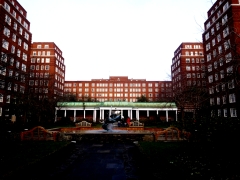
I HAVE NEVER VISITED MOSCOW, but I imagine that the huge, rather forbidding looking apartment block on Grosvenor Road facing the River Thames, would not look out of place in the Russian city. Covering seven and a half acres of land, built with twelve million bricks and almost seven thousand external window units, and containing at least twelve hundred flats, this mammoth building complex, which has been home to many of the famous and infamous, was completed in late 1936. This enormous residential complex is called Dolphin Square.
Maps surveyed in 1869 and 1913 reveal that the land on which Dolphin Square was built, which is west of St Georges Square, used to be the site of the several long buildings that together made up the Royal Army Clothing Department and its storage depots. Before that, the land was occupied by the work premises of the developer and builder Thomas Cubitt (1788-1855), who built much of Belgravia and Pimlico. A few years after his death, the army leased the site and the depot stood there until 1933, when the lease reverted to the Duke of Westminster (https://en.wikipedia.org/wiki/Royal_Army_Clothing_Depot).
An American firm, Fred F French Companies, bought the freehold of the former army clothing compound, and then, discovering it had insufficient funds to develop it, sold it on to Richard Costain Ltd. Costain commissioned the architect Stanley Gordon Jeeves (1888-1964), whose other works include the now demolished Earls Court Exhibition Centre and the still standing large, art-deco Latimer Court at Hammersmith, to design the residential complex that exists today. Writing soon after it opened, the writer AP Herbert (1890-1971) wrote a book extolling the virtues of Dolphin Square. He wrote that it is:
“…a city of 1,250 flats, each enjoying at the same time most of the advantages of the separate house and the big communal dwelling place …”
Commenting on the fact that the complex included a restaurant, he wrote:
“…fortunate wives will not have enough to do. A little drudgery is good for wives, perhaps. The Dolphin lady may be spoiled.” (quotes from www.theundergroundmap.com/article.html?id=2792)
From outside the building, Dolphin Square looks monolithic and forbidding. However, on entering the huge courtyard within it, this impression changes. For, the courtyard contains a lovely garden, which was designed by Robert Sudell in about 1937 (https://historicengland.org.uk/listing/the-list/list-entry/1455668). Though much modified since then, the formal garden retains much of the original design concept including an axial avenue lined with chestnut trees. Appropriately, the middle of the garden is adorned with a fountain with three sculpted dolphins. Created by the sculptor James Butler (born 1931), this was placed in 1987 to replace an earlier fountain. This pleasant garden would be one good reason to entice me to live in this extraordinarily massive complex.
As mentioned already, Dolphin Square offers its residents a restaurant. It also contains an arcade of shops, a café, a gymnasium, a swimming pool, a laundrette, underground parking, a bar, a brasserie, a hotel, a tennis court, and more. And all of this is within a short walk of Westminster and the Houses of Parliament. This proximity to the centre of government means that many MPs have made use of Dolphin Square as their London ‘pads’.
Apart from politicians, including Harold Wilson, William Hague, David Steele, and many others, Dolphin Square has been home to people of fame and notoriety. According to an article in Wikipedia, some of these include Oswald Mosley and his wife Diana Mitford; the novelist Radclyffe Hall; Christine Keeler and Mandy Rice-Davies; the comedian Bud Flanagan; the spy John Vassall; and the tennis player Rod Laver. Princess Anne lived in Dolphin Square briefly in 1993, General de Gaulle based his Free French Government in part of the Square in WW2, and Sarah, daughter of Sir Winston Churchill, was:
It seems that a fascinating book about the residents of Dolphin Square is waiting to be written.
I had passed Dolphin Square plenty of times before entering its garden recently, but until now I had no idea that this far from attractive building was home to such a fascinating range of people nor that it contained such a fine garden. Just as one should not judge a book by its cover, it is a mistake to judge Dolphin Square from its exterior.
CAN YOU BELIEVE that although we have walked through London’s Hyde Park so many times (in order to take exercise as is recommended by our great leader, a biographer of Winston Churchill, and his government) that there are still many things in it for us to discover? Walking in the southwest corner of the park recently, we saw four man-made items that caught our interest.
An octagonal Victorian bandstand, which was built in 1869 and stood in Kensington Gardens, was moved to its current location in Hyde Park not far from Hyde Park Corner in 1886 (www.royalparks.org.uk/parks/hyde-park/). It is said that this bandstand has good acoustics; I have yet to hear music played here. In the 1890s, concerts were held at the bandstand three times a week. Currently, in normal times, that is when there is no pandemic, the bandstand is used occasionally for concerts and other events as well as becoming part of the annual Winter Wonderland fairground held in Hyde Park.
The bandstand, which was/is often used by military bands, is about 100 feet northwest of a black coloured bronze equestrian statue depicting St George slaying a mammoth dragon. Its coiled, scale covered body, my wife considered accurately, resembles a haphazard pile of discarded lorry tyres. The stone base is surrounded by a frieze depicting cavalrymen in action. The equestrian sculpture stands in front of a low wall which bears the names of cavalry regiments involved in WW1. The monument, though erected before WW2, also those involved those:
“… in the war / 1939-1945 / and on active service thereafter.”
The monument, The Cavalry Memorial, which used to stand nearer Park Lane was unveiled in 1924 by Field Marshal, The Earl of Ypres (formerly Sir John French; 1852-1925) and the Prince of Wales (the future Edward VIII, who reigned for 11 month). The knight on the horse was modelled on:
The sculptor was Captain Adrian Jones (1845-1938). Jones was an army veterinary surgeon between 1867 and 1890. He took up painting and sculpting after he retired, specialising in depicting animals. His best-known work, created in 1912, is not far from the cavalry monument: it is the Quadriga that adorns the top of the Wellington Arch at Hyde Park Corner.
The cavalry monument is a mere 200 yards north by north-east of a modest memorial to a fairly recent tragedy that stands beside the South Carriage Drive. It remembers the eleven soldiers who were killed by a bomb planted by IRA terrorists near this spot on the 20th of July 1982.
Returning to a path that leads north from a spot between the Cavalry Memorial and the bandstand, you will quickly reach a small art-nouveau structure. Formerly a fountain, this is a depiction of an almost naked girl wearing a hat and holding a fish under each of her arms. We asked a gardener working nearby if he knew anything about this curious garden sculpture. He informed us that it was a sculpture of Little Nell, a character in “The Old Curiosity Shop” by Charles Dickens and that it used to stand in Hyde Park’s Rose Garden.
The sculpture, created by William Robert Colton (1867-1921) has been variously known as the ‘Memorial Fountain’, ‘The Mermaid Fountain’, ‘The Colton Memorial’, and, much later, as ‘Little Nell’ (www.victorianweb.org/sculpture/colton/7.html). It is not clear why Colton’s sculpture should be associated with Dicken’s character, Nell. What we see today is a concrete cast of the original that was made in 1897. It looks as if it could do with a lot of tender love and care as it seems to be crazed, cracked and scarred.
Colton created various public sculptures in London, but his work is found further afield. I read (www.speel.me.uk/sculpt/coltonwr.htm) that:
“Important in his career was a series of Indian portraits in the mid-1900s, including statues and busts of the Maharajah of Mysore and the Dewan of Mysore, and a monument to J. Tata, including allegorical figures, for Bombay.”
I have probably seen some of his Indian works both in Mysore and Bangalore but took little notice of them. A website (http://mysore.ind.in/chamaraja-circle) extolling the virtues of Mysore reveals:
“The French born celebrated sculptor of the time, William Robert Colton was commissioned to execute a statue in memorial of the maharaja. He is the same sculptor who executed many famous sculpture in India including the statue of Sir K Seshadri Iyer, at Cubbon Park in Bangalore, who was the Dewan of Mysore State from 1883 to 1901. Also the 8 bronze tigers of Mysore Palace too are the works of Colton.
He spend[sic] some three months in Mysore during 1912 for the preliminary study for making the statue of Chamaraja Wodeyar. The statue was executed in white Italian marble in England … In the statue the maharaja is portrayed in standing posture in military uniform.
Though Colton was famous for executing lifelike sculptures, one glitch was the in the appearance of the face of the maharaja. There was not much resemblance between face of the maharaja and the face of the statue. When the statue finally arrived in Mysore in 1918, the queen the late maharaja Chamaraja Wodeyar was not happy with this aspect.”
Colton, whose father was an architect, was born in Paris, but was taken to England when he was three years old. He studied art first at the Lambeth School of Art and then at the Royal Academy.
Three of the items, which I have described, have connections with Britain’s former empire. Some of the cavalrymen remembered on the Cavalry Memorial, fought in not only in WW1 but also in Egypt, South Africa, and British India. Several major cavalry units were based in India and included soldiers of Indian origin. The other item with an association with part of the former British Empire is the small lady with two fishes, created by an artist who has sculpted some notable Indians. The bandstand near these two park features is typically Victorian and octagonal, and not markedly different in appearance from one that stands in Cubbon Park in Bangalore (India). And all of these are but a few minutes leisurely stroll from Apsley house, the former home of Arthur Wellesley (1769-1852), who fought in India in the late 18th century.
ELEGANT BELGRAVE SQUARE is but a stone’s throw from Hyde Park Corner. Many of its neo-classical buildings are home to diplomatic missions and their staff. As with many London squares, the centre of Belgrave Square contains a private garden. That at Belgrave Square is adorned with sculptures, mostly statues of eminent people. At each of its four corners, there is one. The people depicted at these four positions are Prince Henry the Navigator (1394-1460); Christopher Columbus (1451-1506); Simon Bolivar (1783-1830), the liberator of Venezuela, Bolivia, Colombia, Ecuador, Peru, and Panama; and José San Martin (1778-1850), liberator of Argentina, Chile, and Peru. Almost facing San Martin on the north east corner of the square is a statue of Sir Robert Grosvenor, First Marquess of Westminster (1767-1845), upon whose estate Belgrave Square was built.
Elias George Basevi
On the eastern side of the square, close to the statue of Simon Bolivar and within the garden, there is a sculpture by Enzo Plazzotta (1921-1981), which was completed after his death by Mark Holloway. It is called “Homage to Leonardo. The Vitruvian Man”.
Interesting as all the above-mentioned are, the sculpture that intrigued me most is a bust of Elias George Basevi (1794-1845), who is described on his plinth as ‘architect’. I guessed that he was likely to have been involved in the design of Belgrave Square, and I was right. According to a plaque on the base of Grosvenor’s statue, he designed the neo-classical terraces surrounding the square for the Haldimand Syndicate, which was under the control of the brothers George (1781-1851) and William (1784-1862) Haldimand, of Swiss origin, sons of a banker born in Switzerland and an English mother. In 1825, William, a Member of Parliament:
“… negotiated successfully with the 2nd Earl Grosvenor, Seth Smith and William Cubitt for a 99-year lease on Belgrave Square, where he had 49 houses built: 16 to be owned by George Haldimand, 14 by himself, eight by Prevost, four by Smith and three by Cubitt…” (www.historyofparliamentonline.org/volume/1820-1832/member/haldimand-william-1784-1862)
The Haldimands were related to Frederick Haldimand (1718-1791), who became Governor of Quebec in 1777. Thomas Cubitt (1788-1855), who was involved in creating the square, was a major Victorian property developer.
As for Basevi, at first, I thought that his surname sounded Italian. His family might have come from that country as its origins were Sephardic Jewish. The Basevi surname is particularly associated with Sephardic Jews in Verona (https://judaism_enc.enacademic.com/2089/BASEVI). His father, Joshua, usually known as ‘George’, was a London City merchant (www.jewishencyclopedia.com/articles/2616-basevi-george-joshua). Elias George’s aunt, George’s sister Maria (née Basevi), was married to Isaac D’Israeli, whose son was Benjamin Disraeli, Earl of Beaconsfield (1804-1881), who was Prime Minister between 1874 and 1880. In 1810, Elias became a pupil of the great architect John Soane (1753-1837), who specialised in creating in the neo-classical style. According to the Dictionary of National Biography (‘DNB’) (https://doi.org/10.1093/ref:odnb/1615), from which I have gleaned much information about Elias, he:
“… also studied at the Royal Academy Schools, where Soane had recently been appointed professor of architecture. In 1815 he visited Paris with his brother, and on completion of his architectural training in 1816 he embarked on a three-year study tour of Italy and Greece, staying the longest in Rome and Athens, but also travelling extensively elsewhere in Italy and even visiting Constantinople.”
Regarding Belgrave Square, the DNB relates:
“Basevi designed and handled the construction of the terraced houses making up the four sides of the square (1825–40), though not the four detached villas at the corners. He treated the stuccoed terraces of eleven or twelve houses on each side as single palatial façades, giving each a central columnar portico and end pavilions in a similar manner to John Nash’s terraces in Regent’s Park … The financial success of this speculative development during an economically depressed period was due in large part to Basevi’s precise and scholarly attention to detail, not just in the design of the individual houses but also in the paving, street furniture, and composition of the square as a whole.”
Elias Basevi’s other projects included, to give just a few examples, St Thomas, Stockport, Cheshire (1822–5); work at several country houses; a building at Balliol College Oxford; Beechwood House and The Elms in Highgate; and the Fitzwilliam Museum in Cambridge, whose construction was completed after his death. Beechwood House was built for the architect’s brother Nathaniel, a barrister, in 1840, who was married to a niece of Sir Robert Peel (1788-1850).
Noticing Basevi’s buildings in Highgate, I looked at John Lloyd’s “History, Topography, and Antiquities of Highgate”, published in 1888, and discovered more about Basevi. He wrote that the Basevi family had been prominent in the Anglo-Jewish community. One member of the family, Napthali, the grandfather of Benjamin Disraeli’s mother, was an early President of The Jewish Board of Deputies, which was involved in the struggle for the emancipation of the Jews. The Basevis moved away from the Jewish faith as did their kinsmen the Disraelis.
Elias Basevi married Frances Agneta Biscoe. They produced eight children, one of whom was given the name James Palladio Basevi (1832-1871), who became an officer in the Royal Engineers.
On a personal note, I attended Highgate School between 1965 and 1970. Some years later, I acquired a copy of the “Highgate School Register 1833-1988”. Today, I looked up ‘Basevi’ in the index of pupils and discovered that in March 1840, James Palladio Basevi joined the school. This son of the architect joined the school two years after the Reverend John Bradley Dyne (1809-1898) had become headmaster. Dyne was to raise the school’s reputation considerably. Other Basevi family members attended the school were William Augustus Basevi (joined January 1841), George Henry Basevi (joined January 1842) Frederick Biscoe Basevi (joined April 1844), Charles Edward Basevi (joined June 1844). All of these fellows were sons of the architect of Belgrave Square. Why they went to Highgate School is a bit of a mystery. Part of the reason might have been that their uncle, Nathaniel, had his home at Beechwood, a short walk from the school. however, their father, the architect lived in central London. The historian Alan Palmer, who used to teach at the school, wrote that out of the 43 graduates of Dyne’s first ten years, only 16 came from homes near the school. His reputation as a headmaster was already excellent by the time that the first of the architect’s sons entered the school, which attracted boarders.
Elias, who became a Member of the Royal Institute of British Architects, and a Fellow of both the Society of Antiquaries and the Royal Society, ended his life in a frightening way. The DNB relates his tragic ending:
“He died on 16 October 1845, aged fifty-one, after falling through an opening in the floor of the old bell chamber of the west tower of Ely Cathedral while inspecting repairs. His remains were buried in Bishop Alcock’s chapel at the east end of the cathedral.”
The bust of Elias George Basevi is smaller than the other commemorative sculpture placed in and around Belgrave Square and easy to miss if you are walking around the square. I only noticed it because I was watching two people walking with their dogs within the square’s private garden. Had I not seen the bust, I might have never explored the life of this man whose family had connections with Highgate, where I attended secondary school.
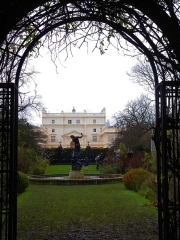
ONE COULD EASILY MISS it whilst walking around the Inner Circle at London’s Regent’s Park. Had I not noticed a couple of people emerging from the discreet gap in a fence, I would have dismissed this as one of the numerous private entrances on the outer circumference of the Inner Circle. The gap in the fencing is near the northernmost point on the circular road. A small notice, framed by vegetation, within the gap in the fencing gives a short history of The Garden of St John’s Lodge. Follow the pathway away from the road, take a left turn and walk between two manicured hedges and then turn right, and you enter a lovely formal garden replete with a pond, several sculptures, and a lawn that gives a fine view of one side of St John’s Lodge. Brave the slippery mud and explore the various separate parts of this almost secret garden. You will not be disappointed.
St John’s Lodge was the first ‘villa’ to be built in Regent’s Park. Completed between 1817 and 1818 (https://historicengland.org.uk/listing/the-list/list-entry/1277478), it was designed by John Raffield (1749-1828), who had worked for the Adam brothers before setting up his own architectural practice. It was later modified and enlarged both by Decimus Burton and Charles Barry. The house was built for the politician Charles Augustus Tulk (1786-1849). Subsequent owners of the private residence have included Lord Arthur Wellesley, Duke of Wellington (1769-1852) who served in India; John Crichton-Stuart, 3rd Marquess of Bute (‘Bute’;1847-1900), whose heart was buried at The Mount of Olives in Jerusalem; and Baron Sir Isaac Lyon Goldsmid (1778-1859). It was Wellesley who employed Decimus Burton to enlarge the house in 1831-32.
Goldsmid was a philanthropist and one of the leading personalities in the emancipation of British Jews. He made his fortune as a partner in the bullion brokers firm of Mocatta & Goldsmid (founded as ‘Mocatta Bullion’ in 1684), brokers for both The Bank of England and The East India Company. It was due partly to Goldsmid that my alma-mater, University College (London), was able to come into existence. Albert Hyamson, author of “A History of the Jews in England” wrote that:
“University College, London … was established in 1826, largely by the efforts and through the munificence of Isaac Lyon Goldsmid …”
Goldsmid paid for the land on which the university was later built.
In connection with Jewish emancipation, the online Jewish Encyclopaedia (www.jewishencyclopedia.com/articles/6765-goldsmid) writes of Goldsmid:
“The main effort of his life was made in the cause of Jewish emancipation. He was the first English Jew who took up the question, and he enlisted in its advocacy the leading Whig statesmen of the time. Soon after the passing of the Act of 1829, which removed the civil disabilities of the Roman Catholics, he secured the powerful aid of Lord Holland, the Marquis of Lansdowne, the Duke of Sussex, and other eminent members of the Liberal party, and then induced Robert Grant to introduce in the House of Commons a similar measure for the Jews. During more than two years from the time when Jewish emancipation was first debated in Parliament, Goldsmid gave little heed to his ordinary business, devoting himself almost exclusively to the advancement of the cause.”
In 1841, Goldsmid became the first Jewish person, who had not converted to Christianity, to become a Jewish baronet. His son, Sir Francis Henry Goldsmid (1808-1878), worked with him for Jewish emancipation and was the first Jewish barrister in England, having been called to the Bar at Lincolns Inn.
Clearly, St John’s Lodge has had some noteworthy residents. Of these, it was Bute who commissioned the Scottish Arts and Crafts architect and landscape designer Robert Weir Schultz (1860-1951) create a garden “… fit for meditation”. Bute at St John’s Lodge, which he acquired in 1888, was one of Schultz’s first major clients (http://www.scottisharchitects.org.uk/architect_full.php?id=200199). Bute had taken an interest in Schultz’s studies, having financed his visit to the British School at Athens in the late 1880s. The garden was created in the early 1890s. It was refurbished and some of its original features restored in 1994, but it has been open to the public since 1928 (https://londongardenstrust.org/conservation/inventory/site-record/?ID=WST108).
Apart from its vegetation, the garden features sculptures, a pond, and a giant urn. The sculptures include “Goatherds daughter” by Charles L Hartwell (1873-1951); “Hylas and the Nymph” by Henry Pegram (1862-1937); an “Awakening” by Unus Safardiar (born 1968), commemorating Anne Lydia Evans (1929-99), a local medical practitioner. There are two stone piers, one on each side of a lawn, bordered by scalloped hedges, leading up to the house. Each of these is topped with a stone cherub holding a fading painted stone shield, the coat-of-arms of Crichton-Stuart. These were made by William Goscombe John (1860-1952).
St John’s Lodge remained in private ownership until World War I, when it became a hospital for disabled officers and then became the HQ of St Dunstans (now known as ‘Blind Veterans UK’) with its workshops from 1921 to 1937. Then, it became the headquarters of the Institute of Archaeology from 1937 to 1959. In 1959 it was occupied by Bedford College (now ‘Regent’s University’). It was vacated and since 1994, it has been leased for private residence to the Royal Family of Brunei.
Had I walked past the small passage leading off the Inner Circle, I would have missed experiencing the almost hidden, delightful garden of St John’s Lodge, which is a building that has housed persons who have influenced the history of Britain significantly. We visited the garden in late December when few plants were in flower. We hope to return a few months later when not only the garden will be filled with blooms as will the nearby Queen Mary’s Rose Gardens within the Inner Circle.
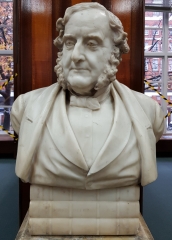
A WHITE STONE BUST depicting a man wearing a jacket and a waistcoat is perched on a pile of books carved in the same material and stands on a marble pedestal in the centre of the open access bookshelves in the public lending library on Hornton Street in London’s Kensington. His face has copious mutton-chop sideburns but neither moustache nor beard. The person depicted is James Heywood (1810-1897), who founded the first public library in Kensington in about 1870. His sculptural portrait in the library was created by Middlesex born James Adams-Acton (1830-1910), some of whose other busts include representations of Emperor Caesar Augustus, John Wesley, and ‘Pharaoh’s daughter’ (www.artuk.org/discover/artists/adams-acton-john-18301910).
Heywood, who was born in Manchester, was a man of many achievements (www.gracesguide.co.uk/James_Heywood). Son of the banker Nathaniel Heywood, James studied at the universities of both Edinburgh and Geneva before joining the family bank at Manchester. On inheriting a large sum from his uncle, he left the bank and matriculated at Trinity College Cambridge in 1829, where he continued to study but did not graduate. In 1838, he was admitted to the Inner Temple in London, where he was called to the Bar but did not practise as a barrister. In that same year, James became a founder member of the Manchester Geological Society. The next year, he was one of the founders of the Manchester Athenaeum, which provided reading rooms and lectures.
“James Heywood, Esq of Trinity College, Cambridge, residing at 17 Cork Street, London, Barrister of the Inner Temple, author of a Report on the Geology of the Coal District of South Lancashire, published in the Transactions of the British Association, & also of a Report on the state of the population in Miles Platting, Manchester, published in the Journal of the Statistical Society of London; a gentleman much attached to science, being desirous of becoming a Fellow of the Royal Society, we the undersigned, do, from our personal knowledge, recommend him as deserving of that honor, & as likely to be a useful & valuable member.”
So, by 1839, Heywood was residing in London. In addition to his scientific work, he was involved in politics. Between 1847 and 1857 he represented the constituency of Lancaster Northern. He was a member of the Whig/Liberal Party. In 1859, he moved to Kensington (Kensington Palace Gardens), where in about 1870 he established Kensington’s first free public library at Notting Hill Gate. Heywood was a Unitarian. His home in Kensington was close to the current location of a Unitarian church, which was only established on this site in 1887. However, before that, in 1867, the Unitarians began meeting in Kensington at Sir Isaac Newton’s old home, now demolished, in Church Lane. The history of the Kensington Unitarians, found at www.kensington-unitarians.org.uk/images/EssexChurchInKensington_forInternet.pdf reveals that:
“The congregation was growing under the Chairmanship of James Heywood, MA, FRS, MP, ‘one of Kensington’s most distinguished citizens’…”
The church moved to its present site near the Mall Tavern in the 1880s.
The free library, which Heywood created in Kensington and was opened on the 15th of August 1874, was located at ‘106, High Street, Notting Hill”, according to “The Catalogue of Mr James Heywood’s Free Public Library”, published in 1879 (and viewable on Google Books). The ‘High Street’ is now named ‘Notting Hill Gate’. If the numbering was the same then as it is today, then 106 would have been on the north side of the street just west of Pembridge Road, roughly between where Tescos and Mark and Spencers Simply Food stores stand currently. Today, the Notting Hill Gate branch of Kensington’s public libraries stands on the corner of Pembridge Road and Pembridge Square.
Heywood’s library was open seven days a week and before receiving a book, an applicant had to fill in a form with the following wording:
“I REQUEST TO READ
Name of books ….
Date …. Signature of applicant .…”
Reading books in the library was free of charge but borrowing them required a monthly payment of sixpence (2.5 p) and one penny (about 0.5 p) per book borrowed. The catalogue included a very respectable variety of books and periodicals. I was pleased to note that there was a book about Albania, “Travels in Albania and Other Provinces of Turkey” by Lord Broughton, Baron John Cam Hobhouse Broughton (1786-1869), who accompanied Lord Byron on his trip through the Balkans at the beginning of the 19th century.
Given his important contribution to the development of public libraries in Kensington, it is entirely appropriate that James Heywood is commemorated in the main branch of the library system of the Royal Borough of Kensington and Chelsea. It is also worth noting that like his pioneering establishment in Notting Hill High Street, the library is not entirely free for borrowers. Although books may be borrowed free of charge, other items including DVDs can only be borrowed after making a payment.
YOU CAN NO LONGER ENJOY a tankard of ale at the Sun Inn in the Essex town of Saffron Walden. However, you can still enjoy the fine pargetting (moulded sculptured plasterwork) that adorns it.
The building that housed the former Sun Inn was built in the 15th century. Late in the 16th or early in the 17th century, an upper floor was added. Indeed, one of the gables with fine pargetting bears the date 1676. This might have been the date when the present pargetting was created or when the upper floor was added, or even both. The former inn has an opening that allowed wagons and other traffic to enter the yard behind it.
The pargetting is described well in a website (www.british-history.ac.uk/rchme/essex/vol1/pp228-260) as follows: “… in the middle bay are two late 17th-century panels in plaster, one with a design of foliage and birds, and the other with a stocking; in the S.W. gable is a design of the same date in plaster, which consists of a circular panel divided into twelve segments; on each side is the figure of a man in a long coat, knee-breeches and high-heeled shoes; one figure holds a sword and buckler, the other a long club.”
One of the panels, that with the man with a sword and the other with a long club, respectively represent Thomas Hickathrift and the Wisbech giant (https://heritagerecords.nationaltrust.org.uk/HBSMR/MonRecord.aspx?uid=MNA108635). Thomas (‘Tom’) Hickathrift was a mythical East Anglian giant-killer, a giant of a man, whose exploits included slaying the Wisbech Giant.
Today (late 2020), the group of beautifully decorated houses that includes the former Sun Inn is empty. The ground floor of part of the building bears a shop sign ‘Lankester Antiques & Books’. Run by Paul Lankester of Thaxted in Essex, the shop closed after 48 years of business in July 2015. Another sign near it reads ‘The 14th century Old Sun Inn. Oliver Cromwell’s Headquarters 1647’. In 1647, when Cromwell’s New Model Army had won the first civil war for the Parliamentarians, they gathered in Saffron Walden. For various reasons the war weary army was becoming dissatisfied. Cromwell and his officers arrived in Saffron Walden on the 2nd of May 1647 to try to satisfy the troops’ various demands and to deal with their grievances (www.saffronwaldenreporter.co.uk/news/a-lasting-place-in-history-1-377880). He was unable to do so and returned to London after staying in the town for 19 days.
Although the town has many other attractions, seeing this old building with its exquisite external decorations is on its own an excellent reason to pay a visit to Saffron Walden.
IT SEEMED APPROPRIATE to visit Runnymede, the so-called birthplace of democracy on a day (7th November 2020) when Donald Trump, the current president of the USA, appears to be losing faith in it and might be about to attempt to undermine it.
Runnymede, a water meadow of the Thames close to Windsor, is close to a former Roman river crossing near the town of Staines. The name is probably derived from the Anglo-Saxon words ‘runieg’, meaning ‘meeting place’, and ‘mede’, meaning ‘meadow’. The ‘Witangemot’, a council of Anglo-Saxon kings, used to meet at Runnymede between the 7th and 11th centuries (AD). This pre-Norman Conquest meeting place was used again on the 15th day of June in 1215, when King John reluctantly signed the Magna Carta in the presence of a group of barons who had met a few months earlier in the Suffolk city of Bury St Edmunds (www.visit-burystedmunds.co.uk/blog/2018/discover-bury-st-edmunds-historic-role-in-the-creation-of-the-magna-carta). Runnymede is the most probable location of the signing, as this is what is written at the end of its text (translation from www.bl.uk/magna-carta/articles/magna-carta-english-translation):
“Given by our hand in the meadow that is called Runnymede, between Windsor and Staines, on the fifteenth day of June in the seventeenth year of our reign.”
The Magna Carta, whose evolution is too detailed to be described here, was, and still, is of great importance because it aims to ensure a fair relationship between the rights of ruler and those of his or her then powerful subjects, his barons, but nowadays its principles have extended to cover all subjects of the realm, It contains chapters such as:
“In future no official shall place a man on trial upon his own unsupported statement, without producing credible witnesses to the truth of it.” (chapt. 38)
“No free man shall be seized or imprisoned, or stripped of his rights or possessions, or outlawed or exiled, or deprived of his standing in any way, nor will we proceed with force against him, or send others to do so, except by the lawful judgment of his equals or by the law of the land.” (chapt. 39)
“In future it shall be lawful for any man to leave and return to our kingdom unharmed and without fear, by land or water, preserving his allegiance to us, except in time of war, for some short period, for the common benefit of the realm. People that have been imprisoned or outlawed in accordance with the law of the land, people from a country that is at war with us, and merchants – who shall be dealt with as stated above – are excepted from this provision.” (chapt. 42)
“We will appoint as justices, constables, sheriffs, or other officials, only men that know the law of the realm and are minded to keep it well.” (chapt. 45)
The Magna Carta includes a number of items that are hardly relevant in the modern world, but those such as I have quoted above are deeply relevant and extremely important. However, the document signed by King John has some elements that illustrate attitudes that we would consider unacceptable today, notably antagonism to Jewish people as can be seen in chapter 10:
“If anyone who has borrowed a sum of money from Jews dies before the debt has been repaid, his heir shall pay no interest on the debt for so long as he remains under age, irrespective of whom he holds his lands …”, and in chapter 11:
“If a man dies owing money to Jews, his wife may have her dower and pay nothing towards the debt from it. If he leaves children that are under age, their needs may also be provided for on a scale appropriate to the size of his holding of lands…”
Seventy-five years after the signing at Runnymede, King Edward I issued an edict expelling all Jews from the Kingdom of England, thus throwing into question whether or not everyone in England was protected by the mostly virtuous intentions of Magna Carta.
In brief, Runnymede was the site of the signing a far-reaching document of great importance to the rights of citizens. Several centuries later, the Magna Carta influenced the formulation of the Constitution of the USA in the late 18th century. The area of Runnymede is now maintained by the National Trust. It contains several monuments and artworks relating to the historic significance of the place.
On arrival at the parking place, we passed a sign that reads:
“Runnymede. A home to politics and picnics for over 1000 years.”
The car park is next to one of a pair of lodges designed by Edwin Lutyens (1869-1944), son-in-law of Edward Robert Lytton Bulwer-Lytton (1831-1891) the Viceroy of India from 1876-1880, and the architect of some of the government buildings in New Delhi. The lodges were built between 1930 and 1932. They are not the only connection between Runnymede and India as I will explain soon.
During our visit to Runnymede on a crisp sunny morning, we walked across the muddy ground to four features of interest in its meadows dotted with lovely trees, many of them oaks. The first place we reached is a cylindrical stone monument standing within a ring of eight square pillars that support a circular ring whose centre is open to the sky. It is approached via a staircase with names carved in its steps. These are the names of lawyers from the USA. The cylindrical stone bears the words:
“To commemorate Magna Carta, symbol of freedom under law”
This monument was designed by the English architect Sir Edward Maufe (1883-1974) and erected by the American Bar Association in 1957.
The American monument stands a few feet above the base of an oak tree, which is growing beside a square marble stone that bears the words:
“Quercus robur, planted by PV Narasimha Rao, Prime Minister of the Republic of India, as a tribute to the historic Magna Carta, a source of inspiration throughout the world, and as an affirmation of the values of Freedom, Democracy, and the Rule of Law, which the people of India cherish and have enshrined in their constitution. March 16 1994”
‘Quercus robur’ is a type of oak tree and Rao (1921-2004), a member of the Indian National Congress Party, was Prime Minister of India from 1991 to 1996.
Twelve bronze chairs are placed in the midst of the meadow closest to the raised wooded area containing the American and Indian monuments. They are arranged in two rows of five facing each other with another two chairs at the two ends of what is effectively a rectangular dining table with the table removed. Each chair back’s two surfaces are decorated with bas-reliefs, one facing the chair opposite it and the other away from it. The bas-reliefs depict the various people, events, and ideas resulting from the ideas expressed in the Magna Carta. One of them depicts Cornelia Sorabji (1866-1954), a Parsi, the first Indian woman to practise law in India. Another depicts Mahatma Gandhi’s portable spinning wheel, his symbol of resistance to the importation of British goods to India. Other motifs are described in an informative website, https://www.nationaltrust.org.uk/runnymede/features/what-does-the-jurors-represent . Seeing the empty chairs set out so formally in the field made me feel as though someone had put them there in readiness for King John’s famous meeting with the barons in June 1215. This effective and moving artwork was created by Hew Locke (born 1959) for the 800th anniversary of the signing of the charter. It is quite likely that the sun would have been shining as brightly on that significant day as it did when we visited Runnymede.
Dramatic as is Locke’s work at Runnymede, it is rivalled, or, better, complemented, by another fantastic creation not far away. From the outside, it looks like a recently constructed circular military bunker with a tall entrance in its wall. Step inside and you find yourself in a dark passageway that runs parallel with the outer wall and another inner circular wall. Soon, you reach an opening in the inner concentric wall. This leads into a circular chamber lit by daylight coming through a circular orifice in its ceiling. The inner circular chamber contains a circular pool of water surrounded by a metal band in which words are written as a mirror image, just like the way that Leonardo da Vinci used to write. The words are reflected in the water, where they appear the right way round. They spell out the words of chapter 39 of the Magna Carta (translated into English). The effect is both dramatic and very moving. The artwork is called “Writ in Water”, the words coming from the inscription on the gravestone of the poet John Keats, which are:
“Here lies one whose name was writ in water”.
This spectacular piece of art was designed by Mark Wallinger (born 1959) as a place to reflect on the principles of democracy that were born at Runnymede in 1215. It was completed in 2018 and it alone is a good reason to visit Runnymede.
While I was writing this, news began arriving from the USA. It suggested that barring any devious surprises from the current president of the USA, the democratic process in the USA might well have a chance of remaining guided by the noble principles enshrined in Magna Carta under a new president, Mr Joseph Biden.
SAINT APOLLONIA WAS born in the 2nd century AD. She was one of a group of virgin martyrs who was killed in 249 AD during an uprising against the Christians in the Egyptian city of Alexandria. Prior to being murdered, she was tortured by having her teeth pulled out and damaged. Since then she has been regarded as the patron saint of dentistry and those suffering from toothache and other dental problems.
St Apollonia by M Landy
When I was a dental student back in the early 1980s, I did some research with a view to writing an article about Apollonia for the dental school’s journal. While carrying out my investigations, I came across an article (I cannot remember where) which described a sacred relic, one of Saint Apollonia’s teeth, which is held in a church somewhere in northern France. I cannot recall where this tooth resides, but I have not forgotten something that was written about relics in general in that article. That is, according to the writer, one of the miraculous properties of sacred relics is that they can self-replicate.
Since working on that unfinished article, I have hardly given Saint Apollonia a moment’s consideration until today when we visited an exhibition based around the works of the German artist Lucas Cranach the Elder (1472-1553). This wonderful exhibition is being held at Compton Verney, a fine old house built 1714 in Warwickshire and set in gardens very capably designed by Lancelot ‘Capability’ Brown (c1716-1783), until the 3rd of January 2021.
One of the rooms of the exhibition is devoted to works of art inspired by Lucas Cranach the Elder. Two such works by Pablo Picasso are on display alongside various other fabulous modern artworks by slightly less well-known artists. One of these pieces is a mechanised sculpture by Michael Landy (born 1963). This was inspired by the depiction of St Apollonia in a painting by Cranach which is held in London’s National Gallery. In Cranach’s work, Apollonia, dressed in a long, pleated dress coloured red, stands beside St Genevieve (martyred in what is now France), dressed in green.
Landy has created a wooden sculpture, a three-dimensional version of what appears in Cranach’s painting. In the latter, Apollonia is depicted with her hands clasped together around the long handles of a pair of pliers whose beaks are wrapped around an extracted tooth. Landy’s three-dimensional version, which is about twelve feet high, looks remarkably similar to Cranach’s. A foot pedal is attached to the sculpture by a cable. When a viewer presses the pedal, Apollonia’s hands move the pliers towards her mouth and then fall back again. It appears as if she has just pulled out her tooth. I wonder what Cranach would have thought about this rather gory adaptation of his original image.
You have now been warned. If you are a dental phobic and happen to visit this marvellous exhibition, do not, I repeat, do not press that pedal beside Landy’s sculpture. Also, try not to miss visiting this superbly curated show.







 yamey
yamey 