The Gay Hussar

THE USAGE OF THE WORD ‘GAY’ to refer to same sex relationships dates back to the 1960s.

Before this time, back in 1953, Victor Sassie opened a Hungarian restaurant in Greek Street in London’s Soho district. It closed a few years ago in 2018.

Apart from serving Hungarian specialities, the Gay Hussar was a popular meeting place for politicians.

My father was often invited to meet his colleague, friend, and occasional co-author the Hungarian born (Lord) Peter Bauer at the Gay Hussar. Dad was not too keen on the fare at the restaurant because he found it too rich and a bit heavy. I only ate there once. I thought that the cooking in Hungary was better than that on offer in Greek Street.

The Gay Hussar was not the only Hungarian eatery in Soho. The other was Csarda in Dean Street. This closed long before the Gay Hussar. It is one of my few minor regrets that I was never able to eat at the Csarda.

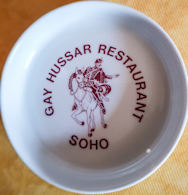
The ‘unearthing’ of an ashtray from the Gay Hussar is what prompted me to write about this no longer existing restaurant.

A powerful smell

Years ago, before the Berlin Wall was breached in 1989, I was visiting Budapest in Hungary with my friend the author, the late Michael Jacobs (he wrote Budapest, A Cultural Guide, published in 1998). We decided to eat dinner in a large restaurant called the Kárpátia, which was founded in 1877 and is one of the city’s longest surviving eateries.

cheese

The dining hall was very spacious. Its decor is Victorian Gothic revival. Diners are serenaded by a small band. As far as I can remember we ate well, as was often the case in Communist Hungary. One could enjoy the restaurants in Budapest if you were a western tourist, but for most Hungarians, who were low paid, eating in fancy restaurants was way beyond their means.  I remember eating a magnificent lunch at another restaurant and paying less than £5 for a gargantuan spread. When I told my Hungarian hosts that I had been to that place to eat, they could not believe that I was able to afford it. I was going to tell them what good value it was, but held my tongue.

At the end of the meal at the Kárpátia , I decided to try a cheese, which I had never heard of  and was on the menu. It was called Pálpusztai. I ordered a portion, and waited. The doors to the kitchen were at the far end of the large room in which we were dining. Our table was as far from the kitchen as was possible. Before the waiter re-entered the dining hall, a strong pungent odour could be sensed. The smell filled the entire dining hall. It was my cheese. Michael was horrified that first, I was prepared to try it, and then, second, that I liked it. Actually, I like most pungent cheeses. 

Pálpusztai is a cow’s milk cheese, which was first made by Pál Heller of the Derby és Vajtermelő Cheese Company in the 1890s. According to Wikipedia, the bacterium, Brevibacterium linens, that gives the cheese its odour is the same as that found on human skin, which contributes to body odour. Maybe, it was lucky I did not know that when I was looking at the menu at the Kárpátia!

Rice and meat

Hyderabad is justifiably renowned for tasty biryani although the very best version of this rice based dish that I have ever eaten was at Paragon in Calicut. There, they serve Moplah biryanis, which are both Arabic and Indian in taste.

The biryani we ate at the Café Bahar in Hyderabad was delicious. It was delicately flavoured and cooked with a light touch. To enter Bahar at lunchtime it is necessary to join a long queue that extends from the top of tje stairs at the doorway to the first floor dining room down on to the busy street outside. It is worth the wait.

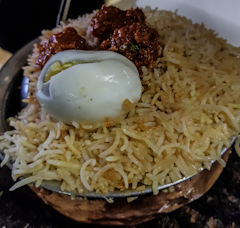
The restaurant itself is very noisy and as busy as London’s Oxford Circus at rush hour. We shared a table with a charming couple, who let us try their ‘double masala’ chicken biryani which is richly laden with extra spices. I preferred the less spicy ‘special lamb biryani’. It is made special by adding hard boiled egg and meatballs made with minced chicken.

One should not visit Hyderabad without eating at least one biryani, but avoid the much advertised Paradise restaurant chain, which is ok but nothing like as good as Bahar or Shadab (near the Charminar)

Sighting the high Himalayas

TODAY, WE WERE LUCKY. When we awoke at about 630 am, the sky was almost cloudless. There was no mist. We headed for breakfast at Bakers Café on MG Marg. We took a table by a window with a view of the hills that face Gangtok. To our great delight, we could see the snow covered slopes of Mount Kanchenjunga far beyond the nearer hills. Even though the great peak was partially obscured by clouds, we had managed to see it at last. Until 1853, this mountain was believed to be the highest on the planet. More accurate surveying showed it to be the third highest, K2 also known as Chhogori.

After breakfast, we strolled along MG Marg and then its continuation, New Market. At the far end of the latter, the hitherto fully built up thoroughfare began to be punctuated with greenery, trees and other plants.

After a short ascent, we reached the Ropeway station. It is the halfway point of s cable car service that runs from a much higher station to a far lower one. Currently, the service only runs from the midway station to the lowest one. We boarded one of the two red cable cars to make the descent. Unlike other cable cars I have been on, each cable car has its own cable instead of being on a continuous loop. When the car reaches a station, its driving cable reverses its direction of motion.

The views during the descent are dramatic. The usually tall buildings of Gangtok appear to have been built on step like terraces cut into the sides of the steep slopes of the terrain on which the city is situated. The cable car glides high above a winding road along which an unending stream of small local taxis flows. Looking left and right the tree covered hills surrounding the city offer exciting vistas. The return journey, the ascent, was less dramatic, but enjoyable nevertheless.

We dawdled back the way we had approached the cable car station, enjoying the warm sunshine. Many people were walking around including a significant number of police men and women carrying lathis and short sticks. Wearing berets and dark blue uniforms, they appeared to be milling around casually and without seeming menacing. Every now and then, we saw porters carrying what looked like heavy loads. They wear a thick padded strap over their foreheads. These straps are attached to cords that are tied around what is being carried on the porters’ backs. As they walk, the porters incline their heads slightly forward. This kind of portering looks like a tough way of earning a living.

The shops on MG Mar were open, but those lining the steps leading down to Lal Bazaar were shuttered up, closed. In Gangtok some businesses close on Thursday and others on Saturday. Today, it is Thursday. Fortunately, the excellent, albeit somewhat scruffy, Potala Restaurant in Lal Bazaar was open. I enjoyed a good number of delicately flavoured delicious beef filled steam momos.

After lunch we visited the Organic Market, which is housed in a curved gallery, one of the floors of the so-called Super Market, which is not a supermarket but a multi-storey covered market. Next, we strolled along some of the elevated pedestrian walkways that run above the National Highway, the main thoroughfare of Gangtok.

Before returning to our hotel, we stopped in a small café for beverages. It had a range of breads and pastries that equalled that you would expect to find in large European cities. This was not an isolated example. Gangtok abounds with well stocked bakeries.

The temperature had begun to drop when we reached our hotel, where we sttled down for a siesta.

PS We were fortunate to sight Kanchenjunga on the 28th November, the anniversary of the independence of Albania. Sadly, that country had just experienced a terrible earthquake.

Check the toilet!

One of my cousins in France gave me a useful tip.

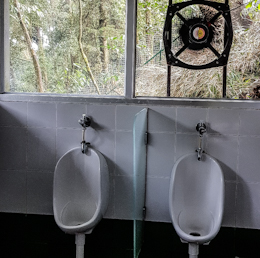
He said that clean toilet facilities are often associated with satisfying restaurants. What he meant was that if the restaurant’s management took care of small details such as the toilets, it was likely that they would take care over the more savoury aspects of the business such as the food and customer care.

Since I was given that tip, I have noticed that there is a remarkably high correlation between my degree of satisfaction with the restaurant and the state of their ‘loos’.

Just desserts

Art of gelato_240

Not long ago, we visited a restaurant. To save it from being emabarassed, I will not mention its name or location. On its dessert menu, it had the following item: “Mango”. This was described as coconut ice cream with mango sorbet, topped with a single raspberry, a lychee, and a fruit sauce. 

One of our party wanted to try the “Mango” as described on the menu. A friend and myself wanted, if possible, a scoop or two of mango sorbet without the other trimmings. We asked one waitress if it would be possible to have the sorbet on its own. She went away to consult, but never returned.

After a while we asked a waiter, who appeared not to be fluent in English, whether we could have the mango sorbet solo. We asked him several times. He kept on replying:

“Strawberry?”

He appeared not to be able to distinguish the word ‘strawberry’ from ‘sorbet’.

Not willing to give up, we called the manager to repeat our wish. He told us that he would speak to the chef. He returned quickly and assured us that our wish would be granted.

The desserts arrived. The person who ordered the “Mango” as described on the menu received a lump of mango sorbet fused to a lump of coconut ice cream. This was topped with a single raspberry and a piece of frozen kiwi fruit, but not a lychee in sight. This was covered with a sweet red fruit sauce.

Those who had sought mango sorbet on its own, my friend and I, received not plain mango sorbet, but a deconstructed version of what was on the menu. The mango sorbet was fused to the coconut ice cream, and the other ingredients, including the frozen kiwi piece, were neatly arranged around the inseparable icecream and sorbet. The sauce was placed in a small dish.

Two things occurred to me later. First, the restaurant only had the mango sorbet inseparably fused to the coconut ice cream. Secondly, the restaurant had no idea how much to charge us had we been served the ice cream/sorbet without the trimmings.

To compensate for the delay and confusion, the manager provided us with an extra portion of the “Mango” dessert ‘on the house’. That would have been kind had the unasked for extra portion not appeared on our bill!


Learning the lingo: Italian

aerial photography of city


Until I was 16 years old, I accompanied my parents on annual holidays in Florence (Italy). We always stayed at the Pensione Burchianti, which was run by two ageing sisters. Almost every evening, we ate dinner in a nearby restaurant (the Buca Mario). This excerpt from my book CHARLIE CHAPLIN WAVED TO ME describes how I began to acquire some limited skill in speaking Italia. Here is the excerpt:

” … After dinner we would walk back to the Burchianti. It might have been during one of these evening strolls that my father came up with a new version of the saying ‘a penny for your thoughts’, namely: ‘a penne for your sauce’. The traffic in the streets would have quietened down by the time that we had eaten, and all of the traffic signals, or ‘robots’ as my South African parents called them, had flashing amber lights instead of the usual sequence of three coloured lamps. The pedestrian signals, which alternated between the red ‘Alt’ and the green ‘Avanti’ during the day, simply flashed both messages at the same time at night.

When we arrived back at the Burchianti, the residents, who had been eating supper, were usually still lingering at their tables. Many of them almost lived in the Burchianti. There was an elderly commendatore, who took all his meals there but slept elsewhere. There were also a number of business people who spent the week working in Florence, but resided some distance away in the weekend. They lived in the pensione during the week. One of these was a lady pharmacist from Parma who spoke Italian with a curious accent, rolling her ‘r’s in an exaggerated way.

On entering the dining room, we would be greeted like old friends, which I suppose we were. We would be invited to sit at the sisters’ table, and then I had to perform. One of the sisters would ask me in Italian what I had eaten for dinner, and I had to reply in Italian. Everyone listened to my reply which usually went something like this:
Primo piatto o mangiato spaghetti con pomodoro. Dopo o mangiato bistecca con patate fritte. E dopo, profiterole.”

It was not difficult to relate what I had eaten because every dinner I ordered the same thing or substituted lombatina di vitello (veal chop) for the bistecca. This nightly recitation gave me the confidence to try to speak in Italian, even if badly. When I did not know a word, I tried using a Latin word but pronounced it in a way that I believed made it sound Italian. Often, this worked! ...”


If you want to know whether Charlie Chaplin really did wave to me, grab a copy of my book from:

https://www.bookdepository.com/Charlie-Chaplin-Waved-Me-Adam-YAMEY/9781291845051

OR

http://www.lulu.com/shop/adam-yamey/charlie-chaplin-waved-to-me/paperback/product-21611544.html

OR Amazon or Kindle store


Photo by Josh Hild on Pexels.com

Keep it clean

close up of menu


We entered a popular Thai restaurant, part of a chain, in London’s West Hampstead and waited for our friends to arrive. As they were taking a long time to reach us, we ordered some prawn crackers to quell our pangs of hunger. They arrived quickly with, much to my surprise, a couple of gooey dipping sauces.

The rather unfriendly waitress who delivered our snack, pushed our cheaply produced paper menus aside and said with an abrupt tone of voice:

“Don’t dirty the menus with the sauces.”

I was surprised. Never before in over sixty years of eating regularly in restaurants all over the world have I been asked, nay ordered, to keep the menu clean. I felt that this order to maintain the integrity of the menus to be unwelcome, unfriendly, and impolite.

After eating a revoltingly over sweet meal, I told the waitress about my disgust at her extraordinary instruction when she delivered the prawn crackers. She seemed unfazed by my complaint. I will never ever enter that restaurant again! 


Photo by Terje Sollie on Pexels.com

Would you trust them with your money?

Back in the early 1970s, I had dinner at a cheap and cheerful Chinese restaurant (Lido, which still exists in Gerrard Street) with about 7 friends. 5 of them were studying to be chartered accountants, I was completing my PhD thesis, and ‘J’ had only the most basic of educational qualifications.

The bill arrived. It was £24 for all that we had eaten. That seemed about right. The bill, consisting of three pages stapled together, was examined by all of us.

When J looked at it, she said it was twice what it should have been. This was because the waiter had added the sub totals at the bottom of each page to the individual prices which added together were equal to the sub totals.

We ended up sharing a corrected bill of £12.

What concerned me was that 5 people who were about to become chartered accountants missed the error in the bill which they had perused. Would you have trusted them with your money?

Incidentally, J went on to become a very successful business woman, probably more prosperous than anyone else sitting around that table in Lido.

Dining in Kerala

gecko

While eating our dinner one tropical evening in a lovely restaurant in Fort Cochin (Kerala, India), I looked up and noticed that high up on the wall overlooking us there was another diner, definitely not a vegetarian.

Clinging to the wall

An insect in its jaws:

A gecko stares at me