Eating off a banana leaf in the south of India

DURING OUR HONEYMOON in 1994, we travelled around places in southern India. At one point, we had to change trains at Coimbatore in Tamil Nadu state. With a few hours to spare, we ate dinner at a modest small restaurant near the station.

At Bheema’s restaurant in Bangalore

We sat down and banana leaves were placed on the table in front of us. These served as plates. There was no menu. A waiter hurried around the restaurant, stopping next to each diner and placing dollops of vegetarian culinary preparations on the leaves. He returned and placed a pile of steamed rice next to the mounds of vegetable items. He kept running from table to table, replenishing foods as required by the diners. This seemingly endless distribution of food set us back a total of 12 Rupees, which in 1994 was about £0.40 (yes, 40 pence). The coffee we drank at the end of the meal was the same price.

Yesterday, the 9th of November 2023, I was reminded of this experience whilst watching a waiter serving Andhra style vegetable preparations on a banana leaf in Bheema’s restaurant on Bangalore’s Church Street. Naturally, the meal cost a lot more than we paid in Coimbatore in 1994, but it was still very good value.

An old survivor in Hampstead

MUCH HAS CHANGED in Hampstead since I used to visit it every weekend during the early 1960s. The same is true for many places in London.

The Pimpernel on Heath Street, where my parents enjoyed espresso coffees, has long since closed. Likewise, my parents’ favourite Cellier du Midi in Church Row. Tragically, the High Hill Bookshop on the High Street disappeared many years ago, only to be replaced by yet another branch of Waterstones.

The venerable Everyman Cinema still functions, but now it is far more plush than it used to be when I was a lad. Of Hampstead’s many second-hand bookshops, only one, Keith Fawkes, remains. However, only recently I spotted Mr Fawkes sitting outside his shop, which has now been rebranded as ‘House Clearance Specialists’.

Another remnant of the Hampstead of my childhood is the Shahbhag Indian restaurant on Rosslyn Hill. Founded in 1954, my parents patronised it occasionally during the 1960s. I ate there once or twice in the late 1960s, but not since. By the 1970s, I had Indian friends, who introduced me to restaurants where the Indian food was far more authauthentic was offered at the Shahbhag. Unfortunately, many of these better eateries, many of which were on or near Warren, no longer exist.

During a recent stroll through Hampstead, I noticed that the Shahbhag was still in business. Seeing this sparked off the memories I have just described.

Farewell to an old friend in the heart of London

OVER THE PAST 45 YEARS (or more), we have eaten at least once a year at the India Club restaurant in London’s Strand. Occupying the first and second floors of the old-fashioned Hotel Strand Continental, the Club’s bar on the first floor is reached via a steep, narrow staircase. Opposite it, there is an office and reception area where our friend Mr Marker, or one of his daughters, greets us. Another narrow staircase ascends to the dining area on the second floor.

The Club was founded either just before India became independent in 1947, or in the very early 1950s. Close to the Indian High Commission, Bush House, and the London School of Economics, it was designed to be a home-away-from-home for Indians in London. The Club’s website (www.theindiaclub.co.uk/our-story) mentioned that the Club:

“… was originally set up by the India League, to further Indo-British friendship in the post-independence era, and it quickly became a base for groups serving the Asian community … The Indian Journalist Association, Indian Workers Association and Indian Socialist Group of Britain were just some of the groups which used 143 Strand for their events and activities. The building was also a base for the new wings of the India League which ran a free legal advice bureau and a research and study unit from this address.”

One of its founding members was Krishna Menon (1896-1974) who was independent India’s first High Commissioner to London. Soon after it was founded, the Club became popular with non-Indians as well as those for whom it was founded. Supplying Indian cuisine at very reasonable prices, the restaurant became a popular eatery. Until a few years ago, alcohol was only available to paid-up members of the Club. To become a member, and thereby have the use of the bar, an annual membership fee of only £1 was payable. Later, the Club’s restaurant must have obtained an alcohol licence because the requirement to become a member (for the purposes of purchasing booze) was dropped.

Both the restaurant and the bar have always looked like they must have done when the Club was first opened so many decades ago. Consequently, the place has an old-fashioned look about it. Should one of its founding members wander in today, they would have found little changed, except the prices. For us, and I suspect many other regulars, part of the charm of the Club was its unchanging appearance. It seemed to me that the management have deliberately not done anything to spoil the early postwar atmosphere of the place. The Club is adorned with paintings and photographs, mainly depicting notable Indians who lived during the period when India was becoming independent. To quote the website again:

“The interior of 143 Strand, particularly the characterful and distinct entrance, stairwells, reception area, first floor bar and second floor restaurant, remain in the same condition as they were during the occupation of the property by the India League. As a result,143 Strand’s interior allows it’s historical and cultural associations to be experienced first-hand by the public. It is the only building in the capital connected to the India League that has not been redeveloped or re-purposed. It therefore remains living history.”

As for the food served at the Club, over the years it has varied in quality according to who was working in the kitchen. Always satisfactory and good value, the Club’s food could never be described as exceptionally good. The menu included both vegetarian and non-veg dishes. I always enjoyed rounding off the meal with the excellent kulfi they served.

A few weeks ago in August 2023, a friend in Bombay (Mumbai) sent me an upsetting newspaper article. It quoted the Club’s owner Mr Marker as saying:

“It is with a very heavy heart that we announce the closure of the India Club, with our last day open to the public on September 17.”

Bearing this in mind, yesterday (Monday, the 4th of September 2023), a small group of us decided to have a last supper at the Club – to say farewell to this wonderful relic. When we arrived at the Club at 6pm, I could hardly believe my eyes. There was a queue of people waiting to dine at the Club. The line stretch from the pavement, up both flights of stairs, to the restaurant, which was chock full of diners. I had never seen the dining room with such a large crowd. The bar was also full of people waiting to get a table. When we learned that we would have to wait at least 45 minutes to be seated, we decided to go elsewhere (to Sagar Indian vegetarian restaurant in Panton Street).

It was various news items about its imminent closure that drew us and all the other people to the Club. Some of them, like Lopa and I, were regulars, but I wondered how many of the other folk queuing that Monday evening had ever eaten at the Club. Did its impending closure, like the film “Oppenheimer” and the play “Dr Semmelweis” – both about figures known mostly to scientists, draw the crowds to a fairly unfamiliar place that had suddenly become attractive because it was soon to be no more?

Places called London

MANY YEARS AGO, I used to visit Yugoslavia frequently. I stayed with friends in both Sarajevo and Belgrade. During almost every stay in Belgrade, several friends and I used to travel to the town of Novi Sad to eat good Chinese food in a restaurant called Szećuan. We used to order, and consume everything on its menu. This food was washed down with copious amounts of alcohol.

After one if these boozy lunches, we began walking to the railway station and as we passed a pub called Bar London, my friend Miša said to me:
“It would be surrealist if you take us for a drink in this bar”.
We had one or more ‘for the road’, and then staggered towards the station.

This memory was aroused by coming across the Restaurante Londres in central Funchal (Madeira). We ate dinner there. The food was excellent. For the first time in my life, I ate limpets. These aquatic snails were grilled in their shells with butter and garlic – they tasted wonderful. The other dishes we tried were so good that we have booked there again.

Returning to the past, if I recall correctly, there was also a restaurant or bar called London in central Belgrade, but oddly I never entered it.

The Brass Rail

I WAS FOURTEEN IN 1966. That year, Selfridges in London’s Oxford Street opened the Brass Rail restaurant on the ground floor, with windows facing Orchard Street. Its speciality was then, and still is, salt beef. I recall visiting the place once or twice with my mother back in the 1960s. In those days, I did not particularly care for the taste of salt beef. For some reason, maybe the cost of the place, we did not frequent the Brass Rail.

Winding the clock forwards several decades, I now enjoy eating salt beef occasionally. Today, the 22nd of March 2023, we needed to go to Selfridges for something, and as we were there, I suggested that we ate at the Brass Rail. Unsurprisingly, the eatery has changed its appearance considerably since the 1960s, but it is still located in the same part of Selfridges as it was originally. Its tables are enclosed in an area lined banquettes upholstered with red fitted cushions. The service was brisk and attentive. We ordered Reuben sandwiches in rye bread. These are generously filled with warm salt beef, sauerkraut, Swiss cheese, gherkin, and Russian dressing.

The Reuben was enjoyable, filling, and quite tasty. However, I felt that the taste of the salt beef was overpowered by that of the dressing and the other ingredients. Good though it is at the Brass Rail, I prefer eating the bagels crammed full of salt beef, which are served at the 24 hour Beigel Bake in Brick Lane. At half the price of the Brass Rail, but without the great service, they are more than twice as enjoyable.

A long way from Paris

BANGALORE IS ABOUT 4800 miles from Paris (France). The French capital is noted for its gourmet delights, but on the whole the same cannot be said for Bangalore. One exception to this statement is Sunny’s restaurant currently located on Lavelle Road.

Arjun Sajnani created Sunny’s at least 25 years ago. Then, it was in a tall narrow house on a lane leading off Lavelle Road. The kitchen was on the ground floor and there were dining areas in the two floors above it. Often, Arjuna could be standing, working in the kitchen. Back in those early days, Sunny’s was one of Bangalore’s few suppliers of imported Western European cheeses, such as genuine parmesan.

Later, Sunny’s shifted to larger premises on the corner of Lavelle and Vittal Mallya Roads, next to a petrol filling station. The dining area was elegant.

For a brief period, Arjun ran a restaurant serving delicious Sindhi dishes in his original premises. Sadly, he decided to discontinue this interesting eatery.

Even later, Arjun shifted his restaurant to its present location – a two storey villa constructed about 20 years ago. The balconies on the upper floor are supported by stout carved timber pillars which remind one of pillars that you can see in much older traditional South Indian edifices. Diners can sit at tables within the building, or in the garden surrounding it, or on the first floor balconies. At lunchtime on Christmas Day 2022, every table was occupied.

At each of Sunny’s different locations, the food has been magnificent. As our daughter correctly said, eating at Sunny’s is as good as eating in a good Parisian restaurant. Also, Sunny’s Italian food (mainly pasta and pizzas) is above average in quality.

Arjun is an actor and director of theater and films, in addition to being a restaurateur. Dramatic productions require many skills. The same is the case for running a restaurant. Some of the required skills are the same for restaurants and for stage/screen. A restaurateur has to perform well both in the kitchen and the dining room to satisfy his or her clientele. Arjun achieves this successfully. If you have never been to Sunny’s, give it a try!

Everything is available …

EVERY FEW MINUTES, a ferry traverses Goa’s Mandovi River between Panjim and the village of Betim. This free river crossing is for the use of pedestrians and those riding two-wheelers. The ferryboat is loaded via an elevatable ramp.

As soon as the ramp touches the concrete landing stage, a wave of pedestrians and motorbikes surge from the boat onto the shore. As they do so, the waiting pedestrians and vehicles swarm on to the ferry.

On arrival at Betim, we walked away from the landing place along a busy country road lined with shops, shacks, and much tropical vegetation. It was not long before we reached the small restaurant set back from the road, which had been recommended to us.

Although it was nearly noon, the eatery seemed rather lifeless. Eventually, we saw a man emerging from it. He showed us a menu. We asked him if all the dishes were available. He replied:
“Everything is available.”
After a pause, he added:
“Today kitchen is closed.”

Retreating from the pandemic misery

FOR SEVERAL MONTHS following March 2020, movement was restricted to within a short distance of home because of rules that were supposed to limit the spread of covid19 infections. Almost everything except food stores was closed. Socialising was frowned upon. And travel for leisure was not possible. Around about June 2020, things eased up just a little bit, and travelling became possible once more, albeit subject to various rules and precautionary measures. It was then we decided to buy a car to travel around without risking infection by using public transport.

After collecting our (pre-loved) car from a garage on the Edgware Road, we decided to drive up to see my wife’s cousin in Baldock (Hertfordshire). We asked him to recommend a nice country pub where we might be able to get something for lunch. He suggested that we tried Ashwell, which is about 4 miles northwest of Baldock. This pretty village has three pubs. Two of these were closed, and the remaining one did not serve food. We asked the rather melancholic barman to suggest somewhere else in the area. He pointed at the pub’s only customer, a gentleman seated at a table, and said:
“You could try his place at Abington Piggotts – it’s only just up the road.”
The man, Mick, told us that his pub was open and serving food. So, we drove a few miles to tiny Abington Piggotts, which is 3 ½ miles northeast of Royston. With about 80 households, the village has one pub, a free house called The Pig and Abbot. Housed in a century’s old building, this hostelry is a lovely example of an unspoilt country pub. We were given a warm welcome. We enjoyed a small snack and a drink and decided to return at a later date for a proper meal.

We returned and enjoyed excellently cooked food prepared by Mick’s wife Pat. It was so good that we began returning at regular intervals to enjoy Pat’s cooking. The Pig and Abbot, like all other pubs and restaurants, was subject to compulsory closures during the various ‘lockdowns’ that were imposed by the government, yet it has remained in business despite these interruptions. I am not sure how many times we have visited the Pig and Abbot, but each time has been as least as enjoyable as the others. It was not long before we began regarding Mick and Pat as good friends. Whenever we visit the pub, Pat gives us all a great hug when she sees us. Especially during the periods when lockdown restrictions were only partly eased, a visit to the Pig and Abbot provided a welcome respite from the gloomy atmosphere during the height of the pandemic. Whenever we drive along the country lanes leading to Abington Piggott, I have a warm feeling of gratitude because it was this countryside that lightened our lives during two years of covid-related misery.

Recently, we booked for Sunday lunch at the pub. Several days before we were due to eat at the pub, Pat rang. At first, we thought she was going to cancel us for some reason, but it was worse than that. She rang to tell us that Mick had died suddenly and completely unexpectedly. We felt devastated by this news. When we asked her whether she wanted us to cancel, she said ‘definitely not’. She had decided she must continue, and she wanted to see us. When we arrived for our lunch, the pub was full, Pat greeted us warmly, and her food was as excellent as usual. We will greatly miss Mick, and we wish Pat all the very best for the future.

A Turkish delight in London’s Dalston

KINGSLAND ROAD AND nearby in London’s Dalston area is rich in restaurants and other eateries serving Turkish food. Early in this century, “Time Out” magazine rated the Mangal Ocakbasi (now called ‘Mangal 1’) restaurant at number 10 Arcola Street as being one of London’s best Turkish restaurants. For those who do not know, ‘ocakbasi’ means ‘fireside’ and ‘mangal’ means ‘barbecue’ or ‘grill’. When we first went to Mangal, and for many years after that, there were tables alongside the long rectangular pit filled hot charcoal, upon which meat and vegetables are grilled. Recently, the restaurant has been redesigned and the grilling area is no longer alongside the tables.

Lokma

The meat served is top quality. It seems far better than that served in the many other Turkish restaurants we have tried in London. Although there is a wide variety of main courses on offer, the range of ‘starter’ dishes on the menu is not as great as at some other restaurants. If it is starters and meze that you are after, the nearby Umut 2000 (on Crossway) is worth visiting. However, their main meat dishes are not nearly as tasty as those at Mangal in Arcola Street. Having said that, Mangal does serve an excellent freshly grilled aubergine hors d’oeuvre. Desserts are not available, but there are plenty of places along Kingsland Road offering a wide range of very sweet but tasty confectionery.

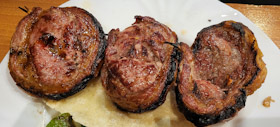
Our favourite dishes at Mangal are lokma, which is grilled rolled fillet of lamb, and yorgutlu Adana, which is pieces of semi-spicy Adana kebab in a yogurt and tomato sauce with lumps of Turkish bread. The lokma and other kebab dishes are served with generous quantities of fresh mixed salad containing many ingredients. As for drinks, you can bring your own alcohol or buy it from the restaurant. If I order a drink apart from water, I always go for Şalgam, which is a purple-coloured drink containing fermented turnip. This has a deliciously sour taste.

We first ate at Mangal in the early 2000s, when we attended a play in which one of my dental patients was acting. The theatre, The Arcola, was across the road from the restaurant, but has now shifted to larger premises on nearby Ashwin Street (close to Dalston Junction station). We loved the food at Mangal from the very first bite. We have been eating there occasionally ever since then, and the quality of the food has never once faltered. We have been there so often that the older members of its staff recognise us, welcome us warmly, and remember what we like eating. Even though this Turkish delight, frequently patronised by the artists Gilbert and George, is far from where we live in Kensington, it is well worth ‘trekking’ across London to get there.

Eating there again at least 50 years later in Venice

EARLY IN SEPTEMBER (2022), I was eating spaghetti alle vongole (spaghetti with clams) in a restaurant in Venice (Italy). The place where I was eating this delicious dish has many memories for me.

Lantern hanging outside the entrance to the Antica Locanda Montin

During the late 1950s and throughout the 1960s, my parents took my sister and me for annual holidays in Venice. My parents were discerning eaters. Unfortunately, back in those now far-off times, there were very few restaurants in Venice which served food that met my parents’ approval.  Eventually, they homed in on one place that they liked enough to return there for every evening meal (our accommodation provided lunch as part of our demi-pension deal). That restaurant is called the Antica Locanda Montin (‘the Montin’). According to its website, it has hosted celebrities including Modigliani, Ezra Pound, Robert de Niro, Luigi Nono, and David Bowie. Well, I did not know that when I used to dine there with my family.

During our recent trip to Venice, we found out that the Montin is still in business, and we booked a table for lunch. To my delight and amazement, the restaurant looks exactly as it did when I last visited it over 50 years ago. It does not seem to have changed one little bit. The front of the Montin faces a small canal. The dining room is long and rectangular. At the far end opposite the front door, a rear door gives access to a pleasant garden, where people can eat in good weather. The walls of the dining room are covered with framed paintings, many of them of great artistic quality. Apparently, they have been donated over the years by artists, who have dined in the restaurant.

I cannot remember what I used to eat at the Montin over 50 years ago. However, my spaghetti alle vongole was tasty and enjoyable. My wife and our daughter were also happy with what they ate. Our lunch was one of the better meals we ate during our four days in Venice. What I enjoyed even more than the food was discovering that the Montin looks as it did when I was much younger. I am glad that the place has survived the trying times we have been through recently and Italy’s various economic crises.