Today, an artist would not portray an African this way

THE PAINTER REX WHISTLER (1905-1944) was commissioned by the Tate Gallery (now the Tate Britain) to create a mural for what was its refreshment room in 1926. Assisted by Katharine Ann West (1904–1930), it was completed by 1927. Completely surrounding the room, it illustrates a narrative, which has been summarised on the Tate’s website as follows:

Whistler’s mural depicts an expedition in search of rare food and drink, led by the fictional Duke of Epicurania. A hunting party sets off from the steps of the gallery. It travels across rivers and seas, through pastoral landscapes and wild forests. The group shoots at leopards and deer and meets unicorns and mermaids. They pass islands topped with Italian cities, encounter shipwrecks and ruins, and visit the Great Wall of China. They return home laden with spoils, greeted by a cheering crowd.

Usually, the former refreshment room and its mural are not open to the public. Recently, it has been opened and within it a large screen has been set-up. A short film is projected on the screen. The film has two actors, one playing the part of Rex Whistler, and the other of a fictional academic, Professor Shepherd, who discusses the mural with him. Unfortunately, because the film is being screened, the former dining room has subdued lighting, which makes it difficult to fully appreciate Whistler’s superbly painted mural.

Most of the mural is gloriously picturesque, and cannot give rise to any objections. However, if you look closely, there are two insensitive depictions of Black people that might easily cause offence to viewers today. Whether they would have upset the Tate’s visitors in the late 1920s, I do not know. The bulk of the dialogue in the film being screened in the room relates to the presence of these two frankly racist images on the mural. During the film, the fictional prof gives the artist a hard time about the way he represented the two Black people. I got the impression that the person who wrote the script wished to convey that Whistler could not see why the prof was upset by the way he had painted these figures.

The mural was painted eight years after WW1, during which Black and Asian soldiers fought and sacrificed their lives for the British who had colonised the countries from which they came. Whistler must have known about them. Only seven years before the mural was created, countless numbers of Indians were slaughtered at Jallianwala Bagh in the Punjab. Their massacre was ordered by Reginald Edward Harry Dyer. After he was reprimanded for this, and had returned to England, the public, regarding him as a hero rather than a murderer, raised over £26000 (approximately £1,485,000 today) for him. And that was after 1920. It might be a big leap, but it struck me that if the British public felt justified raising so much for such a man in the 1920s, maybe many of them would have seen nothing to complain about when seeing how Whistler portrayed people of colour in 1927.

LIBERTÉ ÉGALITÉ (MAYBE) FRATERNITÉ IN A FORMER FRENCH COLONY

PONDICHERRY IN SOUTHERN India was a French colony between about 1674 and 1954. This picturesque city is still divided into White Town, where the French lived, and Black Town, where the Tamils and other Indians resided.  The segregation of Europeans and non-Europeans persisted after the French Revolution  of 1789. It was during (or soon after) this historic uprising that  the motto ‘Liberté, Egalité, Fraternité’ came into existence. However, it was during a visit to the lovely church of Notre Dame des Anges in White Town that we discovered that the motto might not have applied to the Non-European inhabitants of the Pondicherry colony.


Within the neoclassical church, there is an informative panel outlining the church’s history.  The present edifice was constructed in 1855, but the parish is older. It was established by Capuchin monks in the seventeenth century. In 1699, the Capuchins established a Tamil Christian community. Soon, the Jesuits took over the Tamil community, and the Capuchins began a parish for Europeans and “Eurasians” (people with both Indian and European heritage). The Capuchin church of Notre Dame des Anges served Europeans and Eurasians, but not Tamils, who attended another church.


In 1887, almost 100 years after the French Revolution,  Archbishop Lauennen decreed that Notre Dame des Anges was for the exclusive use of Europeans and Eurasians. So much for the ‘égalité’ and ‘fraternité’, which was so dear the the French.


In 1984 Fr. Dusseigne, of the Société des Missions Étrangères de Paris (M.E.P) was the last M.E.P. Parish Priest, to serve the parish. He served until 2007, and was the last of a long line of Capuchin priests to lead the parish.


Dusseigne was succeeded by Fr. Michael John Antonsamy, who was the first Indian priest to lead the parish. Although he was the first Indian parish priest, I  have not yet discovered when non-Europeans began to be allowed to worship in this church in White Town.


Near the church, there is small walled cemetery where Capuchin monks have been buried. The earliest person to have his tomb there died in 1703. Sadly, the graveyard was closed, but we managed to see the well maintained funerary monuments through gaps in the locked gate.

  Colour bars were common in European colonies in Asia and elsewhere. Some of the clubs and schools founded by the British in India forbade entry of Indians even until several years after independence. So, one should not be surprised that colour bars existed in churches such as St Marie des Anges.  But what amazed me somewhat is that even after the French Revolution,  racial inequalities were not frowned upon in a French colony such as Pondicherry.

An unexpected story told in a cafe in London’s North Kensington

LAST YEAR I READ a fascinating book, “Staying Power”, written by Peter Fryer and first published in 1984. It is a history of black people in Britain from the time of the Roman conquest until 1984. In it, the author gives plenty of examples of the hostile reception that black people arriving in Britain received from their racist British neighbours and workmates.

Today (the 28th of March 2024), I was sitting in the Lisboa Patisserie, a cafe in North Kensington’s Golborne Road, when I began chatting about the ‘good old days’ with a gentleman, who is a few years older than me. He told me that he had come to Britain from the West Indies in the early 1950s when he was 8 years old. Having read Fryer’s book and having heard stories of racist behaviour, I asked him whether it had been difficult for him and his family after they arrived in England. I was astonished and very pleasantly surprised by his reply.

He told me not to believe that everything was as bad as is often recorded. From the moment his family arrived, the English people they encountered were all very kind and friendly. As an example, he described what happened when his family were evicted from their flat by their (black) landlord. They were literally out on the street with nowhere to go. Two English (i.e., white) ladies, who were chatting to each other over a garden fence, saw them, and asked what had happened. Hearing their plight, one of them said that she had a spare room in her attic, where they could live until they found somewhere of their own.

The gentleman in the café told me that once they had settled into new accommodation, they were at a loss as to how to deal with things that they had not had previously encountered in the West Indies. For example, back in the Caribbean, their home did not have electricity or gas or many other domestic things that were usual in British homes in the 1950s. It was their white milkman, who came to their rescue. If there was something they could not deal with – for example replacing a fuse – their milkman would come into the house and help them out.

Our friendly neighbour in the café said that he could give me many more examples of kindness and friendliness of white British people, which his family had encountered. However, as he could see that we had finished our coffees, he concluded by saying that contrary to, as he put it: “what millennials only want to hear”, it was not all bad as far as white British behaviour towards immigrants from the Caribbean were concerned. He did not know that I do a lot of writing, but he said that I should write down what he told us as it needed to be known – and that is what I have done.

I must add that his story is somewhat unusual because even today, we still hear of too many cases of intolerance and even harm to Afro-Caribbean people.

PS: although this has been published on the 1st of April, it is NOT an April Fool’s joke!

CREATIONS IN GLASS FROM INDUSTRY AND ARTISTS AND A PUNJABI PUB

TWO TEMPLE PLACE was built for the American businessman William Waldorf Astor (1848-1919) in 1895. Located close to Temple Underground Station and Middle Temple, this distinctive edifice is said to be designed in the ‘neo-Gothic’ style, although I would prefer to describe it, and especially its interior, as ‘Tudor Revival’. Every year, between late January and late April, the building, which is now owned and maintained by the Bulldog Trust charity, houses an exhibition, which is always worth viewing. This year’s exhibition, which continues until the 21st of April 2024, is called “The Glass Heart”.

The exhibition is described on the Two Temple Place website (https://twotempleplace.org/) as follows:

“It will explore the narratives central to glass art and manufacturing, and celebrate the timeless skills, artistry and innovation required to work with this challenging material.”

And it does that very successfully by exhibiting a superb collection of glass creations ranging from industrial products, such as Pyrex, through stained glass, to intriguing artistic creations that defy the imagination. I will not attempt to describe all of these exhibits – each one of them both fascinating and beautiful – but I will concentrate on one small collection of items relating to the Red Lion – a pub in West Bromwich (West Midlands).

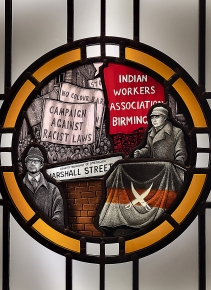
The Red Lion is a ‘desi’ pub owned by Indians, whose families originated in the Punjab, and came to work in the factories of Britain’s Black Country. Although all are welcome, the pub is mainly a socialising place for local people whose families came from the Subcontinent. It is one of several desi pubs in the former industrial heartland. In 2016, Steven Cartwright, who runs a studio that produces creative and decorative glassworks, was commissioned to create some stained-glass windows to decorate the Red Bull. His mission was to create traditional pub style stained-glass, but with an interesting slant – it was to celebrate the rich culture of the desi pub in the West Midlands. To do this, as Steven explained on his website (www.cartwrightglassdesigns.co.uk/projects/red-lion):

“I designed the window to give the appearance of a traditional pub but with a twist. The window utilises some of the colours and elements of the sub continent and tells the story of the punjabi community who migrated to the area in the 50’s. It also celebrates the establishment of the Indian workers association by Avtar Singh Jouhl and the visit of Malcolm X at their invitation.”

At the exhibition in Two Temple Place, there is a small piece of this pub’s stained-glass and some photographs of the rest of it.

What particularly intrigued me was the mention of The Indian Workers Association (‘IWA’) of Birmingham. The IWA was founded in the 1930s by Indian workers from Coventry to combat racist objections to them both by the British trade unions and the British people in general. The quote mentioned Avtar Singh Jouhl. He was born in the Punjab (British India) in 1937, and after the 1947 Partition, he came to London to study at the London School of Economics, arriving in 1958. Three years later, he moved to Smethwick in the Midlands, where he became an industrial worker. There, he saw and experienced racist anti-Indian conditions that prevailed at the time, He joined the IWA, and soon, along with others, he founded its Birmingham branch.

In February 1965, Jouhi invited the civil rights campaigner Malcolm X to visit Smethwick. A few days before his assassination, Malcolm X said of Smethwick:

“This is worse than America. This is worse than Harlem.”

In Jouhi’s obituary (The Guardian, 4th of November 2022), the following was written:

“The anti-racism campaign that attracted Malcolm X to Smethwick was spearheaded by Avtar Singh Jouhl, who has died aged 84 … Jouhl, as general secretary (1961-64; 1979-2015) and national organiser (1964-79) of the Indian Workers’ Association (IWA), challenged trade union members, factory owners and publicans to end this racism … When it came to breaking the colour bar in the town’s pubs, the IWA’s tactics were similar to those used by the Freedom Riders in the US in the previous decade. White university students were enlisted to order drinks, then hand them to British Indians, such as Jouhl. The landlord would invariably eject them, while the students challenged the eviction. The IWA then used evidence of these actions to successfully oppose the publican’s licence when it came up for renewal … This targeted campaign led to discrimination in pubs being outlawed in the Race Relations Act (1965) and paved the way for Britons of Indian heritage to become publicans themselves and set up what are commonly now known as “desi pubs”.

It was his actions described above and many others that helped to suppress racism in the Midlands and elsewhere in Britain. And it is very pleasing to see that what he achieved is being celebrated in glass in a pub owned and frequented by the people whom he helped. I visited the exhibition at Two Temple Place because I enjoy viewing glass artefacts. Little did I know that I would leave the exhibition having been introduced to an important political movement, about which I had known nothing.

Exclusion of Indians even after India became independent

WE HAVE STAYED in the guest accommodation at Calcutta’s Tollygunge Club several times. On our most recent visit, I spent a few minutes looking at the boards on which the names of the Club’s past Presidents are listed.

Between the year in which the Club was founded – 1895 – and 1968 – twenty-one years after Indian Independence- all of the Presidents had British surnames.
In 1969, the post was held by Brigadier RB Chopra. His surname is Indian. He was succeeded in 1970 by HA Whittle – someone with a British surname. Mr SP Achary, who was the next President (in 1971) had an Indian surname.

Mr Achary was followed by CJN Will CBE in 1973. Thereafter, most, but not all, of the Presidents had Indian sounding surnames. An exception was the President in 1979, who was AWG Macintyre, CBE. He was a senior executive in the Dunlop tyre company.

Seeing all of these Presidents with British surnames holding their positions so long after India became independent got me wondering. Already I knew that even after independence, some private clubs and other institutions in India restricted admission to Europeans and refused entry to all but a very few Indians. I became curious to know when the Tollygunge Club began welcoming Indians as members. The answer is that the colour bar was lifted in 1961. Indians were then admitted as “Associate Members”. They had no voting rights. The first non-white Associate Member was the then Japanese consul. In 1967, the first batch of 30 Associate Members (I.e., Indians) were made Permanent Members. The first Indian President, Brig. Chopra was amongst this batch.

Various factors must have swayed the Club towards admitting Indians. One of these might have been the slowly declining British presence in Calcutta. Another was more serious. Cutting a long story short, in the late 1950s, the West Bengal government, acting to some extent on guidelines from Central government, began to question the future of the elite clubs of India.

The government of West Bengal drew up a plan to construct a housing estate on the extensive grounds of the Tollygunge Club golf course. The clubhouse would have then been converted to some kind of communal amenity. These plans caused great concern to Calcutta’s British community. This plan was aborted. I have heard one explanation of why this happened, but it would be best if I do not reveal it.

Declining Club revenues and increased taxation must have also led to the Club enlarging its membership by accepting Indians as full members. During the very early 1970s, my father-in-law, a senior executive in a large company, was offered membership by the Tollygunge Club. He turned down the offer because he was reluctant to join a club that had refused membership to Indians for so many years after India became independent.

It is fortunate that the Tollygunge Club with its lovely grounds has survived because, although still quite exclusive, it is a wonderful place to relax and make new friends.

A club founded for Indians in Bangalore

THE CENTURY CLUB in Bangalore is so-named because when it was founded in 1917 it was decided to limit its membership to one hundred. Today, the Club has about 6000 members. According to the Club’s website it was founded by the highly esteemed Sir M. Visvesvaraya (‘SMV’) who: “… was keen to promote what he felt was good in English society, particularly their orderly habits, punctuality, restraint in speech and social behaviour.”

The Club was founded during an era when Indians were not allowed to join or even enter the clubs (such as the Bangalore Club and the Madras Club), which were designed to be social clubs for the exclusive use of elite Britishers.

Shri Nalwadi Krishnaraja Wodeyar

SMV was inspired to establish a social club that admitted Indians after an unpleasant incident at the Bangalore Club. It occurred when SMV was the Diwan (Prime Minister) of the Kingdom of Mysore. When one day he was invited to the Bangalore Club he was wearing the royal turban of Mysore. The staff asked him to remove it and wear an ordinary cap instead. This insulting request upset him greatly, and led to him founding a club for ‘gentlemen’, which would accept Indians. Thus, the Century Club was born.

Shri Nalwadi Krishnaraja Wodeyar, the king of Mysore, allotted 7 acres of Cubbon Park for the use of the Century Club. Today, the Club is an oasis of peace and greenery in a city that is becoming increasingly less peaceful and disturbingly less green.

The Century Club began admitting Indians in 1917. Not far away, the Bangalore Club only began admitting Indians when India became independent (in 1947), or after that. And even worse, a few other Clubs (and other institutions) continued to admit only British (and other fair skinned Europeans) until the 1960s or later. This was quite remarkable in a country that had struggled for many years to free itself from foreign rule.

White and nutritious – milk and racism

UNTIL I WAS ABOUT 18, I drank a pint of chilled milk in the morning and another when I came home from school. I did not drink all the varieties of milk that were supplied by the milkmen who worked for the Express Dairy Company, but chose the ‘homogenised’ variety, which did not have cream at the top of the bottle. Never once whilst drinking this refreshing slightly watery liquid did I ever imagine that I would one day visit an exhibition about milk. Today, the 29th of July 2023, I viewed an exhibition called “Milk”, which is being shown at the Wellcome Collection in London’s Euston Road until the 10th of September 2023. Amongst the numerous exhibits displayed in this beautifully curated show, the following particularly interest me.

  1. There was a collection of decorated porcelain cream jugs.  Each one was shaped like a cow. Cream used to be poured into the hollow cow via a hole in its back. Then, a lid was placed to cover that orifice. To use the cream jugs, the cows were tilted so that the cream could flow out of another hole through creatures’ mouths.
  2. There was a terracotta model of a mule carrying two trays laden with cheeses. This Ancient Roman artefact dating back to the 3rd or 2nd century BC was found by archaeologists in Southern Italy. In times long before refrigeration, making cheese was one way of preserving milk for future use.
  3. I saw a metal lactometer, which was used to determine the amount of water in milk. My wife said that when she was a child in India, milk used to be delivered to the door. To check whether the milkman had watered it down, her mother used a lactometer just like the one on display at the exhibition.
  4. Our daughter spotted an 18th century etching depicting St Bernard of Clairvaux kneeling before the Virgin holding the Christ Child. As the saint knelt before the Virgin, he received a squirt of her milk from her breast. This was supposed to grant him wisdom and eloquence. When she was studying History of Art, our daughter wrote a thesis about this curious episode – The Lactation of St Bernard’.
  5. A rather uninteresting looking exhibit proved to be most fascinating. It consisted of two milk testing forms, which had to be completed after a farmer’s batch of milk had been tested for diseases, bacteria, fat content, and protein content. The forms on display related to milk produced by cattle on the Dartington Hall Estate in Devon. The Estate was founded to research the merits of various scientific farming methods. One of the founders of the Estate was the agronomist Leonard Elmhirst (1893-1974). What made him special in my mind was that after meeting the great Rabindrath Tagore (1861-1941) in the USA in 1913, he later (in 1922) set up for Tagore an Institute of Rural Reconstruction near Tagore’s university at Shantiniketan (now in West Bengal). After marrying Dorothy Straight, Elmhirst and his wife established the Estate at Dartington in 1925. It was modelled on what he had founded near Shantiniketan.

There were plenty of other exhibits that were both visually interesting and thought provoking. A theme that I felt pervaded the exhibition is related to the colour of milk – white. Because milk is often perceived as being healthy, pure, and virtuous, it may also nourish the malevolent ideas of white racists. One of the exhibits showed a video of Trump supporters cavorting around, each one of them waving large bottles of white milk whilst shouting racist and anti-Semitic slogans. Yet, the ancestors of racists like these were perfectly happy to snatch the newborn babies of black slaves away from their mothers, so that these unfortunate women could be forced to breast-feed the babies of the white women of the families who owned them. Their milk was white, but not their skin colour. To compensate for these and other harsh reminders that all is still not well in the racial tolerance scene, the exhibition includes a satirical film from You Tube ( https://youtu.be/cevXg_SlT-Q ), which makes fun of people with racist tendencies.  

Well, it never occurred to me that milk and racism might be considered in the same brackets until I visited the splendid show at the Wellcome Collection. It is well worth seeing not only because of its historical and scientific aspects, but also for its artistic and sociological content.

From Bombay to Belsize Park

SEVERAL OF OUR FRIENDS born in India came to study accountancy in the UK during the late 1960s and early ‘70s. In those days, studying accountancy had two benefits apart from giving our friends the opportunity to have careers in commerce and finance. First, coming to the UK was an opportunity to live abroad, and, more importantly, because they had to study whilst employed by an accountancy firm, they got income to cover their living expenses. All of them have had successful careers in business and/or banking. Some years earlier (in 1950), Lancelot Ribeiro (1933-2010), born in Bombay, came to the UK to study accountancy. However, he did not complete the course. Instead, he began studying art at London’s St Martins School of Art between 1951 and 1953. At that time, he lived in London’s Chalk Farm with his half-brother, the artist Francis Newton Souza (1924-2002), who was born in Goa. In August 1954, Lancelot was conscripted into the RAF. He was released from this in January 1955. Then, he returned to Bombay.

In Bombay, Lancelot was employed by the Life Insurance Corporation. He remained in this company for four years, by which time his poetry and painting were becoming recognised by Bombay’s artistic community, notably by the poet Nissim Ezekiel, the critic and poet Rajagopal Parthasarathy, the critic Rudolf von Leyden (German born, but lived most of his life in Bombay), and the Tata industrial group (who commissioned some of his works). By 1959, he had decided to make painting his profession. By the early 1960s, he was exhibiting in both group shows and solo exhibitions and was gaining wider, and influential recognition. Lancelot and his wife returned to London at the end of 1962/early 1963.

After living in various parts of London, the Ribeiro’s settled in the Belsize Park area of Hampstead – at Belsize Park Gardens – for a few years. By now, Lancelot’s works, and those of other Indian artists living in England, were being exhibited both in the UK and India. Life in London was not easy even in the late 1970s for people with ‘brown’ skins as Lancelot found out the hard way. Several times, he was attacked in the streets near Swiss Cottage, and once badly injured when attacked outside Hampstead Police Station. In addition, some of his pictures were vandalised when on display at the Swiss Cottage Library in 1986-87. However, none of this subdued his irrepressible creativeness.

Some of his prolific and highly inventive artworks were exhibited in Hampstead’s Burgh House when it held an “Indian Month” in 1980. Although he did not enjoy as much fame as his better-known half-brother, Ribeiro’s work is well worth seeing. An opportunity to do so is currently available at Burgh House until the 17th of December 2023. The well-displayed exhibition, “Lancelot Ribeiro: Finding Joy in a Landscape” can be seen free of charge. The Burgh House website describes it as follows:

“A journey through the changing landscapes of Hampstead-based expressionist poet and painter Lancelot Ribeiro, from his roots in pre-Independence 1930s India to life in mid-20th century Britain.

Ribeiro experimented with form and materials, moving from conventional depictions of the Lake District to otherworldly townscapes and sharp, bright abstracts inspired by geology. Each work encourages us to look anew, reconsider the form and substance of our environment, and how we might depict and share those landscapes with others.”

I can strongly recommend that you pay a visit to this show to see the works of an artist, who should be more widely known.

Finally, I wonder what would have become of our few dear friends had they abandoned accountancy prematurely. One of them, in his retirement from many years in banking, has become written a highly acclaimed novel. Another, who retired from a career in an international corporation, is now highly developing his skills as a cook. A third, who dropped out of accountancy, has become a successful translator.

Baker in the Bank

UNBELIEVABLY, THE ARCHITECT Herbert Baker (1862-1946) demolished a major work of one of England’s greatest architects – Sir John Soane (1753-1837). Imagine the outcry if Sir Richard Rodgers decided to demolish Christopher Wren’s St Pauls Cathedral to replace it with one of his own design. Well, in the 1920s, Baker demolished most of Soane’s Bank of England to replace it with a larger building – the present Bank – which he designed.

There is a small museum in the Bank of England. Some of its rooms have been designed to recreate the kind of interiors that would have existed in Soane’s Bank building. In one of the rooms of the museum, a circular space beneath a glazed dome, there is a framed portrait of Sir Herbert Baker. Baker, who helped design New Delhi, is well known for his architectural work in South Africa. After being commissioned by the imperialist Cecil Rhodes (1853-1902) to redesign Groote Schuur, his house on the slopes of Cape Town’s Table Mountain, he was asked to design many other structures in South Africa.

The portrait depicts Baker standing at a drawing table by a window through which a building in his typical neo-classical style can be seen. At the bottom left corner of the painting, there is a depiction of a framed painting of Cape Town’s Rhodes Memorial, which Baker designed in 1906. If you look carefully at this picture within a picture, an equestrian statue can be discerned. This statue, called “Physical Energy”, was sculpted by George Frederick Watts (1817-1904), who was briefly married to the actress Ellen Terry. The statue was cast in 1902, and placed at the Rhodes Memorial in Cape Town. In 1907, another bronze cast was made, and this stands on a stone plinth in Kensington Gardens almost midway on a line connecting the statue of young Queen Victoria in front of Kensington Palace with the Henry Moore sculpture on the east bank of The Long Water (part of the Serpentine).

When we saw the portrait of Baker, we were viewing an interesting exhibition that explores the Bank of England’s many and varied links with the slave trade. The caption relating to the portrait of Baker concentrated on the small image of the memorial to Rhodes. It correctly pointed out that Rhodes had been a Prime Minister of the Cape Colony, which became part of unified South Africa in 1910. It also mentions that Rhodes:
“…held racist beliefs that Africans were inferior.”
In 1912, the author GK Chesterton wrote of Rhodes that he:


“… had no principles whatever to give to the world. He had only a hasty but elaborate machinery for spreading the principles that he hadn’t got. What he called his ideals were the dregs of a Darwinism which had already grown not only stagnant, but poisonous … It was not his fault that he “figured out that God meant as much of the planet to be Anglo-Saxon as possible.” Many evolutionists much wiser had “figured out” things even more babyish. He was an honest and humble recipient of the plodding popular science of his time; he spread no ideas that any cockney clerk in Streatham could not have spread for him. But it was exactly because he had no ideas to spread that he invoked slaughter, violated justice, and ruined republics to spread them.”


Well, that is something for recipients of, and those applying for, Rhodes Scholarships to ponder over.

Getting back to the Bank that Baker designed, the museum is well worth visiting not only for its temporary exhibition about slavery but also for its permanent collection of exhibits, all of which have easily understood explanatory labelling.

Colour bar at prestigious clubs

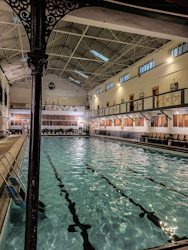
LAST NIGHT, THE 18th of January 2023, a relative by marriage hosted us for dinner at a historic swimming club in Kolkata. It was established in 1887. However, it was not until the 1960s that Indians were able to become members.

Despite India becoming independent of British rule in 1947, many of the prestigious clubs established in India prior to that date did not admit Indians as members until several years later.

In the 1960s, when eventually the Tollygunge Club in South Kolkata began admitting Indians as members, my father-in-law was offered membership to this exclusive previously ‘whites only’ club. He turned down the offer because he was a nationalist at heart and was upset that the Club had remained racist so long after 1947. In contrast, he happily became a member of the Bangalore Club, which welcomed Indian members almost immediately after Independence.

It is a mark of the tolerance of Indians that elite clubs (and some schools) were allowed to exclude non-Europeans so long after 1947, and, incidentally, that statues of Queen Victoria (and other British ‘worthies’) can still be found intact in many Indian cities.