
The wonderful dwelling of a Dewan in Jaisalmer

 ONE OF THE REASONS for our visit to Rajasthan in 2024 is connected with one of my wife’s ancestors: Laxmidas Sapat (also written as ‘Sampath’). He was my wife’s great great grandfather on her mother’s side. Trained as a barrister in London’s  Middle Temple   he was Dewan (Chief Minister) of Jaisalmer between from 1903 for about six years. After that, he became Chief Justice of Jodhpur.


As yet, we have not discovered where Laxmidas resided in Jaisalmer.  But today (8th of December 2024), we have just visited the spectacular haveli (mansion) that was constructed for one of Laxmidas’s predecessors: Mohata Nathmal, who was Dewan between 1885 and 1891. The haveli is called Nathmalji ki Haveli and it was built in 1895.


The facade of the edifice, built in the Rajput style, is a riot of intricately carved yellow sandstone. One interesting detail is a carving depicting a steam engine and a bicycle. I wonder whether this was carved because Nathmal was interested in what was then modern technology. An online article (https://www.rajasthanbhumitours.com/blog/rajasthan-tourism/nathmal-ki-haveli-a-symmetrical-marvel-of-jaisalmers-heritage-architecture/) discusses the haveli in detail and gives another explanation:

“One of one of the most fascinating aspects of the façade is the addition of contemporary aspects, such as bikes and also a European-style heavy steam engine, which were unheard of in Rajasthan at the time. These makings mirror the interested and forward-thinking minds of the craftsmens who created the haveli, mixing conventional themes with contemporary motifs that were brand-new to Jaisalmer in the 19th century.”

Whatever the reason for the presence of these carvings, the facade is a showpiece of the skill of the two brothers who were commissioned to erect the building. Today, visitors can enter the haveli to view and purchase the goods in the shops that occupy the building. The rooms within the mansion have wall paintings that were created in the 19th century, and there are also a few framed historical portraits, including one of King Edward VII of England.

I am pleased that I have seen the home of one of the Dewans of Jaisalmer. I would be even happier if I could discover where Laxmidas Sapat resided during his time as Dewan of Jaisalmer.

Tea makers and politicians in India

MY LATEST BOOK, “The Hitler Lock & Other Tales of India”, is mainly aboutmy very varied and fascinating experiences of travelling in India and only a little bit about Adolf Hitler. Here is a brief excerpt from the book:

Some say that when he was a young boy at school, India’s Prime Minister Narendra Modi helped in his family’s tea stall. Although he never became a chaiwallah, I have met one tea maker who became actively involved in politics. He was the owner of Chai Day Teahouse in Bangalore’s Johnson Market. I visited his establishment a couple of times in 2016, but when I looked for it four years later, it had disappeared.

Chai Day was more of a café than a tea stall. It had tables and chairs within its premises. What struck me immediately was that the walls of the seating area were covered with slogans, such as “Don’t promise when you are happy. Don’t reply when you are angry. Don’t decide when you are sad.”, and “We are not use less. We are used less”, and “Thanking you your faith for Syed Arif Bukhari.” The latter refers to the name of the owner, and the fact that he used to, and may still, put himself forward for election to positions, including MLA, in the Government of Karnataka. He told us that he is an independent and that his symbol is an electronic calculator. Just in case that is meaningless to you, I should explain that all political parties in India identify themselves with symbols as well as their names. For example, the Congress Party symbol is a raised right hand, and that of the BJP is a flowering lotus. This is done so that voters who have difficulty reading can find the party for which they want to vote. After chatting amiably with the charming Mr Bukhari, he said:

“If one chaiwallah can become a Prime Minister, maybe I can do the same.”

He might have been joking, but who can tell what the future will bring.

We are fond of drinking tiny cups of sweet, milky, often spiced, tea at the numerous tea stalls that can be found all over India.  During a visit to the Gujarati city of Baroda (Vadodara), we spoke to two tea makers one morning. One of them was a charming lady, who told us about the working life she led. She operates her stall from 630 am until 730 pm daily. She boils her tea with milk and spices on a gas ring, as do most other chaiwallahs. Each of her gas cylinders contain enough fuel (domestic LPG, which contains butane or propane or a mixture of them) to keep her stall going for 15 days.

The other chaiwallah we spoke with was Gopal. He has a tea stall near the entrance to one of the former pols (see below) of Vadodara. He works from 10 am to 6 pm. His stall was very busy when we visited it that morning. It faces a peepal tree with numerous Hindu offerings around the base of its trunk. One of the daily offerings to the gods is the first cup of tea that Gopal makes each morning. Like many other chaiwallahs we have visited in Gujarat, Gopal adds fresh herbs and spices to his tea. That morning, he had large sprigs of mint leaves and bunches of lemon grass and ginger. He pounds the latter in a pestle and mortar. He told us that pounding the ginger releases more flavour than grating it, which is what many other tea makers do. I asked Gopal whether I could take photographs of him and his stall. He allowed me to do so. As we were leaving him, he told his customers proudly (in Gujarati):

“Our Prime Minister must go to the UK and USA to have his picture taken. See, people from the UK have come all the way from London to Vadodara to photograph me.”

[Note: A pol is an ancient form of gated community, built for protection, found in the historic centres of Varodara and (more prevalently) in Ahmedabad].

You can buy a copy of the book either as a paperback or as a Kindle e-book from Amazon:

British soldiers on the wall in a house in Baroda

BY THE VERY EARLY 19th century, the armies of the Marathas had been beaten by the armed forces of the British East India Company. After this, from 1805 onwards until 1947, the State of Baroda was ruled by a Hindu Maratha dynasty – the Gaekwads of Baroda. Put simply, the Gaekwads controlled the internal affairs of the state in such a way that British interests were not damaged, and the British controlled the external affairs of the state.

Between 1849 and 1854, Bhau Tambekar (Vithal Khanderao) was the Diwan (prime minister) of Baroda. He lived in a large building, which was probably constructed in the early to mid 19th century. Known as Tambekar Wada, this typical Maratha-style mansion has three storeys and surrounds a courtyard. Currently, the first floor of the front (eastern part) of the building is the only part open to the public.

The part of the building that can be visited is a long rectangular hall with a wooden jaali (perforated screen) near one end of it. The walls of this room are covered with beautiful detailed paintings from floor to ceiling. Many of them depict scenes from the Mahabharata, Ramayana, and Hindu religious images. However, the north wall of the hall is even more fascinating.

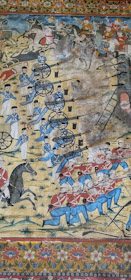
Most of the north wall is covered with a mural depicting a battle between the British East India Company and the Marathas. Most of the picture shows features of the British forces in great detail. There are even several flags that resemble Union Jacks. Some British soldiers, dressed in red uniforms, can be seen riding elephants. Whoever painted this wall had a good eye for both detail and representation of battles.

On the same wall as the battle scene, there are several smaller paintings depicting European men and women. On one of these, a woman in European garb seems to be consoling another woman. In another, a man wearing a red jacket is looking at a European lady affectionately.

The purpose of the painted hall is not known for sure. It has been suggested that it was for entertaining guests. The small part enclosed by the screen might have been reserved for ladies. In its heyday, purdah would have been observed in the house. The hall has a set of windows through which one can access a narrow balcony that extends along the entire length of the eastern side of the house. This terrace has a perforated screen through which people on the balcony could look out onto the street without fear of being seen by passers-by.

Although this December (2023), we are enjoying our fourth visit to Baroda, we would not have known about the Tambekar Wada had our friend Nandita A not told us about it. I am very pleased that she introduced us to this gem hidden within the narrow backstreets of Baroda’s Dandia Bazaar district.

An eminent tourist

MANY YEARS AGO, a now deceased Greek friend, ‘S’, related the following story.

S was born in a small port in the Peloponnese long before WW2. It was a place that tourists disembarked from their boats to visit the Ancient Greek archaeological site of Olympia. S left school at an early age (by the age of about 12 to earn money by working on the docks of the small town. When cruise ships called in at the port, he offered services as a tourist guide to earn a few extra Drachmas.

Most of the tourists swallowed the tales that S told them as they wandered around Olympia. However, one day he met his match. An English gentleman accepted his offer to act as his guide. Soon after they reached the site and S had begun giving his customer his ‘spiel’, the Englishman stopped him, saying

“Listen, young man. It is clear that you know nothing about this site and its history. Let me tell you the correct story.”

S listened to his well-informed customer with interest and amazement. It turned out that the knowledgeable gentleman was no other than the future Prime Minister of the UK, Winston Churchill.

Many years later during one of my several visits to Olympia, I was standing in the lobby of a hotel near the site on a warm afternoon. The place was filled with members of an American tourist group. One lady asked her friend if she was going to take a tour around the famous site. The friend replied:

“Aw, no. It’s too damned hot to see more of those old rocks.”

The months of May are ending

197px-Theresa_May_portrait

Cameron has gone,

May will be ending,

Can Brexit now be resolv’d?


Image source: https://www.gov.uk/government/uploads/system/uploads/attachment_data/file/588948/The_United_Kingdoms_exit_from_and_partnership_with_the_EU_Web.pdf