WOMEN AS DEPICTED BOTH BY A MAN AND BY THEMSELVES AT TATE BRITAIN

I DO NOT KNOW whether it was deliberate or accidental that currently (until the 7th of April 2024) there are two contrasting (or, maybe, complementary) exhibitions on in the galleries of London’s Tate Britain.

On the first floor, there is an exhibition called “Sargent and Fashion”. It is a collection of paintings by the American-born artist John Singer Sargent (1856-1925), who was born in Florence (Italy) and died in London (UK). The aim of the show is, according to the Tate’s website, to show:

“… how this remarkable painter used fashion to create portraits of the time, which still captivate today.”

The exhibition includes some of Sargent’s portraits alongside a few of the items of clothing that his subjects wore whilst he was creating their portraits. In this well laid out show, the viewer gets to see that Sargent was an excellent painter, whose portraits manage to radiate the natures of the sitters’ personalities. I doubt that most of Sargent’s subjects would have been disappointed with the pictures he produced for them. Many of the paintings are portraits of women. Almost all of them were depicted wearing elegant clothes, and are superbly executed conventional portraits. They celebrate aspects of the ‘respectable’ (i.e., wealthy) society of his times.  

Beneath the Sargent exhibition, on the ground floor of Tate Britain, there is an exhibition showing how women in Britain broke out of their conventional male-dominated lifestyle during the 1970s and 1980s. Called “WOMEN IN REVOLT Art, Activism and the Women’s movement in the UK 1970–1990”, it is according to the Tate’s website, it is:

“… a wide-ranging exploration of feminist art by over 100 women artists working in the UK. It shines a spotlight on how networks of women used radical ideas and rebellious methods to make an invaluable contribution to British culture. Their art helped fuel the women’s liberation movement during a period of significant social, economic and political change.”

During a long part of the period covered by the show, Britain had its first female Prime Minister, Margaret Thatcher (in office from 1979-1990). Although she fought her way through hitherto male bastions to emerge as the country’s first lady Prime Minister and showed what women were capable of doing in the world of politics, she was not a feminist icon, as Natasha Walter wrote in The Guardian (online 5th of January 2012):

“Obviously Thatcher was no feminist: she had no interest in social equality, she knew nothing of female solidarity … We should never forget her destructive policies or sanitise her corrosive legacy. But nor should we deny the fact that as the outsider who pushed her way inside, as the woman in a man’s world, she was a towering rebuke to those who believe women are unsuited to the pursuit and enjoyment of power. Girls who grew up when she was running the country were able to imagine leadership as a female quality in a way that girls today struggle to do. And for that reason she is still a figure that feminists would be unwise to dismiss.”

However, as Baroness Burt of Solihull said in the House of Lords on the 5th of February 2018:

“… my next figure is 1979, which, of course, was the date when we got our first female Prime Minister. Personally, I would feel more inclined to celebrate this milestone if she had encouraged other women to come forward, to use some of the talented women that she had at her disposal. But, sadly, she got to the top and pulled the ladder up behind her, which is a great shame, because the whole point of having representation from all parts of society is to make for better government.”

As several exhibits on display at the Tate (until the show ends on the 7th of April 2024), Mrs Thatcher was intensely disliked by artists encouraging ‘female liberation’.

Before entering the exhibition, I was a little worried that all I would see was propaganda and other polemic material. Well, there was plenty of that kind of thing, and much of it was both interesting and often visually intriguing – sometimes quite witty. The exhibition, which is excellently curated, also includes many paintings, sculptures, videos, and other artistic items. These have mostly been created by female artists with whom I am not familiar. And all of them are both visually engaging and satisfying.   Several of these were of Indian heritage, and others have ‘black’ African heritage. There are also cases containing printed material that propagated feminist ideas. Included amongst these were a few copies of the magazine Spare Rib, which I remember seeing at friends’ houses many years ago. My future wife was one its readers. Published between 1973 and 1993, its aim was to challenge the traditional roles of females (of all ages) and to explore new ways in which they could engage in society. In fact, this was the aim of many – if not all – of the works in the exhibition.

We visited both exhibitions today (the 28th of February 2024), to experience the contrast between them. Both are excellent in their own ways and achieve what the curators intended. They are both well worth visiting. However, to my taste, the exhibition on the ground floor was far more exhilarating and inspiring, that the more conventional show on the floor above it.

Repetitions of an image need not necessarily be monotonous

IF I WERE to tell you that I have just seen an exhibition of well over fifty photographic portraits of one person, all reproduced from the same original print, and enjoyed it, you might begin to wonder about me and my sense of aesthetics. Well, I really did enjoy this exhibition at the Thaddeus Ropac gallery in London’s Mayfair. If you wish to share the experience, you will have to hurry, because the show ends on the 9th of February 2024.

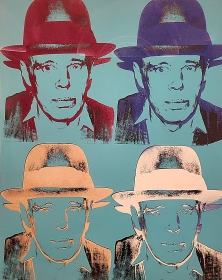
On or soon after the 30th of October 1979, the German artist and political activist (e.g., a co-founder of the German Green Party) Joseph Beuys (1921-1986), who was in New York City for the installation of a retrospective exhibition of his works at the Guggenheim Museum, was taken to meet the American Pop artist Andy Warhol (1928-1987). During that encounter, Warhol used his Polaroid camera to make a portrait of Beuys wearing his characteristic felt hat. It was not the first time that Warhol had photographed Beuys. He had also used his Polaroid when he first met Beuys earlier in 1979 at the Hans Mayer gallery in Düsseldorf (Germany). This meeting has been recorded on film (see https://youtu.be/PRrC8EJ3KxI?si=DM4RoR9nDrX_cJbX).

Between 1980 and 1986, Warhol used his Polaroid photograph of Beuys as the source image for a series of screen-printed portraits. As the Press Release on the website of the Thaddeus Ropac Gallery explained:

Repeating Beuys’s arresting gaze on different scales and in different formats, Warhol exercised his characteristically experimental approach to materials in the portraits. Amongst the paintings, unique Trial Proofs, line drawings, and unique and editioned works on paper, are examples of some of the artist’s earliest uses of diamond dust in portraits. These sit alongside images that have had their tonal values inverted to give the effect of photographic negatives. Belonging to the Reversal Series in which Warhol reproduced key subjects from across his wide-reaching body of work – including his iconic portraits of Marilyn Monroe, the Mona Lisa and Mao …”

In the 1940s, Warhol began his working life in commercial and advertising art. By the 1950s, he had discovered the secret of repeating images making small changes to produce variations on a theme. In 1952, he had his first solo exhibition in an art gallery (in NYC). Although it was not well received, it was not long before he became recognised as an artist of note. In 1962, he learned screen-printing techniques, and became one of the first artists to use this process for creating artworks. These include most of  the images on display at Thaddeus Ropac.

The results, which we were able to see at the gallery were far from monotonous, despite being repetitions of the same photograph. By modifying the sizes, colouration, and many other aspects of the photographic portrait, Warhol managed to bring a considerable degree of liveliness to this image. As I saw the various diverse presentations of the single image of Beuys, the German artist began to feel oddly familiar. It was almost as if I was meeting an old friend.

Before seeing the exhibition, I had my doubts about viewing what I had heard were multiple reproductions of the same photograph. My worries were dispelled within a few seconds of looking at the exhibition. I was fascinated how one image could be altered in so many different ways and the effect that seeing the results had on me, There are now less than 24 hours left before the show ends. So, if you can, hurry up and view it.

Baker in the Bank

UNBELIEVABLY, THE ARCHITECT Herbert Baker (1862-1946) demolished a major work of one of England’s greatest architects – Sir John Soane (1753-1837). Imagine the outcry if Sir Richard Rodgers decided to demolish Christopher Wren’s St Pauls Cathedral to replace it with one of his own design. Well, in the 1920s, Baker demolished most of Soane’s Bank of England to replace it with a larger building – the present Bank – which he designed.

There is a small museum in the Bank of England. Some of its rooms have been designed to recreate the kind of interiors that would have existed in Soane’s Bank building. In one of the rooms of the museum, a circular space beneath a glazed dome, there is a framed portrait of Sir Herbert Baker. Baker, who helped design New Delhi, is well known for his architectural work in South Africa. After being commissioned by the imperialist Cecil Rhodes (1853-1902) to redesign Groote Schuur, his house on the slopes of Cape Town’s Table Mountain, he was asked to design many other structures in South Africa.

The portrait depicts Baker standing at a drawing table by a window through which a building in his typical neo-classical style can be seen. At the bottom left corner of the painting, there is a depiction of a framed painting of Cape Town’s Rhodes Memorial, which Baker designed in 1906. If you look carefully at this picture within a picture, an equestrian statue can be discerned. This statue, called “Physical Energy”, was sculpted by George Frederick Watts (1817-1904), who was briefly married to the actress Ellen Terry. The statue was cast in 1902, and placed at the Rhodes Memorial in Cape Town. In 1907, another bronze cast was made, and this stands on a stone plinth in Kensington Gardens almost midway on a line connecting the statue of young Queen Victoria in front of Kensington Palace with the Henry Moore sculpture on the east bank of The Long Water (part of the Serpentine).

When we saw the portrait of Baker, we were viewing an interesting exhibition that explores the Bank of England’s many and varied links with the slave trade. The caption relating to the portrait of Baker concentrated on the small image of the memorial to Rhodes. It correctly pointed out that Rhodes had been a Prime Minister of the Cape Colony, which became part of unified South Africa in 1910. It also mentions that Rhodes:
“…held racist beliefs that Africans were inferior.”
In 1912, the author GK Chesterton wrote of Rhodes that he:


“… had no principles whatever to give to the world. He had only a hasty but elaborate machinery for spreading the principles that he hadn’t got. What he called his ideals were the dregs of a Darwinism which had already grown not only stagnant, but poisonous … It was not his fault that he “figured out that God meant as much of the planet to be Anglo-Saxon as possible.” Many evolutionists much wiser had “figured out” things even more babyish. He was an honest and humble recipient of the plodding popular science of his time; he spread no ideas that any cockney clerk in Streatham could not have spread for him. But it was exactly because he had no ideas to spread that he invoked slaughter, violated justice, and ruined republics to spread them.”


Well, that is something for recipients of, and those applying for, Rhodes Scholarships to ponder over.

Getting back to the Bank that Baker designed, the museum is well worth visiting not only for its temporary exhibition about slavery but also for its permanent collection of exhibits, all of which have easily understood explanatory labelling.

A man from China painted by Sir Joshua Reynolds

THERE IS A ROOM in Knole House (near Sevenoaks in Kent), which contains several portraits painted by Joshua Reynolds (1723-1792). One of them is a self-portrait. Near to this, there is a portrait of a man with a red cap, seated cross-legged. His youthful face has Chinese features. The sitter is Wang-y-tong (‘Huang Ya Dong’: born c 1753). Reynolds painted him in about 1776.

Wang was one of the earliest known Chinese people to have visited England. He came over following in the footsteps of an earlier Chinese visitor, the artist Tan-Che-Qua (c1728-1796), who arrived in London in 1769. Tan met King George III, and his work was shown at the Royal Academy in 1770. In about 1770, Wang was brought from Canton to England by John Bradby Blake (1745-1773), an employee of the East India Company. Blake was a naturalist and was interested in Wang’s knowledge of cultivating Chinese plants, and their uses. Wikipedia noted:

“Wang visited the Royal Society on 12 January 1775. In a letter of 1775, he is said to be about 22 years old. He was visited at Blake’s house, where he discussed the manufacture of Chinese ceramics with Josiah Wedgwood, and acupuncture with physician Andrew Duncan.”

It also describes how Wang became a page to Giovanna Bacelli (1753-1801), who was a mistress of John Sackville, 3rd Duke of Dorset, who owned Knole House. Wang lived at Knole, and was educated at the nearby Sevenoaks School. He returned to China by 1784, at which date he was working as a trader in Canton.

Wang’s portrait hangs amongst those of many famous men painted by Reynolds, including Samuel Johnson and David Garrick, as well as the 3rd Duke. The latter is said to have paid Joshua Reynolds 70 guineas (almost £76) to paint Wang’s excellent portrait. Wang was well-received in England. It would be interesting to learn what he thought about life as he found it at Knole and other places he visited in England.

A poet in Hampstead and Rome

THE SHORT-LIVED POET, John Keats (1795-1821) resided briefly in Hampstead in what is now called Keats House. In my new book, “Beneath a Wide Sky: Hampstead and its Environs” *, Keats:

“… took a great liking to Hampstead and settled there in 1817. He lived in Wentworth House, which was later renamed ‘Keats House’. The house in Keats Grove was built in about 1815 and divided in two separate dwellings. One half was occupied by Charles Armitage Brown (1787-1842), a poet and friend of Leigh Hunt and the other half by Charles Wentworth Dilke (1789–1864), a literary associate of Hunt and a visitor to his home in the Vale of Health. Keats became Brown’s lodger. This was after Keats had visited his neighbour Dilke, with whom he became acquainted following an introduction by the poet and playwright John Hamilton Reynolds (1784-1852), who was part of Leigh Hunt’s circle of friends.”

Keats remained in Hampstead until 1820, when, ailing, he left for Italy to try to improve his health. Leigh Hunt (1784-1859), who lived in Hampstead’s Vale of Health, noted in his autobiography that Keats died in Rome and was buried in the English Protestant cemetery near the monument to Gaius Cestius. Amongst his graveside mourners was the poet Percy Bysshe Shelley (1792-1822), who also had spent time in Hampstead.

Had Keats not travelled to Italy, he would have probably died in Hampstead. If that had been the case, it would have been likely that he would have been buried in the graveyard of St John’s, Hampstead’s parish church on Church Row, where the artist John Constable rests in peace.

Bust of Keats in St Johns, Hampstead

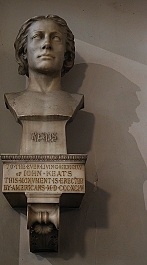
Within the church there is a memorial to Keats, a bust, dated 1894, within 100 years of the poet’s birth. A gift from admirers of Keats in the USA, it was the first memorial to Keats in England. The story of the bust is related on the church’s website (https://hampsteadparishchurch.org.uk/data/keats_bust.php) as follows:

“Anne Whitney, a Boston sculptor (1821-1915) carved her original bust of Keats in 1873. The marble bust was inscribed Keats and not signed. It was exhibited the same year at Doll and Richards, Boston. It was owned by the artist until 1915 when it was bequeathed to Fred Holland Day. Day exhibited it at Boston Public Library in the loan exhibition of his Keats memorabilia in 1921 to mark the centenary of the poet’s death. The Keats bust was given by Fred Holland Day to Keats House and Museum shortly before he died, and its arrival was acknowledged by Fred Edgcumbe the curator of Keats House and Museum on 2 November 1933, the day of Day’s death. The marble replica of the bust inscribed KEATS AW (monogram) 1883 was carved by Anne Whitney in 1883. It was exhibited by F. Eastman Chase, Boston, and presented by Americans, as the first memorial to Keats on English soil, to Hampstead Parish Church on 16 July 1894. The bust remained in position until March 1992 when it was stolen. It was seen by Judith Bingham, the composer, when it was about to be auctioned at Finchley in May 1992. It failed to reach its reserve, Judith Bingham recognised its identity and it was returned to the Parish Church.”

The Keats bust is near the Lady Chapel, in which I saw a remarkable painting by Donald Chisholm Towner (1903-1985), who lived in Hampstead, in Church Row from 1937 until his death. The church’s guidebook revealed:

“The Altar Piece in the chapel was painted by Donald Towner of Church Row, in memory of his mother. True to the medieval tradition Towner used a local resident as the model for Mary, his nephew for John and his own mirror image for Christ.”

What is remarkable is that the three figures are depicted standing in Church Row. St John’s church can be seen in the background.

Apart from the bust and the painting, the church is well worth visiting to see its lovely architecture and to enjoy its peaceful atmosphere.

*My book is available from Amazon: https://www.amazon.co.uk/dp/B09R2WRK92

A hero of Chile in Richmond-upon-Thames

BETWEEN OUR FRIENDS’ house in Richmond and Richmond Bridge, which crosses the River Thames, is but a short walk, taking not more than five minutes at a leisurely pace. Yet, during this brief walk that I took yesterday, on the day that my mother would have been one hundred years old, I spotted three old things that were new to me.

The first thing I noticed for the first time is a small single-storeyed building on Church Terrace close to the Wakefield Road bus station. What attracted me to it was a stone plaque set within its stuccoed façade that stated:

“The Bethlehem Chapel built in the year 1797.”

It is still in regular use. I picked up an information leaflet from a plastic container next to its locked door, and this provided me with some information about the place, whose façade looks original but has otherwise been substantially updated.  The interior of this non-Conformist place of worship appears to be similar to what it was when it was first built but considerably restored and modernised a bit (see images of the interior on the video: https://youtu.be/kIYuxaMyZsA).

John Chapman, market gardener of Petersham, where currently the fashionable, upmarket Petersham Nursery flourishes, built the chapel for an independent Calvinist congregation. It was opened by William Huntingdon (1745-1813), a widely known self-educated Calvinist preacher, who began life as a ‘coal heaver’ (https://chestofbooks.com/reference/A-Library-Of-Wonders-And-Curiosities/William-Huntingdon.html). Because of this, the chapel, which is the oldest independent Free Church in the West of London, is also known as the ‘Huntingdon Chapel’. By Free Church, the leaflet explains:

“We do not belong to any denomination. We are an Independent Free Church, which means that we are not affiliated to any organised body like the Church of England, Methodists or Baptists etc.”

More can be discovered about the congregation and its beliefs on the chapel’s informative website (http://bethlehem-chapel.org/index.html).

Between the chapel and the bridge, there is an Odeon cinema with a wonderful art deco façade. This was designed by the architects Julian Leathart (1891-1967) and W F Granger and was opened in 1930. It was originally named the ‘Richmond Kinema’, but this was changed to the ‘Premier Cinema’ on the 29th of June 1940:

“… to enable the removal of the Richmond name on the cinema, in case German parachutists landed nearby.” (http://cinematreasures.org/theaters/6260)

In May 1944, the cinema’s name was changed to the ‘Odeon’. Before it was converted to a triple screen cinema in 1972, its huge auditorium was able to accommodate 1553 seated viewers.

Crossing the main road in front of the cinema, we descend Bridge Street towards Richmond Bridge, but before stepping onto the bridge, we turn left and enter Bridge House Gardens. This open space was the site of the now demolished Bridge House, which was the sometime home of a Jewish family:

“Moses Medina (nephew of Solomon Medina and three times treasurer of Bevis Marks) lived at Bridge House from the 1720s to 1734, having lived previously at Moses Hart’s old house. Abraham Levy lived there from 1737-1753. Levy was a wealthy merchant of Houndsditch.” (www.richmondsociety.org.uk/bridge-house-gardens/).

Solomon Medina (c1650-1730) followed the future William III to England and became “…the leading Jew of his day” according to Albert Hyamson in his “History of The Jews in England” (publ. in 1928), a book I found in the second-hand department of Blossom Book House in Bangalore. Medina became the great army bread contractor in the wars that followed his arrival in England. He was knighted for his services, thus becoming the first professing Jew to receive that honour. His reputation was called into question because it was alleged that he had bribed John Churchill (1650-1722), the First Duke of Marlborough (see “Marlborough” by Richard Holmes, publ. 2008). Moses, his nephew, was a rabbi at the Bevis Marks synagogue in London and thrice its treasurer and also involved in his uncle’s bread contracting, supplying this food to Marlborough’s forces in Flanders (https://forumnews.wordpress.com/about/bank-of-england-nominees/).

Bridge House was demolished in 1930 to create the present area of parkland. Well, I did not know about the Medina connection with Richmond when we visited the Bridge House Gardens. What attracted my attention as soon as I set foot in the small park was the bust of a man looking across a flight of steps and out towards the river below it.

The bust depicts a man wearing a heavily decorated military uniform with tasselled epaulettes. It is a representation of General Bernado O Higgins  (Bernado O’Higgins Riquelme), who was born in Chile in 1778 and died in Peru in 1842. Bernado was an illegitimate son of Ambrosio O’ Higgins (c1720-1801), who was born in Sligo (Ireland) then became a Spanish officer. He became Governor of Chile and later Viceroy of Peru. Bernado’s claim to fame is that he was a Chilean independence leader who freed Chile from Spanish rule after the Chilean War of Independence (1812-1826). He is rightfully regarded as a great national hero in the country he helped ‘liberate’.  But, what, you might be wondering, is his connection with Richmond?

O Higgins studied in Richmond from 1795 to 1798 and while doing so, lived in Clarence House, which is at 2 The Vineyard, Richmond. Whilst in Richmond, he studied history, law, the arts, and music (https://www.davidcpearson.co.uk/blog.cfm?blogID=632) and met  Francisco de Miranda, who was active amongst a London based group of Latin Americans, who opposed the Spanish crown and its rule of colonies in South America. The bust was inaugurated in 1998 to celebrate the 200th anniversary of the departure of O’ Higgins from Richmond. Our friends told us that once a year, a delegation of Chileans arrives by boat at Bridge House Park to celebrate joyously in front of the bust of their national hero. As they arrive, another boatload of people arrives to join the celebration: members of the administration of the Borough of Richmond.

No far from the memorial to the great O’ Higgins, there is another remarkable sight close to the river: a tree with a small notice by its roots. To me, it did not look exceptional, but the notice explains that this example of Platanus x hispanica (aka ‘London plane’):

 “… is the Richmond Riverside Plane, the tallest of its kind in the capital, and is a great tree of London.” First discovered in the 17th century, this hybrid of American sycamore and Oriental plane, was planted a great deal in the 18th century. The plane growing near to the bust of O’ Higgins has a record-breaking height. What I cannot discover is the date on which the notice was placed. So, being the sceptic that I am, I wonder if any other plane trees in London have exceeded the height of this one since the notice was installed.

All of what I have described can be seen in less than ten minutes, but as I hope I have demonstrated, a great deal of history is encapsulated in that tiny part of Richmond.

Uncle Joe

STALIN


Standing by Stalin,

albeit in bronze:

odd memories evoked


This statue of Stalin, now in Tirana, was cast during Albania’s Communist era (1944-91). Albania was the only country to continue revering Stalin after his death.