
Flower power
A lov’ly thing of the distant past
Now is might right?

Flower power
A lov’ly thing of the distant past
Now is might right?
TODAY, OUR FRIEND took us to see a part of Hampstead, which I never knew existed. Called The World Peace Garden, it is located on a sliver of sloping ground bounded to the south by Hampstead Heath Overground station and to its north by a short stretch of the western end of the road called South Hill Park. Its dimensions are approximately 95 feet in length with a maximum width of about 29 feet. It is entered by a discrete opening on South Hill Park. Some steps lead downward to a couple of paths that wind their way through the dense vegetation and past small ponds to a tiny seating area at the garden’s eastern end. The miniscule park is rich in flowers, bushes, and trees. It is a lovely place.

The World Peace Garden began to be created in about 2014 on waste land between South Hill Park and the railway station. Inspired by a local estate agent, Jonathan Bergman, the garden was designed by Tony Panayiotou and Michael Wardle, and created by gardeners Keiko, Hugh, Laurence, Miki, and Mer. In 2016, it was awarded the ‘Time Out Love London Award for Local Culture in Hampstead’. Today, it is still delightful, although slightly overgrown. During our midday visit, we saw several people enjoying lunch in shady nooks.
Although the garden is to celebrate the idea of world peace, it is not exactly a peaceful place. Every few minutes, the peace of the garden is disturbed by noises coming from trains passing through the station beneath it. Despite speaking to many people about Hampstead, until today nobody has mentioned the Peace Garden to me.
THE COCHIN CLUB’S main, long, single-storey building is a lovely example of British colonial architecture. The club, located near the sea in a large well-maintained garden was officially recorded as having been established in 1914, but might have been in existence before that.

Originally established as “The English Club”, its members were mainly the British elite of Kochi and European tea planters. Some individuals, high level Indians, might have also been welcome. The Club’s Presidents all had British surnames until at least 1969. However, there was one exception – Honourable Justice P Govindan Nair who was President 1963-64. After 1969, the Presidents had Indian surnames.
Today, the Club is a tranquil spot. Usually, there are more crows and egrets than humans in its compound. The Club has five spacious, bedrooms, which can be hired. Their occupants are almost the only people using the Club. There are plenty of staff members, but few people for them to serve.
The Club has a splendid bar with windows overlooking the sea in one direction and the garden in the other. But it is a bar with a difference. Instead of shelves being lined with bottles of booze, they are used to display cups and other prize trophies. And this might be a clue as to why the Club is so often so empty.
The Club does not have a liquor licence. Therefore, it cannot sell alcoholic drinks. The cost of buying an annual licence is so prohibitively high in Kerala that the Club might not be able to break even. The availability of alcohol is one of the factors that brings life to the exclusive clubs of India.
On special occasions such as Diwali and Christmas and Onam, the Club buys a costly 24 hour licence. The rest of the time, the Club is ‘dry’. However, food and soft drinks are available in the bar. The South Indian filter coffee served there is the best we have found in Fort Kochi (Fort Cochin).
Largely because liquor is not available and because there are few members (about 500), this charming Club has acquired a certain unintended (undesired?) tranquillity.
PARKS ARE SAID to be a city’s lungs. They are places where one can escape from the noises and fumes mainly created by traffic. On New Year’s Day 2023, we took a walk in Bangalore’s Cubbon Park. Almost as soon as we had entered it, the air seemed cleaner, and we experienced an uplifting sense of serenity.

Cubbon Park was laid out in 1870 under the direction of Major General Richard Sankey, British Chief Engineer of Mysore State. Initially named after Sir John Meade, it was later renamed to honour Sir Mark Cubbon (1775 – 1861), the longest serving Commissioner of Mysore State. The name was changed again in 1927 to Sri Chamarajendra Park, in honour of Sri Chamarajendra Wodeyar (1863–1794), ruler of Mysore State when the park was created. There is a statue of this man in the park. Despite that change of name, the place is still popularly known as Cubbon Park. Even the recently built metro station at the northern edge of the park has that name.
The popular park has plenty of trees that provide shade. Many different species grow in the park, several of them flowering trees. Footpaths cris-cross the park, but visitors do not need to be confined to them. A main road winds its way through the verdant landscape, but this is closed to vehicular traffic on Sundays.
Words are inadequate to convey the joys of Cubbon Park. Only by entering this lovely island of nature in Bangalore’s ocean of urban development can one appreciate the beauty and delightfulness of this city’s important green lung.

Which way will it blow?
The wind of war brings fear and rage
Let peace reign soon
THE CRANE IS a tributary of the River Thames. Named after Cranford (Middlesex) through which it flows it is about 8 ½ miles in length. It rises as Yeading Brook and flows towards its mouth at Isleworth, just opposite the southern tip if Isleworth Ait. On its way, the Crane passes east of Heathrow Airport, Hounslow Heath, Whitton, Twickenham, and St Margarets. It also feeds the man-made Duke of Northumberland’s River, which enters the Thames about 610 yards downstream from the mouth of the Crane.

The Crane flows through beautiful, wooded parkland known as Crane Park. This incredibly peaceful open space, part of which is a nature reserve, is in Whitton near Twickenham. Part of the park is in the Borough of Richmond-on-Thames and the rest in the Borough of Hounslow. The Crane, which contains a wooded island and breaks up into rivulets occasionally, is bordered on both sides by the park. The island, Crane Park Island, now a lovely nature reserve, a peaceful oasis in a busy part of London, was created for a purpose that was far from peaceful: warfare.
In the 1760s, a gunpowder works was established in what is now the west part of Crane Park. The island was created to form a millstream for operating a waterwheel connected to a mill for grinding saltpetre (nitrates of either sodium, potassium, or calcium) used to make gunpowder. It was part of a complex of buildings that housed the Hounslow Powder Mills. Before the 19th century, what is now Crane Park would have been part of the then much vaster Hounslow Heath. The website of the Twickenham Museum noted that gunpowder mills were established on the Heath as early as during the reign of King Henry VIII.
All that remains of the Hounslow Powder Mills is a tall brick tower topped with a lead roof and a small lantern with a weathervane. It resembles a lighthouse. This was built either late in the 18th century or early in the 19th. Lying near it are a couple of circular millstones, which might have been used for grinding gunpowder. Described by some as a shot tower, it might have been used to manufacture lead shot. Molten lead would have been poured through a copper mesh near the top of the tower, and as it fell downwards, it formed into droplets, which when cooled became pellets of lead shot. This is most likely, but others suggest that the tower was part of a windmill.
Manufacturing gunpowder was a hazardous procedure, and unintended explosions were not unusual. The Twickenham Museum’s website related:
“Joseph Farington noted in his diary on Monday 25 January 1796 that: “The Powder Mills at Hounslow were blown yesterday. The concussion was so great as to break the windows in the town of Hounslow. Hoppner having been to Eaton, on his return rode to the spot where the Mills had stood, not a fragment of them remained. They were scattered over the country in small pieces. Three men were killed”… Burial records note deaths from further explosions: 5 on 17 November, 1 on 19 June 1798, 7 0n 15 July 1799, 2 on 27 June 1801, and so on through the century. Abraham Slade noted in his diary for 1859 that: “On the 29 of March the Powder Mills blew up, sending 7 poor souls into eternity in a moment. It has broken a great deal of glass in Twickenham & neighbourhood. We thought the whole place was coming down.””
The last major explosion at the Hounslow Mill was in 1915.
The powder mills passed through the hands of various operating companies: Edmund Hill, John Butts and Harvey and Grueber until 1820, then Curtis and Harvey until 1920, and then by Nobel Industries.The licence for producing explosives at Hounslow Powder Mill was revoked in 1927. In 1927, a Twickenham councillor, Frank Yates, bought the site. Later, he sold part of it for housing and the rest to Twickenham Council, who used it to create what is now Crane Park.
In addition to the impressive tower and a rusting sluice gate, several other less impressive remnants of the manufacturing complex can be seen on the island in the form of the bases of engine housings: lumps of bricks and concrete with thick metal rods protruding from them. Apart from the tower and a few other barely identifiable remnants, it is hard to believe that the sylvan and peaceful Crane Park was ever a place where the material of warfare had been produced for several centuries.
IT IS WONDERFUL how easy it is to escape from bustling activity on London’s main thoroughfares. Seymour Walk, a cul-de-sac leading north from London’s busy Fulham Road, is one of many such peaceful havens. In the 1860s, Seymour Walk was called ‘Seymour Terrace’. In those days it was bordered on its west side by market gardens and on its east by a line of buildings. Today, it has buildings on both sides and is entirely surrounded by land that has been built on. It is worth leaving the main road to enjoy a bit of quiet in this picturesque short street.

The small lane was built-up during the period between the 1790s and 1820s and is included in an area called Little Chelsea. Most of the terraces of houses along it appear to be from that era, but there are one or two newer constructions. The large house on the western side of the part of Seymour Walk nearest to Fulham Road is older than the other buildings. This larger house or a predecessor on the same spot might have existed as early as 1664 (www.british-history.ac.uk/survey-london/vol41/pp162-194#h2-0008). Its earliest occupant was a Dr John Whitaker, who lived there from 1666 to about 1670. The elegant house, number 1 Seymour Walk, as we see it today looks as if it was largely built in the 18th century. Amongst its various occupants there was one, Mary Moser (1744-1819), the Royal Academician and flower painter (https://www.royalacademy.org.uk/art-artists/name/mary-moser-ra). The house became a school or academy from about 1831 to 1939.
Socially, the population of Seymour Walk was very mixed during the 19th century. Its inhabitants ranged from ‘poor’ and ‘very poor’ to the ‘better off’ amongst whom were The Reverend Elias Huelin; a jeweller; an architect; a lady doctor; and various artists.
Huelin (1786-1870), who owned several properties, was murdered in one of his homes along with his house-keeper Ann Boss. It has been recorded that:
“The murders were only discovered when a box was found in the kitchen of Reverend Huelin’s unlocked house, sitting in a pool of blood. It contained the body of the housekeeper. The police then began searching for the clergyman. He was eventually found buried in the backyard of the house he had rented to Walter Millar.” (https://www.royalparks.org.uk/parks/brompton-cemetery/explore-brompton-cemetery/elias-huelin)
Huelin was murdered by Millar during a robbery, when he was living in Paulton Square in Chelsea, but still owned property in Seymour Walk.
Other buildings in Seymour Walk are pleasant aesthetically, but not notable architecturally or from a historical point of view. A curve near the beginning of the Walk effectively insulates most of it from the busy thoroughfare into which it leads. It was only because the road looked so attractive from Fulham Road that I decided to wander along it. It is small peaceful enclaves such as Seymour Walk that help to make London a pleasant city to live in and visit.
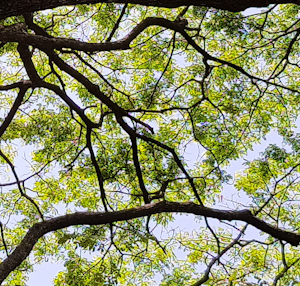
Light filtering through
Leaves and branch-es:
Felicity reigns serenely
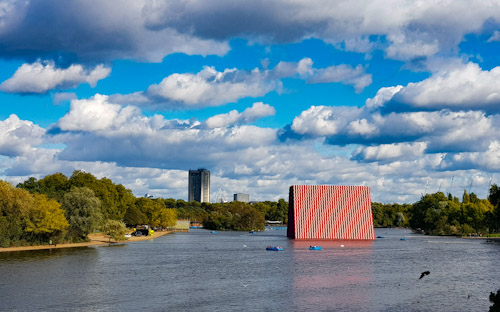
Clouds hover
Over the serene Serpentine:
Hyde park on a Sunday
 yamey
yamey 