WHEN WE VISITED Wigan in Lancashire in 2022, we saw hoardings that advertised the forthcoming opening of an “artisan deli”, and wondered what George Orwell would have made of it.
We returned to Wigan Pier in September 2025, and headed for the site of the proposed artisan deli. However, it has not been built and the signs advertising the plans to build it are no longer to be seen. The area around the Pier looks similar to what it did in 2022. The warehouses that were to have been redeveloped stand empty. Peering through their windows all that could be seen were huge, dusty empty spaces.
During our second visit to Wigan, we took a stroll in the town’s Mesnes Park. This beautifully maintained park was laid out in 1878 on glebe land (terrain set aside to provide income and support for a parish priest). Apart from a lovely pond, lawns, and carefully tended flower beds, the park contains several interesting features. One of these is the octagonal pavilion built in 1880. Now containing a café, it stants on a raised mound, and can be approached by elegant stone staircases. In fron of its main entrance, there is a statue of a soldier, which is part of a memorial to those men of Wigan who fought in the 2nd Anglo-Boer war (1899-1902). And a few steps down from this, there is the elegant cast-iron Coalbrookdale Fountain. This is a replica of one which stood in the park until 1921. Near the pavilion, there is a 10-sided Victorian bandstand.
Between the Pavilion and the main entrance to the park, there is a statue of a seated man. It depicts the Conservative politician Sir Francis Sharp Powell (1827-1911). He held a seat in the House of Commons from 1863 until 1910. He was born in Wigan, but represented several different constituencies during his long parliamentary career. The bronze statue in the park was created by Ernest George Gillick (1874-1951), and erected in Wigan in 1910.
Just over two miles northeast of central Wigan, lies Haigh Hall (built between 1827 and 1840), which was undergoing restoration in 2025. It is surrounded by Haigh Woodland Park, which is a vast parkland area containing a variety of leisure facilities including eateries, adventure playgrounds, a golf course, a mini-golf course, and a fine walled garden. It is hoped that when the restoration of the Hall is completed in 2028, it will provide opportunities for a whole range of activities for visitors.
Our second visit to Wigan has shown us that there is much more to the place than Orwell’s famous Wigan Pier.
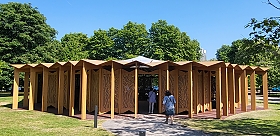
EVERY SUMMER, THE Serpentine South Gallery in London’s Kensington Gardens hosts a temporary pavilion in its grounds. Each year, a different architect is invited to design a pavilion. And the chosen architect must be someone who has never before had any of his or her buildings constructed in England. This year, the chosen architect is Marina Tabassum, who was born in Bangladesh in 1969.
A Capsule in Time
Along with her associates, her architectural practice (Marina Tabassum Architects (MTA)) has designed a capsule-shaped pavilion, appropriately named “A Capsule in Time”. The long axis of the capsule is aligned along a north/south axis. Most of this lovely, airy structure consists of series of parallel hoops between which there are sets of angled panels made of a tinted translucent material. The walls of the pavilion have benches along their inner edges. It is not a continuous construction because there are two wide gaps between sets of parallel hoops. One of these is aligned with the clock tower on top of the Serpentine South gallery. At each end of the capsule, the hoops decrease in diameter to form quarters of spheres. Within one of these, there is a counter where refreshments are available. One of the design criteria for the annual pavilions is that they can accommodate such a counter.
In the last few years, I have found some of the pavilions to be disappointing aesthetically and architecturally. This year’s most satisfying effort by Marina Tabassum is the best Serpentine pavilion I seen during the last five years.
ALMOST ALWAYS I ENJOY the annual temporary pavilions erected beside the Serpentine South Gallery in Kensington Gardens. This year’s offering was designed by the South Korean architect Minsuk Cho (born 1966 in Seoul). The Serpentine website (www.serpentinegalleries.org/) explained:
“Tracing the history of past Serpentine Pavilions, Minsuk Cho observed that they often emerge as a singular structure situated at the centre of the Serpentine South lawn. To explore new possibilities and previously untold spatial narratives, Cho approaches the centre as an open space. The 23rd Serpentine Pavilion envisions a unique void surrounded by a constellation of smaller, adaptable structures strategically positioned at the periphery of the lawn.”
The five structures surrounding the void (or open space) in the middle of the pavilion compound vary in shape and purpose. One serves as a library, another as a café serving area with minimum seating, another as a children’s play area, another is a kind of hallway, and the fifth is supposed to represent a tea house.
Apart from two of the small buildings (the play area and the library), I did not find the others visually satisfying. Also, I did not feel that the five structures surrounding the central space were in harmony with each other. All in all, I was unimpressed by this year’s so-called pavilion.
I realise from reading the information on the Serpentine’s website that Minsuk Cho was trying to express a set of concepts by designing the small complex of buildings that together form the pavilion. However, without knowing that, the result looks unsubstantial compared with almost all the pavilions that have preceded it over the years. The architect’s ideas have not translated well into concrete forms. Apart from this, the current pavilion, unlike its predecessors, has few places for people to sit and enjoy the space. In all the pavilions that have been constructed before this year, there has been ample place to sit and rest. And providing such a place within uniquely designed architectural spaces has, until this year, been one of the things that makes the pavilions accessible for people of all ages to enjoy – whether or not they have an interest in the architecture or its designer.
EVERY YEAR SINCE 2000, the Serpentine Gallery in London’s Kensington Gardens has commissioned the construction of a temporary pavilion in its garden. These pavilions have two things in common. One is that they contain a café and the other is that it must be designed by a noteworthy architect who has never had one of his or her creations constructed in England. Almost all the pavilions constructed to date have been examples of adventurous and exciting architecture. This year’s architect is Lina Ghotmeh, who was born in Lebanon and now works in her studio in Paris.
Given the French name “À table”, the circular timber pavilion was conceived as a place for people to sit together and chat, just as they would around a dinner table. Given this aim of the architect, it succeeds. To enhance her aim, the specially designed tables and chairs are arranged in a circle. As my wife said, it is the homeliest of all the pavilions built to date. Unlike some of the earlier pavilions, one does not feel that one is entering an unfamiliar, or even alien, environment. Despite its welcoming nature and very human scale, the pavilion’s design is far from mundane. Although it is far from being amongst the most visually spectacular of the temporary buildings, it is pleasing to the eye. I will certainly visit it again before it is dismantled on the 29th of October 2023.
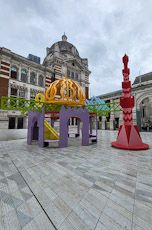
IN 2023 RAMADAN WILL occur between about the 22nd of March and the 21st of April. To celebrate this holy Islamic month, a colourful pavilion has been erected in the courtyard of the Exhibition Road entrance to the Victoria and Albert (‘V&A’) museum. It has been designed by Shahed Saleem and set up by The Ramadan Tent Project and the V&A. According to the museum’s webpage (www.vam.ac.uk/event/ok1kLZm29xJ/ramadan-pavilion-march-may-2023), the pavilion: “…draws inspiration from the V&A’s Prints and Drawings collection to represent the history of the mosque and Muslims in Britain.”
Another webpage (https://www.vam.ac.uk/blog/museum-life/the-ramadan-pavilion-by-shahed-saleem) contains some interesting information about the history of Islamic edifices in the UK. The first mosque in Britain was built in 1889 in Liverpool by 20 British converts to Islam. It was housed in a Georgian terraced house. Since the arrival of many Muslim migrants in the UK im the 1950s and ‘60s, there is now a sizeable Muslim population in the country, and they worship in Britain’s approximately 1800 mosques. The earliest of these were in converted buildings, but now there are plenty of purpose-built mosques. Of these, one of the most beautiful and original is the mosque in Mill Road, Cambridge.
Shahed Saleem is an architect who specialises in designing mosques. Apparently, his pavilion at the V&A is the result of years spent studying mosques in Britain. With his Ramadan Pavilion, Saleem hopes that it will encourage people, who have never entered mosques, to explore mosque architecture and encourage them to enter these holy places to discover more about them. Well, that is an admirable aim, but from what I have seen of the pavilion, it is unlikely to fulfil that aim.
Undoubtedly, Saleem’s pavilion incorporates elements of mosque architecture and design. Sadly, it looks to me more like a children’s play area than a homage to Islamic architecture. I love Islamic architecture, but feel that the multi-coloured pavilion, which resembles something made with over-sized Lego bricks, does not respect the great beauty, delicacy, and intricateness that can be found in mosques both old and modern.
EVERY SUMMER SINCE 2000 except for the year 2020, the Serpentine Gallery in London’s Kensington Gardens has hosted a special event. On each of these years between June and October, a temporary pavilion has been erected near to the original Serpentine Gallery (now known as Serpentine South). No two pavilions have looked the same. However, what they have in common is that each one of them is the first ever completed structure erected in England by the pavilion’s designer/architect.
This year (2022), the pavilion, called “Black Chapel”, was designed by the American artist Theaster Gates (born in Chicago in 1973). In the past, we have seen exhibitions of his works hosted in the White Cube Galleries at both Masons Yard and in Bermondsey. Many of his exciting artworks have impressed us greatly. So, it was with high expectations that we went to see his pavilion.
At first sight, we were disappointed by the Black Chapel. It is a huge black cylinder with three apertures. Two of them are entrances and the third is a circular orifice in the centre of the tall structure’s circular, domed ceiling. A segment of the cylinder is walled off and serves as a café servery. Benches line the lower parts of the wall of the rest of the building. Seven large, flat rectangular, metallic paintings (or plates) are attached to a part of the internal wall, and there is a large bell just outside one of the pavilion’s two entrances.
Today, many people like to have art explained to them. For me, it is my visceral reaction to an artwork that is more important than its intended meaning or the artist’s intentions. The ‘meaning’ of a work of art is, for me, secondary to the way I am affected by it. For those, who seek meaning in art, this is what the Serpentine’s website has to say about the pavilion:
“The structure, realised with the support of Adjaye Associates, references the bottle kilns of Stoke-on-Trent, the beehive kilns of the Western United States, San Pietro and the Roman tempiettos, and traditional African structures, such as the Musgum mud huts of Cameroon, and the Kasubi Tombs of Kampala, Uganda. The Pavilion’s circularity and volume echo the sacred forms of Hungarian round churches and the ring shouts, voodoo circles and roda de capoeira witnessed in the sacred practices of the African diaspora.”
Interesting as this might be, it neither increases nor diminishes my appreciation of the Black Chapel. Theaster Gates’s Black Chapel is less exciting visually than some of the past pavilions. Although our initial impressions of this seemingly simple structure were not particularly favourable, after spending a little time in it, the place grew on us and now we hope to visit it again.
EVERY YEAR SINCE 2000, excepting 2020, The Serpentine Gallery in London’s Kensington Gardens has erected a temporary summer pavilion. Each pavilion is designed by a different architect or group of architects. What they have in common is that their pavilion is the first of their designs to be constructed in London, or maybe the UK. They stand in front of the Serpentine Gallery during the summer months and into early autumn. They are always fascinating visually and always contain a café with seating. Over the years some of them have been used as event spaces.
At the end of the season, the pavilions are dismantled and are never seen again in Kensington Gardens. Some of them might be sold and others re-erected elsewhere, but until recently I have never seen one again.
A few years ago, a contemporary art gallery, Hauser and Wirth, which has a branch in London’s West End, bought a farm on the edge of Bruton in Somerset. They have used some of the farm buildings and constructed some new ones to accommodate another branch of their gallery. In addition to the exhibition spaces, there is a superb restaurant, an up-market farm shop, and a wonderful garden created by the Dutch garden designer Piet Oudolf (born 1944).
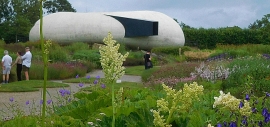
The garden slopes upwards from the gallery. At the top of the slope, there is something that at first sight looks like a giant hamburger patty or the profile of an oversized bagel. I recognised it immediately as being one of the former summer pavilions that once stood next to The Serpentine Gallery in Kensington Gardens. It is the 2014 Serpentine pavilion designed by Smiljan Radic (born 1965 in Santiago, Chile).
When I saw it in London in 2014, I was not overly impressed by it. However, seeing it at Hauser and Wirth in Somerset, it looks great. My description of it as an oversized bagel is not too far from the truth. It is, basically, an annular structure like a ring or a bagel, but it is far more interesting than that. Supported on rocks, the ring is not in one plane, but it undulates gradually. Irregularly shaped holes in its translucent skin provide intriguing views of Oudolf’s garden, which looks good in all seasons, and the surrounding hilly Somerset countryside.
A visit to Hauser and Wirth in Somerset makes a fine day out even if you have only a scant interest in contemporary art. The food served in the restaurant is of a high quality and not unreasonably priced. The buildings on the estate are lovely and the garden is hard to beat for its beauty.
EVERY YEAR SINCE 2000 (except 2020), the Serpentine Gallery in London’s Kensington Gardens has commissioned a temporary pavilion to be constructed next to it. A website (www.inexhibit.com/case-studies/serpentine-galleries-pavilions-history/) explains:
“The pavilions, which last for three months and should be realized with a limited budget, are located in the heart of the Kensington Gardens and are intended to provide a multi-purpose social space where people gather and interact with contemporary art, music, dance and film events.”
The architects chosen to design these temporary structures have not had any of their buildings erected in London prior to their pavilions. Some of the architects involved over the years included Zaha Hadid, Smiljan Radić, Sou Fujimoto, Herzog & de Meuron and Ai Weiwei, Kazuyo Sejima and Ryue Nishizawa, Frank Gehry, Olafur Eliasson & Kjetil Thorsen, Álvaro Siza, and Eduardo Souto de Moura with Cecil Balmond, and Oscar Niemeyer.
With a very few exceptions, I have liked the pavilions and admired their often visually intriguing, original designs. My favourites were the 2007 pavilion by Olafur Eliasson & Kjetil Thorsen; 2009 by Kazuyo Sejima and Ryue Nishizawa; 2013 by Sou Fujimoto; and 2016 by Bjarke Ingels.
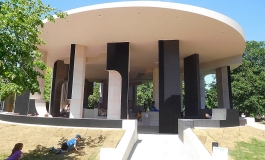
This year, the pavilion was designed by an architectural practice, Counterspace, based in Johannesburg (South Africa) and led by Sumayya Vally, who is the youngest architect to have become involved in the Serpentine pavilion project. According to the Serpentine’s website (www.serpentinegalleries.org/whats-on/serpentine-pavilion-2021-designed-by-counterspace/) the 2021 pavilion is:
“… based on past and present places of meeting, organising and belonging across several London neighbourhoods significant to diasporic and cross-cultural communities, including Brixton, Hoxton, Tower Hamlets, Edgware Road, Barking and Dagenham and Peckham, among others. Responding to the historical erasure and scarcity of informal community spaces across the city, the Pavilion references and pays homage to existing and erased places that have held communities over time and continue to do so today.”
Well, maybe this was the designers’ aim, but it does not convey that concept to me. This circular, building coloured black and white, immediately conjured up in my mind images of often disused municipal structures such as bandstands and public conveniences that might have been constructed on provincial British or even South African seafronts in the 1930s to 1950s. It might have been conceived with high-minded ideas in the architects’ heads, but I felt that the structure is lacking in visual interest both in detail and in its entirety. Compared with many of the previous pavilions erected on its site, this is one of the dullest I have seen. It is a shame that the pavilion’s creators did not put more effort into its appearance than into the message(s) it is supposed to convey. To my taste, it is a disappointment but do not let me put you off: go and see it for yourself.
DURING OUR TEENAGE YEARS, my friends. Francis, Hugh, and Michael, and I used to take short trips to places of interest outside London. Amongst the many places we visited were Oxford, Cambridge, Salisbury, and Winchester, to name but a few. In those days, the mid to late 1960s, none of us could drive. So, we had to rely on getting to places by public transport. On one occasion, we arrived in Cirencester, hoping to find some way of getting to the remains of the Roman villa at Chedworth, which is about ten miles distant from it. The situation looked desperate. We were worrying that we would have to walk when I spotted an old-fashioned looking bus arrive. The driver told us that he operated a once a week service that passed Chedworth. We boarded and reached our goal.
Pavilion by Smiljan Radic in the Oudolf Field garden
One place that we always wanted to visit was the garden at Stourhead in Wiltshire. Famed for its spectacular landscaping including many architectural ‘follies’, this place was, despite our extensive research, impossible to reach using public transport. It remained one of our greatest wishes to see Stourhead, as great as the Jewish people’s desire to see the so-called Holy Land. Stourhead was almost our ‘Goldene Medina’. We never managed to reach it together.
Many years later, in the 1990s, my wife and I made our first visit to Stourhead, travelling by car. We saw the place at its best on a bright sunny afternoon. In late September 2020, we returned to Stourhead on a grey, rainy afternoon during the covid19 pandemic. Despite the inclement weather and the restrictions as to where we could walk, we had a wonderful time. Every footstep we took led to one after another exciting view of the landscaped parkland. Wherever we looked, we saw fine trees and a wide variety of shrubs and other plants. Much of the walk is around an irregularly shaped man-made lake, the shores of which are dotted with architectural ‘follies’, constructed to enhance the romantic landscape. Many of these are built to resemble Greek or Roman classical temples. There is also a cottage built in Gothic Revival style and a wonderful and rather weird artificial grotto containing statues and fountains. Words cannot begin to do justice to the beauty of the gardens at Stourhead. The place has to be seen to be believed, and the weather, both good or bad, simply enhances the delightful experience that has been produced by nature skilfully assisted by mankind.
The gardens in the 2650-acre estate of Stourhead were designed by Henry Hoare II (1705-1785), a banker and garden designer. They were laid out between 1741 and 1780 in a classical 18th century design, based on the landscape paintings by artists such as Claude Lorraine and Poussin. The Hoare family owned paintings by some of these great masters. Many of the monuments or follies that adorn the garden were designed by the architect Henry Flitcroft (1697-1769), who died in Hampstead, the area in which I grew up. The slightly over one-mile long walk around the lake was designed to try to evoke a journey similar to that of Aeneas’s descent into the underworld. The design of this path was conceived to produce alterations in the mood of the visitor as he or she walks along it, moods reflecting those of Aeneas on his journey. If that was the intention, Aeneas must have had a wonderful trip.
In brief, the grounds at Stourhead should not be missed by anyone with even the very slightest interest in gardens. In the words of the Dutchman Baron Van Spaen van Biljoen (1746-1827), who visited the garden in the late 18th century:
“Nothing in England could compare with Stourhead … we were in such ecstasy we had the utmost difficulty in tearing ourselves away from this charming spot…”
This noble Dutchman visited many gardens in England with his stepfather-in-law, Baron W. C. H. van Lynden van Blitterswijk (1736–1816) during the summer of 1791. His opinion is still valid today. The Dutch visitors would have seen Stourhead when the oldest part of the garden would have been only fifty years old. The plants would have been far less developed than they are today. As my wife said wisely, Hoare and his family were not only creating the garden for themselves but for the many generations that would surely follow in their footsteps.
On the day we visited Stourhead, we visited another garden not far away, near the charming town of Bruton in Somerset. Like Stourhead, created in the 18th century to depict nature naturally but under the guiding hand of man, the Piet Oudolf Field next to the Somerset branch of the Hauser & Wirth art gallery is a carefully curated ‘wilderness’, an attractive sea of wild flowers and shrubs. Piet Oudolf (born 1944), a Dutch garden designer, began creating the one-and-a-half-acre garden next to the gallery less than ten years ago.
The garden grows on a plot that slopes gently down to the buildings housing the gallery. At the highest point in the garden, there is what looks like an oversized donut or, perhaps, a huge whiteish mushroom (when viewed from outside it). It is in fact a structure that was the temporary summer pavilion at London’s Serpentine Gallery in 2014. It rests on giant rocks and was designed by Smiljan Radic, a Chilean architect born in 1965. Made of a semi-transparent fibre-reinforced plastic shell, it is hollow and allows the visitor to walk around in what looks like part of a large snail shell. Although it looks quite different from the plants growing around it, its fungal resemblance makes it blend with them in a remarkably pleasing way.
Incidentally, the Oudolf Field is worth visiting in combination with the spacious art gallery and its associated restaurant that provides exceptionally good food. I recommend their Sunday roasts!
Both Stourhead and the nearby but much younger Oudolf Field, are fine and beautiful examples of man’s interaction with nature. Visiting these gardens lifted our spirits despite the rain that fell almost incessantly. I had to wait for over thirty years before my wish to visit Stourhead was fulfilled, but it was well worth waiting for.





 yamey
yamey 