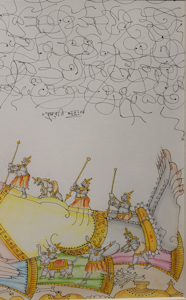
GANJIFA IS A traditional art of decorating playing-cards. Ganjifa cards originated in Persia and spread to India. They can be rectangular but are often circular. Traditionally, the Indian cards were decorated with scenes from the Ramayana.
By Raghupati Bhat
In the 1980s, Indian artist Raghupati Bhat revived the Mysore tradition of ganjifa painting. The Victoria and Albert Museum in London has a set of his ganjifa cards. Images of these are projected on a wall of Kaash Space, a gallery in Bangalore’s Berlie Street. They form part of a superb exhibition of later works by Bhat, all of which are developments of his earlier ganjifa artworks.
Raghupati Bhat’s drawings and paintings depict mythological stories from the Ramayana. All of them are exquisitely executed and filled with minute details. A set of four painted miniatures are painted with dyes made from natural products, using single hairs from paint brushes to achieve the great detailing within them. In many of his line drawings, Bhat included delicate, beautiful ‘doodles’ in addition to the pictures’ main subjects. All in all, the exhibition includes a fine selection of the artist’s intricately executed creative interpretations of episodes and characters in the Ramayana.
In addition to Bhat’s works, the exhibition includes three other artists’ works: some photographs, some paintings, and two beautiful inlaid wood panels. These other artists’ works were inspired by those of Raghupati Bhat.
This wonderful exhibition continues until 21 December 2025, and should not be missed if you happen to be in Bangalore.
DURING A VISIT to London’s National Gallery, I entered a room in which paintings by JMW Turner (1775-1851) and J Constable (1776-1837) were being displayed.
By Turner in the National Gallery
Seeing these artists’ works together reminded me of a visit to the Lady Lever Gallery in Port Sunlight (Cheshire). I wrote about this place in my book “An Alphabetical Tour of England”, and compared the two artists. Here is what I wrote in my book:
“In one small gallery, … two paintings hang close to each other but are separated by a neo-classical fireplace (an exhibit). One of them is by JMW Turner (1775-1851) and the other by his contemporary and rival J Constable (1776-1837). It is interesting to see them almost side-by-side because it allows the viewer to compare their styles and what they tried to convey in their paintings. The Turner painting depicts “The Falls of the Clyde”, and the Constable depicts “Cottage at Bergholt”. Neither of the paintings, both created in the age before photography, achieves the accuracy of, say, a photograph. Both seem impressionistic, but the effects that the artists were attempting to have on the viewer are entirely different. Turner’s paintings are often far more impressionistic than Constable’s. Although his subject matter is always at least almost discernible, I feel that Turner’s works were created to evoke both the artist’s and the viewer’s psychological and/or emotional reaction(s) to what was being depicted. In contrast, Constable’s painting techniques seem to have been designed to emphasise aspects of the scene he was painting to give the viewer the impression that he or she is looking at the very same view as that which attracted the artist. Constable regarded painting as being a branch of science. In a lecture he gave in 1836, he said:
‘Painting is a science and should be pursued as an inquiry into the laws of nature. Why, may not landscape painting be considered a branch of natural philosophy, of which pictures are but the experiments?’
Turner, in his almost abstract paintings such as the one at the Lady Lever, appeared to be wanting to stimulate the viewer’s deepest emotions. In contrast, Constable tried to convey to the viewer what he saw or felt was important in his subject matter. Without resorting to the almost photographic accuracy of, for example, both Canaletto and Vermeer, the two artists, whose paintings hang almost next to each other in the Lady Lever, successfully achieve their aims. For me, the avoidance of detailed accuracy of representation in both Turner’s and Constable’s paintings, enhances the impression of reality in my mind, something that photography cannot do to the same extent.
Even if you do not wish to compare Turner and Constable, I can strongly recommend a visit to the soap maker’s gallery in Port Sunlight …”
Seeing the paintings at the National Gallery reinforced my feelings as expressed above in the excerpt from my book.
THE WRITER CHARLOTTE Bronte (1816-1855) and her sister Emily lived in Brussels from 1842 to 1844. Charlotte’s novel “Villette” (published in 1853) is based on her stay in Belgium’s capital city. In the novel, a young female character, Lucy Snowe, visited a gallery in the city, and noticed a painting that had been set aside to be viewed by connoisseurs. It was described in the story as follows:
“It represented a woman, considerably larger, I thought, than the life. I calculated that this lady, put into a scale of magnitude, suitable for the reception of a commodity of bulk, would infallibly turn from fourteen to sixteen stone. She was, indeed, extremely well fed: very much butcher’s meat—to say nothing of bread, vegetables, and liquids—must she have consumed to attain that breadth and height, that wealth of muscle, that affluence of flesh. She lay half-reclined on a couch: why, it would be difficult to say; broad daylight blazed round her; she appeared in hearty health, strong enough to do the work of two plain cooks; she could not plead a weak spine; she ought to have been standing, or at least sitting bolt upright. She, had no business to lounge away the noon on a sofa. She ought likewise to have worn decent garments; a gown covering her properly, which was not the case: out of abundance of material—seven-and-twenty yards, I should say, of drapery—she managed to make inefficient raiment. … On referring to the catalogue, I found that this notable production bore the name ‘Cleopatra.’”
Today, 29 October 2025, we looked at a small exhibition in London’s Bury Street. Presented by a Turkish gallery, Guler & Guler, the show was called “Silks & Sultanas: Courtly Fabrics and Depictions of Women in the Ottoman World”. Mr Cem Güler kindly showed us around his small, but superb exhibition. One of the larger paintings, which depicts a reclining lady, is called “The Almeh” (i.e., The Sultan’s favourite), and was painted by Eduoard de Biefve (1808-1882), a Belgian. It was painted in 1842, the year that the Bronte girls arrived in Brussels. Mr Guler explained that this was the painting that Charlotte described in “Villette”. The description in the extract reproduced above is a good description of what we saw today, but the author added a few details that are not present in the painting.
In December 2023, the painting was auctioned by Sotheby’s in Dallas (USA). The auction house’s website remarked of this painting:
“The present painting met with a tumultuous reception in 1842 largely because of its title. The Arab term Almeh designates a class of educated women who sang and recited poems from behind a screen or from another room during parties or private entertainments. However, the term’s meaning became distorted and for many at that time it was associated with exhibitionist dancers whose suggestive dances had a sexual connotation. L’Almeh by Bièfve is deliberately provocative: languorously reclining on a couch, the woman looks directly at the viewer and points a finger at the mattress. It is hardly surprising that the painting met with such reactions.”
And in “Villette”, after being caught looking at the painting, the young English lady viewing it is told off by Monsieur Paul Emanuel, who clearly thought it an unsuitable picture to be seen by a young lady. And Lucy Snowe did not approve of it, as is related in the following from artdaily.com:
“We may think of our historic and leading creative minds as endlessly progressive, but in 1842, the indelible Charlotte Brontë came face to face with a controversial new painting, a true succès de scandale that by all evidence disturbed and irritated her so badly that she wrote at length about it in her final — and some say her best — novel, Villette. Brontë’s fictional proxy, the main character Lucy Snowe, stares at the painting (and its seductive subject) and thinks: ‘…this picture, I say, seemed to consider itself the queen of the collection. She lay half-reclined on a couch: why, it would be difficult to say … She had no business to lounge away the noon on a sofa. She ought likewise to have worn decent garments; a gown covering her properly, which was not the case … Then, for the wretched untidiness surrounding her, there could be no excuse … it was on the whole an enormous piece of claptrap’.”
We had entered the small gallery to see the exhibition because I wanted to see whether there were any paintings of women dressed in traditional Albanian folk costumes (Albania was part of the Ottoman empire until 1912). There were none, but, instead, I came face to face with a painting that had caught the attention of Charlotte Bronte soon after it was painted.
DURING A VISIT to the Frieze Masters art fair in London’s Regents Park in October 2025, we looked at a collection of Flemish paintings being exhibited by the De Jonckheere Gallery. One of these was “Allegory of Sight: A Collector’s Cabinet with Venus and Cupid”. It was painted in Antwerp between 1601 and 1678 by “Workshop of Jan Brueghel the Younger”. It is an example of several paintings with this title. According to Wikipedia, these artworks:
“… showcases varied objects associated with sight, the arts, and navigation. The painting was heavily influenced by The Five Senses, a series of allegorical paintings done by the younger Brueghel’s father, Jan Brueghel the Elder.”
“…translated as “rooms of art” and are meant to offer a glimpse into the depth and variety of these collections accumulated by the Dutch aristocracy.”
The painting at Frieze contains a gold chandelier that hangs from the ceiling. It is a decorative example, which includes an object that has interested me greatly since I was a teenager. At the top of the chandelier there is a double-headed eagle (‘DHE’). This is a bird with two heads, each on its own neck. In the painting, each of the heads is surmounted by a crown topped with a small cross. My interest in the DHE began when my fascination with Albania, whose flag contains a DHE, began in the mid-1960s. Chandeliers with DHEs appear in several other paintings by members of the Brueghel family (and their studios) in which the subject matter described above was depicted. I asked one of the gallery assistants about the DHE on the chandelier, and she had no idea about it. I was hoping that she would confirm my suspicion that the two-headed bird in the painting was related to the Holy Roman Empire and the Habsburgs, both of whose emblems included the DHE.
On returning home, I investigated further, and found a book (available online), “Rubens & Brueghel, A Working Friendship” by Anne T. Woollett and Ariane van Suchtelen. It deals mainly with paintings by Rubens and Jan Brueghel the Elder (1568-1625), the father of Jan Brueghel the Younger (1601-1678). In relation to the painting of “Sight” by Brueghel the Elder, it noted:
“It has often been assumed that this costly series of paintings was commissioned by Archdukes Albert and Isabella. Rubens had, after all, held the post of court painter since his return from Italy in 1 6 0 8, and Brueghel regularly worked for the court at Brussels. The couple’s palaces serve as background scenery in three of the five depictions, and Sight contains a double portrait of the regents and an equestrian portrait of Albert, as well as a brass chandelier crowned with the Habsburgs’ double-headed eagle.”
This being the case and because Brueghel’s son (and his workshop) would have been influenced by his father’s art, it is perhaps unsurprising to see the DHE on the chandelier in the painting we viewed at Frieze.
RACHEL JONES IS an artist who was born in London in 1991. She trained at Glasgow School of Art, then at the Royal Academy Schools. There is an exhibition of her paintings, “Gated Canyons”, at Dulwich Picture Gallery until 19 October 2025. I must admit I had never heard of her before visiting the show in August 2025. So, I went to see it without knowing what to expect.
Rachel’s colourful paintings on display vary in size and shape. All of them are more abstract than figurative, but not completely abstract. The artist uses colours well, producing appealing images. Many of them interested me as a retired dentist because most of what was on display included somewhat abstract depictions of jawbones, teeth, lips, and tongues. The artist regards the mouth as being important as it is a portal through which we interact with the outside world, express our feelings, and explore psychological landscapes. If I understand it correctly, Rachel regards the mouth as a gateway to both our inner selves and the outside world. Having read the informative labels that tell viewers about her work, I began seeing, or even imagining, elements of her paintings that might be interpreted as features of oral anatomy.
The exhibition occupies three rooms, one of which I felt was too small to properly view the three large pictures within it. Otherwise, the paintings were nicely displayed and well-lit. I am glad I saw the show, but I would be reluctant to recommend it to most people I know.
FRANCESCO CLEMENTE IS an artist born in Naples (Italy) in 1952. Since 1973, he has been visiting India regularly, and has worked there. He has developed a great interest in Asian religions including Hinduism and Buddhism. The 8 paintings in his exhibition, which is showing at the Lévy Gorvy Dayan gallery in Mayfair’s Dover Street until 27 September 2025, are evidence of Clemente’s interest in these belief systems.
The exhibition is called “Francesco Clemente: Self-Portraits in the Bardo”. The Bardo in the title is a concept of Tibetan Buddhism. It is the state of consciousness during the period between death and rebirth. The artist is depicted in the forefront of each picture. Behind them are fantastic depictions of both the peaceful and the angry deities that are believed to inhabit the Bardo. Whereas Clemente paints himself mainly in shades of grey, the deities are painted in vivid reds, yellows, and black. The artist insisted that the gallery walls be painted purple. This makes these vibrant paintings look even more dramatic.
Hung in a lovely large room with a patterned stucco ceiling, this small exhibition is definitely worth seeing.
THE ARTIST ANDREW Salgado was born in Canada in 1982. He graduated at Chelsea College of Art with a Masters Degree in Fine Arts. He lives and works between London (England) and New Brunswick (Canada). Until 28 June 2025, there is a wonderful exhibition of his imaginative, colourful paintings at Beers gallery in Little Britain, close to the Barbican and Smithfield Market.
The exhibition has the artist’s chosen title “Self-portrait as a Stack of Books”. Several of the paintings on display and one sculpture portray books. Salgado is an avid reader, and he says he has been influenced by some of the authors he has read. Whether they contain books or not, his creations are intriguing and hint at confused imagery of dreams. As to the artist’s intentions in the collection of works at Beers, the gallery’s hand-out noted:
“Asking Salgado about the intentions, symbolism, or directive in this collection of paintings – because it’s obviously ripe with his (now) trademark imagery – he becomes deferential, ambiguous, and almost evasive about everything from idea to technique, to presentation, and even the compelling title piece: a rare venture into sculpture which seems – whether through its books or its chair, or its uncanny, discombobulated human parts – to reference the paintings and even the act of painting itself. But also books. Words. Memory. Fallability. That head at the apex is glass. It’s his.”
It is right that the artist is evasive. He leaves the enjoyment of interpretations of his works to the viewer, and that is admirably democratic.
If you have not come across Beers gallery already, it is always worth visiting their exhibitions. The works they display are often joyfully colourful and never dull.
SIR WILLIAM ROTHENSTEIN (1872-1945) was born of German-Jewish parents in the Yorkshire city of Bradford. His father was involved in Bradford’s textile business. Trained at the Slade School of Art (part of London’s UCL), William became a well-known painter and cultural figure. Between 1920 and 1935, he was director of the Royal College of Art. Rabindranath Tagore dedicated his work “Gitanjali” to William. One of William’s sons, Michael Rothenstein (1908-1993), who was born in Hampstead, became a noted printmaker. He married Betty Mona Desmond Ayers (née FitzGerald; 1915-2017), who was known as ‘Duffy Ayres’. She was an English portrait painter.
Michael and Duffy had two children, one of whom is Anne Rothenstein (born 1949). She is a self-taught artist, who lives and works in London. Until 12 April 2025, there is an exhibition of her paintings at the Stephen Friedman Gallery in London’s Cork Street. Her attractive paintings, which seem deceptively simple when compared with those made by her grandfather William, depict portraits, interiors, and landscapes. However, they are far from simple. They are subtle and sometimes dreamlike. And as the gallery’s handout noted, her portrayal of perspective is unusual: the landscapes seem flattened. The paintings on display are oddly compelling and this along with their somewhat muted colouring, enhanced my enjoyment of Anne’s art.
As soon as we entered the gallery and I saw the artist’s name, I wondered whether she is related to the famous Sir William Rothenstein. When the gallery assistant informed us that she is from the same family, I was excited. Already, I knew of William’s connections with Hampstead and that he hosted Tagore, when the great Bengali visited London, but I had no idea that both his son and his granddaughter were artists (although far less well-known than him).
AN EXHIBITION AT LONDON’S Victoria and Albert Museum, which is showing until 5 May 2025, displays works of art created in the Moghul Empire between about 1560 and 1660, a period in which the Emperors Akbar, Jahangir and Shah Jahan reigned. Apart from wonderful jewels, jewellery, jewel-encrusted swords, and various other luxurious items, the exhibition contains a superb array of painted miniatures. Each one of these meticulously painted images is filled with a wealth of detail, and depict people as well as scenes of (often) courtly life.
The miniature paintings differ from those created in Western Europe (notably in Italy, France, Germany, and the Low Countries) during that period in many ways. One of these differences is the portrayal of perspective. To the eyes of people used to looking at Western European paintings of the late sixteenth and early seventeenth centuries, the Mughal miniatures seem to lack any obvious portrayal of perspective when compared to what was being painted at the same time in Western Europe.
Many of us living in the twenty-first century are accustomed to seeing perspective portrayed in the way it has been done since the fifteenth century, when it was pioneered by the architect and engineer Filippo Brunelleschi, who rediscovered what the Ancient Greeks and Romans knew already. While I was looking at the Mughal miniatures, I wondered whether people who were living in the Mughal Empire at the time when they were painted saw the images in a different way to us, who are used to having perspective ‘spelled out’ or depicted in the Western European way. Did they look at the paintings and understand the perspective, without it having to be emphasised as it is in European art? Did their experience of life, as it was, allow them to understand the spatial relationships of the subject matter depicted in the paintings, or would it have seemed to lack depth as it does when we look at it today? Or was the subject matter more important to them than how it looked in ‘real life’?