WE OFTEN VISIT the excellent Pig and Abbot pub in the tiny village of Abington Piggots in south Cambridgeshire because it has good food and a homely atmosphere. Near the pub stands the parish church of St Michael and All Angels, parts of whose structure date to the twelfth century. It contains many interesting features including a seventeenth century pulpit combined with a reading desk and a clerk’s desk. This is made from timber panelling including some carvings and is probably Flemish in origin. Fascinating as this is, there are two unusual features, which were pointed out to us by a church volunteer when we visited the church in April 2025.
The north door of the nave, which faces the entrance on the south side of the church, has two small squarish holes in it. And if you look carefully at the stone archway that marks the boundary between the nave and the chancel, you can see that a small chunk of masonry is missing. The holes in the door were most likely caused by the sharp tip of a spear or of a pikestaff. The missing chunk of masonry is most likely the result of musket shot having been fired at the archway. It is believed that the damage to the door and the archway was done in the time of Oliver Cromwell, when he had ordered the removal of decorative features from churches, Interestingly, a few panes of mediaeval stained glass remain intact high up in a window in the north wall of the nave. Clearly, Cromwell’s men missed these while they were destroying the rest of the stained glass.
HITCHIN IS A SMALL, attractive town in Hertfordshire. When we first visited it in 2020, despite an easing of the covid19 lockdown rules, we were unable to enter the town’s 14th to 15th century church of St Mary’s. On the 26th of August 2023, we spent a couple of hours in Hitchin and were able to enter the church. It contains many items of interest including a large painting created in the studio of Ruben’s.
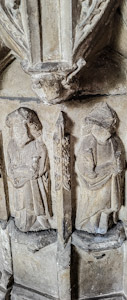
It was the 15th century carved stone font that particularly interested me. The column supporting the bowl, which contains water with which children are baptised, has twelve carved figures. These depict the 12 apostles. Looking at these closely, you will see that they are all mutilated. Their faces have been chipped away, leaving the figures faceless.
The very helpful and informative gentleman who was looking after the church was not sure whether the faces were obliterated by Thomas Cromwell during the Reformation of Henry VIII or during the time of that other iconoclast Oliver Cromwell.
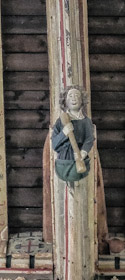
Luckily the carved angels that adorn the ceiling of the Chapel of St Andrew and a finely carved 15th century wooden screen escaped the attention of the iconoclasts. In one or two Suffolk churches we have visited, angels such as these were destroyed as part of the attempts to ‘purify’ the English Church.
Apart from what I have described, there are plenty of other things that make a visit to Hitchin’s church worthwhile. And if you enjoy ‘Olde Worlde’ British buildings, the town centre is rich in them.
IN 1975 I WENT to the town of Prizren in Kosovo, which was then part of the former Yugoslavia. I visited an old church in the town. Once, its internal walls had been covered with frescos. However, they had been badly defaced up to a certain height above ground level. Above that height and on the ceiling, they were intact. When the Ottoman soldiers arrived in Prizren, they used their spears to destroy the frescos, but only did so as far as they could reach. Being lazy, they did not use ladders to reach the higher parts of the church. So, the frescos beyond their reach survived.
In England, both the Dissolution of the Catholic religious establishments by Henry VIII, and later the defacement of churches by Oliver Cromwell and his followers, resulted in the destruction of many fine works of religious art. During a recent visit to Suffolk, we saw a few fine artefacts, which like the frescos in Prizren, have survived.
Bardwell
In accordance with Cromwell’s decree, many of the 15th century carved wooden angels that overlooked the nave of the parish church in Bardwell were destroyed. But, a few were left intact. Why was that? Did the workmen lose interest, or were they not paid enough? Who can say? And why was some of the 14th century stained glass left intact? Again, nobody can remember.
Over in the sleepy little town of Eye, the Parish Church contains a wooden rood screen containing beautifully painted panels that should surely have been destroyed by Cromwell’s iconoclastic vandals. Were they covered up with, say, wood panelling before the wreckers arrived, or were they removed and hidden? Luckily for us, these wonderful mediaeval paintings have survived.
Near Eye, there is a tiny church with a thatched roof in the village of Thornham Parva. It contains a rectangular wooden frame containing several mediaeval paintings that were created the 14th century. It was once the retable of an altar. Most likely, it was originally part of an altar in the Dominican Thetford Priory, which was dissolved during the reign of Henry VIII.
It is most probable that when the priory was dissolved, the retable was rescued by a Catholic family who put it in their private chapel. It passed through two other families before it was donated to the church at Thornham Parva in 1927. It is a rare surviving example of 14th century British religious painting. Interestingly, there is another series of painted panels in the Musée Cluny in Paris that resembles the Thornham Parva retable. Comparison of detailed aspects of these two sets of paintings suggests that they were both painted by the same team of artists, and were originally designed for the same location – most probably Thetford Priory.
In the space of three hours, we visited the churches at Bardwell, Eye, and Thornham Parva. All three contain artefacts of great interest and beauty which survived the religious upheavals orchestrated by Henry VIII and later by Cromwell. Once again, touring around in England has opened our eyes to its treasure house of history.
BANK HALL IN Warrington (Cheshire) was designed for the local industrialist Thomas Patten (1690-1772), who had successful copper processing works, and built in 1750. It was designed by James Gibbs (1682-1754), whose other creations include St Martin-in-the-Fields (London), Radcliffe Camera (Oxford), and the Senate House (Cambridge), to mention only a few. This elegant building with neo-classical features has served as Warrington’s Town Hall since about 1870. Impressive as the building is, its magnificence pales when it is compared to the grand gates at the entrance to its grounds.
Frederick Monks, a local ironmonger and town councillor, heard about a pair of wonderful cast-iron gates which had been made at the Coalbrookdale works at Ironbridge in Shropshire. The gates had been made to be exhibited at the International Exhibition held in South Kensington in 1862. The gates were intended for Queen Victoria’s residence at Sandringham (Norfolk). However, when she saw them at the exhibition, she noticed a statue of the regicide Oliver Cromwell behind them. This put her off the idea of installing them at Sandringham.
The gates, having been rejected by Victoria, were offered for sale by the company that had made them. Eventually, Frederick Monks purchased both the gates and the statue of Cromwell for his town, Warrington. The gates were installed in front of the Town Hall in the late 1890s. An informative website (www.warrington.gov.uk/history-golden-gates) describes features of the gates, which were recently restored beautifully:
“Because the owner was supposed to be Queen Victoria, the gates have four winged figures of Nike, the goddess of victory. They also had a Prince of Wales motif above the arch in the middle, but this was changed to Warrington’s Coat of Arms.” We had no idea that these gates with gold gilding existed. So, when we came across them during a post-prandial stroll, we were both surprised and delighted. When you see these beautiful gates, you can understand why Warrington is so lucky to have them. Incidentally, the bronze statue of Cromwell is also in the town: on Bridge Street. Before it was erected there in 1899, there was much discussion in the town council about the suitability of celebrating the regicide with the statue.
THE BOSTON TEA Party in Salisbury’s High Street serves great coffee and tasty breakfast dishes. It is housed in the premises of what used to be The Old George Inn. This hostelry is in a building, whose construction is said to have begun in the 14th century. Most of the older part of the former tavern straddles a pedestrian footway leading from the High Street to a modern shopping mall and its associated multi-storied car park.
The entrance to The Boston Tea Party is via a shop beneath a building that looks newer than the older looking half-timbered edifice straddling the passageway mentioned above. A staircase leads to a dining area above the shop, which is where we enjoyed breakfast one morning in March 2022. This room has a decoratively patterned plaster ceiling and the remains of an old inscription in gothic script. As we were leaving, I saw a notice that advised customers that if the section, where we ate, was closed, customers should proceed up to the ‘Great Hall’. I was intrigued.
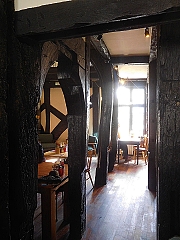
The Great Hall is one of the historical marvels of the city of Salisbury. Its ceiling is supported by beams cut from old ships’ timbers. The Inn has been rebuilt several times. However, the beams that exist today include wood from trees that were felled in the mid-15th century (www.buildingconservation.com/articles/george/inn_conservation.htm). Some of the walls are covered with wood panelling decorated with carvings and there are at least two elaborately carved wooden fireplace surrounds. Other decorative features include plasterwork covered with intricate bas-relief designs, and a lovely bow window overlooking the High Street. The hall is overlooked by a gallery with a balustrade. There is also a window with stained glass that includes a depiction of a royal coat-of-arms and the name of a king, probably Edward VI, who reigned from 1547 until 1553. According to the historicengland.org.uk website:
“On lst floor the south room has early C17 plaster work friezes on beams and carved wood overmantel. Projecting to east on north side open hall through 2 storeys. C15 hammerbeam roof, arched braces to collars. Heavy scissor bracing visible on 2nd floor lath decorated wall plates and spandrels. 2 rooms with tie beams and kingposts with 4-way struts.”
Over the centuries, The Old George Inn has had many visitors including William Shakespeare, Oliver Cromwell, Samuel Pepys, and Charles Dickens. It is believed that Shakespeare and his players, whilst on their way to Wilton, rehearsed “As You Like It” in the garden of the inn. Samuel Pepys spent one night at the inn but moved to another after having argued with the innkeeper over his bill.
Once upon a time, the Great Hall of the Old George Inn would have been filled with guests enjoying tankards of beer and ale and hearty meals. Today, in its reincarnation as The Boston Tea Party, the place is bustling with customers drinking cappuccinos and chai lattes as the consume trendy delicacies such as poached eggs on smashed avocado and ‘The Vegan Boss’. Whether or not you are thirsty or hungry, a visit to the Great Hall is a ‘must’ before or after you have viewed the cathedral.
DURING RECENT MONTHS, we have visited several places in East Anglia associated with Oliver Cromwell (1599-1658) and his family. These include Huntingdon, where he was born; Ramsey in Cambridgeshire, where his Royalist relative Oliver Cromwell lived; and Cambridge, where some say his head is hidden within one of the city’s colleges. Most recently, we visited Swaffham in Norfolk, where we entered the town’s magnificent parish church.
While looking around Swaffham’s Church of St Peter and St Paul, which was built in 1454 in the Early English gothic style, we came across an interesting funerary monument in a chapel on the south side of the building. The monument contains a sculpture of a woman on her knees with the left side of her face in profile and looking to the left. This monument, covered with heraldic crests, is a memorial to Catherine Stewart, only child and sole heir of Thomas Payne, formerly of Castleacre (Norfolk). Catherine Stewart, who died in 1590, was the second wife of the tithe farmer (a kind of tax collector) William Stewart of Ely, who was buried in Ely Cathedral in 1593.
William and Catherine’s daughter Elizabeth married twice. Her second husband was Thomas Cromwell. Oliver Cromwell, Britain’s ruler, The Lord Protector, between 1653 and 1658, was the son of Thomas and Elizabeth Cromwell. Thus, Catherine Stewart, whose monument we admired in Swaffham’s church, was Oliver Cromwell’s maternal grandmother.
Someone working at the museum in Swaffham told us that because his grandmother lived in Swaffham, Oliver Cromwell and his troops avoided damaging it during the Civil War, even though it was a town that supported the Royalists. After the Civil War was over, Cromwell mentioned Swaffham once in his recorded correspondence. When the fighting ended, the draining of the Fens resumed under the supervision of a new organisation of which Oliver Cromwell was a member, The Company of Adventurers for Draining the Great Level of the Fens. In 1653, 150 petitioners from Swaffham, who had asked about certain rights for them and had received notice that their grievances would be redressed, forced the Company’s workmen to cease working on the dykes and began to vandalise the work that had been done already. On the 23rd of April 1653, Cromwell wrote to Mr Parker, an agent of the Company:
“… I hear some unruly persons have committed great outrages in Cambridgeshire, about Swaffham and Botsham … Wherefore, I desire you to send one of my Troops, with a Captain, who may by all means, persuade the people to quiet, by letting them know, They must not riotously do anything, for that must not be suffered: but ‘that’ if there be any wrong done by the Adventurers, – upon complaint, such course shall be taken as appertains to justice, and right will be done.
I rest, your loving friend, OLIVER CROMWELL”
(Quoted from: “Oliver Cromwell’s Letters and Speeches: with Elucidations”, by Oliver Cromwell and Thomas Carlyle, published 1845)
I was puzzled to see that Cromwell associated the Norfolk town of Swaffham with the county of Cambridgeshire. With help of Google, I discovered that there is a Swaffham in Cambridgeshire: its full name is Swaffham Bulbeck. The latter is near Cambridge and includes the parish of Botsham (Bottisham).
“I think therefore, that I have succeeded that Oliver Cromwell’s ‘Royal Descent’ which passed muster with Carlyle and other historians, who have made it a peg on which to hang reflections more or less ridiculous, is a fabrication; and that he really sprang, ex parte materna, from a Norfolk family, probably of illegitimate descent, and certainly of no credit or renown, which had settled in Swaffham long before the alleged Scottish ancestor is supposed to have landed in England with his Royal master and kinsman.”
The Royal relative referred to above was King James VI of Scotland and Stewart is quite a common surname. Others might dispute Rye’s conclusion, but this is not the place to explore this further. Once again, a chance visit to a small town in the English countryside has opened a window to reveal one of the many fascinating aspects of the history of England.
NOT MUCH REMAINS of Ramsey Abbey in a part of Cambridgeshire, which used to be in the former county of Huntingdonshire. Like most of the monastic institutions in England, Ramsey Abbey was ‘dissolved’ by Henry VIII. Ramsay was closed in 1539.
Founded in 969 by Bishop Oswald of Worcestershire (died 992), this abbey in the Fens achieved great importance, rivalling Ely and Peterborough. Three centuries before the first college (Peterhouse) was established at Cambridge in 1284, Ramsey was a renowned centre of scholarship. In addition to theological matters, the scholars at Ramsey studied a wide range of other subjects. One of the most eminent scholars, Abbo of Fleury (c945-1004), was brought to Ramsey by Oswald in 985. Abbo brought much knowledge from both the Classical world and the Arabic world to Ramsey, where he stayed for 18 months. Another leading scholar was Byrhtferth (c970-c1020), who was well-known for his studies of English history. He also wrote a scientific compendium in about 990. This included material about mathematics, properties of matter, astronomy, and medicine.
Geoffrey of Huntingdon, who lived in the 13th century, was Prior of Ramsey Abbey for about 38 years. He was a scholar, with great fluency in the languages of Latin, Greek, and Hebrew. When the Jewish people were expelled from Britain in 1290, he bought from them as many Hebrew texts as he was ablee to find, including from the synagogues at Huntingdon and Stamford. Under Gregory’s influence, Ramsey became a centre of Hebrew studies. From the books and texts collected at Ramsey, a priest, Laurence Holbeach (died c1420), compiled a Hebrew dictionary in about 1410.
When Ramsey was dissolved in 1536, the dictionary was amongst the many scholarly works taken (or stolen) from the monastery by Robert Wakefield (or ‘Wachefeld) of Oxford, where he taught Hebrew from 1530 until his death. Wakefield, who died a year later, was a renowned English orientalist and Hebraist who taught at famous universities including Cambridge, Oxford, Paris, Louvain, and Tübingen. What became of this dictionary, I have not yet been able to discover.
Whether the dictionary remains in existence or not, I cannot say, but I do know that by visiting the small town of Ramsey, the visitor can see some remains of the former abbey. These include the remains of a gatehouse, which is now looked after by the National Trust and the Church of St Thomas à Becket, now a parish church. The latter was already constructed in the 12th century. It was probably originally built as a hospital or infirmary for the abbey, but by 1222, it had become a parish church. The aisles were rebuilt in the 16th century and the current west tower was built in 1672. The church contains some lovely stained-glass windows both behind the high altar and on the eastern part of the southern wall. These windows, created in the early part of the 20th century, were made by Morris & Co, a company founded by William Morris.
The former abbey has a connection with Oliver Cromwell (1599-1658), who was born in the nearby town of Huntingdon. In 1540, the estate of the former Ramsey Abbey was sold to Sir Richard Williams (1510-1544), also known as ‘Sir Richard Cromwell’. This man, who was Oliver Cromwell’s great grandfather, demolished most of the abbey, which was:
“… turned into a quarry, the lead from the roofs being melted down into fodders and ingots for sale to the highest bidder. Gonville and Caius college in Cambridge was built from the stone and Kings and Trinity were partly rebuilt. Stone from the Abbey also found its way into many local churches and other buildings” (https://ramseyabbey.co.uk/richard-cromwell/)
Richard’s son Henry built a Tudor house on the former abbey’s grounds. Henry’s son Oliver (born 1562), who was an ardent Royalist, much to the embarrassment of his nephew Oliver Cromwell, the famous Parliamentarian and ruler of England (the ‘Lord Protector’), lived in the house his father had built. This, the manor house, was sold to Coulson Fellowes in 1737 by the then owners, the Titus family. In 1804, the architect Sir John Soane enlarged the house. The building was further enlarged in 1839. Now the building houses Ramsey’s Abbey College. Currently the building looks far from being Tudor and by looking at its exterior, one cannot guess that it contains some remains of the early mediaeval abbey, on which it was built.
As a notice beside the remains of the gatehouse aptly states:
“After existing for nearly four centuries as the grounds of a private residence it is most fitting that a large part of the abbey site is now occupied by the Abbey College. The eighty or so monks in their black habits have been succeeded by a far greater number of students. Across the generations Ramsey has been the home of scholars who have sought to expand their knowledge of the world …”
I am certain that Bishop Oswald would be pleased to know although his scholarly establishment was closed by a King with dubious intentions, Ramsey continues to be a place of scholarship.
THE SUNDAY MORNING SERVICE at the parish church, St Mary the Virgin, in Haverhill in Suffolk had just ended when we entered the building. My wife chatted with a priest, who said he knew little about this church’s history. She asked him if there were any other churches in the district worth a visit. He mentioned two across the county border in Cambridgeshire, at the villages of Bartlow and at Hildersham. The two churches have something of interest in common: unusual colourful paintings.
Bartlow’s St Mary’s church has a distinctive round bell tower. But this is not the only thing that is remarkable about it. It was built in the 11th or 12th century and modified gradually during the following centuries. A real treat greets the visitor on entering the building: some colourful 15th century wall paintings, two on the south wall and one on the north. They depict St George’s dragon (north wall), and opposite this on the south wall: St Michael weighing the souls on The Day of Judgement, and east of it another shows a portrait of St Christopher carrying the Christ Child. The paintings existed long before the Civil War. On the 20th of March 1644, they were covered up with paint by Oliver Cromwell’s men under the command of William Dowsing (1596-1668), a fanatic iconoclast, also known as ‘Smasher Dowsing’. The frescos began to become uncovered in the 19th century, but it was only in 2014 that serious conservation work was undertaken on them.
St Christopher painting at Bartlow
The artists who created the wall paintings at Bartlow have been long forgotten, but this is not the case for the creators of the colourful chancel at Holy Trinity Church in nearby Hildersham. In 1806, the Reverend Charles Goodwin was appointed Rector of Hildersham. Ten years later, his son Robert was born. He studied at Clare College in Cambridge and whilst a student he joined The Cambridge Camden Society, whose aims were to promote the study of Gothic architecture and ‘ecclesiastical antiques’. This society grew to be a great influence on the design of Victorian churches.
In 1847, following the death of his father, Robert became Rector of Hildersham’s church. Soon, he began to consider how to ‘restore’ his church in accordance with gothic revival ideals. Amongst these ‘improvements’ was the painting of frescos on the walls of the chancel. These were executed using a novel technique known as ‘spirit fresco’, which made use of a complex mixture of beeswax, oil of spike lavender, spirits of turpentine, elemi resin, and copal varnish. This technique, invented by Thomas Gambier Parry (1816-1888), produced durable images that were easier to produce than the traditional fresco technique used, for example, in renaissance Italy. The chancel at Hildersham was painted using the new technique by Alfred Bell, John Clayton, and Stacy Marks. They and many assistants produced a magnificent display of saints and religious scenes, all from The New Testament. They were painted in 1890 and are in wonderful condition. The two churches are just under 4 miles apart and both are well worth visiting. And, when you do go to these buildings, you will find light switches near their entrance doors. We might never have seen them had it not been for my wife engaging in friendly conversation with the priest at Haverhill.
THE BATTLE OF NASEBY was fought on the 14th of June 1645 between the Royalists, led by King Charles I and his nephew Prince Rupert of the Rhine, and the Parliamentarians, led by Sir Thomas Fairfax and Oliver Cromwell. It was a victory for the Parliamentarians and the last major battle in the (First) English Civil War (1642-1646), putting an end to any hopes that the king had of winning the conflict. The battlefield at Naseby is about 5 miles southwest of the small Leicestershire town of Market Harborough, which we visited for the first time in July 2021. We dove there, almost accidentally, after having had a frustrating experience navigating the ring road around the town of Rugby without finding a route to its old centre. Shamefacedly, I must admit that we were completely ignorant of this town’s connections with the Civil War and the Battle of Naseby.
It was at Market Harborough that King Charles had his headquarters before the fight at Naseby. I am not sure which buildings in the town were used by the king, but one of them, still in existence, might possibly have been visited by the royal person. This is the former coaching inn, The Three Swans. Its website informs us with appropriate cautiousness:
“Like most old inns, The Three Swans has become the subject of a number of legends, often passed on with varying degrees of accuracy. One is that Charles I visited the inn on the night before the Battle of Naseby in June 1645. According to surviving records made at the time, the king actually retired for the night two miles down the road at the private house of Lubenham Hall. He was raised from his bed at 11pm by reports of the unexpected arrival of the Parliamentarian army just eight miles away at Naseby. He rushed to Market Harborough to meet his senior General, his nephew, Prince Rupert of the Rhine, who had established his military headquarters in the town.
At midnight they met with several other commanders for a council of war. The venue for the meeting is unknown. It could have been The Swan, or it could just as easily have been anywhere else in the town…” (from a pdf accessed via www.threeswans.co.uk/about/history/).
An information plaque in the town suggests that on the eve of the battle, the king and Prince Rupert conferred in an Inn on Church Street, the site of the present Kings Head Pub. The present establishment was built in the 19th century.
There might be some uncertainty about the king’s whereabouts in Market Harborough before the Battle of Naseby, but there is no doubt where some of his soldiers spent some time as prisoners after the Royalists were defeated. After the battle, the Parliamentarian Provost Marshall had to secure the 4000 to 5000 Royalist soldiers who had been captured during fight at Naseby. The only building in Market Harborough large enough to house this large number of captives and to secure them was the centrally located church of St Dionysius, which is close to both the Three Swans and The Kings Head. They were held in the church for one night before they were marched to London via nearby Northampton.
St Dionysius church and The Old Grammar School in Market Harborough
The construction of the Church of St Dionysius with its tall tower with steeple was started in the 13th century, but much of its structure dates to the 14th and 15th centuries. High up on a wall at the west end of the church is a depiction of the royal coat-of-arms dated 1660. This was the date when the monarchy, led by King Charles II, was restored in England. Five years earlier, the church was crowded with tired soldiers, who had fought in vain for Charles’s father, who was executed on the 30th of January 1649.
Some, if not all, of the Royalist soldiers, who were about to be incarcerated in St Dionysius, might have noticed a curious structure next to its southern side. Built in 1614, this building, which stands on sturdy wooden posts at least 6 feet high, must have seemed quite new in 1645. It was the grammar school founded by in 1607 by Robert Smyth, a resident of the town who became Comptroller of the City of London’s Chamber and member of the Merchant Taylors’ Company. The structure, which you see today, was funded by Smyth’s money. The school, which is accessed by a staircase, stands raised high above the ground. The space beneath it was created to keep the town’s market dry in wet weather. Many years later, a descendant of this school was established elsewhere in the town. Now known as the Robert Smyth Academy, one of its past students was the Nobel Prize winning physicist, Sir William Henry Bragg.
Today, the centre of Market Harborough is pleasantly vibrant with a good range of shops and eateries. Contemporary life and memories of the town’s history rub shoulders harmoniously in this place that deserves the attention of more tourists.
On our return from Market Harborough and the fascinating Foxton lock staircase nearby, we did manage to find our way into the heart of the town of Rugby, which did not impress us nearly as much as Market Harborough.
THE CONSERVATIVE CLUB in Cornwall’s Wadebridge has opened its doors to the general public. Visitors to the club of any political persuasion can enjoy superbly cooked food in its bar and dining room, which bears the name ‘Winstons’. The club, which is located at the higher end of Molesworth Street, is housed in a building that is far more than 100 years old. The street runs gently downhill towards a multi-arched stone bridge that crosses the River Camel.
Before there was a bridge across the river, the town now known as Wadebridge was called ‘Wade’ and stood beside a ford across the Camel, whose name probably means ‘crooked one’. Crossing the river by means of the ford was perilous. Before the bridge was built, a ferry became available as an additional means of traversing the wide stream. Becoming distressed by the number of people and animals that died whilst attempting to cross the river, the Reverend Thomas Lovibond, Vicar of Egloshayle, had the idea of building a bridge. This bridge was constructed between 1468 and 1485. It is said that its supporting piers rested on packs of wool. With the arrival of the bridge, the town of Wade became renamed ‘Wadebridge’. The chronicler and topographer William of Worcester (1415-c1482) mentioned the bridge as ‘Wade-brygge’ in 1478’.
The bridge was widened in 1853 and again in 1963. It was refurbished in 1994. Although the stonework of the arches looks old, I am not sure how much of it is part of what was constructed in the late 15th century.
During the Civil War (1642-1651), Cornwall was a Royalist stronghold. Much of the rest of the southwest of England supported the Royalist’s opponents, the Parliamentarians. Wadebridge’s bridge was an important strategic location. In 1646, the Parliamentarian Oliver Cromwell (1599-1658) led 500 dragoons and 1000 horsemen successfully to take control of the bridge. The story goes as follows (www.cornwalllive.com/news/history/oliver-cromwell-came-person-take-511634):
“After losing the decisive Battle of Torrington in Devon on February 16, 1646, the Royalists escaped into Cornwall … [the] Parliamentarians, led by Thomas Fairfax, hunted them down and reached Launceston on February 25 and Bodmin on March 2 … On March 5 the Cornish Royalist leaders realised they were fighting a losing battle and surrendered the east of Cornwall to the Parliamentarians at Millbrook … A day later, as the battle moved westwards, Parliamentarian commander Oliver Cromwell and 1,500 of his soldiers descended onto Wadebridge to take control of the bridge and prevent its use by the Royalist army. The route across the bridge was considered to be of such strategic importance that Cromwell, who had been spending months mopping up resistance in Devon and Cornwall, personally led his troops there to capture it.”
The huge forces brought by Cromwell were either unnecessary or an effective deterrent because the Royalists withdrew without putting up a fight (www.wadebridgemuseum.co.uk/bridge.html).
The first motor car to cross the bridge did so in 1901. The crossing continues to play an important role in the transport network of Cornwall. The town is a charming small centre, well supplied with pubs, independent shops, and branches of supermarket chains. It is a part of the Parliamentary constituency of North Cornwall. Diners at, and members of, Wadebridge Conservative Club might (or might not) be pleased to know that the local MP since 2015 is Scott Mann, a Conservative. He was born in Wadebridge and attended its local state secondary school. I suppose that he must have dined or drunk at the Conservative Club where we enjoyed first class food. So, next time you are in Wadebridge, sweep aside any political prejudices you might harbour and head for Winstons at the Conservative Club and enjoy a great meal.





 yamey
yamey 