WE VISITED BANGALORE’S Chitrakala Parishath, an art school, on the last day of an exhibition called “Hidden Gems of the Western Ghats”. We were alerted to it by a good friend, Ajay Ghatage, who posted something about it on Facebook.
The Western Ghats are a line of hills and mountains that separate the Deccan Plateau from the western coastal strip of India, the shore of the Arabian Sea. The ghats are in the most part forested.
The exhibition included sculptures, many of them beautiful stone carvings, paintings, and a few ‘installations’. Each work expresses its creator’s reaction to the nature and its exploitation (and/or despoliation) by mankind. And the majority of the artworks on display did this well, beautifully, and often highly imaginatively.
Amongst the installations, there was one by Shivanand Shyagoti that particularly attracted my attention. It consisted of a tree trunk into which hatchets had been stuck. On the wooden handles of each of these choppers, there were line drawings of the woodland creatures whose habitat would be disturbed by deforestation.
The other works on display were at least as imaginative as the one described above. What was impressive about the majority of the artworks was that although they often conveyed messages about the fragility of the natural environments of the Western Ghats, they did it subtly, creatively, and, most importantly, beautifully.
DURING THE EASTER weekend, we visited two exhibitions. Unlike many exhibitions I have written about lately, neither of them finish soon. Both shows relate to wood and trees. One is being held at the Serpentine South Gallery in Kensington Gardens and it ends on 7 September 2025, and the other is at Japan House in High Street Kensington and continues until 6 July 2025. So, there is plenty of time to see both exhibitions.
By Giuseppe Penone
The show at the Serpentine is of artworks by the Italian artist Giuseppe Penone. I have already written a bit about him (https://adam-yamey-writes.com/2025/04/15/boulders-lodged-in-trees-at-a-park-in-london/). I did this after seeing those of his works that are on display near the outside of the Serpentine Gallery. I have now seen what is on display within the gallery, and was pleasantly surprised. Penone is fascinated by the intricate relationships between humans and nature, and this is what inspires his artworks. Many of the artefacts (paintings, installations, and sculptures) on display relate to trees and their leaves. The walls of the central hall of the Serpentine Gallery are lined with containers that hold thousands of dead laurel leaves. Another exhibit consists of semi-abstract sculptures that resemble human forms, and these are entwined with living plants growing out of large flower pots. Other works are formed from pieces of wood and twigs. One particularly effective work consisted of living branches with leaves and twigs. One of the twigs has been forced through a hole cut in a photograph of a man’s face in such a way that the twig seems to have grown from within the centre of the eye. I like this piece because it encapsulates what Penone does: he sees nature through his eyes and is inspired by what he sees.
In contrast to Penone’s work at the Serpentine, which is art for art’s sake, the exhibition at Japan House is designed to illustrate how man can create artistic yet functional artefacts from wood. Called “The Craft of Carpentry: Drawing Life from Japan’s Forests”, the show sets out (successfully) to illustrate the amazing skills of traditional Japanese carpentry. This informatively labelled exhibition has exhibits showing the variety of tools used, the types of wood employed, the range of joinery methods, templates for cutting shapes, and some of the final products including a life-size replica of the Se-an teahouse in a temple in Kyoto. Although everything on display is related to creating functional products, each exhibit is so beautiful that it could be considered a work of art in its own right. As with every exhibition I have seen at Japan House, the exhibits are displayed imaginatively and beautifully. The exhibitions themselves are works of art.
I recommend visiting both exhibitions not only because they are fascinating but also because they illustrate two completely different approaches to dealing with trees and their wood.
AJIT KUMAR DAS was born in 1957, son of a laundry man (washer man). From an early age, he became fascinated with the wonderful colours of the textiles that his father washed. He became involved with traditional fabric printing and design. Today, Das is recognised as one of India’s foremost natural dye painters.
Das paints on cloth using natural dyes, rather than artificially created colours. He uses dyes derived ed from sources such as, for example, pomegranate rind, turmeric, fermented iron solution, indigo, and madder. He applies them using bamboo brushes and handmade quills. The colours are fixed using alum as mordant. With decades of experience and experimentation, he is able to use the natural dyes to produce interesting colourful effects.
At his exhibition held in a magnificent gallery in the Kolkata Centre for Creativity, we were able to view more than 20 of his paintings. All of them feature closely observed natural objects, such as foliage, birds, and fish, all arranged in patterns on the textiles. Some of these compositions are naturalistic. In others, Das has arranged the details from nature to produce lovely patterns.
We were fortunate to have been at the inauguration of the exhibition, during which the soft-spoken Das discussed his works with a panel of invited guests. From what I could gather, the panellists were more interested in the current state of natural dye crafts than the artist’s works on display. I am pleased that we made the journey from central Kolkata to the outlying district of Anandapur to see the exhibition and to learn a little about the use of natural dyes in traditional methods of textile making.
I ENJOY VIEWING sculpture displayed in the open-air. Seeing sculpture ‘al-fresco’ is for me much more pleasant than viewing it in a gallery. From time to time, the Royal Botanic Gardens at Kew hosts outdoor sculpture displays. In the past, I have seen exhibitions of works by Henry Moore and Dale Chihuly. This year (2024), there are several sculptures by Marc Quinn dotted around the gardens. Quinn, who was born in the UK in 1964 is an adventurous creator, whose works sometimes give rise to controversy. I do not believe that the collection of his works now on display in Kew will give rise to much, if any, controversy.
Except for several bronze sculptures depicting larger than life bonsai trees, which have been placed in the Temperate House, the rest of the sculptures are made in highly reflective stainless steel. Appropriately for their setting, these sculptures are derived from the shapes of plants, leaves, and flowers. Because they are so reflective, they reflect the plants and trees growing near them. This helps to camouflage them, or make them seem as if they are merging with the surrounding vegetation. Although they contrast dramatically with their surroundings, their reflective nature softens the contrast when viewed from certain angles.
When I see sculpture next to nature, I often feel that however well the artwork has been created, it often palls when compared to what Nature has created. Quinn’s work at Kew has this effect, but somehow, probably because it reflects the plants around it, the comparison between what he created and what has been growing naturally is not too marked, and did not disturb me.
A visit to Kew Gardens is always enjoyable, and seeing the place with Quinn’s work in situ was a good experience. The exhibition will continue until the 29th of September 2024.
BETWEEN 1983 AND 1994, I owned a house in Gillingham, Kent. It was not an exceptional building, but it had a long back garden – 180 feet in length and about 22 feet wide. Much of the garden was covered with a lawn bordered by plant beds. When I first moved in, I attended the garden keenly even though I had little idea about gardening. As soon as I unearthed weeds, they re-appeared. It was most disheartening. I discovered that planting shrubs was the best way to hide the weeds, about which I soon stopped worrying.
As for the lawn, I acquired a mowing machine, and for some months, or maybe years, I trimmed the grass regularly. Then, I found that whenever I cut the lawn, my nose would start streaming and I would have fits of sneezing. I realised that I had a grass allergy. So, I decided to cease mowing the lawn. I let the grass grow higher and higher. When it reached its greatest height, people sitting in the garden would be hidden by it. At the end of the year, the grass collapsed and more or less disappeared – only to begin growing again the following spring. I let nature take its course, and ceased worrying about it until a deputation consisting of my immediate neighbours came to my house to complain about my unruly lawn and garden. One of them, an elderly lady, was convinced that all the weeds and insects in her garden had come from mine.
One summer evening, I came home after dark and as it was a pleasant evening, I stood in my back garden looking up at the stars. As I did so, I was aware of a slight smell of burning. The following day, one of my neighbours saw me in the street as I was setting off for work. He told me that the neighbour on the other side of the garden had set fire to mine, hoping that the flames would kill the weeds. Luckily, he had spotted the conflagration, and extinguished it before it did too much damage.
Following the neighbours’ complaints, I conceived an idea about how to deal with my lawn. I decided that I would let it grow without interference, but I would mow a narrow sinuous path along its length. The idea was that I could then explain to the neighbours that the wild grass was part of my garden design. Meanwhile, my shrubs increased in size steadily and the weeds flourished. In the warmer months of the year, whenever I strolled in my garden, clouds of butterflies used to billow from the luxuriant vegetation.
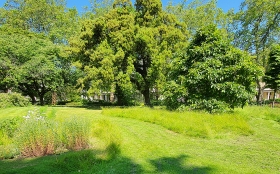
Today, in June 2023, whilst walking in Kensington Gardens, I noticed that much of the grass was growing wild – not being mowed. Here and there, the gardeners had trimmed small areas of grass with a lawnmower, much as I used to do back in Gillingham in the 1980s.
To be honest, I let my garden grow wild because I could not be bothered to spend hours of my life making it look neat and tidy. Today, what I was doing – letting the plants ‘do their own thing’ – is known as ‘wilding’. Maybe, unwittingly I was a pioneer of wilding.
The artist uses delicate models of the natural world to illustrate that life simultaneously has its dark and light aspects. This innovative exhibition has to be seen to be believed. It makes for an intriguing accompaniment to the lovely botanical gardens.
THE ARTIST JOHN Constable (1776-1837) loved Hampstead and eventually lived there. It was in that part of London, then a large village, that he became fascinated by the depiction of clouds. Here is an extract relating to this from a book about Hampstead, which I am in the process of writing:
In the last of a series lectures he gave to the Royal Institution in Albermarle Street in 1836, Constable emphasised his systematic approach to depicting nature, by saying:
“Painting is a science and should be pursued as an inquiry into the laws of nature. Why, may not landscape painting be considered a branch of natural philosophy, of which pictures are but the experiments?”
Clouds over Hampstead Heath by John Constable
One of Hampstead’s attractions for Constable was its wide expanse of sky, which, as the historian Thomas Barratt wrote, the artist:
“… regarded as the keynote of landscape art, and so assiduously did he study cloud, sky, and atmosphere in the Hampstead days that Leslie, his biographer, was able to become possessed of twenty of these special studies, each dated and described. Constable was a man of Wordsworthian simplicity of character, fond of all things rural, and devotedly attached to birds and animals.”
The website of Cambridge’s Fitzwilliam Museum reinforces what Barratt wrote:
“While living at Hampstead, Constable made a series of oil sketches of the sky alone, each one marked with the date, time and a short description of the conditions. His interest in clouds was influenced partly by the work of the scientist Luke Howard, who had in 1803 written a pioneering study, classifying different types of cloud …”
In “The Invention of Clouds” by Richard Hamblyn, a biography of the chemist and amateur meteorologist, who devised the modern classification of clouds (cumulus, nimbus, etc.), Luke Howard (1772-1864), it is noted that Constable, who was familiar with Howard’s work, focussed his concentration:
“… on the extension of his observational range and clouds were the means that he had chosen for the task. After years of searching for an isolated image, seeking a motif upon which to weigh his technical advancement as a painter, he had found it at last in the unending sequences of clouds that emerged and dissolved before his eyes like images on a photographic plate.”
During the summers of 1821 and 1822, Constable made over one hundred cloud studies on the higher ground of Hampstead and its heath. Writing in 1964 in his “The Philosophy of Modern Art”, the art critic/historian Herbert Read (1893-1968), who lived in Hampstead, commented that Constable was:
“… rather a modest craftsman, interested in the efficiency of his tools, the chemistry of his materials, the technique of his craft. His preparatory ‘sketches’ are no more romantic than a weather report. But they are accurate, they are vividly expressed, they are truthful.”
Read next contrasted Constable with Turner, pointing out that the former was far more attentive to depicting nature accurately than the latter, who became increasingly extravagant in his portrayal of it, always moving towards what is now called ‘expressionist’. Barratt wrote that although Constable admired Turner, he had no desire to imitate him and:
“He knew his limits, and recognised that within those limits were to be found subjects worthy of the highest aspirations. “I was born to paint a happier land,” he wrote, “ my own dear England ; and when I cease to love her may I, as Wordsworth says, — ‘never more hear her green leaves rustle or her torrents roar..’”