THE ROYAL BOMBAY Yacht Club faces the famous Gateway of India. One side of the club’s compound runs along Adom Street. ‘Adom’ is a transliteration of a transliteration of ‘Adam’.
Adam at Adom Street
According to Samuel T Sheppard’s book “Bombay Place-Names and Street-Names”, the Street is named after the British architect John Adams. He taught architectural drawing at Bombay’s esteemed Sir JJ School of Art.
Adams designed the Royal Yacht Club’s present building that faces the Gateway of India. Although the club was founded in 1846, Adams’s edifice was opened in 1898.
It is appropriate that a Street running next to his building now bears his name, even though on the street ame sign, it is now spelled Adom instead of Adam.
ALMOST EXACTLY TWO years ago (in December 2023), we spent a few nights in the Moti International hotel in a street leading off Bombay’s bustling Colaba Causeway. Despite its impressive sounding name, this hotel was curiously interesting.
It is housed in Moti Mansion, a large house built by a Parsi family in about 1900.
Moti Mansion in November 2025
We had not booked the hotel in advance, but walked in to enquire whether we could stay fir a few nights. The young man at the small reception desk asked us: “Are you married?”
We told him that we were and then he said: “I have to ask you because, you see, my grandfather who lives with us on the top floors, is an old fashioned orthodox Hindu.”
Our ground floor room was adequate, air-conditioned,and had a decent attached bathroom. Sadly, the windows had been painted over. So there was no daylight. When we asked for a kettle, the young man explained: “Yes, but I must charge you an extra 100 rupees for three days of electricity.” We were happy with that.
On our last morning, we met the boy’s mother. She showed us the buildings impressive main wooden staircase. She explained that many of the rooms in the building were occupied by long-stay guests.
Today, 19 November 2025, we walked past Moti Mansion. Its street facing facade wast partly hidden by scaffolding and almost all the windows were covered over with wooden boarding.
I wonder what the future holds for this charming edifice.
THE IMPRESSIVE GATEWAY of India stands on a short promontory surrounded on three sides by the water of the Arabian Sea. The sea surrounding the Gateway is crowded with small, colourful vessels. Seeing one of these craft reminded me of a story told to me by a friend many years ago.
In Bombay
My friend had just returned from Kenya. During his stay there he spent several days at sea on a local trading ship. It was a very basic vessel. He told me that he could not find a toilet on board. Eventually, he could no longer resist the urge, and asked the crew where he could relieve himself. He was directed to the rear of the vessel and shown a toilet seat that was suspended from it over the waters below. With some difficulty he managed to sit on the swinging toilet seat, and to his great embarrassment, the entire crew came to the back of the ship to watch him in action.
That really happened a long time ago. Today, 17 November 2025, while visiting the Gateway of India, I spotted a small boat. Projecting from its rear and hanging over the water, there was a small, square based cubicle with a door. On the door, there was the word “TOILET”. Seeing this reminded me of my friend’s story. Users of this cabin are shielded from sight, unlike that swinging loo seat on the Kenyan boat.
BORN IN PUNE (Maharashtra, India) in 1949, Sudhir Patwardhan qualified as a medical doctor in 1972. He worked as a radiologist in Thane (Bombay) between 1975 and 2005. Then, he moved from medicine to become a full-time artist. Until the 19th of October 2024, there is an exhibition of his paintings at number 3 Cork Street in London’s Mayfair.
The exhibition is called “Cities: built, broken”. As its name suggests, the show is filled with Patwardhan’s paintings, each of which depicts scenes of urban life. His beautifully executed, colourful paintings evoke daily life in Thane and Bombay (Mumbai). As the gallery’s website (www.frieze.com/no9-cork-street/vahdera-art-gallery-sudhir-patwardhan) explained:
“As a man of medicine, Patwardhan displays a profound understanding of the human figure, including its mental distortions and physical vagaries, with early inspiration from Cézanne and Picasso refining his intent. In this recent body of work, Patwardhan’s well-regarded visceral realism explores various dialectics and asymmetries, including class struggles, tensions between the material and spiritual and the emotional theatre of community. The shifting deportment of his figures across a series of charged slice-of-life scenes offers a moving portrait of the bustling annals of cities, where capitalist consumption, gentrification and the erosion of natural spaces are but few of the contested arguments about what constitutes as urban progress. He brings us a visual meditation on the geometric correspondences between various kinds of structures growing out of anarchic infrastructural development – often referred to colloquially in India as jugaad, or a kind of organized chaos.”
I could not have put this better. It describes the subject matter of the paintings beautifully. However, rather than just reading about it, I suggest that you see these wonderful paintings before the exhibition ends.
A DEEPSTHAMBH IS a Hindu architectural feature found near temples or temple compounds. It is a tower with many small niches into which small oil lamps (diyas) are placed and lit to celebrate special Hindu occasions. A good place to see a number of these is at Bombay’s Banganga Tank in the Walkeshwar area.
Two deepsthambhs next to Banganga Tank
The tank is a rectangular pool surrounded by steps that lead into the water contained within it. At one corner of the tank water flows from a spring vigorously into the pool. The tank is full of large fish, which the locals feed. Being in a strictly vegetarian neighbourhood, these fish are safe from being caught and eaten. The tank is surrounded by houses and many smallish temples. The Tank is a few yards from the rock strewn seashore.
The tank was first built in 1127 AD by Lakshman Prabhu, a minister in the Sihara Court of Thane. This makes the Tank one of the oldest surviving features of what is now Mumbai. It was rebuilt in 1715. According to legend, the spring that now feeds the Tank appeared suddenly when Rama stopped at this spot during his search for Sita.
Banganga Tank is a pleasant spot at which to linger. So near to the hustle and bustle of Mumbai, here is a place that us both beautiful and relatively peaceful. It gives me a good feeling.
THERE IS A PHOTOGRAPH in the “Times of India” (Mumbai edition: 19th of December 2023). It is a good image showing a group of women wearing saris, and seated on a wall next to the sea close to the Gateway of India. The picture on its own is a pleasure to see, but what enhanced my enjoyment of it was its wonderfully witty title: “SAREE SOIREE AT THE GATEWAY”
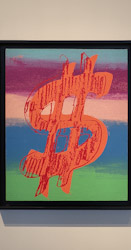
DURING THE FEW DAYS we have been in Bombay, we have visited 10 art galleries. With one exception, the exhibitions have been both beautifully displayed and contained exciting works of art. The exception is an exhibition of Pop Art being held at the recently constructed Nita Mukesh Ambani Cultural Centre in the Bandra Kurla district of Bombay.
The spacious gallery occupies parts of four floors of a glitzy cultural centre-cum-shopping mall. To view the exhibition, one needs to book a time-slot, and part with 800 Rupees (about £8) per person. When we visited on a Sunday afternoon, the few visitors to the gallery were vastly outnumbered by security personnel and charming, but seemingly poorly informed, young ladies who are employed to provide information about the exhibits.
The flyer for the exhibition promises the visitor the opportunity to see works by 12 exponents of Pop Art. However, the majority of the items were creations of Andy Warhol. Almost my favourite piece was a large creation by Robert Rauschenberg.
Each of the very spacious, well-lit galleries had surprisingly few artworks. Of the four galleries, I thought that the one on the third floor was best. It contained, amongst a few other things, the Rauschenberg, and a work by Claes Oldenburg, and yet more Warhol images.
Would I recommend making a visit to this exhibition? Probably, I would not. If you are familiar with Pop Art it offers little to add to what you already know and/or like. If you are not familiar with this kind of art, I am not sure that the exhibition would provide you with much if any insight. And at 800 Rupees per person, you might be better off buying a decent book about this exciting era of art.
NEAR BOMBAY’S FLORA Fountain there are several booksellers on the pavement. They stock both new (original and pirated copies) and old books. In general, the vendors are amenable to bargaining with their customers.
Today (in December 2023), I found a second-hand, oldish book about the history of Bombay. It looked as if it would satisfy my requirements. I asked the price. It was 800 Rupees. Because I have become accustomed to hagling over the price I offered 600. I was hoping that we would eventually agree on a price of about 700. The bookseller was adamant. He would sell it for 800 and no less. He kept saying it had been 1000 when it was new … long ago. I walked away, and viewed other bookstalls nearby.
Keen to have the book, I returned and offered 750. The stubborn vendor said to me: “What is 50 Rupees to you? You are rich man.” I walked away, and joined my wife who had just engaged a taxi to take us elsewhere. Seeing me board the taxi, the bookseller ran up to our vehicle, and proposed that we pay 780. My wife, who was not yet in the vehicle, offered him 750, which he accepted.
The man was right. What was 50 Rupees to me? Only about 50 pence. However, that was not the point. Getting the book was one thing but the pleasure of fighting to reduce the price, and succeeding, is another. And the sense of achievement after serious bargaining leaves me with a curiously fine sense of contentment.




 yamey
yamey 