MOST PEOPLE ASSOCIATE Varanasi (Benares) with Hindu temples and practices. However, the city is important to other religions, notably Islam.
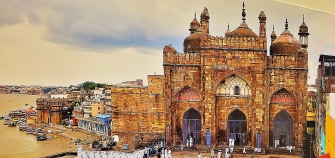
The largest mosque in Varanasi
Recently, we viewed an exhibition called “Mughal Banaras” at SOAS Gallery in London. It was a collection of excellent photographs taken by architect and photographer Jateen Lad who collaborated with historian Malavika Kasturi.
In a Hindu math (monastery) which existed during the time when the city was under Mughal rule, there is a collection of Mughal firmans (official documents) on display, including one written by Dara Shikoh, who was murdered by his brother Aurangzeb).
We were fortunate to have met Jateen at the exhibition, and he showed us around. His superb commentary brought the pictures to life, and discussed the historical importance of, and the current circumstances of the Muslims in the city.
THE CITY OF Ahmedabad was founded in 1411 AD when Ahmad Shah I of the Gujarat Sultanate moved his capital to the already existing settlement of Ashaval. He renamed the place as Ahmedabad. During the fifteenth and sixteenth centuries, many fine mosques were built in the city. During previous visits to Ahmedabad, we have looked at many of these edifice.
Today, 29 November 2025, we came across a mosque we had not seen before. It, the Rani Rupamati (aka Rupavati) Masjid, is beside the main road (Mirzapur Rd) that leads from the Sidi Saiyed mosque in the city centre to the Delhi Gate.
The Rani Rupamati Masjid was constructed in the fifteenth century, possibly Sultan Mahmud Begada for Rani Rupamati, whom he married. The mosque and the dargah next door to it are connected with Sunni Sufism.
Architecturally, the mosque shares many features in common with other mosques built in Ahmedabad and the rest of Gujarat in the fifteenth and sixteenth centuries. Built in the so-called Indo-Saracenic style, this mosque and others built in the same era contain architectural and decorative features often found in Hindu and Jain temples. Although rich in decorative ornamentation, the mosques, unlike the temples, are devoid of representations of people and animals. Floral and leafy motifs can be found at the Rupamati Masjid, as well as at other mosques built in the same era. The highly decorated bases of two minarets can be seen but the tall upper parts of the minarets were listed during an earthquake in the early nineteenth century.
Beside the mosque and within its grounds, there is another structure, topped by two domes. This pillared hall contains the tombs of Rupamati and other worthies.
The mosque is a protected historical monument, but is still used by worshippers. Although it is an attractive building, it does not seem to be on the main ‘tourist trail’.
THE TOLLYGUNGE CLUB in South Kolkata stands on land, which was once the home of members of the family of Tipu Sultan (1751-1799). He fought first the Marathas, and then the British valiantly until his death at Srirangapatnam. Had Tipu not been defeated, the British might have had great difficulty maintai g a foot in India.
Four years before Tipu’s death, his youngest son Ghulam Muhammad Sultan Sahib (1795-1872) was born in Srirangapatnam. In 1806, he and the rest of his family were deported to Calcutta by the British, and were settled in Tollygunge, south of the city. Where they lived is now occupied by the Tollygunge Club (founded 1895).
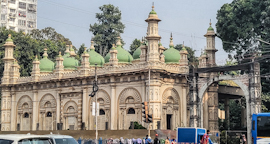
About 900 yards north of the Tollygunge Club’s clubhouse and across a very busy road, there is a mosque (on the corner of Deshparan Sasmal Road and Prince Anwar Shah Road). It stands within its own peaceful compound.
One of the first details I noticed when visiting the mosque and its grounds was that all of its outdoor lighting stands use old cannons for their bases. Maybe this is not surprising because this mosque is one of two in Kolkata named after Tipu Sultan. The Tollygunge Tipu mosque was constructed in 1860 by Tipu’s youngest son, Ghulam Muhammad Sultan Sahib. It is designed in the Indo-Islamic style. Its exterior is attractive, but its interior has very few visual attractions.
In the garden of the mosque, there is a raised rectangular platform. Upon this, there are five or six unmarked graves, each one looking dilapidated. One of these marks the burial place of Tipu’s youngest son. The walls of the platform have a few plaques engraved with words in a script resembling Urdu or Arabic. I was told that these words are of religious significance, rather than the names of the deceased.
At the east end of the compound, there are a few steps leading to a deep depression that was once a pond or small lake. An elderly caretaker told us that never in his long life had he ever seen water in it.
A review of the mosque on the TripAdvisor website described the place as not being somewhere in Kolkata that “must be seen”. This is correct, but as we often stay at the Tollygunge Club and have visited Srirangapatnam several times, I was keen to view the place with such an interesting link to Tipu Sultan.
AT THE TOP OF a short but hazardous flight of stairs, one reaches the compound of an extremely interesting mosque in Ajmer (Rajasthan, India). It is the Adhai Din Ka Jhonpra mosque, whose name means ‘Two and a half day hut’. To what the two and a half day refers is not certain.
The building was originally constructed as a Jain temple in 660 AD. In about 1190, the temple was destroyed by the Afghan leader Muhammad of Ghor. He built the mosque on the site of the former temple using carved stonework plundered from Hindu and Jain temples. The resulting edifice, although shaped like a mosque, contains many architectural features and decorative motifs that you would expect to find in 12th century (and earlier) Hindu and Jain temples.
The mosque and its ccompound is very popular with visitors. I noticed that I was the only European amongst several hundred visitors. The site is a much desired place to be photographed. There are many photographers carrying Nikon SLR cameras, all touting for business. And there is no shortage of people wanting to pose for photos. The photographers seemed to have plenty of customers despite the fact that most people carry mobile phones.
Although the nearby dargah (a Sufi shrine) attracts most tourists, the Adhai Din Ka Jhonpra is well worth visiting.
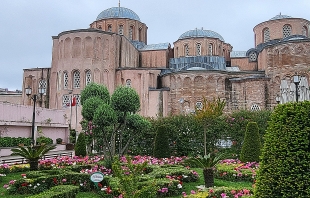
THE MOLLA ZEYREK mosque stands high on one of Istanbul’s seven hills. From its garden, which has a pleasant café, you can enjoy a wide panorama that includes views of the Bosphorus, the Golden Horn and bridges crossing it, the Galata Tower, the great Suleymaniya Mosque, and many other historic buildings around it. Turn your back on the view, and look across the well-kept flower garden, then you will see what looks like a large Byzantine church with three apses and several domes. However, as you stroll around this building, you will soon notice that it has its own minaret. This mosque was a church before 1453 when the Ottomans captured Constantinople/Istanbul.
As is the case with many other places of historic interest in Istanbul, there is an informative notice outside the mosque, written in three languages (Turkish, Arabic, and English). It outlines the history of the mosque. The building, designed by the architect Nikeforos, was built in the 12th century by Eirene (died 1134), the wife of Emperor Ioannis II Komnenos (ruled 1118-1143). Her father was King Laszlo I of Hungary. The edifice which is, in fact three churches joined in one building were the churches of the large Pantokrator Monastery. This institution included a 50-bed hospital, a library, an old-age home, a sanctuary for lepers, a medical school, a pharmacy, and a holy spring. The triple church was exceptional because:
“Except for the Church of the Holy Apostles, no other Byzantine building received as many imperial burials. John II (1118-43) and Eirene (Piroska of Hungary), their son Manuel I (1143–1180), and his wife Bertha of Sulzbach, were buried there, as were the Palaiologan emperors Manuel II and John VIII in the 15th century. In front of Manuel’s black marble sarcophagus was the Stone of Unction (a marble slab on which Christ’s body laid after his crucifixion), which Manuel brought from Ephesus around 1170. The large funerary chapel of the Archangel Michael is described by the typikon as a heroon – the shrine of a hero later used for the imperial mausoleum of Constantine and his imperial successors at the Church of the Holy Apostles.” (www.thebyzantinelegacy.com/pantokrator-monastery)
These monuments can no longer be found in the building.
Soon after Mehmet the Conqueror captured Istanbul, the monastery was converted into a madrassa. It became the first educational establishment created by the Ottomans in Istanbul. The monastery’s monk cells became cells for the madrassa and the triple church, suitably modified with a minaret, a mimbar, a mihrab, and other Islamic features, became a mosque with two classrooms for religious instruction. One of the new establishment’s professors was Molla Mehmed Efendi, nicknamed ‘Zeyrek’ – now, part of the mosque’s name. This learned man not only offered education to those who were already Muslim, but also to those who converted to Islam. In addition, he was instrumental in persuading many local people to convert to his religion.
Apart from the former church complex, now mosque, the other monastery/madrassa buildings have disappeared. This century, what had become an unusable, badly dilapidated structure was restored, and is now back in use as a mosque. The mosque occupies the southernmost of the three chapels. The other two chapels, although attractively painted, were empty spaces. One of these once served as the Byzantine Imperial mortuary chapel.
The Molla Zeyrek Mosque was formerly a Byzantine church. When the Ottomans took Istanbul, rather than destroying the places of worship of their Christian enemies, they recycled or repurposed them – they modified the churches and converted them to become mosques. Probably, the best-known example of this is Istanbul’s enormous Ayasofya-i Kebir Cami-i Şerifi (i.e., the ‘Hagia Sophia Grand Mosque’), constructed in the 6th century. Apart from Ayasofya, which we walked past almost every day during our recent 16-day visit to Istanbul, The Molla Zeyrek mosque was one of the most impressive and largest former Byzantine churches that we saw in the city. However, my favourite of these recycled churches was near where we were staying: the Kucuk Ayasofya Mosque, in whose charming walled garden we enjoyed numerous glasses of tea, met many friendly Turks, and watched the antics of the garden’s large feline population.
I have visited many cities in America, Asian and Europe. Many of them are fascinating, but now I can safely say that amongst these wonderful places, Istanbul has become my favourite because here the past, present, and future blend together with an exciting vibrance.
A MOSQUE DESIGNED by Mimar Sinan (c1489-1588), probably the best of Ottoman architects, stands a few yards away from Istanbul Modern (modern Art museum) designed by one of Europe’s best contemporary architects – Renzo Piano (born 1937).
The mosque is the Kiliç Ali Paşa, designed by Sinan and completed 1580. Like other mosques designed by this architect, the spaces contained within feel most satisfying. Sinan was masterful in his creation of contained spaces. The mosque with buttresses also has some attractive tiled panels both inside and outside.
One minute’s walk away from the 16th century mosque stand Piano’s Istanbul Modern, which was completed in 2004. Quite different from the mosque, it shares one thing in common – brilliant spatial design. Located next to the waterfront of the Bosphorus, brilliant views of Istanbul can be obtained from the waterfront, from the rooftop terrace, and through the gallery windows.
Piano’s building is so utterly engaging visually that it competes with the exhibits for one’s attention. Although many of the mostly Turkish artworks are both beautiful and engaging – we spent three hours looking at them, it is Piano’s building that steals the show.
I found it fascinating that two magnificent buildings, their constructions separated by 424 years, should be standing so close one another. Had I been in Renzo Piano’s shoes, I would have felt honoured to have one of my buildings so close to that of an architect who has easily passed the test of time.
I NEEDED NEW shoes today (20th April 2024). After buying a pair in the superbly stocked Fast Step shoe shop, we felt the need for coffee. Near the shop, we found a café called Gutta. Having enjoyed good coffees – both Turkish style and Italian style, we needed to answer the call of nature.
We asked if the café had a toilet. It did not, but, as has happened frequently in Istanbul, we were directed to the nearest mosque. This mosque, like others in Istanbul, has public toilets, for which in this case a modest charge was levied. As with most WCs in Istanbul, this one was well-maintained.
Kalenderhane Mosque
The mosque in this case is called the Kalenderhane Mosque. Its name derives from the Kalender dervishes, who once used it as a ‘tekke’. From the outside it looks remarkably like a very old Greek Orthodox church. It was converted for the use of the dervishes by Sultan Mehmet (the Conqueror) in 1453. In the 18th century, it was converted into a mosque.
Built in about the 9th to 10th century next to the Aqueduct of Valens , it is now thought to have been dedicated to Theotikos Kyriotissa. Sadly, as it was locked up, we were unable to enter the edifice.
Had it not been for nature’s call, we might not have come across this interesting mosque. As is the case for many old mosques in Istanbul, it is a fine example of Ottoman repurposing existing Christian buildings in the 15th century.
IN 1492 THE ANDALUSIAN Arabs were thrown out of Spain. Just like some of the Jewish people who were expelled at the same time, some of the Arabs came to Istanbul, which had been under the rule of the Islamic Ottomans since 1453, when they captured the city from the Byzantine rulers.
In 1475, Fatih Sultan Ahmed converted a church in Beyoglu to a mosque, known as the Galata Mosque. Today, this mosque, whose interior feels (but does not resemble) more like that of church, is now known as the ‘Arap Camii’ (Arab Mosque). This is because the Arabs forced to leave Andalusia settled in the area around the mosque, and used it for worship.
From the outside, the mosque could easily be mistaken for a church. This is because of its shape and what had once been a tall square bell tower. The tower is now topped with a conical feature, such as is found on the tops of most minarets. However at the Arap Camii, the conical object could be mistaken for a church steeple.
We visited this large mosque. The interior is rich in timber features, and looks as if it has been recently restored or renovated. An informative sign outside the mosque stated that when the building was repaired in 1913, Christian gravestones commemorating the deaths of people from Genoa (Italy) were discovered, and placed in a museum of archaeology.
We would have been unlikely to have visited this interesting mosque had we not taken a wrong turning. As the saying goes ‘every cloud has a silver lining ‘.
BY THE LATE SIXTEENTH century, Istanbul had become an extremely important crossroads between Asia and Europe. It was the capital of the Ottoman Empire, which by then extended over large parts of Europe, the Middle East, Egypt, and the north coast of Africa.
Part of the military force that the Sultan of the Ottomans used to maintain the empire was a group of soldiers called janissaries. These were (usually) Christian men who had been captured by the Turks, converted to Islam, and trained in military skills. They were often most effective soldiers.
Today (16th of April 2024), we visited an elegant complex of Islamic buildings close to the waterfront at Üsküdar on the Asian shore of the Bosphorus Straits. Designed by the famous Ottoman architect Mimar Sinan (c1489-1588) in 1580, it houses a former madrasa (now used to house a library), cloisters, a mosque to which is attached the turbe (edifice housing a grave, like a dargah, as can be found in India), and a small mosque.
This complex was commissioned by Ṣemṣi Ahmed Paṣa (1516 – 1580). Amongst his numerous achievements he was, for a time, head of the janissaries. He also served as the beglerbeg (governor) of several provinces including Rumelia (which included much of the Balkans and Romania) and Anatolia.
This lovely architectural ensemble is visited by some of the many tourists who stream past it, and by many pious locals.
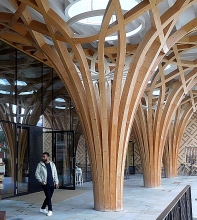
KINGS COLLEGE CAMBRIDGE has a superb perpendicular gothic chapel, whose construction commenced in about 1446 and took almost 100 years to complete. Its fabulously intricate fan-vaulting makes it one of the finest buildings in Cambridge, if not in all of England. Until recently, it was the one and only building in Cambridge that visitors to the city needed to see, even if they did not have time to see anything else. Although this continues to be the case, there is another building, which visitors should make time to see in addition to the chapel. Unlike the college edifice, this is not in the historic academic part of the city but in Mill Road, not far from the main railway station. Near the eastern end of this thoroughfare, which is rapidly becoming a ‘trendy’ part of Cambridge, you will come across a wonderful modern building set back from the road and separated from it by a pleasant, small garden. This structure is The Cambridge Central Mosque.
The mosque was completed in 2019 and designed by Marks Barfield Architects (London) in conjunction with Professor Keith Critchlow (1933-2020), who was Professor of Islamic Art at London’s Royal College of Art, and the garden designer Emma Clark. The designers of the mosque aimed (in the words of Abdal Hakim Murad, chairman of the Cambridge Mosque Trust) to create:
“…a brand new sacred space … to bring together something that’s very ancient and timeless with the very latest technologies.” (https://cambridgecentralmosque.org/design/)
This has been achieved very successfully. The visually spectacular deep portico, reached after walking through a pleasant garden, is supported by clusters of curved timbers, which immediately bring to mind thoughts of the masonry fan-vaulting in Kings College Chapel. These clusters continue through the entire building, creating a sense of continuity of the exterior and interior spaces. The vaulting that reminds us of the mosque’s gothic relative at Kings College also evokes purely Islamic architecture such as one finds at the Alhambra in Spain. The outside of the building is covered with brickwork in two colours, the bricks being arranged to produce patterns which are contemporary versions of a traditional Islamic design. The centre of the mosque is topped by a single dome made in matt-gold coloured metal.
The glass walls that separate the portico from the interior of the mosque reflect the mundane houses opposite the mosque (across Mill Road). I do not know whether the designers intended it, but I felt that these reflections were a way of giving the impression that the garden and the world beyond the mosque is merging with the building itself, that the religious structure was merging with its secular surroundings. Whether or not this was the designers’ intention, this mosque deserves a place in the highest echelon of great British architecture alongside Kings College Chapel. The beauty of the chapel and the mosque, separated by many hundreds of years in age, both have the effect of taking one’s breath away in amazement.





 yamey
yamey 